
The Overwhelm Recovery ProtocolWellness & Routines · ~5 min
About this template · Updated November 2026
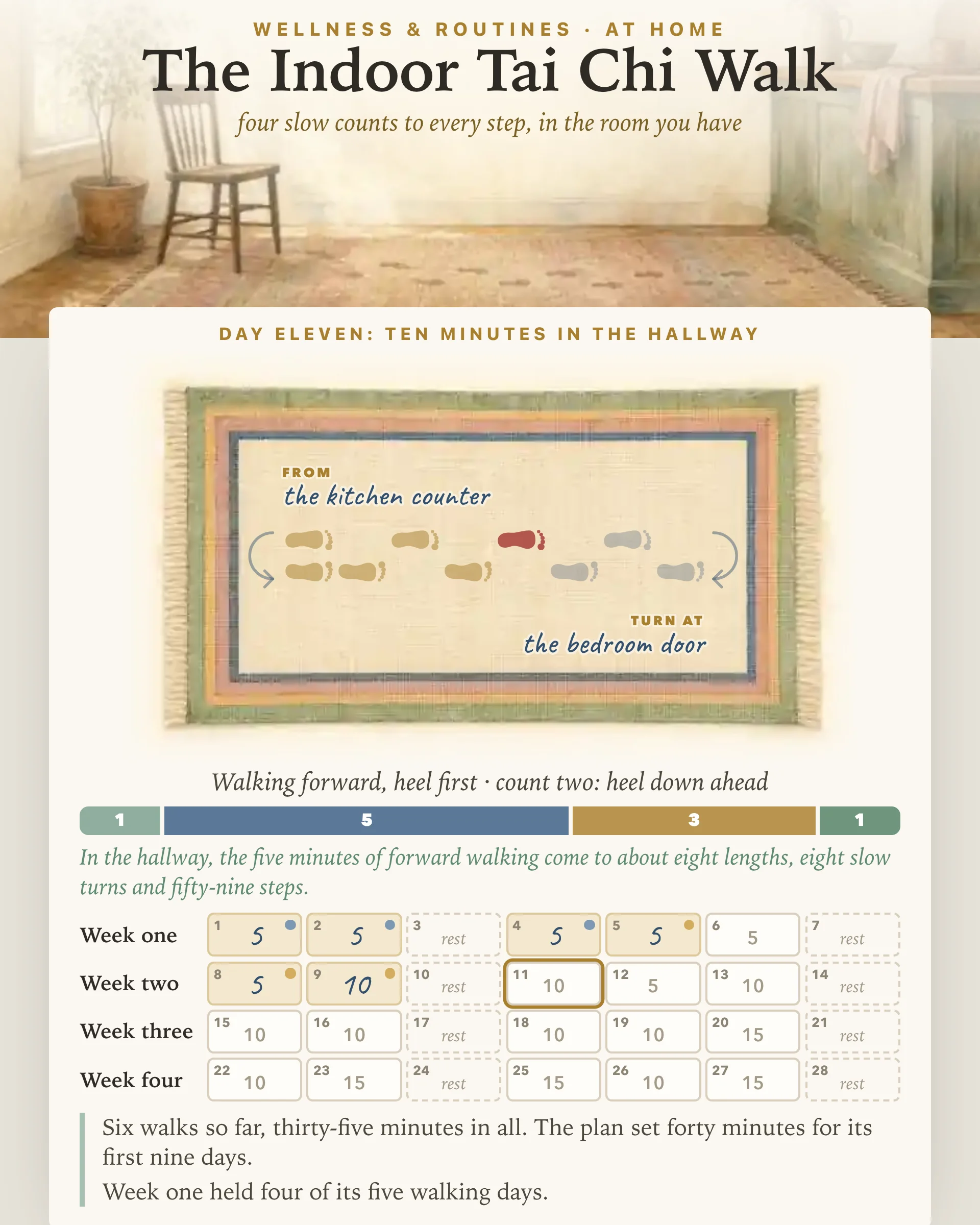
Most people who want to try a tai chi walk picture a park at dawn. What most of us have is a hallway, a strip of floor beside the couch, and about ten minutes before something else needs doing. You tell this page the room you have and how long you can spare, and it lays out one slow walk on a painted rug: where your feet go, when to turn, and what each count is for.
Tai chi indoor walking slows ordinary walking down until you can feel each part of it. Every step here takes four counts, at about one count a second. On one, you pick up the back foot. On two, the heel touches down ahead of you, carrying nothing. On three, you roll onto the whole foot as your weight moves forward. On four, you settle. Only then does the other foot stir. From across the room it looks like very little. Your calves may disagree after a few lengths.
At the end of a lane you turn, and the turn gets eight counts of its own: the front toes swing out on the heel, your weight moves onto that foot, the other foot comes around, and you settle facing back. Your feet are close together and your weight is moving sideways, so the page cues every turn.
Pick a space first. A short lane is about six feet of clear floor, three steps each way. A hallway gives you about fifteen feet, seven steps and a wall for your fingertips. An open room trades turns for a slow twelve-step loop around a table or the couch. The footprints redraw for each one, and you can write in where your lane starts and ends.
Then pick five, ten or fifteen minutes. The session under the rug does the arithmetic for your space: ten minutes in the hallway holds five of forward walking, which comes to about eight lengths, eight turns and fifty-nine steps. Ten minutes also adds side steps at the counter, the footwork of wave hands like clouds, a slow side-to-side sweep of the arms. Fifteen adds three minutes of walking backward, toes first, with a hand on the counter the whole way.
Press begin and the pacer takes over: the count, a plain cue for what your foot is doing, and one footprint lit at a time. It makes no sound, so prop the screen where you can see it, or learn the count and leave the screen behind.
The log holds four weeks, five walking days and two rest days in each. Week one asks for five minutes a day, and week four reaches fifteen on three of its days. Tap any day to see what it asks, change the length if you like, and log the walk. If you stopped early, the page offers the minutes you really walked.
Each walk also asks how you held on: held on, a hand close by, or hands free. The reading under the log compares your minutes with the weeks, names the space you use most, and shows how your support has shifted. Holding on is a fine answer on any day.
If you would rather have each step taught in turn, the Tai Chi Walking Plan is the longer course.
The firmest evidence belongs to tai chi as a whole practice. A 2019 Cochrane review of exercise and falls in older people living in the community pooled 108 trials. In the trials of tai chi, it may have lowered the rate of falls by about 19 percent, with low certainty, and it lowered the number of people who fell by about 20 percent, with high certainty. The same review could not say what walking programs do on their own. None of it tested a slow walk down your own hallway, so this page makes no promise about falls, and it does not score your risk.
The NCCIH summary of tai chi says the practice appears to be safe, with reported problems mostly limited to minor aches and pains, and it warns against using tai chi to put off seeing a provider about a medical problem. The CDC's overview of activity for older adults lists walking heel-to-toe among its balance activities, alongside 150 minutes of moderate aerobic activity a week and muscle strengthening on two days. A few slow minutes indoors can sit in the balance column and leave the other two to fill.
Check with a doctor or physical therapist first if you have had a fall, dizzy spells, a joint replacement, a heart or blood pressure condition, or pain. Stop if anything hurts. Clear away cords and loose rugs. Keep a counter, a wall or a sturdy chair within reach the whole time. Every move here can be done with a hand on something.
Reach for this on the days outdoors is off the table: bad weather, an icy sidewalk, a long afternoon at home. Afterward, The Daily Stretch Mat can follow if your hips or calves want more. And when you can get outside, The Awe Walk takes the same unhurried attention out the front door.
To learn the arm moves that go with the steps, Tai Chi Move Cards lays them out one by one, and if you want a hand on the counter for every walk, The Counter Walk is built around that.
It is the slow stepping of tai chi practiced on whatever floor you have at home. Each step takes about four seconds: the back foot comes up, the heel touches down ahead carrying nothing, the foot rolls down as your weight moves onto it, and you settle before the next foot stirs.
On this page it is one minute settling in place, five minutes walking forward heel first with slow turns, three minutes of side steps at a counter, and one minute standing still. In a hallway of about fifteen feet, those five walking minutes come to about eight lengths.
About six feet of clear floor is enough, which gives you three steps each way and a lot of turning. A hallway gives you longer lengths and a wall for your fingertips. A larger room lets you skip turns and make a slow loop around a table or the couch.
Every move here can be done with a hand on something, and the side steps and backward steps are written that way. Check with a doctor or physical therapist first if you have had a fall, dizzy spells, a joint replacement, a heart or blood pressure condition, or pain, and stop if anything hurts.
It is free to personalize. It builds one walk at a time and logs four weeks of them, with the length growing from five minutes to fifteen. If you want each step taught in turn, the Tai Chi Walking Plan on this site is the longer course.
By the team behind Fabulous, the science-based self-care app used by over 30 million people.


