
Leaves on a StreamEmotional Fitness · ~3 min
About this template · Updated September 2026
Virginia Sturm and her colleagues at the UCSF Memory and Aging Center designed the awe walk as a research practice and tested it with the Berkeley psychologist Dacher Keltner, and the Greater Good Science Center at UC Berkeley publishes a version on Greater Good in Action, where it now goes by the name Awe Outing. This page is an independent worksheet built around their idea. Nobody at UCSF, UC Berkeley or the Greater Good Science Center made it or reviewed it, and none of them endorses it.
Awe is the feeling of meeting something too big for your usual way of seeing. In a widely cited 2003 paper, Keltner and Jonathan Haidt argued that two things sit at the center of every clear case: perceived vastness and a need for accommodation, the moment your mind has to stretch to take something in.
Vast does not have to mean a canyon. A sky that keeps going, a crowd moving as one body, a bridge you suddenly see as the work of thousands of hands, a patch of moss that turns out to be a whole small forest: any of them can do it. An awe walk is an ordinary walk taken with your attention set to catch those moments. You look up, you look far, you look close, and when something stops you, you let it.
In the UCSF trial, published in the journal Emotion, sixty healthy adults between sixty and ninety took a fifteen-minute walk outdoors once a week for eight weeks. One group, chosen at random, was told that awe is most likely to turn up in places that are physically vast or new to you, and was asked to tap into a sense of wonder and walk somewhere new when possible. The other group simply walked. Everyone photographed themselves before, during and after each walk and rated their emotions afterward.
The awe walkers reported more awe and joy on their walks, and more of the warm, outward feelings such as compassion and gratitude. In their photos, their smiles grew more intense over the weeks while they filled less and less of the frame, the small self of the paper's title. Away from the walks, in daily check-ins, their warm feelings rose further and their distress fell further than in the comparison group.
Fifty-two people made it into the analyses, most of them white and highly educated, and all of them healthy. Nobody was followed up after the eight weeks. Questionnaires for anxiety, depression and life satisfaction did not move in either group. So this is a small, careful and promising study about everyday emotion, not proof that an awe walk treats anything. Hold this page to the same standard: a practice worth trying, and a way to watch what it does for you.
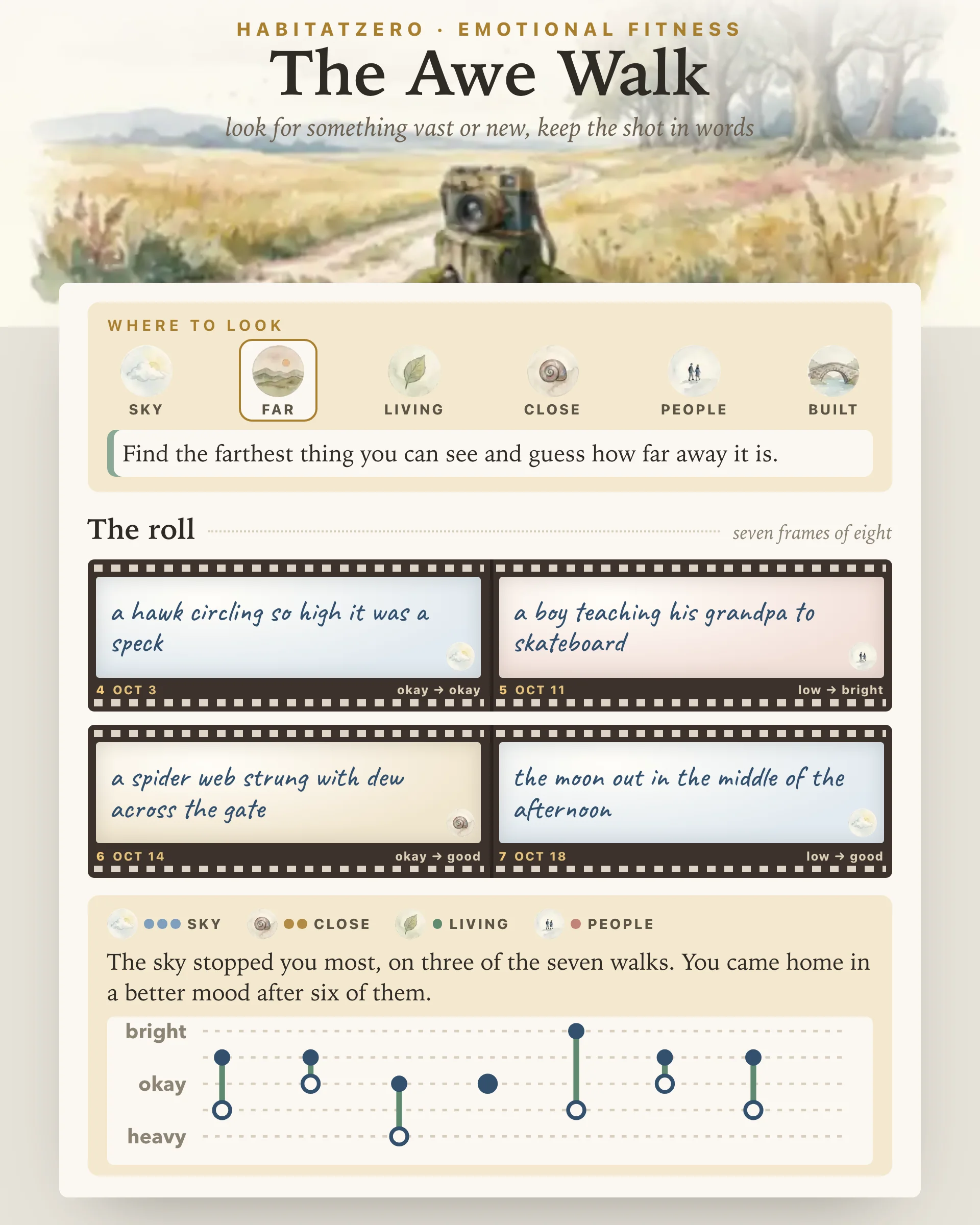
Before you leave, tap one of six kinds of wonder, from the sky to built things, and carry the prompt it hands you. Then rate how you feel setting out, from heavy to bright, and name what is taking up room in your head.
Walk for about fifteen minutes with the phone in your pocket. The trial's walkers took photos; here a line of handwriting stands in for the camera, which asks you to look a little longer before you decide what the picture is.
Once you are back, write the moment that stopped you in a few words inside the viewfinder and tap where it found you. Rate your mood again and say whether the thing you carried out now takes up less room. Then wind the frame onto the roll.
A roll holds eight frames, one per walk, the same eight weeks the trial ran. From the third frame on, the page reads the roll back to you: which kinds of wonder stop you most, how often you came home in a better mood and by how much, which moment came with the biggest change, and whether the worry you set out with shrank. Fix a frame's words or moods and the reading changes with it. When the roll is full, load a fresh one, and the old roll stays behind as a one-line summary.
Take one a week, the trial's pace, or on any day when your head feels crowded and everything in it seems enormous. There is no streak to keep.
If you only have a minute, The Minute Bench offers a shorter pause with the same habit of attention. If what you want is steps and distance, the Walking Challenge keeps count of those, while this page counts what you noticed. If the walks leave you thankful, The Gratitude Jar will hold that too.
It is a short walk, about fifteen minutes, taken with your attention tuned to things that feel vast or new: a huge sky, an old tree, a tall building, a detail you never noticed. The practice grew out of research on awe, the feeling of meeting something too big for your usual way of seeing.
Leave the phone in your pocket, pick a route you do not know well if you can, and walk at an easy pace. Look up, look far, then look close, and when something stops you, stay with it before moving on. A city works as well as a trail: tall buildings, a long street and strangers helping each other all count.
In a UCSF study, sixty healthy adults between sixty and ninety took a fifteen-minute walk each week for eight weeks. The ones shown how to look for awe reported more joy and compassion on their walks, and less distress in daily life, than people who simply walked. Anxiety, depression and life satisfaction scores did not change in either group, so read it as a small, promising study.
No. Greater Good in Action, run by the Greater Good Science Center at UC Berkeley, publishes its own version of the practice, and the awe walk study came out of UCSF. This worksheet is independent, and neither organization made it, reviewed it or endorses it.
What you see here is a sample roll, already filled in. To deal your own prompts, wind your walks onto a roll and keep the reading from one week to the next, open the awe walk in HabitatZero, which is free.
By the team behind Fabulous, the science-based self-care app used by over 30 million people.


