Leaves on a StreamEmotional Fitness · ~3 min
About this template · Updated September 2026
A mindful minute is the smallest practice that still counts: sixty seconds with your attention resting on one thing, usually your breath, the sounds around you or the soles of your feet. The hard part is the taking, because a minute that could happen at any time of day tends to happen at none of them.
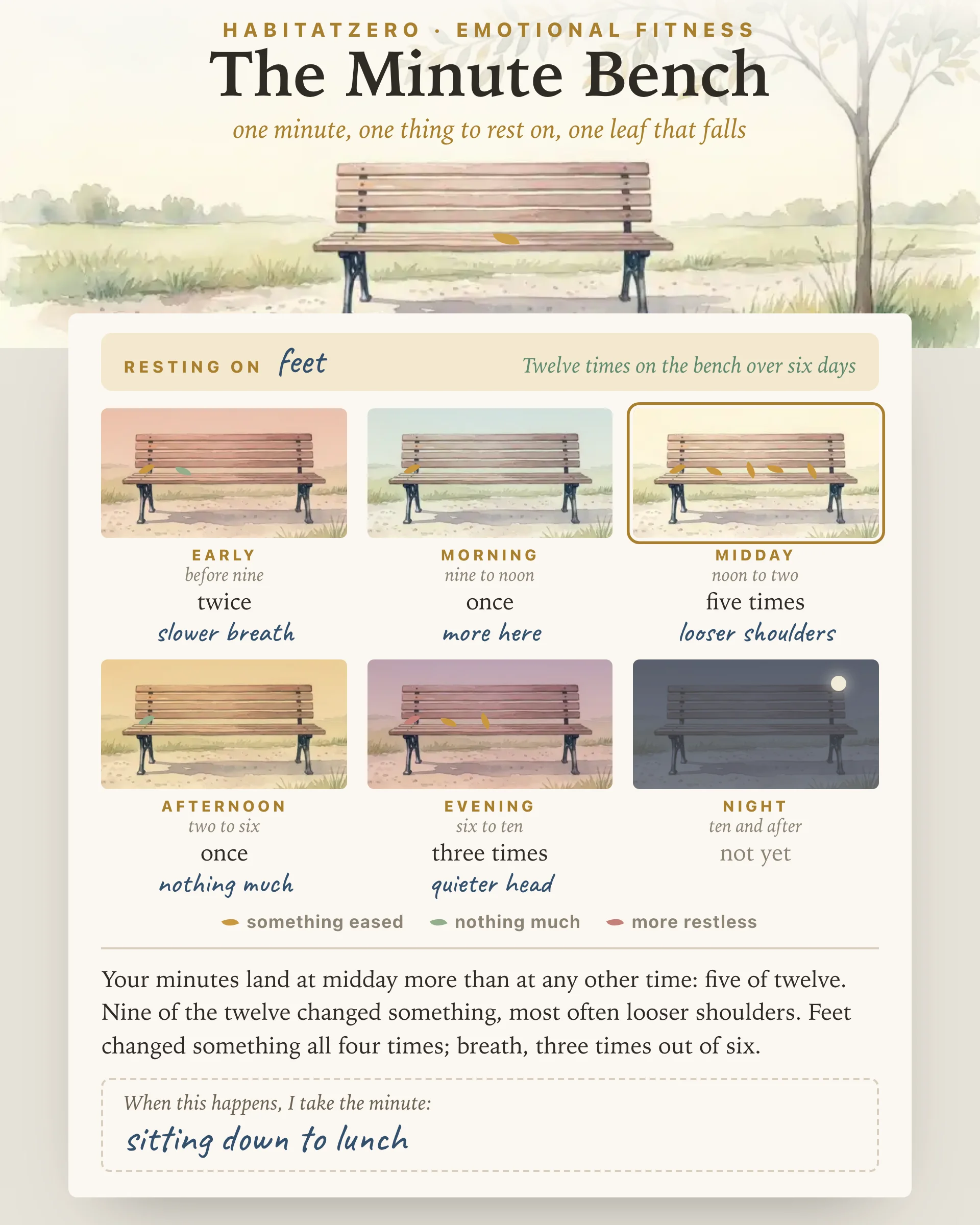
This page gives the minute a place to happen: a painted park bench and a leaf that takes exactly one minute to fall. Then it keeps track of when your minutes land and what they change, so after a week or two you can see where a pause fits into your day instead of guessing.
Pick one anchor and stay with it for the whole minute. Hopping between breath, sounds and feet keeps you busy and turns the minute into a tour.
Your attention will wander within seconds. That is the practice rather than a failure of it, since every time you notice the drift and come back, you have done one repetition. If paying attention to your breath makes you more aware of a racing heart, choose sounds or feet instead. Both keep your attention outside your chest.
Choose an anchor and press sit for a minute. A few lines of guidance stay on screen while a leaf drifts down through the painting and settles on the bench. When it lands, the minute is over. You can stand up early; anything past ten seconds can still be kept, and the log notes how long you sat.
Then say what the minute changed. The choices are plain on purpose: slower breath, looser shoulders, a quieter head, feeling more here, a clearer next step, nothing much, or more restless. The last two matter as much as the others, because a record that only collects good news cannot teach you anything.
Each kept minute drops a leaf onto one of six small benches, one for each part of the day from early morning to night. Gold leaves mean something eased, sage means nothing much, and rose means the minute left you more restless. Beneath them, a short reading says where your minutes cluster, what they most often change and whether one anchor works better than another. If you took a minute on a walk or in the car, log it from the away row so the picture stays honest.
The bench keeps thirty minutes; when it is full, clear the ten oldest to make room. Single lines come off with two taps, so a stray touch deletes nothing.
In a smartphone study, people were thinking about something other than what they were doing almost as often as they were thinking about it, and they were usually less happy while their minds were elsewhere. A 2025 study that sampled more than three hundred people six times a day for a week complicates that picture: the dip in mood depended largely on whether the wandering thoughts were pleasant or unpleasant. So the aim of a mindful minute is not to banish thinking. It is to notice where your attention went and choose where it goes next.
Brief practice has real but modest support. A systematic review of eighty-five studies of brief mindfulness interventions, nearly all of them randomized trials, found that seventy-nine reported a benefit on at least one health-related outcome, sometimes after a single session. The shortest practices in that review lasted about five minutes, though, and one good result among many measures is a low bar. Treat a single minute as a reset and as practice, not as treatment.
The time-of-day tracking leans on habit research. Plans that name a specific cue, in the form of when this happens I will do that, had a medium-to-large effect on reaching goals across ninety-four tests. That is why the bench asks you to name the moment your next minute goes with, and suggests moments from the part of the day where your minutes already land.
Take a minute in the gaps your day already has: after parking the car, before opening your inbox, while the coffee brews. After a week, look at which bench holds the most leaves and tie your next minute to something that happens then. If your early mornings stay bare, the Morning Mindfulness Routine hangs small moments on things you already do after waking. When one minute leaves you wanting more, The Meditation Timer keeps time for a longer, unguided sit. For short practices to rotate through the week, the Mindfulness Tea Chest holds fifteen of them. And when anxiety is running high and one anchor will not hold, 5-4-3-2-1 Grounding walks you through your senses one at a time.
If anxiety or low mood is shaping most of your days, a minute on a bench works best alongside care from a professional, not in place of it.
A mindful minute is sixty seconds spent resting your attention on one thing, such as your breath, nearby sounds or the soles of your feet, and returning to it whenever your mind drifts. It is short enough to fit between two tasks and long enough to notice how you are doing.
Sit or stand comfortably, choose a single anchor and keep your attention there for one minute. When a thought pulls you away, notice where you went without scolding yourself, then come back. On this page a falling leaf keeps time, so there is no clock to check.
Most of the eighty-five trials in one review of brief mindfulness reported a benefit on at least one health measure, sometimes after a single session, yet the briefest practices tested lasted around five minutes. Think of one minute as a reset and a way into the habit rather than as a treatment.
The best time is the one you will actually use. Tie the minute to something that already happens every day, like parking the car or sitting down to lunch, and let your own record show which part of the day makes room. Every kept minute leaves a leaf on one of six benches, so the pattern shows within a week or two.
Sitting your own minutes and keeping the leaves they leave behind happens in HabitatZero, which costs nothing to use. This page shows a filled-in bench so you can see how a week of minutes reads before you start.
By the team behind Fabulous, the science-based self-care app used by over 30 million people.