Leaves on a StreamEmotional Fitness · ~3 min
About this template · Updated September 2026
Most advice about a mindful morning quietly assumes you have an empty hour: wake early, sit on a cushion, journal, stretch, then start the day. If your mornings run on an alarm, a shower, a hurried coffee and a walk to the car, that advice mostly produces guilt. A morning mindfulness routine that survives real life tends to be made of smaller parts. A few seconds of full attention, placed on something you were going to do anyway.
The kettle boils whether or not you watch it. The water in the shower lands on your shoulders either way. What a mindful morning routine changes is where your attention is while those things happen, and that costs very little time.
The things you already do every morning are the most reliable cues you will ever get. They turn up without effort, in the same order, most days of the week. Psychologists call a plan that ties a new behavior to a specific cue an implementation intention, usually phrased as if-then. A review that pooled ninety-four tests of these plans found a medium-to-large effect on whether people actually did what they had set out to do.
There is also some evidence that ordinary chores can carry mindfulness practice. In a small experiment with fifty-one college students, those given instructions for mindful dishwashing (the smell of the soap, the warmth of the water, the feel of each dish) reported more present-moment awareness afterward, less nervousness and more inspiration than students who had washed the same dishes with ordinary instructions. It was a single session with young adults, so read it as a promising hint rather than proof.
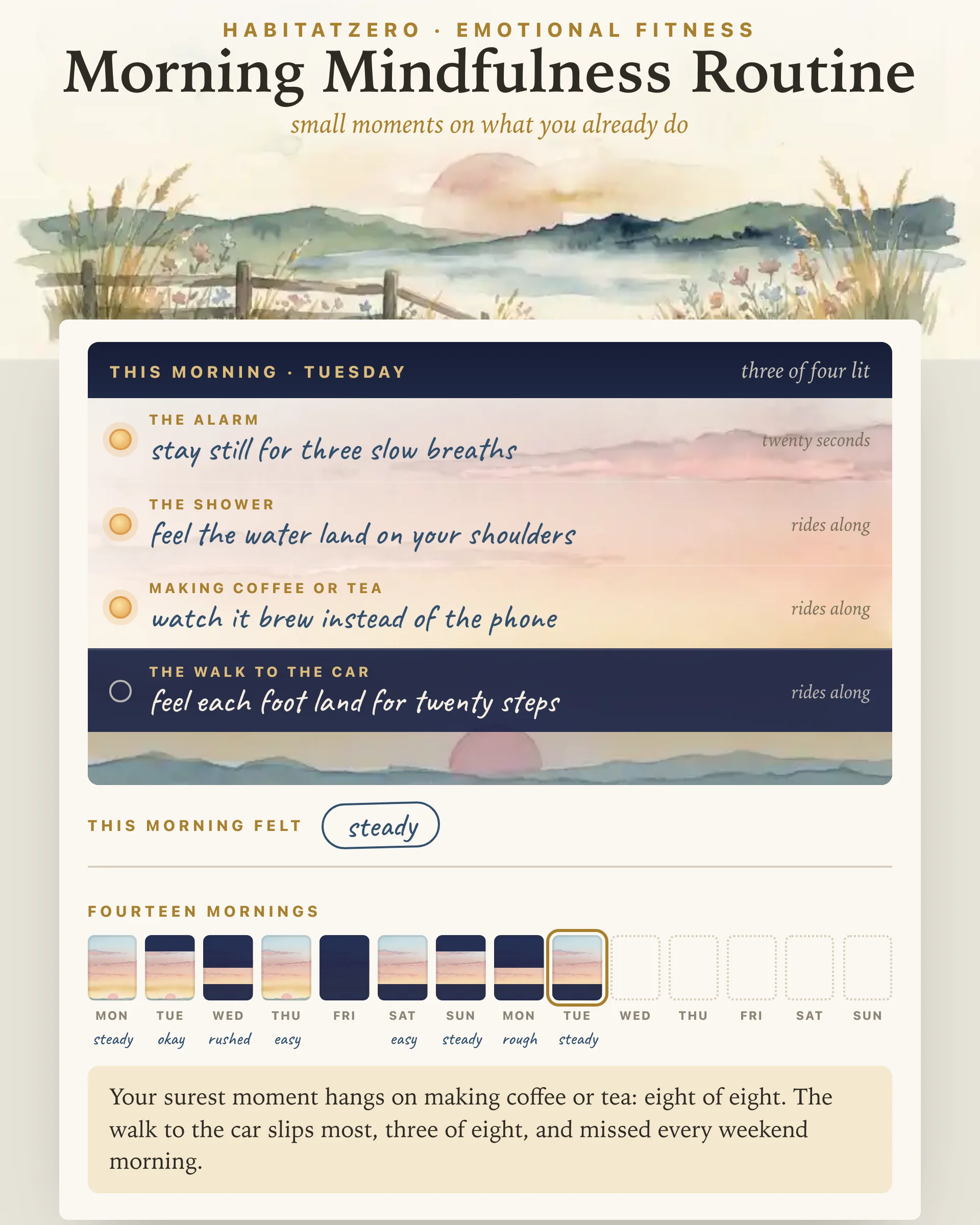
The page is a painted dawn sky, with one horizontal band for each moment you hang. Until a moment happens, its band stays under a wash of night. When you tap it, the night lifts from that band and the painting underneath shows through. The strip of hills at the bottom brightens as more of the morning fills in, so a full morning shows the whole sunrise.
To build a band, pick something you already do from the list or write your own, then choose a moment to go with it. Every moment carries a size. Many simply ride along, while a few ask for twenty seconds, a minute or longer. Tell the sheet how much spare time your mornings really have, and it will turn away a moment that would push past that, with a note saying why. Six bands is the limit. Two or three is a better start.
After each morning, one tap records how it felt, from rough to easy. Below the sky sits a row of fourteen small skies, one for each morning of your two weeks. A band that stays dark across several of them is a moment that keeps slipping. Once three mornings are marked, the sheet reads them back to you: the moment that holds best, the one that slips most (and whether it only slips on weekends), and whether your fuller mornings felt steadier than the thin ones.
Two weeks will not make any of this automatic. In a study that followed ninety-six volunteers repeating one new behavior daily in the same setting, reaching near-full automaticity took anywhere from under three weeks to more than eight months. The encouraging part: missing a single day did not undo the progress. A practical guide for doctors drawn from the same line of work suggests choosing a time and place you meet every day and expecting the new action to feel natural in something like ten weeks.
So treat the fourteen mornings as a trial run. Its job is to show which moments your real mornings will carry. Keep those, then swap or shrink the one that slips.
Read the comparison between fuller and thinner mornings with care. The sample is small, and the link can run either way. Sometimes the moments steady the morning. Other times, a morning that starts badly makes every moment easier to forget. The sheet shows the pattern and leaves the verdict to you.
Set the sky up the evening before, when you can picture tomorrow morning in order. If one of your moments grows into a proper sit, The Meditation Timer keeps the time so you don't have to. If the trouble is the whole morning rather than your attention inside it, the Morning Routine Checklist works backward from the time you need to leave. And if you want a few words after a longer practice, the Mindfulness Journal holds two short lines about what pulled at you.
It is a handful of short stretches of full attention in the first hour of your day, each one given to something ordinary: a breath before you sit up, the water in the shower, the taste of the first sip. Rather than a session you add, it changes how you do what the morning already holds.
Only as long as you truly have. Plenty of mindful moments cost nothing extra because they ride along with something you would do anyway, like breathing slowly while the coffee brews. With two spare minutes, spend them on one short pause; with none, keep every moment riding along.
No. A seated practice is one option and can grow out of this routine later. Paying full attention to an everyday task is called informal practice, and it is far easier to keep on a crowded weekday.
A habit you already have turns up every morning without any effort from you, so it makes a dependable cue. Deciding in advance that a specific moment follows a specific cue, a plan often phrased as if this, then that, has a strong research record for helping people follow through.
The filled-in example on this page is there to look through as it is. Building your own sky and lighting it morning by morning happens once you personalize the template in HabitatZero, which costs nothing.
By the team behind Fabulous, the science-based self-care app used by over 30 million people.