Leaves on a StreamEmotional Fitness · ~3 min
About this template · Updated September 2026
Mindfulness often arrives as a twenty-minute recording and a vow to play it every morning. The vow rarely survives the second week. This page starts at the other end: fifteen short mindfulness exercises, each tied to a moment your day already contains, like standing in line, sitting down to eat or lying in the dark before sleep. You try them, you say honestly how each one sat, and over a couple of weeks the few that suit you gather into a short list of your own.
A widely quoted working definition comes from Jon Kabat-Zinn: mindfulness is paying attention on purpose, in the present moment, and nonjudgmentally to the unfolding of experience. An exercise is any small, repeatable way of practicing that. You choose an anchor, such as your breath, the soles of your feet, the sounds around you or the taste of one bite, and you rest your attention there. Your mind drifts, as minds do, and you notice and come back. The coming back is the exercise itself, not proof that you are doing it wrong.
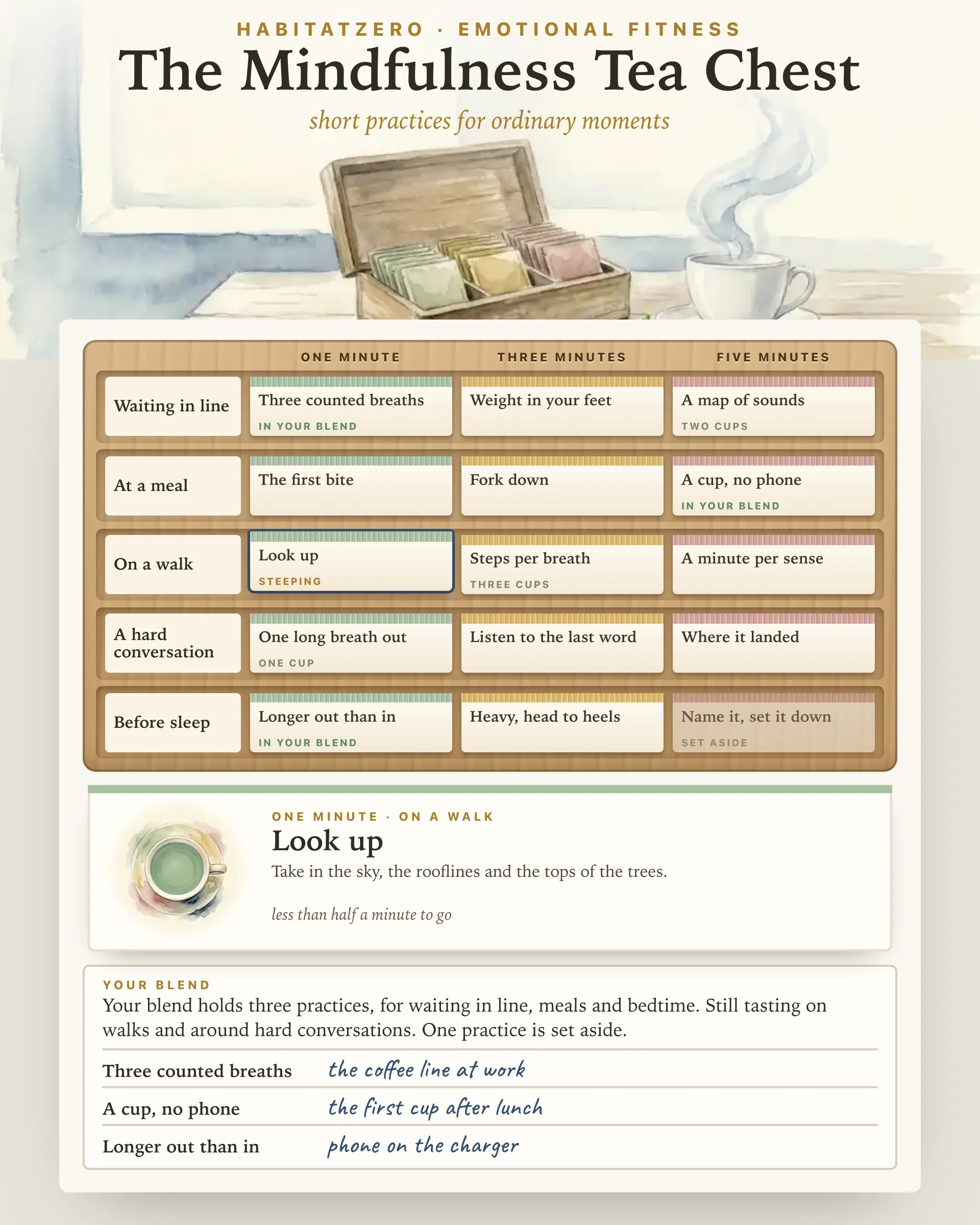
The chest has five rows, one for each everyday moment, and three columns for the time you have: one, three or five minutes. The sachets are banded like the teas they stand for, pale green for the quickest, gold for the middle length and dusty rose for the longest.
Tap a sachet and it opens under its row with three short steps. Press start and the painted cup begins to steep, darkening slowly until the time is up. Nothing beeps or buzzes, because a sudden alarm would undo the point. Turn the phone face down if you like and let the cup keep time.
Afterward, say how it sat: a keeper, fine, or not your cup of tea. You can also rate a practice done away from the screen, mid-walk or mid-meal. A practice joins your blend once it has been a keeper twice and at least half the time, so one lucky morning cannot crown it. Two misses, with more misses than keepers, set a practice aside; it stays in the chest, faded, because knowing what does not suit you is useful too.
Your blend is what the page is really for: a short list, filed by moment, of the practices that keep earning their place. Give each one a cue, a plain line like the coffee line at work or phone on the charger, so the habit has something to hang on. Print the set and all fifteen exercises fit on one page, with your blend underneath or blank lines to fill in.
Be realistic about what a few minutes can do. A 2018 meta-analysis of sixty-five randomized trials looked at brief mindfulness training, anything from a single session to two weeks of practice. It found a small drop in negative states such as stress, rumination, anxiety and low mood. When the authors adjusted for studies that probably never got published, that effect shrank to almost nothing. Brief practice is promising, then, but its measured effect is modest.
Longer programs stand on firmer ground. A JAMA Internal Medicine review of forty-seven trials found moderate evidence that mindfulness meditation programs improved anxiety, depression and pain, while the evidence on sleep, attention and positive mood was weak or absent. The programs were not shown to beat other active treatments such as medication, exercise or behavioral therapy.
Mindfulness is generally low risk, though not risk free. The NCCIH overview of meditation safety describes a 2020 review in which about eight percent of participants reported an unwanted effect, most often anxiety or depression. If turning inward stirs up more than it settles, open your eyes, switch to an outward anchor like sounds or your feet, or simply stop. None of these practices replaces care for anxiety, depression or trauma, and if you are struggling, a clinician is the right next step.
Use the chest in the gaps your day already has. The one-minute sachets fit a slow elevator or a boiling kettle; the five-minute ones suit a lunch break or the walk home. When you want a longer, unguided sit, The Meditation Timer keeps time with a singing bowl. When anxiety spikes and you need your senses quickly, 5-4-3-2-1 Grounding takes you through them one at a time. And if a hard conversation leaves you raw, The Loving-Kindness Circle is a longer practice of warmth toward yourself and the people involved.
Give it two weeks before you decide anything. Expect your blend to stay short, since a handful of practices you actually use is the whole idea.
They are short, deliberate ways of resting your attention on what is happening right now, such as a breath, a sound, a taste or the feel of your feet, and coming back each time your mind wanders off. Jon Kabat-Zinn describes mindfulness as attention paid on purpose, in the present moment, without judging what you find there.
Yes. Personalize the chest and press print the set: all fifteen exercises fit on a single page, grouped by moment and length, with your blend at the bottom or blank lines to fill in by hand.
Long enough to notice one wander and one return, which can take less than a minute. A short practice you actually do beats a long one you keep postponing, so every moment here offers a one, three and five minute option. Most of the research has tested longer, regular practice.
A little, on average. A 2018 review of sixty-five trials found that brief mindfulness training eased stress, rumination and low or anxious moods by a small amount, and the effect shrank to almost nothing once the authors adjusted for studies that likely went unpublished. Treat these as small resets for ordinary days, not as treatment.
Every exercise can be read on this page at no cost. Timing a cup, rating how each one sat and building your blend start once you personalize the chest in HabitatZero, which is also free.
By the team behind Fabulous, the science-based self-care app used by over 30 million people.