Leaves on a StreamEmotional Fitness · ~3 min
About this template · Updated September 2026
Loving-kindness meditation is the Buddhist practice of metta, far older than any script online. The Karaniya Metta Sutta compares it to a mother guarding her only child and asks for that same boundless care toward every living being. Its best-known teacher in English is Sharon Salzberg, who co-founded the Insight Meditation Society with Joseph Goldstein and Jack Kornfield in 1976; the four wishes this page opens with are the ones on her own website. The Loving-Kindness Circle is an independent worksheet built to help you practice; none of these teachers, nor the society, is involved with it or has endorsed it.
The words are simple. What makes the practice hard is how differently they land depending on who they are for.
Sit comfortably and give the breath a minute to settle. Then move through five circles, saying each set slowly two or three times before you widen to the next.
End by letting the words go quiet and resting in whatever is there.
The order is old: the Visuddhimagga, a classic Buddhist meditation manual, goes from yourself to a dear friend, a neutral person and then someone hostile, warning that starting with someone you dislike is simply tiring.
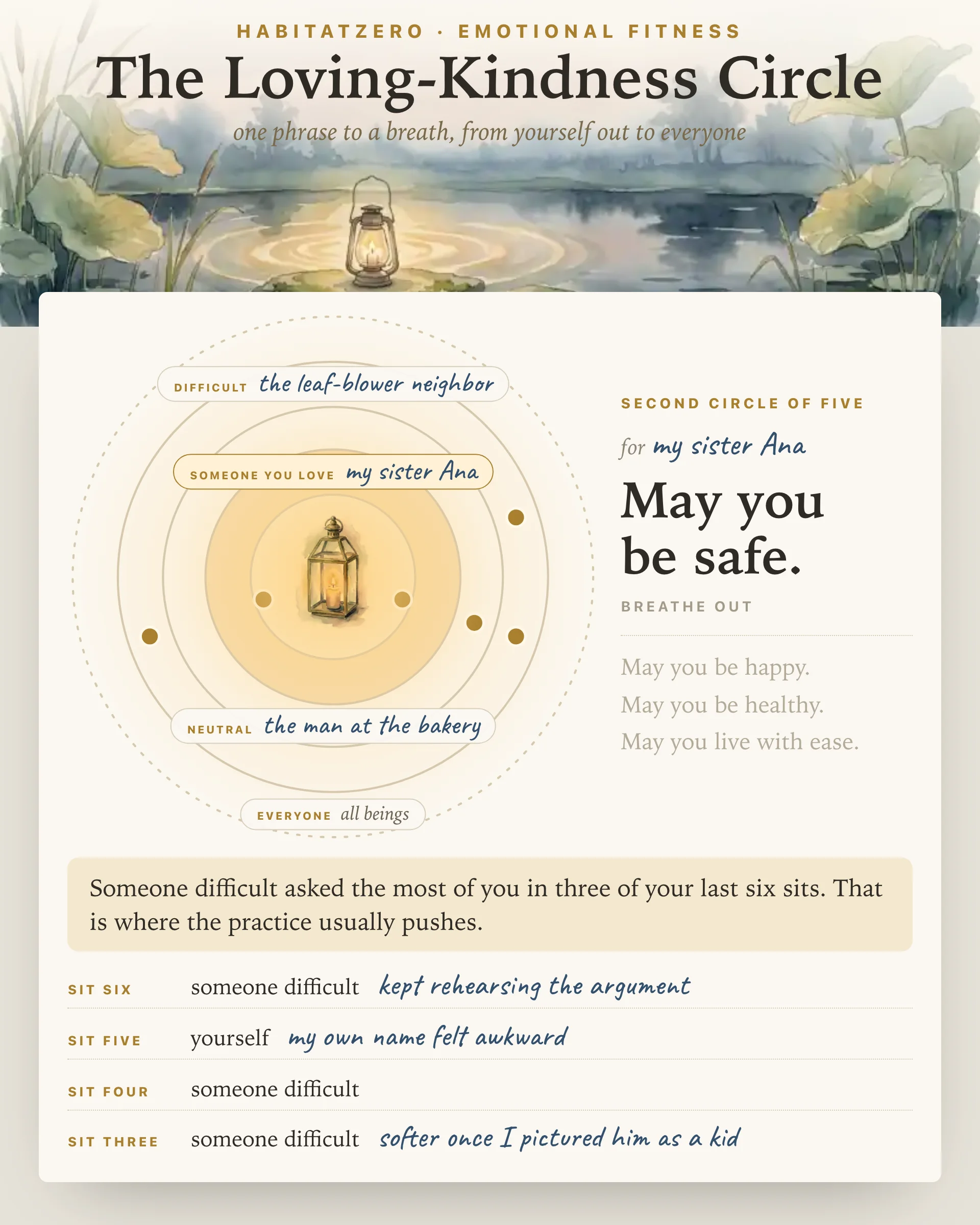
The page draws the five circles as rings around a painted lantern, each person's name written on their ring. Tap the lantern and, after two settling breaths, each circle opens with a short cue, then one phrase appears per breath while a soft glow swells and settles to pace you: about eight seconds a phrase at the gentle pace, ten at the slow one, or tap on at your own. You can pause, skip ahead, widen early or stop. Nothing makes a sound.
Keep the classic wishes or mix in your own, up to five. Type them after May you and the page rewrites each one for the other circles, so be kind to yourself becomes May I be kind to myself, then May all beings be kind to themselves. The full script, names included, sits below the lantern to read or print.
When the circle closes, you mark which circle asked the most of you. One line goes into a log of up to twelve and that ring gains a small gold mark. After a few sits, the reading above the log names the circle that keeps pushing and suggests one small change.
The evidence is encouraging and modest. A 2011 review by Hofmann, Grossman and Hinton linked loving-kindness and compassion meditation with more positive and less negative emotion, saw early clinical promise, and framed both as additions to established treatments such as cognitive behavioral therapy, not replacements.
The best-known single trial, by Fredrickson and colleagues in 2008, assigned working adults either to a seven-week loving-kindness workshop or to a waiting list. Among the 139 who finished, the meditators felt more positive emotion day to day, and those gains built resources such as purpose and social support that in turn predicted higher life satisfaction and fewer depressive symptoms. Two details keep it honest: the increase did not show up until about the third week, and the comparison group simply waited their turn.
A 2014 meta-analysis of 22 randomized trials found moderate benefits compared with no practice, inconclusive results against active alternatives, and studies of low to moderate quality. It also noted the practice can feel challenging at first for some people, which is why the log here asks where it was hard.
So treat the circle as a skill that builds over weeks, not a mood switch. It is not a treatment for depression or anxiety, and persistent low mood deserves a conversation with a professional.
Use it in the morning, after a day that left you short with someone, or before a conversation you are dreading, with that person in the fourth circle.
If the first circle stays the hardest week after week, the Inner Critic Translator works on the voice that makes May I be happy feel false. If the difficult circle keeps pulling you back into the argument, Leaves on a Stream trains you to let that thought pass. Once the phrases come on their own and you want silence instead, The Meditation Timer keeps unguided time with a bell.
The set most people learn is four short wishes: may you be safe, may you be happy, may you be healthy, may you live with ease. You offer them to yourself first, then to someone you love, someone neutral, someone difficult and finally to all beings, and only the person changes while the wishes stay the same.
Yes. Metta is the Pali word usually translated as loving-kindness or friendliness, so the two names describe one practice. People searching for the metta prayer are often after the Karaniya Metta Sutta, a short Buddhist discourse that asks for a boundless heart toward every living being.
Sharon Salzberg, a co-founder of the Insight Meditation Society, is the best-known teacher of this practice in English, and the four wishes this page starts with are the ones printed across her own website. The worksheet itself is an independent tool with no connection to her or to the society, and neither has reviewed or endorsed it.
Both are ordinary. The old meditation manuals already warned that starting with someone you dislike is tiring, which is why that circle comes fourth. Pick someone mildly irritating rather than someone who hurt you, and when the words turn heavy, go back to wishing yourself well for a breath before carrying on.
The script and the classic phrases can be read on this page without signing up. Naming your own circle, keeping your wording, running the paced practice and building the log of hard circles happen once you personalize the template in HabitatZero, which does not cost anything.
By the team behind Fabulous, the science-based self-care app used by over 30 million people.