Leaves on a StreamEmotional Fitness · ~3 min
About this template · Updated July 2026
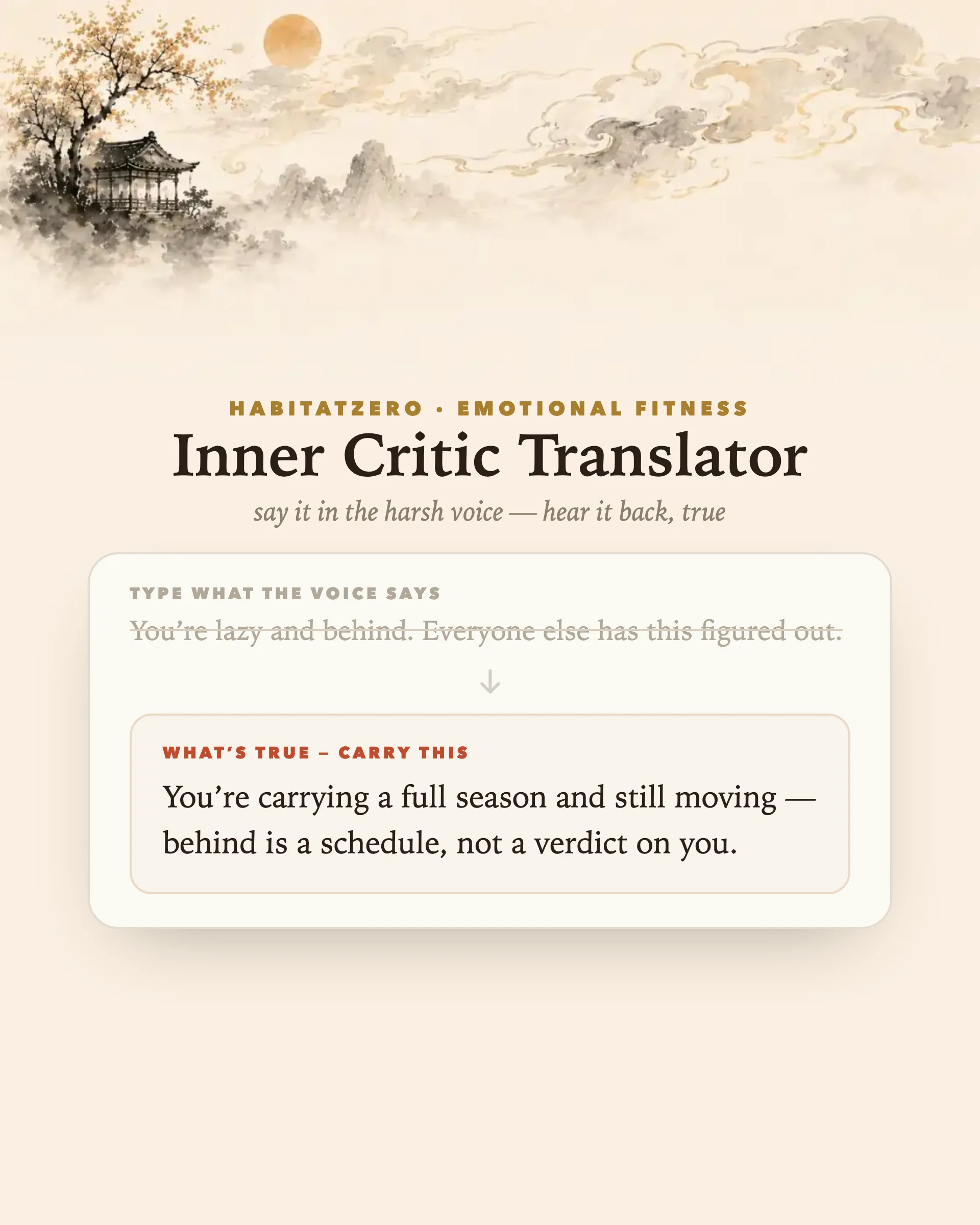
The inner critic has one real advantage: it speaks first. By the time you notice the sentence — you're lazy and behind, everyone else has this figured out — it has already landed, and the usual options are to believe it or to exhaust yourself arguing. This worksheet, the Inner Critic Translator, adds the third option: translate it. You type what the voice says, in its own words. You name the thinking pattern behind it, if you can spot one. And you hear the same thought back — kind, believable, and true enough to carry.
Self-compassion has a precise meaning in the research: treating yourself, in moments of failure or inadequacy, the way you would treat someone you care about. Kristin Neff — who built the field's definition and its measurement — breaks it into self-kindness over self-judgment, common humanity over isolation, and mindfulness over over-identification. All three are in the translator's output spec, and none of them require the thought to be false. That is the design constraint that makes translations land: the kinder sentence has to survive contact with the facts. You're behind on some things this month can stay true; you're lazy was never the accurate part.
The stakes are larger than tone. A meta-analysis across fourteen studies found a large association between self-compassion and lower anxiety, depression, and stress — being on your own side is not a luxury; it tracks directly with psychological health. And the popular fear about self-compassion — that without the whip, nothing gets done — runs backwards: people who are not braced for their own attack can afford to look at mistakes squarely, which is where actual improvement starts.
Between the harsh thought and the translation sits an optional move borrowed from CBT: name the distortion. The worksheet offers the six that self-criticism most often hides inside — all-or-nothing, mind-reading, catastrophizing, labeling, should statements, and discounting the good — each with a one-line description of the tell. Tapping one does two things. It sharpens the translation, because a thought that is labeling gets answered differently than one that is catastrophizing. And it builds the quieter skill underneath the whole exercise: hearing a harsh thought as a pattern running rather than a fact arriving. If you want to train that spotting skill on its own, the thinking trap spotter is this worksheet's natural companion — it names the pattern, this page answers it.
The output rules are strict on purpose: one sentence, addressed to you, no quotation marks, no preamble — and never toxic positivity. The translator is not allowed to tell you you're amazing; it is only allowed to tell you something kind that is true. You're carrying a full season and still moving — behind is a schedule, not a verdict on you. The strikethrough over the original matters too: the harsh version stays visible, crossed out, because the exercise is not pretending the thought never happened. It is showing, side by side, that the same raw material supported a fairer sentence all along.
Each finished translation is worth keeping — inside Fabulous they save privately, and a collection of kinder-but-true sentences, written against your own critic's greatest hits, is one of the more useful documents a hard week can inherit.
Most inner critics respond to practice; translation gets easier and eventually starts happening without the worksheet. But if no kinder sentence ever feels believable — if the voice is relentless across months, or what it says is getting darker — that is not a translation problem, and it deserves a person rather than a page. A therapist is the right next reader, and the worksheet's record of what the voice keeps saying makes an unusually useful thing to bring to a first session. If you are in crisis or thinking about hurting yourself, call or text 988 (US) right now, or reach your local emergency number.
And the honest edge of the tool: translating the critic is a practice, not treatment. If the voice you are writing down is relentless enough to shape your days, that pattern deserves a professional's ear as well as a kinder sentence.
An exercise for treating yourself the way you would treat a friend — which research by Kristin Neff and others has shown is a skill, not a temperament. This one works at the exact place self-criticism happens: the sentence in your head. You type what the inner critic says, optionally name the thinking pattern behind it, and the worksheet translates it into a version that is kind and still true.
Three moves, about a minute each. Type the harsh thought in the critic's own words. Tap the distortion at work if you spot it — the six on offer are the classic patterns self-criticism hides inside. Then translate: the original gets struck through and the same thought comes back as one believable, compassionate sentence addressed to you. The point is not to silence the critic but to answer it accurately.
No — the research says roughly the opposite. Self-compassion is associated with more accountability and steadier motivation, not less, because a person who is not braced for their own attack can afford to look at mistakes squarely. The translations this worksheet produces are deliberately believable rather than flattering: kind, and still true, is the entire standard.
Translate again — the exercise is built for repetition, and different phrasings land on different days. If no kinder sentence ever feels believable, that stubbornness is worth taking seriously: a relentlessly harsh inner voice that will not soften is a genuinely good thing to bring to a therapist, and this worksheet makes a fine record of what the voice keeps saying.
Free, in your browser — this public page is a locked preview with an example. Inside Fabulous, your draft thought and each finished translation save privately to your account, so the kinder sentences accumulate into something you can reread on the days the critic is loudest.
By the team behind Fabulous, the science-based self-care app used by over 30 million people.