
The Overwhelm Recovery ProtocolWellness & Routines · ~5 min
About this template · Updated November 2026
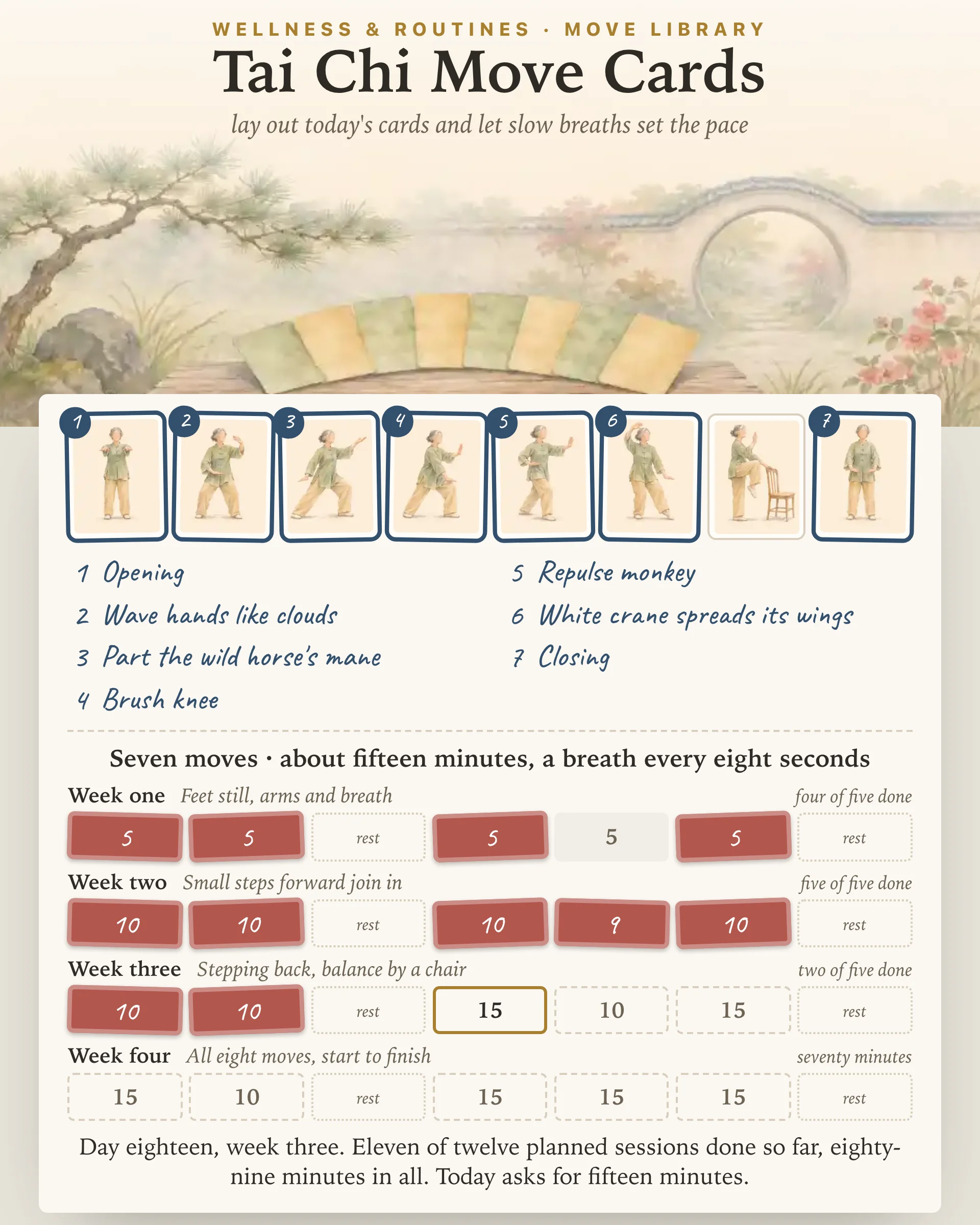
Search for tai chi exercises and most of what you find is video: someone in a park moving far more smoothly than you will on a first try, with no easy way to slow them down or remember what came next. This page takes the opposite approach. It puts eight foundational moves on cards you lay out yourself, then counts the breaths so you can stop watching the screen and move.
The names are traditional, and you will hear most of them in any beginner class, though teachers may run them in a different order.
Lists of twenty tai chi moves exist, and they mostly add variations and harder stepping. You will get further repeating these eight slowly than skimming a longer list.
Tap a card and it joins today's routine. Tap in any order, because the sheet sorts them for you: opening first, the arm sweep next, stepping forward before stepping back, the balance moves once your legs are warm, closing last.
Then choose five, ten or fifteen minutes, and how long one slow breath takes you. The sheet shares that time across your cards in whole breaths and tells you what each move gets. Five minutes holds four moves at most, about a minute each; ask for a fifth and it says so, leaving the choice with you.
When you begin, a silent timer walks you through the routine. It names the move, shows its cues and its easier version, and marks each breath with a small circle that swells and settles. Pause, skip a move or stop whenever you like.
The strip at the bottom follows a plan of twenty sessions with two rest days a week. Week one keeps the feet still, with the arm moves at five minutes a day. Week two brings in small steps forward at ten minutes. Week three adds stepping back and the balance work beside a chair, at ten to fifteen minutes. Week four runs all eight, mostly at fifteen.
Finishing a routine stamps the day with the minutes you actually practiced, and you can stamp a day by hand if you practiced away from the page. A missed day simply stays blank, and nothing resets.
A 2019 Cochrane review of exercise and falls in older people found low-certainty evidence that tai chi may lower the rate of falls by 19 percent, and high-certainty evidence that it lowers the number of people who fall by 20 percent, compared with control groups. Balance and functional exercise had the firmest evidence of any category.
A 2018 randomized trial followed 670 adults aged 70 or older who had fallen in the past year or had trouble getting around. They took two one-hour classes a week for 24 weeks of tai chi based training, mixed exercise or stretching, and falls were lowest in the tai chi group. Its lead author also earns licensing fees from that training program, which is worth keeping in mind.
Neither study tested ten minutes at home with a set of cards. Those were long, supervised programs, so this page promises no fall prevention, no steadier balance by a certain date and no other result. What it offers is a way to start a slow practice and an honest record of whether you kept it up.
The National Center for Complementary and Integrative Health describes tai chi as appearing safe, with reported problems mostly minor aches, and warns against using it to put off seeing a provider about a medical problem. Talk with a doctor or physical therapist first if you have had a fall, dizzy spells, a joint replacement, a heart or blood pressure condition, or ongoing pain. Stop if anything hurts, and keep a sturdy chair or counter within reach for the standing moves.
Mornings suit many people, but any quiet ten minutes works. If stepping turns out to be your favorite part, the Tai Chi Walking Plan spends four weeks on nothing else. If tight hips and shoulders get in the way, try The Daily Stretch Mat on your rest days. And if the slow breath is what you keep coming back for, Resonance Breathing gives you only that.
On a day with no room to step, Chair Tai Chi keeps you seated the whole way through, and The Indoor Tai Chi Walk turns a hallway into a place for slow steps.
Beginners tend to meet the same handful: an opening, wave hands like clouds (a side-to-side sweep of the arms), part the wild horse's mane (a small step as one arm opens out), brush knee, repulse monkey (slow steps backward), white crane spreads its wings, golden rooster stands on one leg, and a closing. All eight are on these cards with plain cues.
For a newcomer, five to fifteen minutes most days is a reasonable way in, and that is what the four-week plan here asks for, with two rest days a week. The research trials ran far longer, such as two one-hour classes a week for six months, so a short home session is a start and not the same dose.
Eight is plenty to begin with. Longer lists mostly add variations and harder stepping, and you will learn more from repeating a few moves slowly than from skimming twenty. Once these feel familiar, a class can show you how they link into a longer form.
Slowly and without forcing it, with one breath for each part of a move: usually in as the hands gather or rise, and out as you step, push or lower. Never hold your breath to get through a move. You can set the pace on this page to six, eight or ten seconds a breath.
Every move here has an easier version. Keep a sturdy chair or counter in reach, leave the feet still and move only the arms, or sit for the opening, the arm sweep and the closing. On the one-leg move a hand stays on the chair, and lifting just the heel counts. If you have had a fall or dizzy spells, ask a doctor or physical therapist first.
By the team behind Fabulous, the science-based self-care app used by over 30 million people.


