
The Overwhelm Recovery ProtocolWellness & Routines · ~5 min
About this template · Updated November 2026
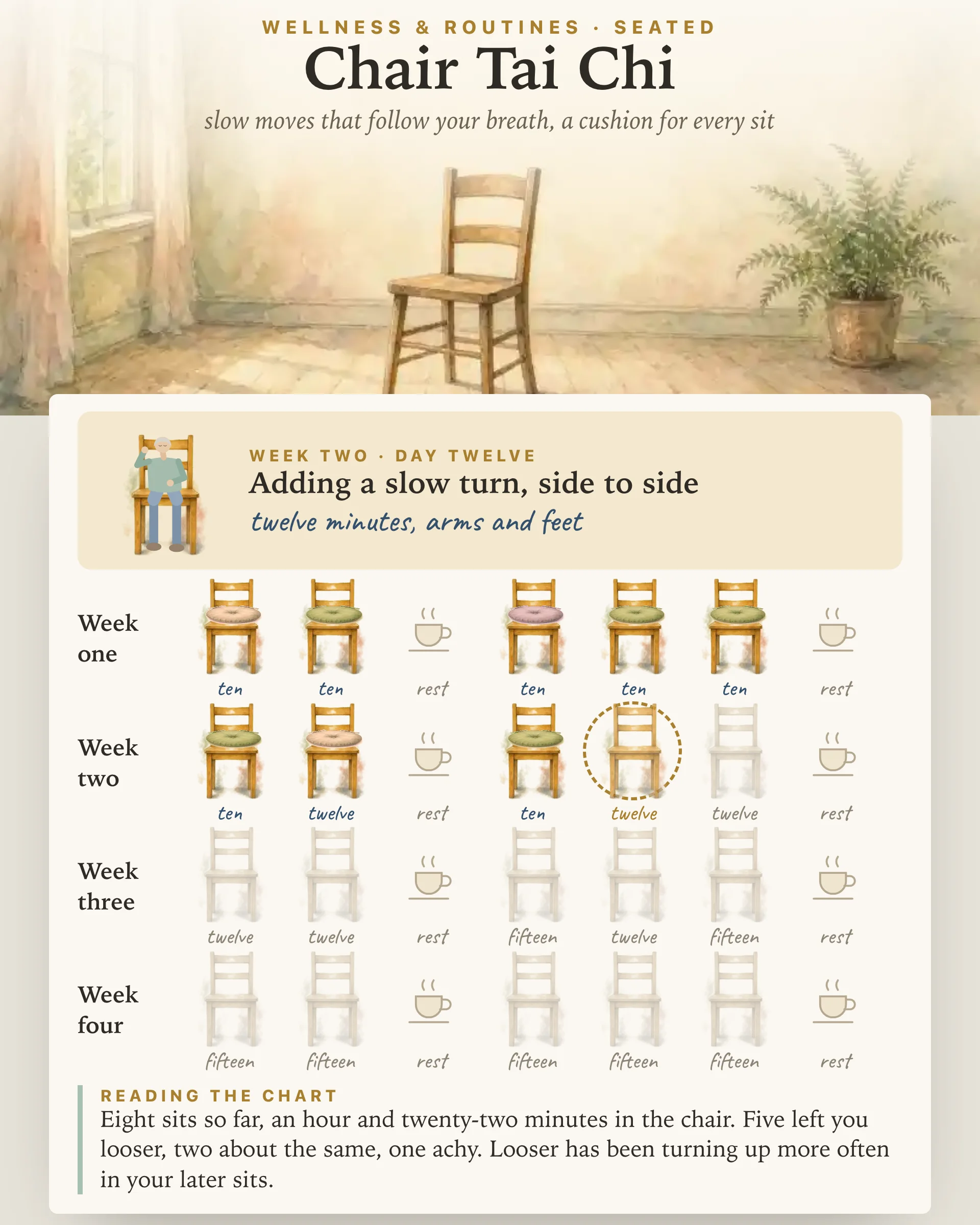
Chair tai chi keeps the part of tai chi most people come for, slow movement timed to an unhurried breath, and takes away the standing. You sit near the front of a sturdy chair with both feet on the floor, and your arms and waist do the traveling.
Check with your doctor or physical therapist before you begin if you have had a fall, dizziness, a joint replacement, a heart or blood pressure condition, or pain. Stop if anything hurts. Nothing on this page asks you to stand or balance, and a counter or table close by will steady you when you get up at the end.
A sit is one session in the chair, ten to fifteen minutes long. Each move repeats for a stretch of breaths rather than a count of reps, because the breath sets the speed. The eight moves come from traditional tai chi and qigong shapes, simplified for sitting:
Press begin and a figure on a painted chair starts to move, with the words "breathe in" and "breathe out" beside it, so you can glance up and copy the shape. The timer walks through the day's moves by itself, and you can pause, skip ahead or stop anytime.
Arms only keeps your feet still on the floor, while arms and feet adds small foot work, such as raising a heel as you turn. The breath runs at a gentle seven or eight breaths a minute, or a slower six. Never hold your breath. If you feel lightheaded, breathe normally and let the arms follow.
When a sit ends, the page asks how your body feels: looser, about the same, or achy. Your answer puts a tinted cushion on that day's chair, and a short reading adds up your sits and minutes. If two of your last three sits ended achy, it suggests smaller movements and a talk with your doctor or physical therapist if the ache stays. It never scores you.
The chart holds twenty-eight days: twenty sits and eight rest days, drawn as a cup of tea.
On any longer day you can take a short ten instead, and the cushion records what you actually did. The plan moves by sits, not dates. Miss a Tuesday and the next empty chair is still the next one, with nothing to catch up on.
The closest study to this page is a randomized trial of seated tai chi with sixty older wheelchair users in a single care facility in Taiwan. Those who practiced for forty minutes, three times a week over twenty-six weeks, reported better quality of life and fewer depressive symptoms than those who kept to their usual activities. One small trial, in people living in care, with far longer sessions, says little about ten minutes at home.
A Cochrane review of exercise for older people living in the community found low-certainty evidence that tai chi may cut the rate of falls by about nineteen percent. That review covers exercise programs broadly and does not show that a seated practice does the same job, so this page makes no promise about balance or falls. If falls are your worry, a physical therapist can suggest supported work on your feet.
On safety, the US National Center for Complementary and Integrative Health says tai chi appears to be safe, and also warns against using it to put off seeing a health care provider about a medical problem.
Pick a sturdy chair without wheels, one where your feet reach the floor. A chair without arms is easiest for the wide sweeps. If a shoulder complains during holding up the sky, stop at chest height. When the sit ends, stay put for a moment before you stand.
Mornings suit many people, and so does the slump after a long stretch of sitting. To spend more time on the breath alone, Belly Breathing slows things down further. For a broader session, try The Daily Stretch Mat. And when your doctor or physical therapist agrees you are ready, the Tai Chi Walking Plan takes this same unhurried pace onto your feet, close to a wall.
Once sitting feels easy and you want to try the moves on your feet, Tai Chi Move Cards shows them standing, and for seated strength rather than slow flow, The Chair Circuit builds a workout around what you pick.
It is the slow, breath-led arm and waist movement of tai chi done sitting down. You stay on a sturdy chair with your feet on the floor, so no standing balance is involved. The moves here are simple seated versions of traditional tai chi and qigong shapes, such as wave hands like clouds, a slow side-to-side sweep of the arms.
People use armchair tai chi, seated tai chi and tai chi chair exercise for much the same thing: tai chi shapes practiced while sitting. A chair without arms leaves your elbows more room for the wide sweeps, but an armchair works if you keep the movements inside it and it is the seat you trust.
It is a gentle way for older adults to move, and one small trial in a care facility found better quality of life scores and fewer depressive symptoms with seated tai chi than with usual activities. That cannot promise the same for you. If you have had a fall, dizziness, a joint replacement, a heart or blood pressure condition, or pain, check with your doctor or physical therapist first.
This plan starts at ten minutes and builds to fifteen, five days a week for four weeks, and any longer day can become a short ten. The trial of seated tai chi ran much longer, forty minutes three times a week, so nobody has settled on one proven amount.
Nobody can promise that. A Cochrane review found tai chi may lower the rate of falls in older people living in the community, but it looked at exercise programs broadly, not at tai chi done in a chair, and sitting asks little of your standing balance. If falls are your concern, ask a physical therapist what to work on.
By the team behind Fabulous, the science-based self-care app used by over 30 million people.


