Leaves on a StreamEmotional Fitness · ~3 min
About this template · Updated September 2026
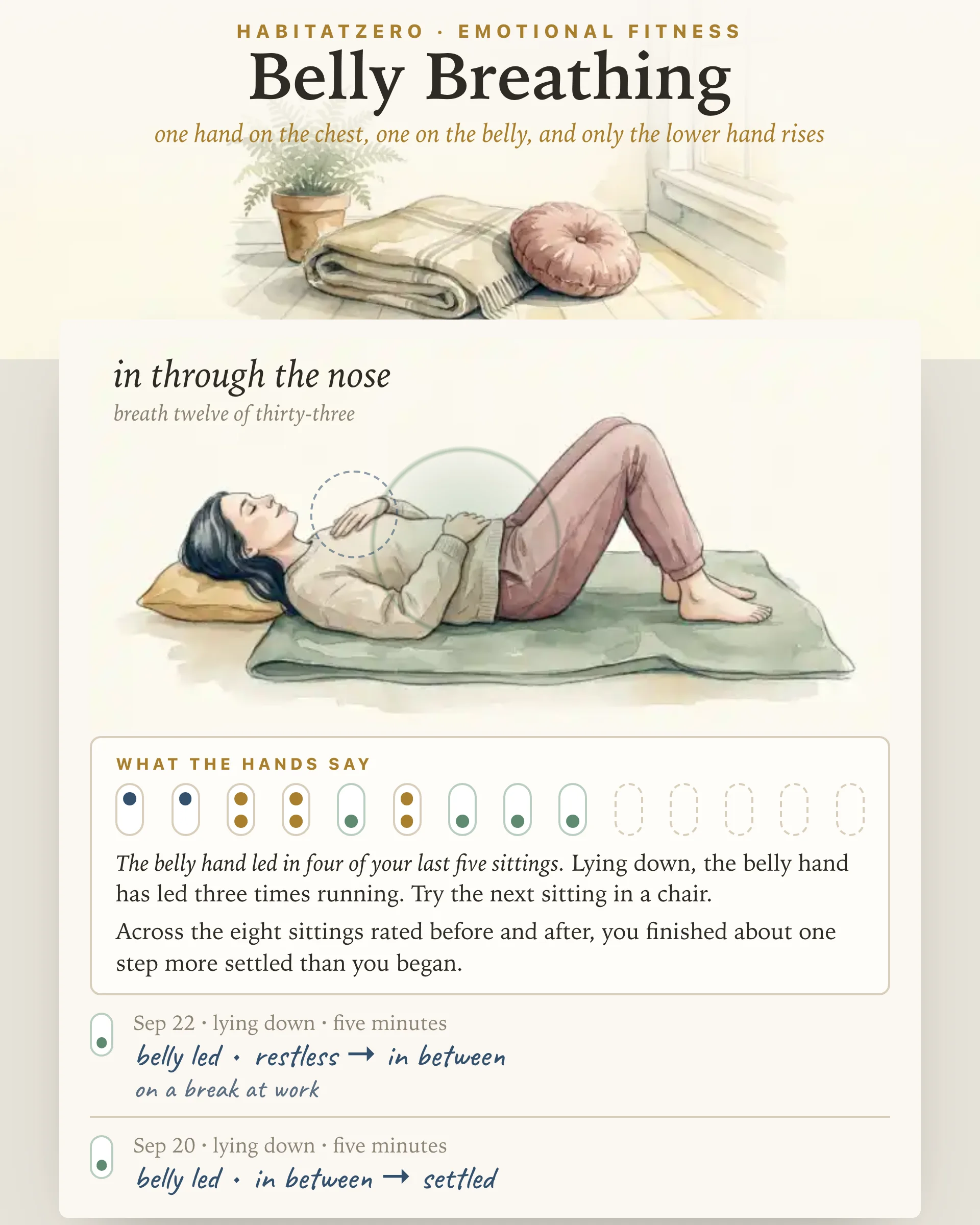
Rest one hand on your upper chest and the other just below your ribs, then take an ordinary breath. Which hand moved? If it was the top one, your breath is sitting high, as it often does on tense days. Belly breathing, also called diaphragmatic or abdominal breathing, lets the lower hand do the rising while the upper one stays almost still. This page paces the breath, asks which hand moved, and shows you whether the breath is sinking toward your belly.
Cleveland Clinic's step-by-step guide to diaphragmatic breathing starts on your back, since the technique is often easier to learn lying down:
The American Lung Association's breathing exercises page suggests an out-breath two to three times the length of the in-breath, and the paces here keep that shape: in for two and out for four, in for three and out for six, or in for four and out for eight.
Your two hands are a crude but honest gauge. When the lower hand rises first and the upper one stays quiet, the diaphragm is pulling down and making room. When the upper hand rises, often with the shoulders creeping up, the chest and neck are doing the work; when both rise together, you are in between.
Two habits get in the way: holding the stomach in, and shoving it out with your muscles, which is a push rather than a breath. Loosen the waistband, slow the in-breath and aim the air low.
Press begin and a soft ring swells over the painted belly hand on each in-breath and settles on each out-breath, while a dashed ring marks the chest hand that should stay put. Pick a pace, a length of three, five or ten minutes and, if you like, how settled you are before you start.
When a sitting ends, a hand check asks which hand did most of the moving, where you were and how settled you feel now. The log holds fourteen sittings, about two weeks of daily practice, and letting an old one go takes two taps.
The part paper cannot do is the reading. Each sitting becomes a capsule in a strip, its dot high when the chest led and low when the belly led, so you can watch the dots sink. After three belly-led sittings in a row, the page suggests the next position: a chair, as Cleveland Clinic suggests once you have some practice, and later your feet. It also averages how settled you were before and after.
The research is encouraging and small. In a randomized trial by Ma and colleagues, forty healthy adults were split into two groups. One trained in diaphragmatic breathing for twenty sessions over eight weeks, with a real-time feedback device, at about four breaths a minute. That group reported less negative mood, did better on a sustained attention test, and showed lower cortisol afterward, while the untrained group's cortisol did not change. That is far more training, and a much slower breath, than a few minutes with this page.
A systematic review by Hopper and colleagues searched for studies of diaphragmatic breathing on its own as a way to lower stress in adults and found only three that qualified. All three reported less stress, measured through blood pressure, cortisol, breathing rate or a stress questionnaire, but the studies were too different to pool and the samples were small.
Treat it as a low-cost skill that may help you feel steadier, not as a treatment for an anxiety disorder; the settled scale is your own impression, not a measurement. Pulmonary rehabilitation teams teach it to people with asthma and COPD, so if you live with a lung or heart condition, ask your care team how to fit it to you.
Learn it on an ordinary day. The respiratory therapist quoted on the lung association's page says to practice while you are breathing comfortably, and to use it when short of breath only once it feels natural. Cleveland Clinic's starting dose is five to ten minutes, three or four times a day; one sitting is a fine place to begin.
Once the belly leads reliably, take it with you: three slow belly breaths before a hard conversation, in the car before you walk in, or in bed when your mind will not settle. For a stricter count, Box Breathing gives each side of the breath four beats, 4-7-8 Breathing stretches the out-breath further for winding down, and The Physiological Sigh is the quicker reset for a sudden spike.
If you feel dizzy, tingly or short of air, stop, breathe however your body wants to for a minute, and come back later with a shorter in-breath.
It is slow breathing in which the diaphragm does most of the work, so the belly swells as you breathe in while the chest barely moves. Belly breathing, diaphragmatic breathing and abdominal breathing are three names for the same technique.
Rest one hand on your upper chest and the other just under your ribs. If the lower hand rises on the in-breath while the upper one stays nearly still, the breath is reaching your belly. If the upper hand rises first, or both rise together, you are still breathing mostly with your chest, which is where many beginners start.
Cleveland Clinic suggests five to ten minutes about three or four times a day while you are learning, with longer sessions as it gets easier. Learn it while you are breathing comfortably, so it feels familiar by the time you need it on a hard day.
It may take some edge off stress, but the evidence is thin. A 2019 systematic review found only three small studies of diaphragmatic breathing on its own; all three reported less stress, yet they were too different to combine. Use it as a steadying practice, not as a treatment for an anxiety disorder.
For most people it is gentle. Stop and let your breathing return to normal if you feel dizzy, tingly or short of air, and if you live with COPD, asthma or a heart condition, ask your care team how to adapt it. Someone who is struggling for air, with the belly heaving hard, needs medical help rather than an exercise.
By the team behind Fabulous, the science-based self-care app used by over 30 million people.