Leaves on a StreamEmotional Fitness · ~3 min
About this template · Updated September 2026
Credit where it is due. The physiological sigh was named and popularized by Andrew Huberman, a Stanford neurobiologist, who has taught it on his podcast for years and, with the psychiatrist David Spiegel, put it through a randomized trial. His lab's own write-up of the breath is the canonical description. The reflex it borrows from was mapped by the laboratories of Jack Feldman and Mark Krasnow. This page is an independent practice tool built by HabitatZero; nobody named above has reviewed it, endorsed it or had any hand in it.
Your body already sighs, awake or asleep, whether or not you notice. During ordinary quiet breathing the smallest air pockets in the lungs slowly deflate, and a sigh, which is a deep breath with a second breath stacked on top, opens them again. The researchers who traced this reflex to a small cluster of neurons in the brainstem describe sighs as arriving spontaneously every few minutes to reinflate the alveoli, and arriving more often under stress. You also do it on purpose without deciding to: the shuddering double breath after a cry, the long exhale when the hard phone call finally ends.
The physiological sigh is that reflex, done on demand. Breathe in through the nose until the lungs feel full. Without letting anything out, take a second, shorter sip through the nose to fill the last of the space. Then let the whole breath go through the mouth, slowly, until you are empty. That is one. One to three is usually enough to feel the shift.
The trial most people cite is Balban and colleagues in Cell Reports Medicine, 2023. Just over a hundred adults were assigned five minutes a day of one practice for a month: cyclic sighing, box breathing, a fast breathing pattern with breath holds, or mindfulness meditation. All three breathing groups reported a bigger lift in positive mood than the meditation group, and cyclic sighing showed the largest improvement, together with a fall in resting breathing rate that grew over the weeks. Stanford Medicine's report on the study tells the story plainly, including the instruction the participants were given.
Read the fine print alongside it. This was one month, run remotely, with two or three dozen people in each group and no follow-up afterwards. People with moderate or severe psychiatric conditions were excluded. The daily practice was five continuous minutes of sighing, not the single sigh in a tense moment that the technique is famous for; the quick reset is a sensible extension of the same reflex rather than something the trial tested on its own. It is good early evidence for a cheap and harmless practice. It is not proof that a sigh will fix anything in particular, and nothing on this page should be read as treatment.
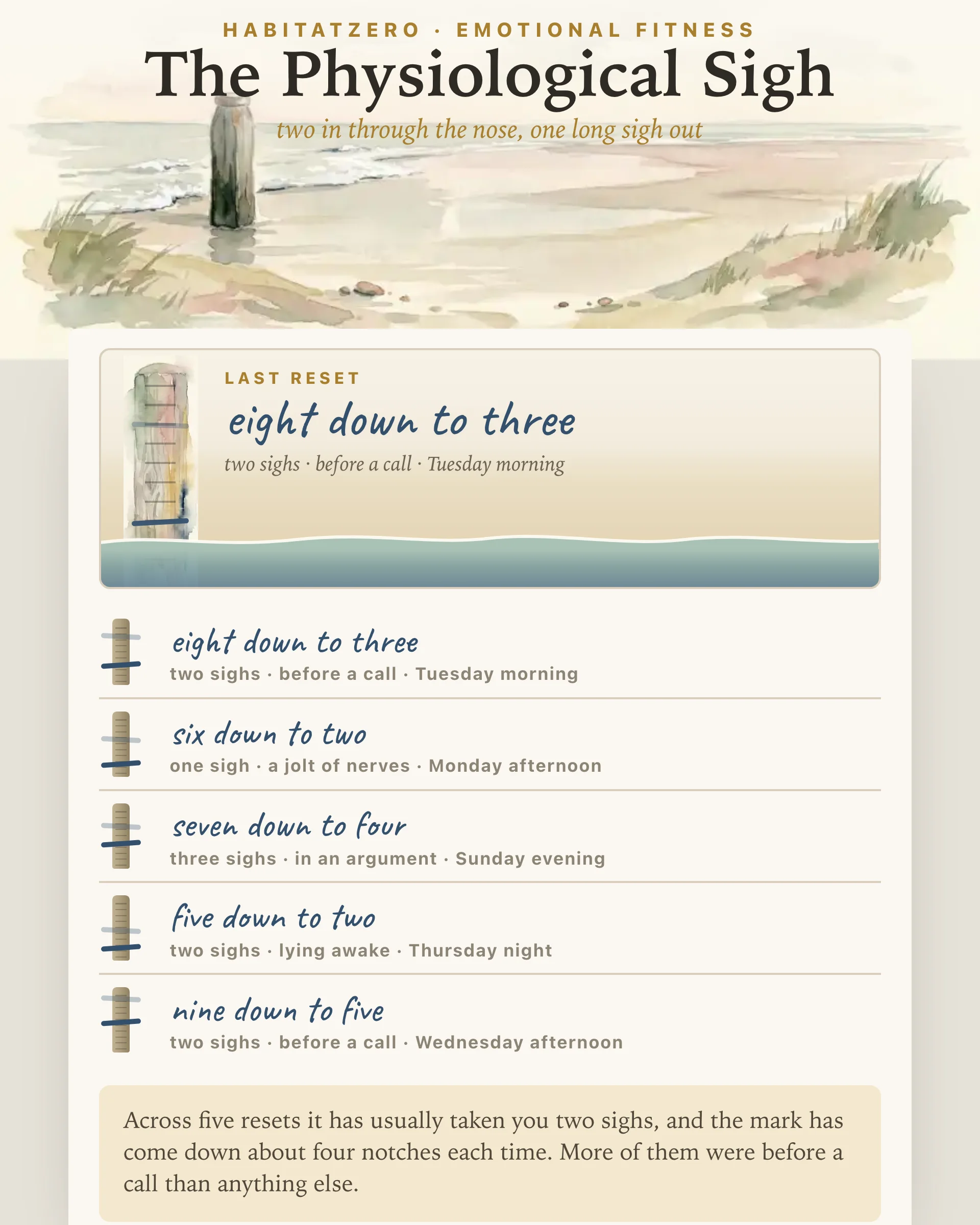
The stage is a shoreline with a weathered tide post standing in the shallows. Before you sigh, tap the post where the tension sits: the bottom notches are easy, the top ones are wired. Then press sigh. The water climbs the sand for the first breath in, climbs a little further for the short second sip, and slides back down for the whole of the long exhale, while the words and the count keep time above it. One sigh takes about nine seconds.
After each sigh the page stops and asks: settled, or one more? You are never committed to a set. When you have had enough, tap the post again to say where it sits now. The old mark stays faint beside the new one, and you can name the moment if you want it on the record: before a call, lying awake, after bad news, or a few words of your own. Keep the reset and it goes into the log with both marks, the number of sighs it took, and the day.
The log holds twelve. Once it has a few entries it works out two things a description of the technique cannot tell you: how many sighs a reset usually takes you, and how far the mark tends to come down. If that second number stays flat over weeks, the sigh may not be your tool.
Reach for it in the seconds before the thing, not the hour: the pause outside the meeting room, the moment after the message lands, the middle of the night when the mind will not stop. If you feel dizzy, breathe normally for a moment and let the next sigh be smaller; the second sip is a top-up, not a strain, and anyone with a heart or lung condition should check with a doctor before making any breathing practice a daily habit.
If you would rather settle into a longer rhythm than reset in three breaths, Box Breathing walks a square with four equal sides and 4-7-8 Breathing stretches the exhale further still. When the trouble is more in the head than in the chest, 5-4-3-2-1 Grounding brings the senses back into the room first.
It is a breath your body already takes on its own every few minutes: a full inhale through the nose, a second short sip stacked on top of it, then one long exhale through the mouth. Done on purpose, one to three of them is a fast, quiet way to take the edge off in real time.
Breathe in through your nose until your lungs feel full. Without letting any air out, take a second, shorter sip through the nose to fill the last of the space. Then let the whole breath out slowly through the mouth until you are empty. Repeat once or twice if the first one did not land.
A 2023 Stanford trial in Cell Reports Medicine had just over a hundred adults practice one of four things for five minutes a day over a month: cyclic sighing, box breathing, a fast breathing pattern with holds, or mindfulness meditation. Cyclic sighing showed the largest gain in positive mood and a drop in resting breathing rate. It was one month, with small groups and no follow-up, so treat it as encouraging rather than settled.
They do different jobs. The sigh is for the next thirty seconds: one to three breaths to come down fast. Box breathing is a steady four-sided rhythm you settle into for a few minutes. In the Stanford comparison the sighing group improved a little more on mood, but the practical answer is the sigh in the moment and a longer pattern when you have the time.
The page shows a filled-in example of the shore, the post and the log so you can see how it works, and the technique itself needs no screen at all. Running the timer against your own tension and holding on to your resets happens inside HabitatZero, which costs nothing to join.
By the team behind Fabulous, the science-based self-care app used by over 30 million people.