
The Overwhelm Recovery ProtocolWellness & Routines · ~5 min
About this template · Updated November 2026
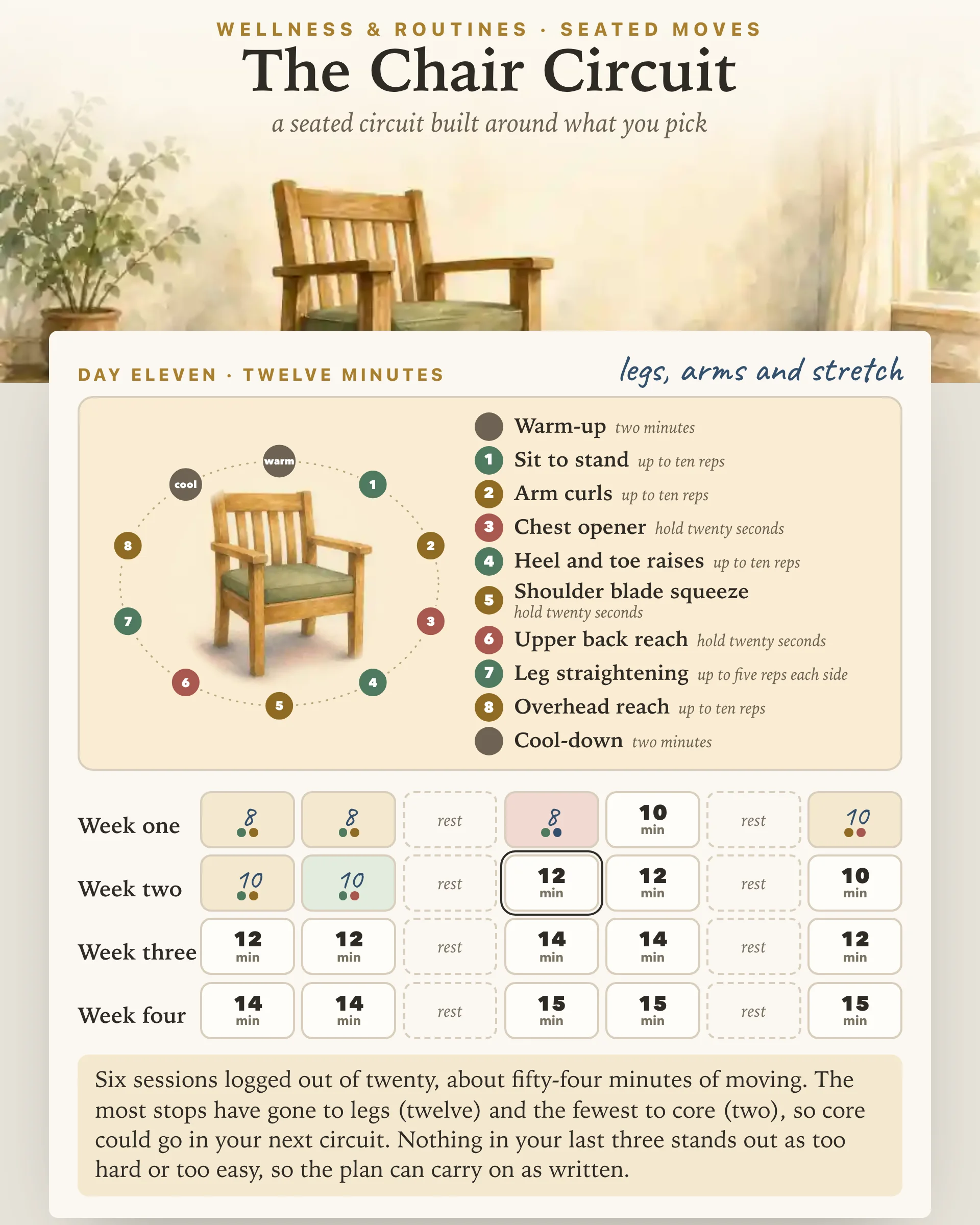
Most people searching for chair exercises want two things: a routine that fits the energy they have today, and someone to say what comes next. This page handles both. You tap what you want to work on, legs, arms, core or stretch, and a loop of numbered stops fills in around a painted chair, sized to the minutes your plan sets for that day. Then it counts you through them.
Before your first session, talk with your doctor or a physical therapist if you have had a fall, dizziness, a joint replacement, a heart or blood pressure condition, or pain. Stop any move that hurts. Use a sturdy chair without wheels, pushed against a wall, and keep a counter within reach for sit to stand, the one move here that leaves the seat.
Every session starts with two minutes of warming up, marching your knees and rolling your shoulders. Then a run of one-minute stops. Then two minutes of slow breathing and ankle circles. Inside each stop you do the reps or the hold it asks for and rest until the minute runs out, so a slower pace simply means less rest.
The areas you pick take turns. If you choose legs and arms, a leg move is followed by an arm move, which lets one part recover while the other works. The first move shifts from day to day, so the same picks do not hand you the same session twice in a row. If you only pick one area on a long day, its moves come around more than once, and the page tells you so.
Start the timer and it steps through each stop on its own, showing the instructions and how long is left. You can pause, skip ahead or stop early.
Each one comes with a plain description, and nearly all with an easier or supported version. If a move bothers you, or a clinician has told you to avoid it, tap to leave it out and the circuit rebuilds without it.
The tracker follows a set plan: five days of moving and two of rest each week. Week one runs eight to ten minutes at up to eight reps, because the job is to learn the moves. Week two adds a little time and goes up to ten reps. Week three stays at ten and slows the way back to three counts. Week four reaches up to twelve reps and up to fifteen minutes. If you came looking for a 10 minute chair workout for seniors, days five and seven of the first week are exactly that: two minutes warming up, six stops, two minutes cooling down.
After each session you mark it easy, about right or hard, and that day fills in with colored dots showing what you worked on. The reading underneath adds it up: how many sessions, roughly how many minutes, which area has had the most stops and which the fewest. If two recent sessions felt hard, it says fewer reps still count.
A good place to start on seated exercises for seniors is a 2021 review of twenty-five studies covering 1,388 adults aged fifty and older. Chair-based programs improved handgrip strength, thirty-second arm curl scores and thirty-second chair stand scores. That is encouraging, though an earlier review focused on frail older people found only six controlled trials, all of low quality, with inconclusive results. It did report no harmful effects.
On falls, it helps to be exact. A Cochrane review of exercise in older people living in the community found exercise programs lowered the rate of falls by about 23 percent, and the programs behind that result mainly used balance and functional exercises. The authors were uncertain about strength work without balance training. A seated circuit is not one of those programs, and nothing here promises fewer falls. If falls worry you, ask a physical therapist about supervised balance work.
The World Health Organization's 2020 guidelines ask adults for 150 to 300 minutes of moderate activity a week along with regular muscle strengthening, and they also say some activity is better than none. Week four of this plan adds up to seventy-three minutes. Treat it as a solid start rather than the whole picture.
Pick a fixed moment, such as after breakfast or before the evening news, and keep the chair in the same spot. On days your joints are stiff, choose stretch alone and let that be enough. Once the circuit feels comfortable, the Walking Challenge is a natural way to add time on your feet, the Tai Chi Walking Plan slows that walking down, and The Daily Stretch Mat gives your rest days something gentle to do.
If you want something slower from the same seat, Chair Tai Chi follows your breath through eight gentle moves.
The plan waits if you miss a day, so go back to the next open square and carry on.
No single move suits everyone, so a mix tends to work better than a favorite. Sit to stand and leg straightening work the legs, arm curls and overhead reaches work the arms, a tall sit hold works the middle, and gentle stretches finish things off. Leave out anything that hurts.
It is a fair place to begin, and the World Health Organization says some activity beats none. Its guidelines ask adults for 150 to 300 minutes of moderate activity a week plus regular muscle strengthening, so ten seated minutes count toward that without covering all of it.
A 2021 review of twenty-five studies found chair-based programs improved grip strength, arm curl and chair stand scores in adults fifty and older. An older review of frail older people found the studies weak and inconclusive, so the honest answer is promising, with room for better research.
This plan uses five days a week with two rest days, starting at eight minutes and building to fifteen. If that feels like too much, keep the same moves and do fewer of them. A missed day simply stays empty, and you pick up at the next one.
Ask your doctor or a physical therapist first, since they can tell you which moves to change or skip. Use a sturdy chair without wheels, stop anything that hurts, and keep a counter close by for sit to stand, the one move here that takes you out of the seat.
By the team behind Fabulous, the science-based self-care app used by over 30 million people.


