Leaves on a StreamEmotional Fitness · ~3 min
About this template · Updated September 2026
Resonance breathing grew out of heart rate variability biofeedback research by Evgeny Vaschillo, Bronya Vaschillo and Paul Lehrer, whose manual for resonant frequency training sets out the method step by step. The other name you may know it by, coherent breathing, comes from Stephen Elliott, who introduced Coherent Breathing in 2005 at about five breaths a minute and holds the name as a registered trademark of his company, COHERENCE LLC. The swing on this page is our own practice tool. None of these researchers, nor Elliott or his company, had a hand in it or has vouched for it.
Your heart does not keep a fixed beat. It quickens a little as you breathe in and eases off as you breathe out. Your body also runs a slower wave of its own, driven at least partly by the reflex that holds blood pressure steady. Breathe at about six breaths a minute and the two rhythms fall into step, so the rise and fall of your heart rate grows larger than either rhythm would make alone. Lehrer and his colleagues call this resonance, and in their work the effect peaks close to that pace.
Think of pushing someone on a swing. Push at a random moment and you fight the motion. Push just as the swing starts to move away from you and a small effort sends it higher. The breath is the push, and the right pace is the moment.
Six a minute is only an average. A practical guide to resonance frequency assessment places the adult range anywhere from four and a half to six and a half breaths a minute. Clinics find a person's rate by having them breathe for two minutes at each pace, stepping down half a breath at a time, while a sensor follows the heart. This page has no sensor. What it can do is keep three likely candidates within reach and help you notice how each one leaves you.
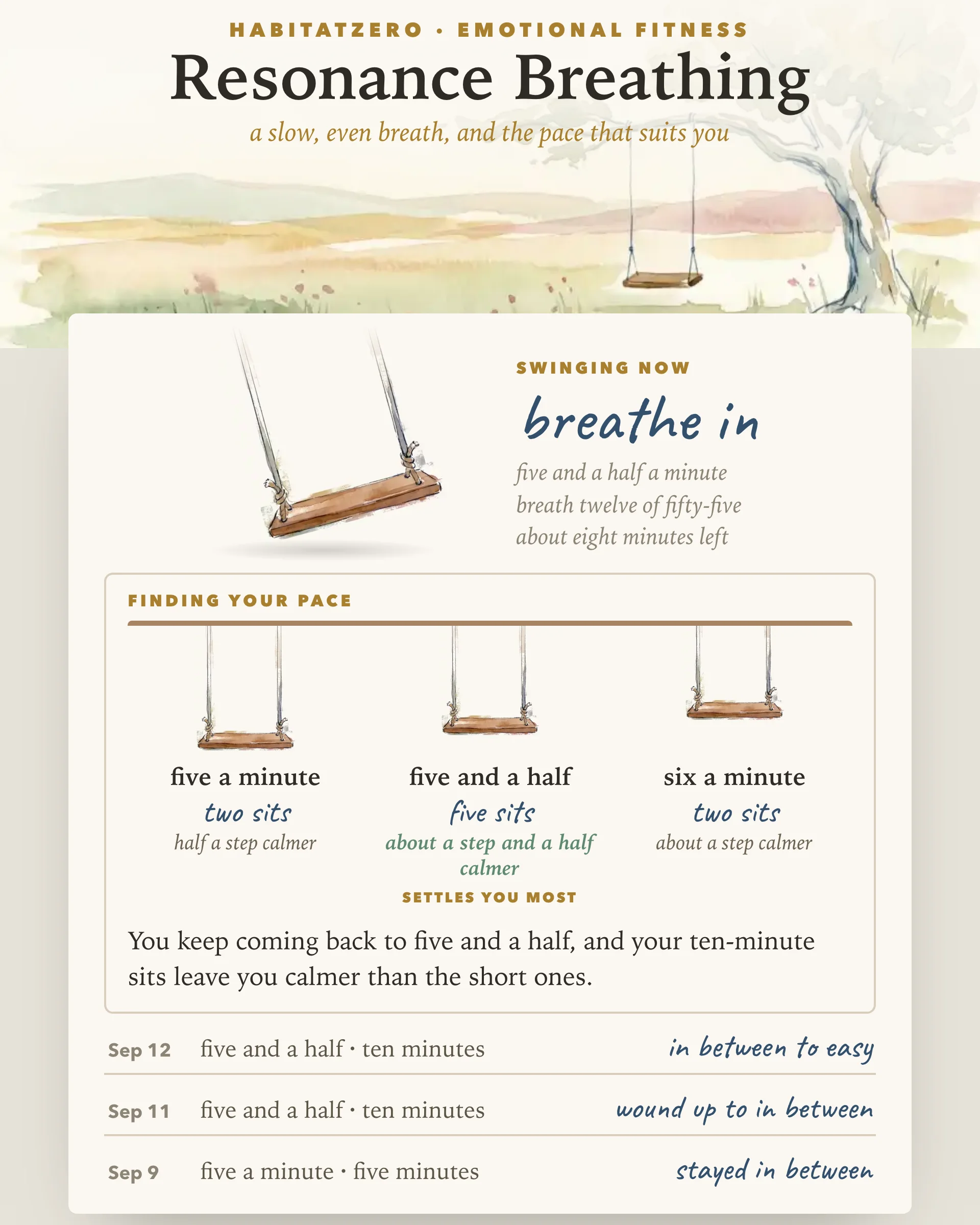
Choose five, five and a half or six breaths a minute, and a length from five to twenty minutes. If you like, tap a word for how settled you feel, from wound up to calm. Then set the swing going. Breathe in through your nose while it travels forward, and let the breath go while it travels back. Nothing is held at either end: the swing slows, turns and sets off again, and your breath does the same. The in and the out take equal time, about five and a half seconds each at the middle pace.
When the time is up, the swing comes to rest and asks how you feel now. Keep the sit and it joins your log with its pace, its length and the change. Stop early and anything past the first minute still counts, in whole minutes.
Below the big swing, three small ones hang from a single rail, one for each pace, with the slowest on the longest ropes, because a longer rope really does swing more slowly. Each gathers a line for every rated sit, drawn from how you began to how you finished. After a few sits the page says which pace you keep coming back to, which one settles you most once two paces have two rated sits apiece, and whether sits of ten minutes or more leave you calmer than the shorter ones. While a pace is still untried, it suggests giving that one the next turn, ideally on another day.
The strongest support comes from biofeedback training rather than from breathing on your own. A 2017 review of twenty-four studies, covering close to five hundred people, linked heart rate variability biofeedback with a large drop in self-reported stress and anxiety, and its authors still asked for better controlled trials. Those programs paired the breathing with a heart sensor and, usually, a series of guided sessions. A pacer on a screen is the home practice half of that picture, and your calm rating is a personal yardstick rather than a reading of your heart.
So treat this as practice, not treatment. If anxiety is shaping your days, it deserves a clinician's attention, and slow breathing can sit alongside that care rather than replace it. Keep the breaths gentle rather than big. If you feel light-headed or your heart starts to pound, take smaller, smoother breaths, which is the same advice the assessment guide gives to clinicians.
Resonance breathing rewards regular practice more than rescue. Research sessions have run from two-minute trials to twenty-minute practices; five or ten minutes a day is an easy place to begin, and your own log will soon show whether longer sits earn their extra time. Good windows are the gap after work, the half hour before bed, or a slow start to the morning.
For a spike you need to handle in the next thirty seconds, The Physiological Sigh works faster. Before a hard conversation, Box Breathing gives your attention four corners to hold on to. And once the swing has done its work, The Meditation Timer keeps time for a quiet sit with no pacing at all.
It is slow, even breathing at roughly five to six breaths a minute, the pace at which the natural rise and fall of your heart rate with each breath grows largest for most adults. The method comes from heart rate variability biofeedback research by Evgeny Vaschillo, Bronya Vaschillo and Paul Lehrer.
Close to it. Coherent Breathing is a form of resonant breathing that Stephen Elliott introduced in 2005, practiced at about five breaths a minute, and the name is a registered trademark of his company, COHERENCE LLC. This swing is an independent pacer with no link to him or to his company.
Clinics measure it. You breathe for two minutes at a time at rates stepping down from six and a half to four and a half breaths a minute while a sensor follows your heart, and the rate with the largest swing in heart rhythm is yours. Without a sensor, the fair substitute is what this page offers: try five, five and a half and six on different days and compare how settled each leaves you.
The best evidence comes from biofeedback training that uses this kind of breathing. A 2017 review of twenty-four studies linked it with a large drop in self-reported stress and anxiety, while its authors asked for better controlled trials. Treat it as a daily practice that may take the edge off, not as a treatment for an anxiety disorder.
The page shows a filled-in swing, the three paces and a sample log so you can see how the comparison builds. Setting the swing going for yourself and keeping your own record of sits happens once you personalize it in HabitatZero, which costs nothing.
By the team behind Fabulous, the science-based self-care app used by over 30 million people.