
The Overwhelm Recovery ProtocolWellness & Routines · ~5 min
About this template · Updated September 2026
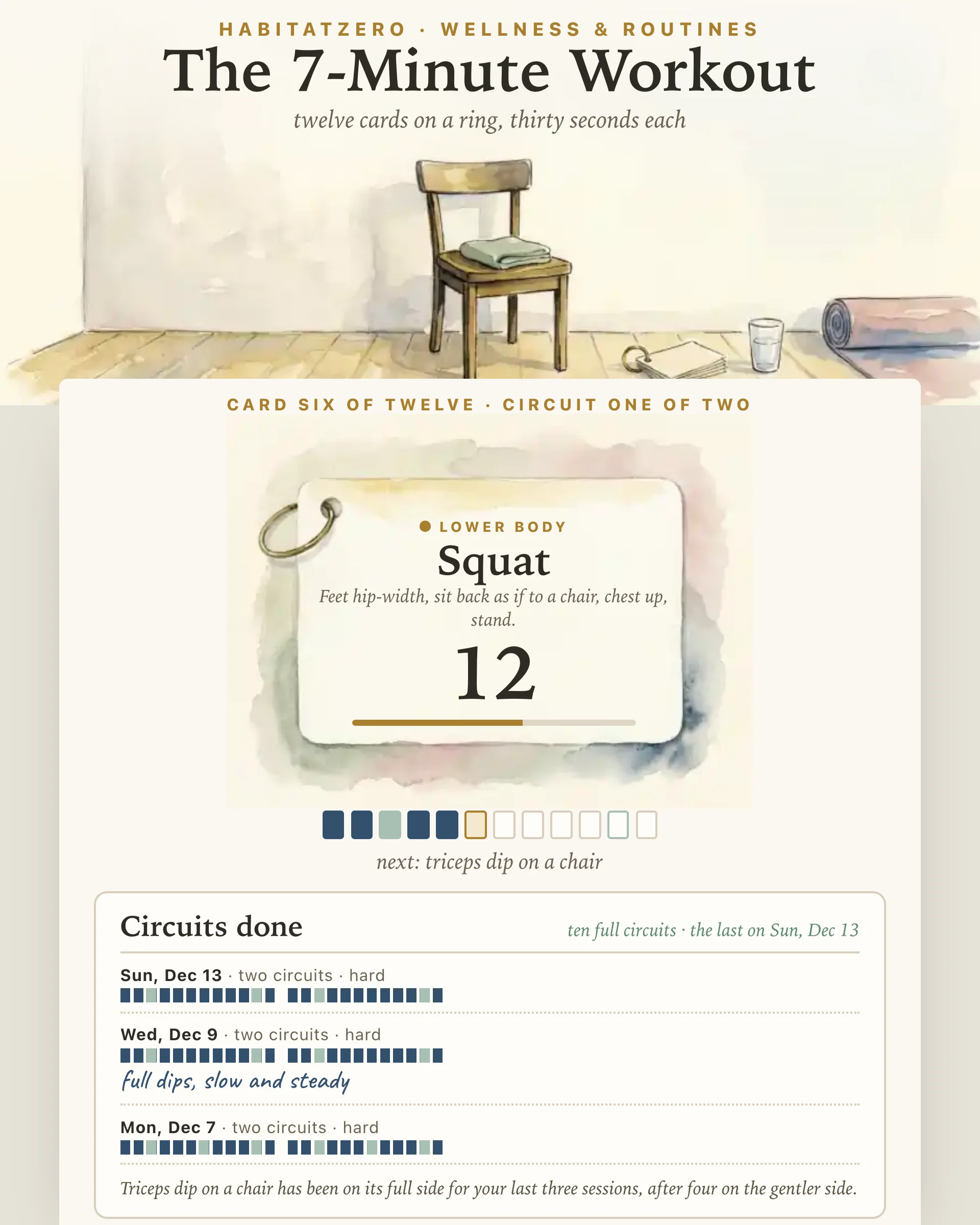
The circuit on this page comes from Brett Klika and Chris Jordan, then both at the Human Performance Institute in Orlando, who laid it out in the May 2013 issue of ACSM's Health & Fitness Journal as High-Intensity Circuit Training Using Body Weight. This timer is an independent tool built around their sample program. Klika, Jordan, the institute and the journal had no part in making it, and none of them has endorsed it.
Their sample program is twelve stations in a fixed order: jumping jacks, wall sit, push-up, abdominal crunch, step-up onto a chair, squat, triceps dip on a chair, plank, high knees, lunge, push-up and rotation, and side plank. You work for thirty seconds at each and take ten seconds to reach the next. The order cycles through total body, lower body, upper body and core three times, so one part of you recovers while another works. You need only a sturdy chair and a stretch of wall.
The name rounds down. Twelve thirty-second bouts make six minutes of work, and eleven changeovers add a minute and fifty seconds more. The authors wrote that it can be repeated two or three times, and since most people can't work far above their maximal aerobic capacity, they pointed to the American College of Sports Medicine guideline of at least twenty minutes of high-intensity exercise. Seven minutes is the unit, not always the whole session.
The worksheet is the deck itself, and every card has two sides. The front is the move as written; the back is a gentler version that does the same job, like wall push-ups for push-ups or sit to stand for squats. Tap a card to turn it over. Turn all twelve and you get a standing circuit with nothing on the floor, which helps when getting down and back up is the hard part.
Pick the circuits, a warm-up and a changeover length, and the cover card adds up the time. Flip the first card and the page fills the screen: the move and a one-line cue on the card, a count you can read from the floor, and the next move during each changeover. The count comes from the clock, so a reload or a locked phone won't lose your place. It stays silent unless you switch the sound on; then a rising whistle opens each card and a falling one closes it. If a move is too much halfway through, tap the corner of the card to turn it gentler right there.
When you finish or stop, say how it felt. The log keeps each session as rows of tiny cards, ink for the full side and sage for the gentler one, so you can watch a card come back to its full side over the weeks. After a few sessions it names what it notices, like a card back on its full side or recent sessions that felt too hard.
The original article describes a program rather than testing it, and the studies since are small. In a lab comparison, Riegler and colleagues had fourteen active adults do the 7-minute workout from a popular phone app and, on another day, a time-matched session of hard cycling intervals. The circuit brought lower heart rates and oxygen uptake than the cycling, though it still reached bursts close to ninety percent of maximum heart rate and counted as vigorous. The researchers put it at the low end of the intensity range for interval training.
Over eight weeks, Schmidt and colleagues split ninety-six active college students into three groups: a seven-minute body-weight circuit three times a week, the same circuit doubled in the second month, or no training. Both training groups improved their push-up endurance; the men also gained some strength, and aerobic capacity rose only among the women on the longer version. So expect a real training effect, modest in size and bigger when you repeat the circuit. It is not a weight-loss plan, and this page doesn't sell it as one.
Warm up before card one; the timer can run two or four minutes of marching and arm circles first. Keep breathing through every card, especially the three holds (wall sit, plank and side plank), where Klika and Jordan warn against holding your breath. They also advise people with high blood pressure or heart disease to swap those holds for moving exercises, and recommend medical clearance before starting a program like this. That is why each hold card's gentler side is a moving version.
Stop right away if you feel chest pain, faintness, dizziness, or breathlessness that doesn't settle. If you live with a heart condition, a joint problem or unsteady balance, ask your clinician which cards suit you before your first circuit. Brace the chair against a wall so it can't slide during step-ups and dips.
The circuit fits a morning before the day fills up, a lunch break, or a hotel room on a work trip, one of the settings the authors had in mind. For a shorter and harder block, The Tabata Timer runs eight rounds of twenty seconds. Workout Calendar lays out which days the circuit happens, and Walking Challenge keeps the days between moving.
In Klika and Jordan's order: jumping jacks, wall sit, push-up, abdominal crunch, step-up onto a chair, squat, triceps dip on a chair, plank, high knees, lunge, push-up and rotation, and side plank. Each one gets thirty seconds, with ten seconds to move to the next.
The studies are small but point the same way. College students who did a seven-minute body-weight circuit three times a week for eight weeks got better at push-ups, and a lab test found the workout vigorous, if lighter on heart rate than hard cycling intervals. Think of it as a real but modest training dose.
It can be, with a gentler start. Turn the hardest cards to their easier side, choose twenty-second changeovers, warm up first, and stop for chest pain, dizziness or pain in a joint. With a heart, joint or balance condition, ask your clinician which moves suit you before you begin.
Klika and Jordan wrote that it can be repeated two or three times, depending on the time you have, and noted that most people need about twenty minutes of high-intensity exercise to meet the ACSM guideline. One circuit is still a sensible start on a crowded day.
You can see how it works right on this page, which shows a sample deck partway through a circuit. To run your own circuits, keep your gentler sides and build up a log, personalize it in HabitatZero at no cost.
By the team behind Fabulous, the science-based self-care app used by over 30 million people.


