
The Overwhelm Recovery ProtocolWellness & Routines · ~5 min
About this template · Updated September 2026
Credit where it is due. The Tabata protocol carries the name of Izumi Tabata, the Japanese exercise physiologist who studied it in the 1990s, and it began as a routine that Kouichi Irisawa, head coach of Japan's national speed skating team in the 1980s, used with his skaters. Tabata tells that history and defines the method in a 2019 review in The Journal of Physiological Sciences. This timer is our own work. Neither man, nor any institution they worked for, had a part in it or has endorsed it.
The 1996 paper put seven people on a mechanically braked exercise bike five days a week for six weeks. Each session was seven or eight bouts of twenty seconds at about 170 percent of the intensity that matched their maximal oxygen uptake, with ten seconds of rest between bouts. The authors call the training exhaustive, and Tabata's later definition keeps that at the center: the name means work set hard enough to wear you out in the seventh or eighth set, not simply the twenty-and-ten clock.
After six weeks, maximal oxygen uptake had risen by about seven milliliters per kilogram per minute and anaerobic capacity by 28 percent. A companion study helps explain why. Twenty-second bouts with ten-second breaks taxed both the aerobic and the anaerobic energy systems almost to their limits, while a protocol of longer bouts and two-minute rests fell short on both counts.
High-intensity interval training is the family name for any workout that trades hard efforts for recovery, from thirty seconds on and thirty off to four-minute repeats. Tabata is one fixed member of that family: twenty seconds on, ten seconds of full rest, eight times through. Two details set the original apart. The effort sits above what your aerobic system can supply rather than just under it, and each rest is a complete stop, not easy pedaling.
By that standard, most of what gyms and videos call Tabata is Tabata-style: the same rhythm at an effort a person can repeat. That is still a sound way to train. It just is not what the 1996 group did, and Tabata's review points out that evidence for twenty-and-ten routines built from other exercises, burpees and squat jumps among them, is thin.
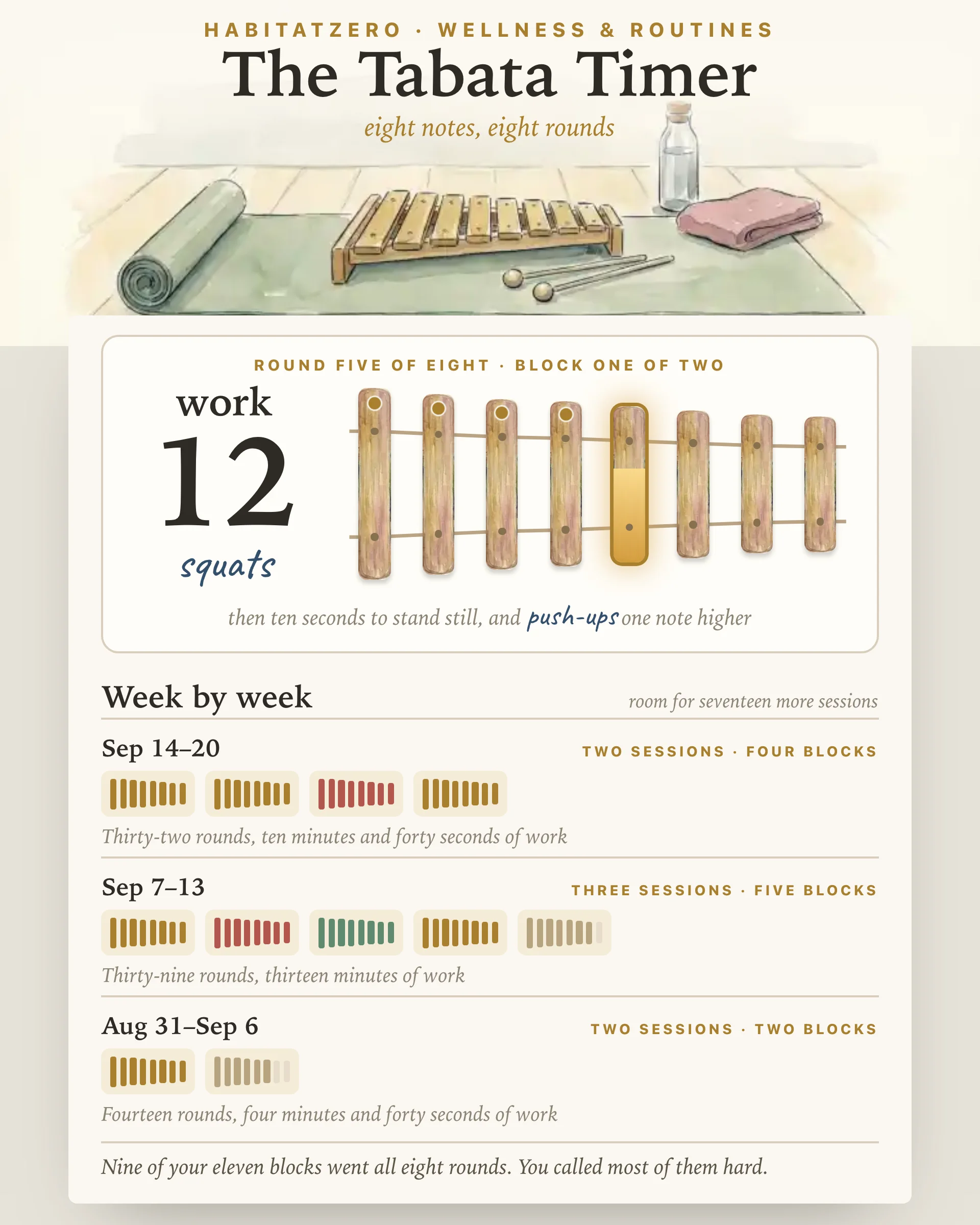
Your session is a wooden xylophone with eight bars, one for each round, the longest on the left. Tap any bar to hear its note, then press strike the first bar. A short get-set count fills the first bar with pale blue, and when it runs out, round one opens on the lowest note. The lit bar's gold drains away as the twenty seconds run down. A soft low tone marks the rest, the next bar fills while you stand still, and three quiet ticks come before every switch.
Each round sounds one step higher than the one before, so a block climbs a full scale. Deep into a hard block, when reading a screen is beyond you, the pitch alone tells you how far you have come.
Pick up to four moves to take turns round by round, and play up to six blocks with a short breather between them. When the top note rings, mark how each block felt: steady, hard, all out or eased off. Every block you log becomes a small scale in its week, inked as far as you climbed and tinted by the feel you chose, and each week adds up its rounds and minutes of work.
The notes come from the page, so a locked screen can quiet them, but the count cannot drift: it is worked out from the clock.
Warm up for five minutes or more; nobody should go from a standstill to all out. Hard is relative: all out for you might be quick squats in the living room. The American College of Sports Medicine notes that heart problems during exercise are often preceded by warning signs, and that the risk falls as people become more active. If you have a heart condition or any other health condition, or you are coming back to exercise after a long break, talk with your clinician before you push toward all out, and stop at once if you feel chest pain, faintness or breathlessness that is out of the ordinary.
What this page will not promise is weight loss or a fitness result. In Tabata's own review, body weight did not change across the six weeks of training, and he calls the weight-reducing effect of the method minimal. Read the study's numbers as what happened to a small group on laboratory bikes, not a forecast for your body.
Four minutes fits almost anywhere: before breakfast, between meetings, at the end of a walk. Log each block straight after, while you still remember how round seven felt. On the days between hard sessions, the Walking Challenge sets a daily goal in steps or minutes. If the rounds leave you curious about running, the Running Plan for Beginners starts from walk-run intervals of its own. And to turn a few sessions into a month, The 30-Day Challenge deals out one small task a day around a theme you pick.
Tabata is an interval pattern of twenty seconds of very hard work and ten seconds of complete rest, repeated eight times, for about four minutes in all. It is named for the Japanese researcher Izumi Tabata, whose 1996 study tested a routine that speed skating coach Kouichi Irisawa had been using with his skaters.
HIIT is the whole family of workouts that alternate hard efforts with recovery, in many ratios and lengths. Tabata is one fixed member of it: twenty seconds on, ten off, eight rounds, and in its original form an effort so hard that people gave out around the seventh or eighth round. Most classes use the Tabata rhythm at an effort people can repeat, which is still interval training, just not the original protocol.
One Tabata block is eight rounds of twenty seconds on and ten seconds off, a little under four minutes. Plenty of people string two to four blocks together with a minute or two of rest between them. This timer plays up to six blocks, and with its ten-second count before round one, a single block comes to exactly four minutes.
No honest page can promise that. In the original six-week training study, body weight did not change, and Izumi Tabata has written that the weight-reducing effect of the method seems minimal. What the study measured was a rise in aerobic and anaerobic capacity in a small group training five days a week.
The page shows the timer and a filled-in example to look over. Playing the bars with sound and keeping a week-by-week log start once you personalize it in HabitatZero, which costs nothing.
By the team behind Fabulous, the science-based self-care app used by over 30 million people.


