
The Overwhelm Recovery ProtocolWellness & Routines · ~5 min
About this template · Updated November 2026
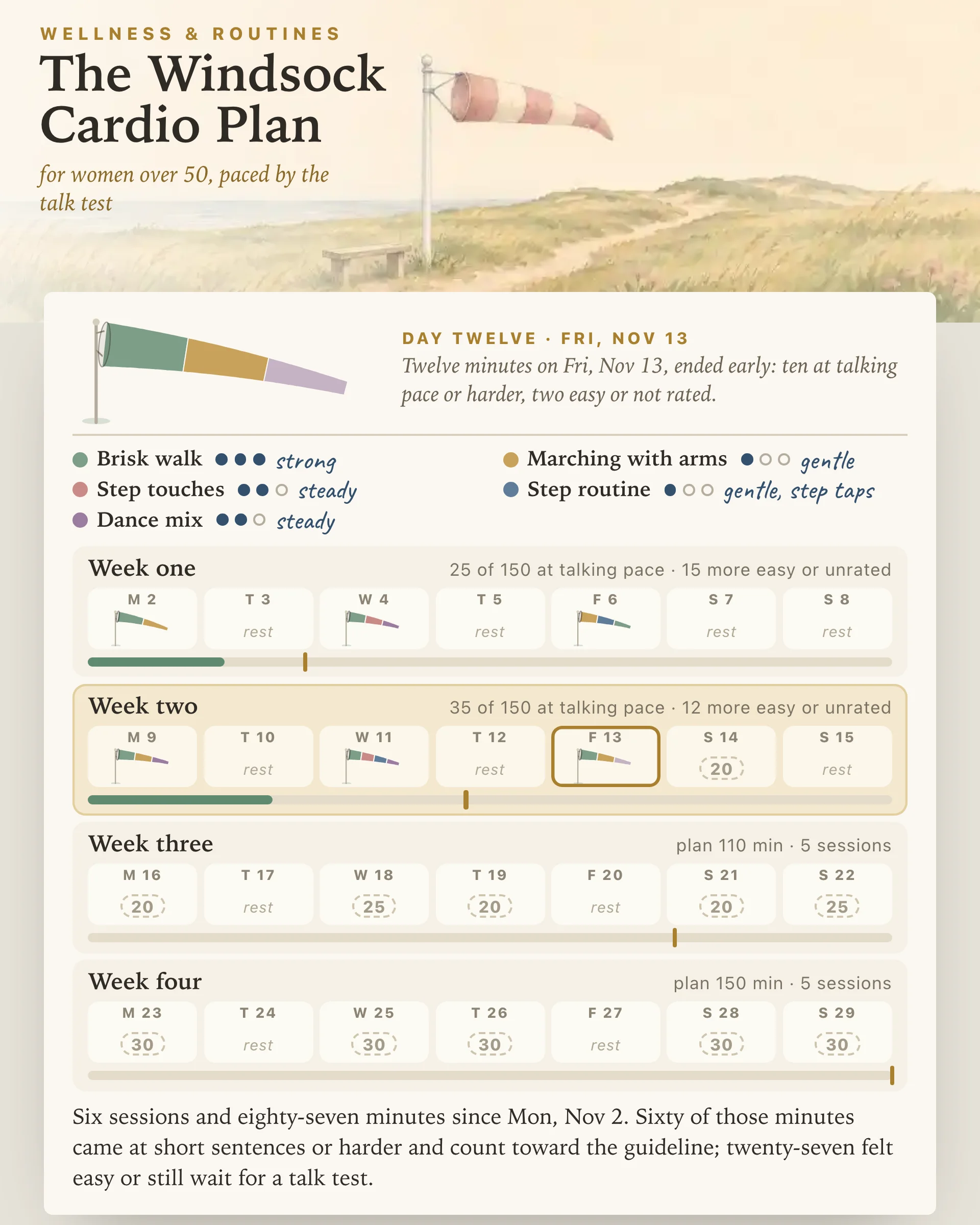
Cardio for women over 50 does not have to mean jumping, a gym or a class you can barely follow. It means moving steadily enough, for long enough, that your breathing picks up and stays up. This page builds five low-impact blocks into a session of ten to thirty minutes, times it for you, and lets your own voice decide how hard each block should be next time.
The CDC's guide to measuring intensity offers a rule of thumb: during moderate activity you can talk but not sing, and during vigorous activity you cannot say more than a few words without pausing for breath. The page turns that into three taps:
Halfway into each block, say a full sentence out loud and tap what happened. Every block keeps its own effort, gentle, steady or strong, so your brisk walk can climb while the step routine stays put. Talk easily through a whole block and it steps up next time; manage only a few words and it eases back, even if you cut the block short. Nothing steps up from a block you skipped or stopped partway.
That block-by-block tuning is what sets this page apart. The Chair Cardio Mixtape keeps you seated and lets the talk test move one beat for every move, and The Aerobic Wreath logs walks, swims and gardening after they happen. Here you build the session stripe by stripe, and each block learns its own pace.
A foot stays on the floor or the step in every block, so none of them brings the jolt of landing from a jump.
Pick ten to thirty minutes. Each five minutes is one stripe of the windsock and one block, with an easy first minute and a slower last one. The page suggests a mix that rotates through all five; tap the × on a stripe twice to swap it for another.
The timer reads the clock, so a phone that locks partway through still knows where you are. Skipped time never counts, and an early stop keeps only the whole minutes you moved. As you answer, the windsock lifts: slack before you start, straight out at only a few words.
The CDC's overview for adults puts the weekly guideline at 150 minutes of moderate activity or 75 of vigorous, plus two days of muscle strengthening, spread across the week in smaller chunks. The plan climbs toward it: forty minutes in week one, seventy in week two, a hundred and ten in week three, then five half-hour sessions.
Each week's bar fills only with minutes at short sentences or harder, since easy minutes sit below the pace the guideline counts. A vigorous minute counts once here, though the guideline lets it stand in for two.
A randomized trial of 464 women past menopause took women who were inactive, had blood pressure above normal and a body mass index of 25 to 43. Six months of moderate exercise raised measured fitness in step with the dose: about 4 percent at roughly 72 minutes a week, 6 percent at 136 and 8 percent at 192. Even the smallest dose helped. The trial did not test home routines like these, and blood pressure did not change.
The Women's Health Initiative observational study followed 73,743 women aged 50 to 79 with no diagnosed heart disease or cancer at the start. Walking and vigorous exercise went with similar drops in cardiovascular events, and a brisker pace and less sitting went with lower risk. The women reported their own activity rather than being assigned any, so this shows a link, not proof. This page makes no promise about your heart or your weight.
Check with your doctor first if you have a heart condition, chest pain, dizzy spells, high blood pressure or a recent injury, or if you have had a fall or a joint replaced. Stop any block that hurts. Stop at once for chest pain or pressure, faintness, or breathlessness that rest does not settle, and get medical help if it does not pass. Keep a sturdy chair or the counter within reach when standing.
If you would rather walk the whole time, The Living Room Mile times an indoor walk and The Walking Workout Ribbon lengthens outdoor walks week by week, a good fit for rest days.
The kind you will keep doing and your joints put up with. Brisk walking, marching, side steps, a low step and dancing all lift your breathing without any jumping. Mixing them spreads the work around, and a seated or supported version keeps a sore knee or hip from ending the session.
The US guideline for adults is 150 minutes a week of moderate activity, or 75 minutes of vigorous activity, along with two days of muscle strengthening. Short pieces spread over the week count. This plan starts at forty minutes in week one and reaches 150 in week four.
Use the talk test. If you can talk but could not sing, you are at moderate effort, the pace the guideline counts. If only a few words come out before you need a breath, you are working vigorously. If you could chat or sing with ease, pick up the pace a little.
For heart and lung fitness, effort matters more than impact. Low-impact moves reach moderate or even vigorous effort once you add arm work, a quicker count or a step. A large study of women aged 50 to 79 linked walking with a drop in cardiovascular events close to that of vigorous exercise, though it observed the women rather than testing a program.
Talk with your doctor first if you have a heart condition, chest pain, dizzy spells, high blood pressure or a recent injury, or if you have had a fall or a joint replaced. Stop any block that hurts, and stop at once for chest pain, faintness or breathlessness that does not settle.
By the team behind Fabulous, the science-based self-care app used by over 30 million people.


