
The Overwhelm Recovery ProtocolWellness & Routines · ~5 min
About this template · Updated November 2026
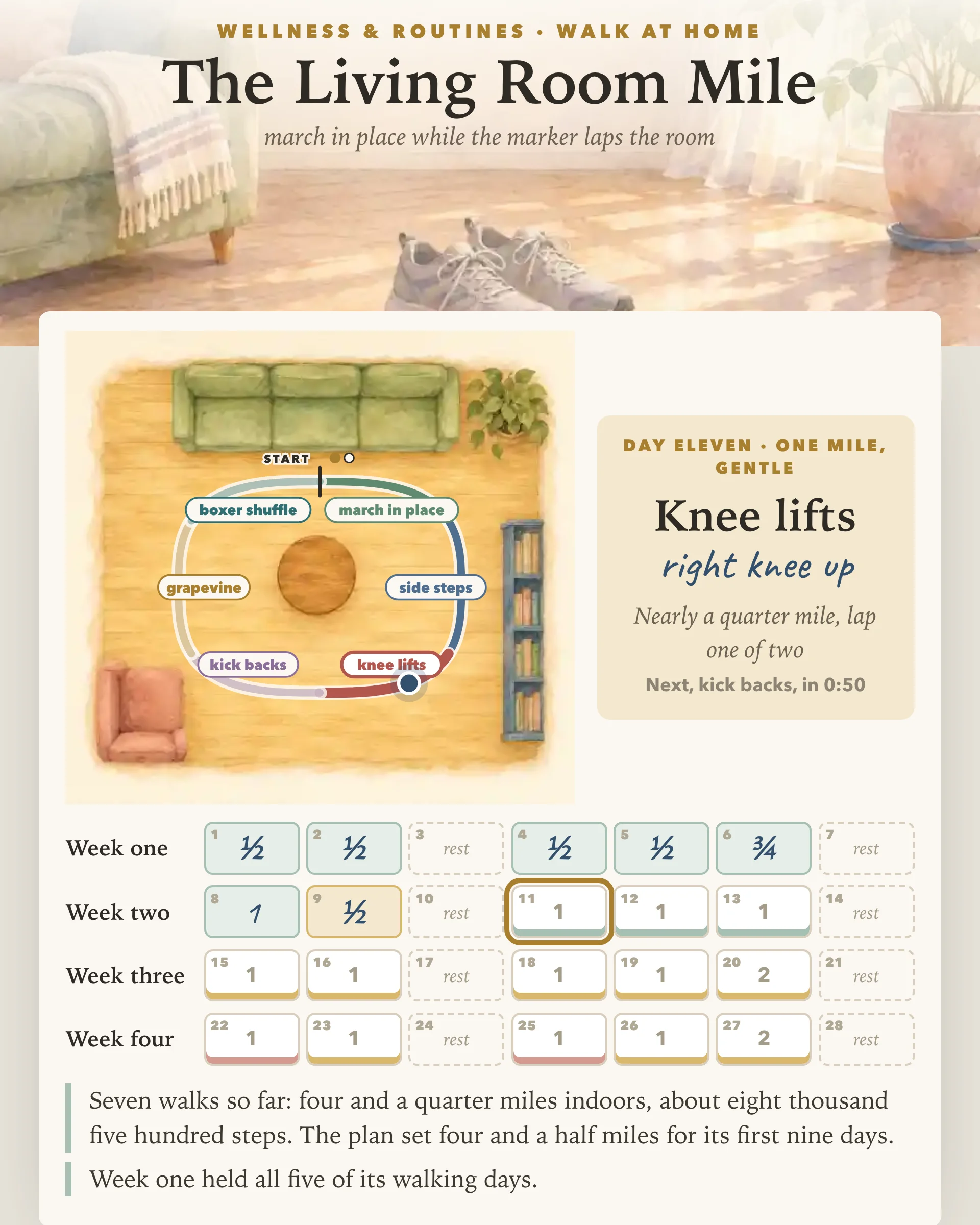
Rain, ice, an early sunset or a sidewalk you no longer trust can all cancel a walk. An indoor walking workout keeps it on the calendar: you stay on one patch of floor and keep your feet moving through a short run of moves. This page turns your living room into the route. Six moves make one lap of a painted room, each lap counts as half a mile, and a marker travels around the room while you march.
Walking in place covers no ground, so any indoor mile is a convention. This page counts it by time at a steady step rate, the way you might count laps in a pool you never leave.
A review of thirty-eight studies on walking cadence found that about one hundred steps a minute is a consistent rough marker of moderate intensity in adults, while noting that people differ around that line. The page's three paces sit at or above it:
Each works out to roughly two thousand steps, and that count is what this page means by an indoor mile. Use it to compare one walk at home with the next, never as a distance on a map. To turn an outdoor step count into real miles, the Steps to Miles Calculator uses your own stride.
The route runs clockwise from the couch, and every move fills a sixth of the lap:
The last boxer shuffle of every walk turns into an easy march, so you always finish slowly. The gentler moves switch rewrites each move for a hand on the counter: the grapevine becomes wide side steps with no crossing, and the shuffle becomes weight shifts with no bounce. They count exactly the same miles.
Tap a distance, from half a mile to three miles, and a pace. The room shows how many laps that is, and the list under it gives the minutes, the steps and how long each move lasts: a minute and forty seconds at the gentle pace, eighty seconds at brisk.
Press start and the caller takes over. It names the move you are on, spells out its beat ("left knee up, right knee up"), counts down to the next move and says how far you have come, while dots by the start line fill in lap by lap. If you stop early, the page offers to log only the quarter miles you finished. Each walk then goes on its day in a four-week grid, shaded by pace, and a reading adds up your indoor miles against the plan.
Week one is four gentle half-mile walks of ten minutes and one gentle mile. Week two makes the gentle mile the usual walk. Week three moves to a steady pace and adds one two-mile walk. Week four mixes brisk and steady miles and ends with another steady two-mile walk. Every week holds five walks and two rest days, and a missed day stays open until you get to it.
US guidelines ask adults for 150 to 300 minutes of moderate activity a week, and ask older adults to add balance and muscle-strengthening work. These weeks climb from about an hour to roughly a hundred minutes, so they are a start toward that target, and walking in place is not strength training.
A meta-analysis of fifteen groups of adults found that more steps a day went with a lower risk of death, leveling off around six to eight thousand steps a day in people sixty and older. Those were steps from whole days of ordinary life, an association rather than proof of cause, and nobody tested a living-room routine. Nothing here promises weight loss or any particular result.
Clear a patch of floor, wear supportive shoes, and stand where a counter or a sturdy chair back is within reach. If you have had a fall, dizzy spells, a joint replacement, a heart or blood pressure condition, or ongoing pain, ask a doctor or physical therapist first. Stop if anything hurts or you feel lightheaded.
Use it whenever going outside is off the table. On good-weather days, the Walking Workout Ribbon shapes an outdoor walk into easy and brisk stretches. For something slower that works on steadiness, the Indoor Tai Chi Walk uses the same floor at four counts to a step. To turn indoor miles into a daily step target, The Daily Steps Ladder starts from your own phone's history.
It is a walk done on one spot of floor, kept going with a run of simple moves such as marching, side steps, knee lifts and kick backs. Here six of those moves make one lap of a painted living room, and every lap counts as half a mile.
For effort it can. Research on step rate treats about one hundred steps a minute as a fair sign of moderate effort, and that is this page's gentle pace. For distance it does not, because you cover no ground: an indoor mile here is time at a pace, close to two thousand steps, rather than a measured mile.
Twenty at the gentle pace, eighteen at steady and sixteen at brisk. So a walk at home workout of two steady miles lasts thirty-six minutes, and three gentle miles fill a full hour.
Switch on the gentler moves. The grapevine becomes wide side steps with no crossing, the boxer shuffle becomes weight shifts with no bounce, and each move is written for a hand on a counter or chair back. If you have had a fall, dizziness, a joint replacement, a heart or blood pressure condition, or pain, talk to a doctor or physical therapist before you begin.
Yes, personalizing it costs nothing, and it keeps your log. The weeks run from gentle half-mile walks, to a gentle mile on most days, to steady miles, and finally to brisk miles with one steady two-mile walk, always five walks and two rest days.
By the team behind Fabulous, the science-based self-care app used by over 30 million people.


