
The Overwhelm Recovery ProtocolWellness & Routines · ~5 min
About this template · Updated September 2026
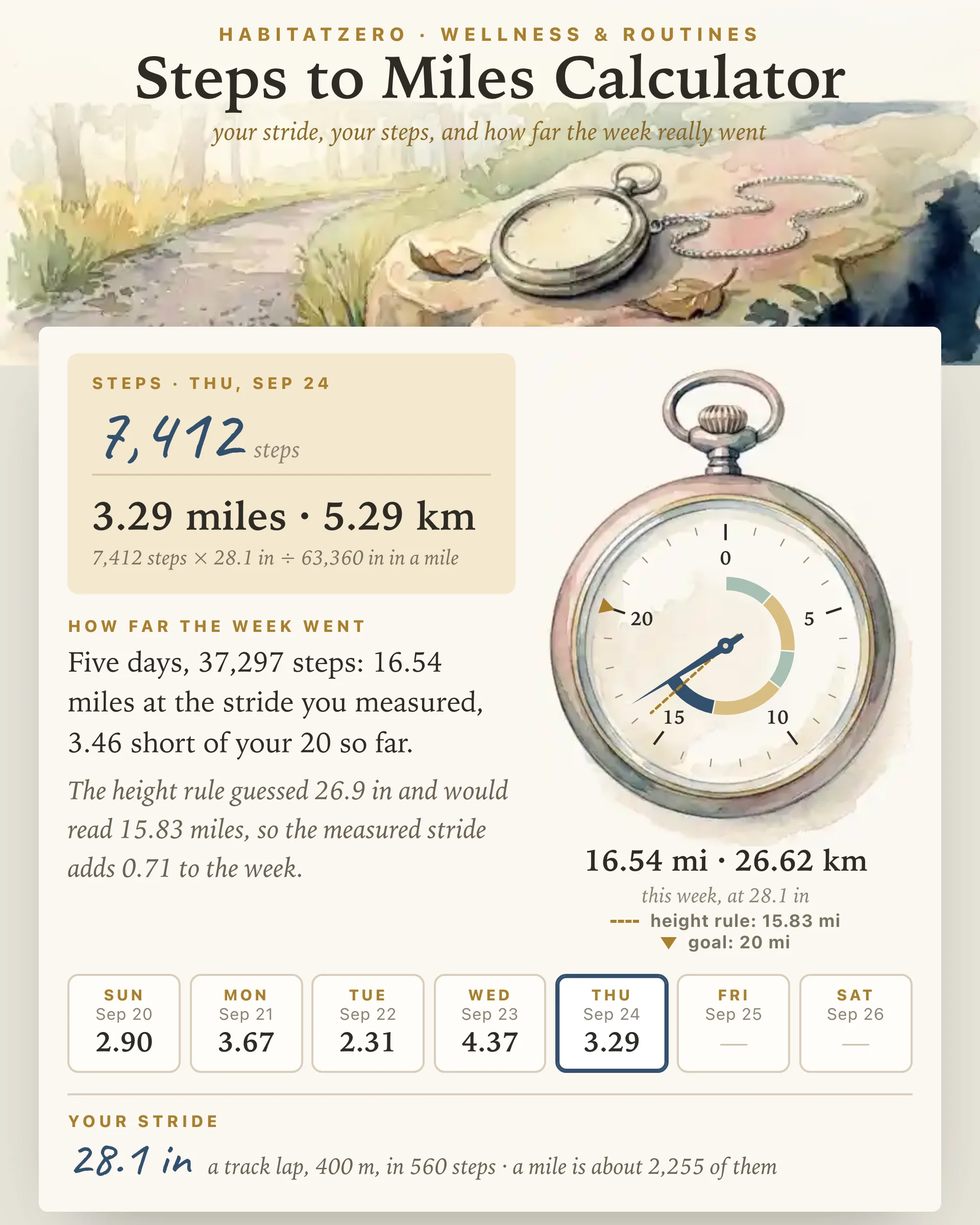
Your phone counts steps well. The distance it prints beside them is a different kind of number: a count multiplied by a guess about how far each step carries you. This calculator puts that guess in plain view, lets you replace it with a measurement, and keeps a week of days on a pocket pedometer dial so you can see what the guess is worth.
Converting steps to miles takes one multiplication and one division. Multiply your steps by the length of one step in inches, then divide by 63,360, the number of inches in a mile. For kilometers, multiply by the step length in centimeters and divide by 100,000. So 8,400 steps at a 27.7-inch step come to 8,400 × 27.7 ÷ 63,360, or 3.67 miles, which is 5.91 km.
The step count is usually solid. The step length is where the uncertainty lives, and any error in it is multiplied by every step.
A note on words: pedometers call one step a stride, while gait researchers keep "stride" for two steps, heel strike to heel strike on the same foot. This page always means one step.
The quick way is a rule of thumb: one walking step is about 0.414 times your height. Many online calculators use it, some as 0.413 for women and 0.415 for men, and since the two versions land a fraction of an inch apart, this page splits the difference. At 5 ft 7 in, that is 67 × 0.414, about 27.7 inches, an estimate from averages that your legs, pace and footing can all pull away from.
The better way takes one walk. Pick a distance you know: a lap in the inside lane of a standard 400-meter track, 100 yards from goal line to goal line, or a mile measured on a map or marked on a trail. Walk it at your usual pace, count every step, and divide the distance by the count. A lap in 560 steps gives 15,748 inches ÷ 560, about 28.1 inches, more than an inch longer than the height rule gives someone who is 5 ft 5 in.
Pace matters because your step lengthens as you speed up. When researchers put ten pedometers through a treadmill test, six of them counted steps to within 1 percent at about 3 mph and faster, yet the distances the devices reported were mostly within about 10 percent only at that pace, running long at slower speeds and short at faster ones. A single stride setting cannot follow a walker who changes speed, so measure at the pace you log most often.
Type the day's steps into the pedometer's line, or tap a round number to try one. Miles and kilometers appear as you type, with the arithmetic printed underneath and worked from the same rounded stride the page shows, so you can check any figure with a pencil.
Each day you log adds an arc around the dial's face, the hand points at the week's total, and a notch marks your weekly goal. Once you have set both a height and a measured walk, a dashed second hand shows where the week would stand on the height rule alone. The reading beside the dial says how far the week went, what is left to your goal in miles and in steps, and how many miles the gap between the two strides is worth. With only the height estimate, it says how much each inch of stride moves the week instead. Change any count or setting and the reading follows. A finished week closes, and when you start the next one, its total joins a list of up to eight earlier weeks.
The 10,000-step target is older than the research on it. A review of pedometer guidelines traced the number to Japanese walking clubs and a decades-old business slogan, and proposed a graded scale around it, from under 5,000 steps a day to over 12,500.
Larger studies have since looked at steps and health directly. A meta-analysis of fifteen cohorts found that the risk of death fell as daily steps rose until about 6,000 to 8,000 steps a day in adults aged 60 and older, and about 8,000 to 10,000 in younger adults, after which the curve leveled off. Those are associations across large groups of people, not a promise about any one walker.
Miles are a translation of steps, not a measure of effort: a hilly mile and a level one read the same on the dial. The conversion turns a count you already have into a distance you can picture and compare week to week.
Log in the evening, when the day's count is final. Measure your stride once, and again whenever your usual pace changes. If you want the miles to add up to something, the Walking Challenge turns a daily goal into a route across a map. If you want to build a quicker pace, the Japanese Interval Walking Timer alternates brisk and easy minutes. And if your walks serve a weight goal, the Walking Plan for Weight Loss sets their length week by week.
That depends on your stride. With the rule of thumb for someone 5 ft 7 in tall, one step is about 27.7 inches, so 10,000 steps come to about 4.37 miles, or 7.04 km. A 26-inch step makes the same count about 4.1 miles, and a 30-inch step about 4.7.
A mile is 63,360 inches, so divide that by the length of one of your steps. At 26 inches a mile takes about 2,437 steps, at 28 inches about 2,263, and at 30 inches 2,112. Walking steps between 25 and 32 inches long put a mile somewhere from about 2,000 to 2,500 steps.
The quick way multiplies your height by about 0.414, a rule of thumb many online calculators use, some as 0.413 for women and 0.415 for men. The better way is to walk a distance you know, such as one 400-meter lap in the inside lane of a track, at your normal pace, count the steps and divide the distance by that count.
Usually it is less. At a 27.7-inch step, 5,000 steps cover about 2.19 miles, or 3.52 km. Covering 3 miles in 5,000 steps would take steps of about 38 inches, more than ten inches longer than the height rule gives a 5 ft 7 in adult.
The public page shows a sample week on the dial so you can see the arithmetic at work. To log your own days, keep a measured stride and let the weeks pile up, personalize the calculator in HabitatZero at no cost.
By the team behind Fabulous, the science-based self-care app used by over 30 million people.


