
The Overwhelm Recovery ProtocolWellness & Routines · ~5 min
About this template · Updated September 2026
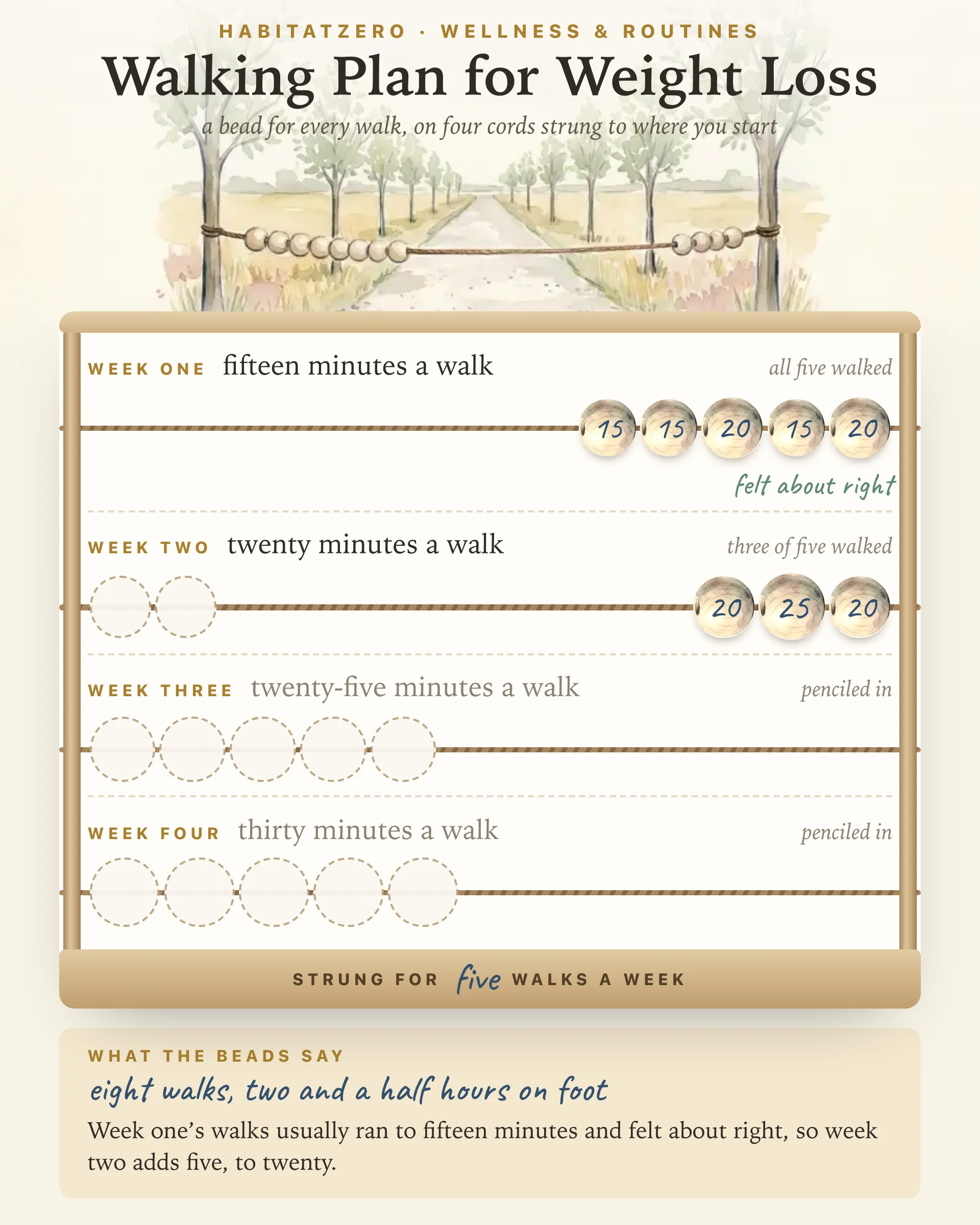
Most walking plans hand you a fixed ladder: twenty minutes in week one, thirty by week four, whatever your knees or your calendar have to say about it. This one begins with a question instead. How long could you walk today, at an easy and steady pace? Ten minutes is a perfectly good answer. So is thirty. The plan is strung from there, and every week after the first is rebuilt from the walks you actually took.
People who navigate on foot, from army land navigators to orienteers, often carry pace beads: a short cord of beads they slide along as the ground adds up, so the count lives on the cord instead of in their heads. This page borrows that idea for a month of walking. Each of the four weeks is a cord. The dashed beads resting on the left are the walks still ahead of you. When you get home, tap the cord and one bead slides across, recording the minutes that week was planned at. If the walk ran longer or shorter, tap the bead and change it in five-minute steps. Longer walks make bigger beads, so a glance at the four cords shows how your walks are growing.
You also decide how many walks each cord holds, anywhere from three to seven a week. Five is a sensible middle. A full cord takes no more beads, which is your signal to say how the week went and move down to the next one.
When a week is done, tell the page whether it felt too hard, about right or too easy. The next cord is then restrung from your usual walk that week, the middle value of the beads you logged, rather than from the plan:
Weeks you have not reached stay penciled in, five minutes longer than the week before, until the week ahead of them is rated. No single walk is asked to run past an hour. Nothing on the page is dated, so if a week falls apart, keep walking the same cord until it is done. A week that takes ten days is still a week.
Walking is one of the best-supported habits you can build for your health. A review of randomized trials in adults who had been inactive found that walking programs on their own raised aerobic fitness and lowered blood pressure, waist size and body fat, though they did not shift blood lipids. Those gains count whether or not the scale moves.
For weight in particular, the honest picture is more modest. When researchers pooled pedometer-based walking programs that made no change to diet, the weight change was small, and longer programs produced more of it than shorter ones. The CDC puts the balance plainly: most weight loss comes from eating fewer calories, regular activity is what helps you keep it off, and the amount of activity a person needs varies greatly. So treat these four weeks as the movement half of a larger plan, and take the eating half to a clinician or dietitian if you want support with it. This page makes no promise about pounds, and you should be wary of any walking plan that does.
Aim for a pace where you can talk but could not sing. That talk test is how public health guidance describes moderate effort, the kind the Physical Activity Guidelines for Americans count toward their advice of two and a half to five hours a week for adults. The same guidelines stress that the least active people gain the most from even modest increases, which is why a ten-minute start is not a lesser version of this plan. Under the cords, the page works out what your week four comes to and how that sits against the guideline, so you can see the total without doing the sums.
If you live with a heart condition, joint problems or any other health condition, check with your clinician before your first walk and bring the plan along. Stop and seek help for chest pain, faintness or breathlessness that feels out of proportion to the effort.
Start on a week you can mostly steer, and settle the when and where in advance: after dinner around the block, or the long way home from school drop-off. There is a line for it under the cords, so at six in the evening the decision has already been made.
If you would rather walk toward a finish line, the Walking Challenge turns a daily goal into a route on a painted map. If you also choose to track the number on the scale, the Printable Weight Loss Tracker keeps that log calm and free of verdicts. And if four weeks of walking leave you curious about running, the Couch to 5K Plan starts from short jogs mixed with walking.
No single length suits everyone. US guidelines ask adults for two and a half to five hours of moderate activity a week, brisk walking included, and the CDC notes that the activity needed to manage weight differs greatly from one person to the next. Begin at a length you can finish today and add a few minutes each week, which is how this plan is built.
Thirty brisk minutes on five days reaches the weekly guideline, but you do not need to start there. Ten minutes a day is an honest first week if that is what feels steady, and the cords grow from whatever you actually walk. For the scale itself, the CDC says most weight loss comes from eating fewer calories, with regular activity helping to keep it off.
Some people do, but it tends to be slow. A pooled analysis of walking programs that left diet unchanged found only modest weight change, and the longer programs produced more of it. Walking on its own still improves fitness, blood pressure and waist size, so it is worth keeping up whatever the scale says, and a clinician or dietitian can help with the eating side.
One that starts at a length you can finish comfortably, grows by about five minutes a week, and eases off when a week feels too hard. Here you choose ten, twenty or thirty minutes and three to seven walks a week, then rate each week so the next cord is rebuilt from what you really walked. If a heart condition, sore joints or another health problem is part of your life, ask your clinician first.
The filled-in example on this page is free to look through with no account. To string cords of your own and keep every bead between walks, personalize the plan in HabitatZero at no cost.
By the team behind Fabulous, the science-based self-care app used by over 30 million people.


