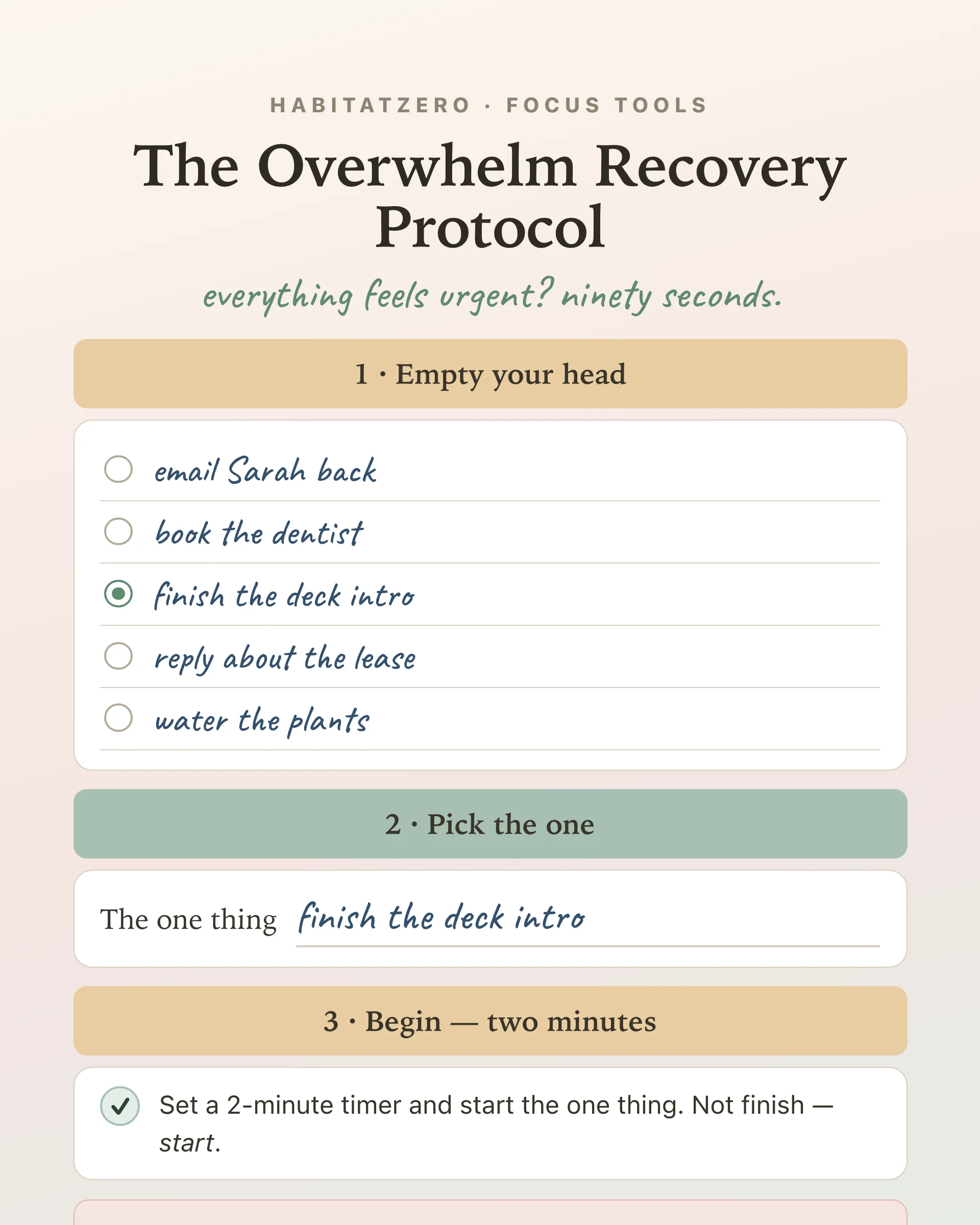
The Overwhelm Recovery ProtocolWellness & Routines · ~5 min
About this template · Updated July 2026
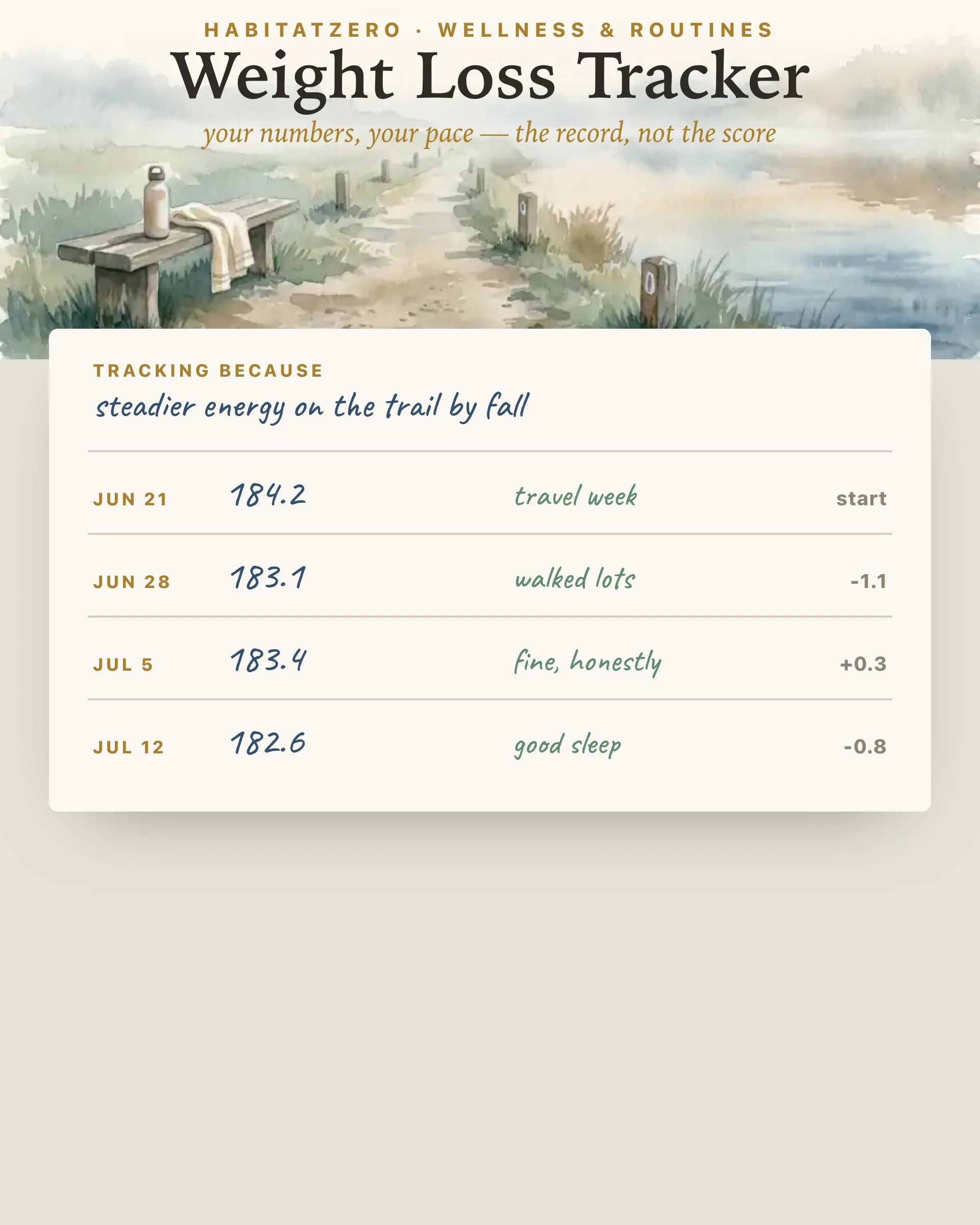
Most weight trackers are loud. Red arrows, goal thermometers, confetti for one direction and guilt-gray for the other — a scoreboard bolted onto a number that was only ever supposed to be information. This one is a log. Sixteen weekly lines, a quiet change column, and your own reason at the top of the page. It tracks what you choose to track, and it keeps its opinions to itself.
That restraint isn't just taste; it's the part of tracking that actually works. The best-supported ingredient in weight management research is unglamorous: consistent self-monitoring. A systematic review of the literature found that people who regularly recorded their numbers did meaningfully better than those who didn't — across studies, the recording itself was the active ingredient (DOI: 10.1016/j.jada.2010.10.008). A tracker's job is to make that recording effortless enough to still be happening in week fourteen. Nothing about that job requires a verdict.
It filters the noise. A body's day-to-day number wobbles for reasons that have nothing to do with anything — water, salt, sleep, travel. Weekly lines, logged on the same day under the same conditions, skip the wobble and keep the signal. Four lines in, you have a trend; sixteen lines in, you have a season.
It keeps the story attached. Each line carries one word about the week — travel week, walked lots, fine, honestly. Months later, that column is the difference between a bare curve and a record you can actually learn from: the trend plus what life was doing at the time.
It ends. Sixteen lines fill the page, and then the sheet is complete. Not abandoned — complete. A tracker with a last line built in never becomes a treadmill; it becomes a finished document, and the next season gets a fresh page.
The week-to-week difference prints small, gray, and typographically identical in every direction: −0.8, +0.3, steady. No color coding, no arrows, no celebration or penalty. If a number moving up and a number moving down look the same on the page, the page can't scold you — and a page you don't brace against is a page you keep filling in.
The same thinking removed the goal field. There's no target weight, no countdown, no percent-complete. The only context the sheet requests is one line, at the top, in your handwriting: tracking because ___. Steadier energy, a race in October, curiosity, a doctor's suggestion — the reason is yours, it can change, and it does more to keep a log alive than any target ever printed on a form.
On screen, the tracker fills itself in as you type — dates, entries, and the computed change, all in handwritten ink on ruled lines. On paper, the buttons disappear and what prints is just the log: a clean one-page record for a fridge door, a folder, or an appointment where a two-month trend answers questions better than memory can. Print it blank at the start of a season, or full at the end of one — both are the sheet doing exactly its job.
One boundary, plainly stated: this page is a record-keeper, not a health advisor. It has no opinion on what your numbers should be — for what they mean, a professional who knows you beats any printable ever made.
Yes — the tracker is free to use, personalize, and print. Sixteen weekly lines fit one clean page, and when the page is full you simply start a fresh sheet with the old one as the record.
This sheet is built around one line a week, logged on the same day under the same conditions. Weekly spacing keeps the normal day-to-day noise out of the picture, and a single quiet line is easy to keep doing for the full sixteen weeks.
On purpose. The week-to-week change prints small, gray, and identical in style whether the number moved up, down, or held steady. This tracker treats every entry as information, and information does not need a color that cheers or scolds.
No. There is no goal field, no target line, and no countdown. The only context the sheet asks for is your own one-line reason for tracking, written in your words at the top of the page — that reason is yours to define and yours to change.
Whatever you write. The entry column is freehand, so kilograms, pounds, stone, or any number you have chosen to watch all work — the change column simply does the arithmetic between consecutive entries when both are plain numbers.
Yes. The tracker works fully on screen and saves with your HabitatZero worksheet answers on your devices, but the layout is designed paper-first — the printed page drops the buttons and keeps only the log, ready for a fridge door or a folder.
By the team behind Fabulous, the science-based self-care app used by over 30 million people.