
The Overwhelm Recovery ProtocolWellness & Routines · ~5 min
About this template · Updated November 2026
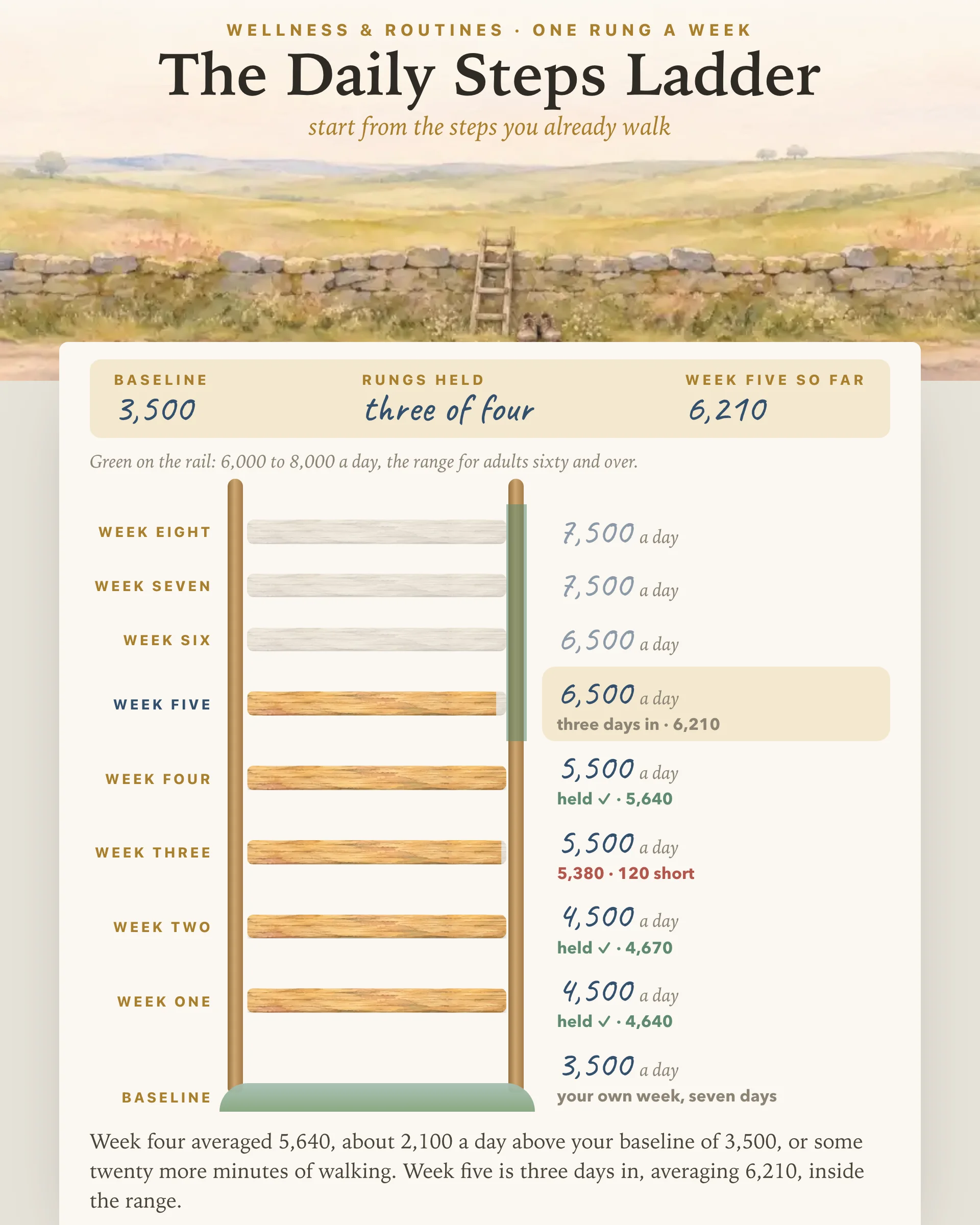
Ten thousand is the number everyone has heard, and it is the wrong place to begin. The question that actually helps is smaller and more personal: how many steps do you walk on an ordinary day now, and how much higher can you climb from there without it turning into a chore? This page answers it with your own numbers, with the research on age set beside them.
The round figure did not come out of a laboratory. A 2004 review of pedometer research traced it to Japanese walking clubs and a business slogan from decades earlier. The same review pointed out that ten thousand may not be realistic for many older adults or people living with chronic illness, and that goals built on gradual increases from a person's own starting count looked promising. That second idea is the one this page is built on.
Much of the evidence on daily steps comes from studies that had people wear a step counter for about a week and then followed them for years. In 2022, researchers pooled fifteen such groups, covering more than 47,000 adults followed for a median of about seven years. In that analysis, the risk of dying from any cause kept falling as daily steps rose, then leveled off. Where it leveled depended on age: around 6,000 to 8,000 steps a day for adults sixty and over, and around 8,000 to 10,000 for adults under sixty.
An earlier study of nearly 17,000 older women, with an average age of seventy-two, found a similar shape. Women who took about 4,400 steps a day had lower death rates than those taking about 2,700, and the rates kept dropping until roughly 7,500 steps before leveling. In that study, walking at a brisker pace was not clearly linked to lower death rates once total steps were taken into account.
The biggest differences sat between people who walked very little and those who walked a moderate amount, which is the stretch of the curve a gradual climb covers.
They are observational, so they show a link and cannot prove that adding steps causes the drop in risk. People who walk more may differ in other ways, such as being healthier to begin with. Steps were usually measured once, over a single week. The outcome was death from any cause, so the findings say nothing direct about weight, mood, blood pressure or fitness. And a population curve is not a verdict on you: your number is a starting point, not a grade.
A widely cited review of step guidance treats about 100 steps a minute as a reasonable floor for moderate walking, which makes a thousand extra steps roughly ten more minutes on your feet. The same review notes that walking programs have typically raised people's counts by around 2,000 to 2,500 steps a day. A ladder that adds about a thousand steps every two weeks reaches that kind of gain around week four, then keeps climbing slowly, which gives your legs and your calendar time to adjust.
Start at the bottom. Open the step history on your phone or watch and copy last week into the seven boxes. Blank days are left out of the average rather than counted as zero, and five filled days are enough. The page rounds your average to the nearest hundred and calls it your baseline.
Above that baseline stand eight rungs, one per week. The first two ask for about a thousand more steps a day than your baseline, the next two about two thousand, and so on. Choose your age group and a green stretch appears on the rail beside the rungs that fall inside the range from the 2022 analysis. If your climb would pass the top of that range, the rungs stop there; if you already walk more, the ladder simply keeps you at your own level.
Each week, copy in the days you walked. A rung paints in from left to right as your average approaches its number and holds once five or more logged days reach it. Miss one by a little and the ladder says so, along with whether the next rung is the same height or a step higher. A note under the ladder tracks how far you have come, and a small card does the ten thousand arithmetic for your baseline. When week eight is in, you can start a new ladder with it as the baseline.
Set it up once with last week's history, then return weekly. To see what your steps mean in distance, the Steps to Miles Calculator turns them into miles. To give the extra minutes some shape, The Walking Workout Ribbon builds a timed walk, and once you are steady, the Walking Challenge gives you a route to finish. When the weather keeps you in, The Living Room Mile turns laps of your own room into steps.
If you have a heart or lung condition, joint pain, dizzy spells or a recent fall, talk with your doctor or a physical therapist about how fast to add steps, and stop for the day if something hurts. A rung can always wait another week.
Start from what you walk now rather than from a round number. Find your average over an ordinary week, then add roughly a thousand steps a day every two weeks. In a 2022 analysis of fifteen studies, the risk of dying during follow-up kept falling with more daily steps until about 6,000 to 8,000 for people sixty and over, and 8,000 to 10,000 for younger adults.
The clearest age split comes from that 2022 analysis: the benefit stopped growing at around 6,000 to 8,000 steps for adults sixty and older and at 8,000 to 10,000 for adults under sixty. A separate study of women with an average age of seventy-two saw the curve level off near 7,500. Read these as ranges to move toward, never as a grade.
No. The figure goes back to Japanese walking clubs and a pedometer slogan rather than to research. It is a perfectly good goal if you already walk a lot, but the measured benefit leveled off below it for older adults, and for someone starting near 3,000 steps it means more than an hour of extra walking every day.
It can be a fun push for a few weeks if you already walk seven or eight thousand a day. From a lower starting point the jump is large, and a goal built on your own number asks for a much smaller change each week. This ladder is built that way, rising about a thousand steps every two weeks and stopping at the top of your age range.
Yes, it is free. The picture on this page shows a sample ladder partway up, and your own copy keeps every week you log, so the rungs and the note under them pick up exactly where you stopped.
By the team behind Fabulous, the science-based self-care app used by over 30 million people.


