
The Overwhelm Recovery ProtocolWellness & Routines · ~5 min
About this template · Updated November 2026
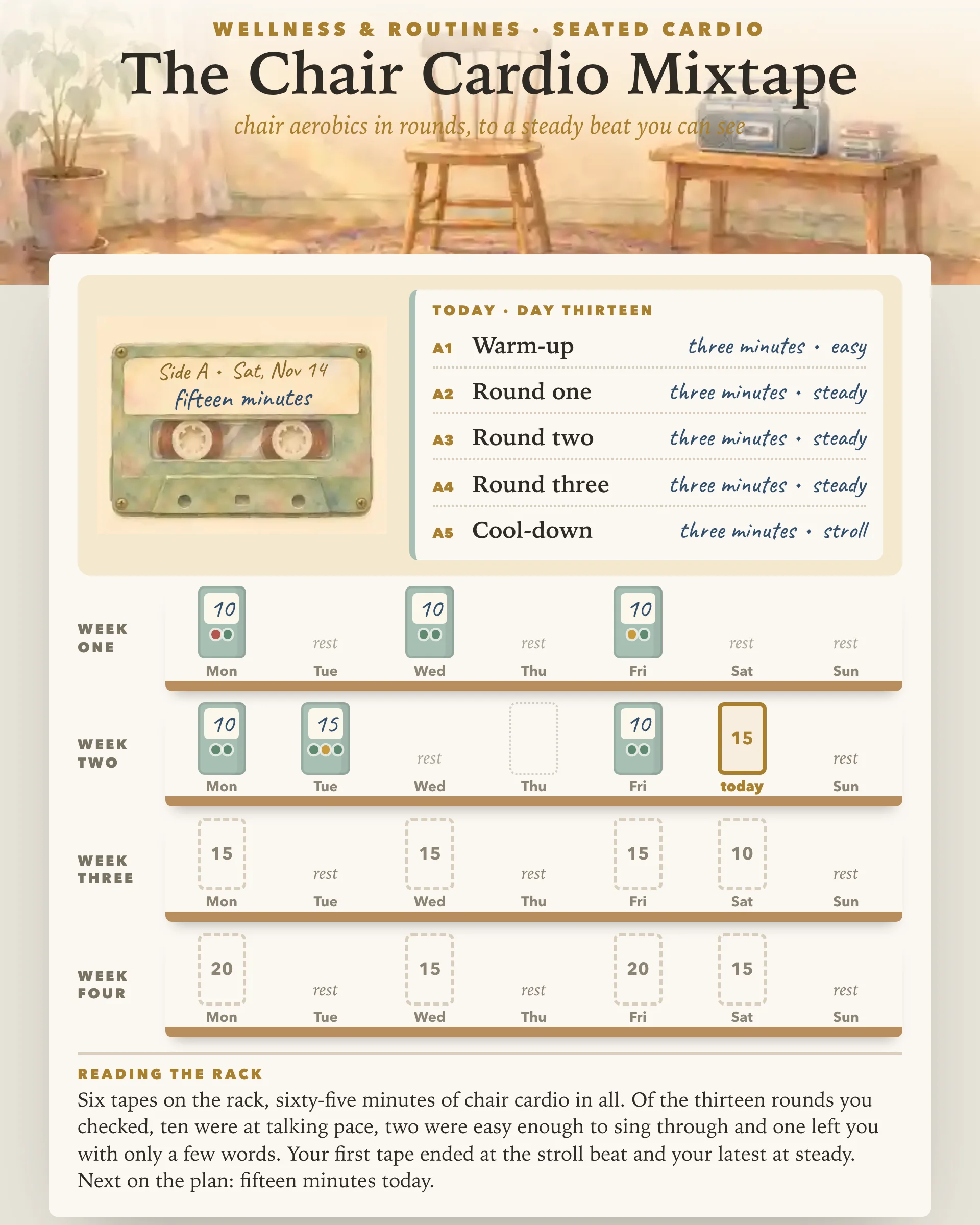
Chair aerobics is cardio you do sitting down. You march, punch, tap and sweep your arms and legs in a steady rhythm for long enough that your breathing picks up, and the chair takes care of your balance. If standing for long is hard or your knees dislike jumping, it gets your heart working without leaving your seat.
This page plays each session like one side of a cassette. You pick ten, fifteen or twenty minutes, press play, and a small lamp flashes a steady beat to move to. When the tape runs out, it joins the others on a four-week rack.
Every tape has the same shape: a warm-up, a set of rounds, and a cool-down. A ten-minute tape holds two rounds, fifteen minutes holds three, and twenty minutes holds four. The warm-up and cool-down each last as many minutes as there are rounds, so the longer sessions ease you in and out more gently.
A round is six moves, half a minute each, back to back: a seated march, arm punches, heel taps, seated jacks (feet step wide while the arms sweep overhead), a knee lift and reach, and seated skaters (one foot slides out as the opposite arm sweeps across). Each has a gentler version you can switch to at any moment, such as raising only your heels or keeping your arms at shoulder height. The beat runs a notch slower during the warm-up and two notches slower during the cool-down, and the last minutes end with slow breaths and no beat at all.
The beat comes in five settings, from stroll at eighty-eight flashes a minute to lively at one hundred thirty-six. Moving one step, tap or punch on each flash keeps your effort even, and a faster beat asks more of you.
How fast is right? After each round the page asks you to keep moving and say a full sentence out loud. If you could have sung it, the beat goes up a notch for the next round. If talking was comfortable, it stays where it is. If you could only get out a few words, it drops a notch. The next tape starts at whatever beat you finished on, so over a few weeks the beat settles where your body is.
This is the talk test, and it has a decent track record. A review by Reed and Pipe found that comfortable speech is usually possible below the point where breathing starts to climb steeply, and usually not possible above it, in healthy adults and in people with heart disease alike, and that the test behaved consistently across walking, cycling and other machines. Those studies did not test seated arm and leg moves, so treat the talk test here as a sensible guide rather than a measurement.
The plan begins with three ten-minute tapes in the first week and builds to four sessions of fifteen or twenty minutes by the fourth, with rest days between. You can choose a different length on any day, and if a tape gets cut short, only the minutes you actually moved are kept. Each tape on the rack shows its minutes and a dot for every round, colored by what the talk test said, and you can write what was playing on its label: a dance playlist, big band swing, or nothing but the lamp.
Music is optional. Chair dancing exercises are the same moves set to songs you like; pick one with a steady beat close to the lamp's.
If you would rather build strength with slower, controlled moves in the same seat, The Chair Circuit is a seated circuit for that. On a day you feel steady on your feet, The Kitchen Chair Barre is a short standing class with one hand on the chair back, and The Low-Impact Stepping Stones lays out gentle sessions across a month. To add up a week of aerobic minutes from walks, the pool and this chair, The Aerobic Wreath fills a weekly ring toward the guidelines' target.
A 2021 systematic review by Klempel and colleagues pulled together 25 studies of chair-based exercise in adults aged 50 and over, with 1,388 people in all. The programs improved grip strength, an arm curl test and a chair stand test. Those are measures of strength and everyday function rather than heart and lung fitness, so the review does not tell you how much seated cardio on its own improves fitness.
The broader picture is clearer. The World Health Organization's 2020 guidelines advise adults to build up to 150 to 300 minutes of moderate activity a week and say plainly that some activity is better than none. This plan sits below that range on purpose: it is a start you can repeat and stretch.
Talk with a doctor or physical therapist before you begin if you have had a fall, spells of dizziness, a joint replacement, a heart or blood pressure condition, or pain that does not go away. Use a solid chair without wheels, set on a floor where it cannot slide. Skip any move that hurts, and stop and rest if you notice chest pain, feel faint, or your heartbeat races and does not settle; if it does not pass quickly, get medical help.
Chair aerobics is cardio done sitting down: steady, rhythmic moves of the arms and legs, such as marching, punching and stepping the feet out and in, kept up long enough to make you breathe harder. It suits anyone who cannot stand for long, feels unsteady on their feet, or wants movement that is easy on the knees.
It can, when your arms and legs work together at a lively pace. The talk test is a simple check: if you can talk in sentences but could not sing, you are working at a moderate effort. Bigger arm moves and a faster beat add effort, while smaller moves and a slower beat ease it.
Start with a seated march, arm punches, heel taps, seated jacks, a knee lift with an overhead reach, and seated skaters. Each one on this page has a gentler version, such as raising only the heels or keeping the arms at shoulder height, for days when a joint needs a lighter touch.
Mostly, yes. Chair dancing exercises use the same seated steps and arm moves, set to songs you enjoy rather than a count. Pick music with a steady beat close to the tempo shown on the page and move one step, tap or punch to each beat.
This plan starts with ten minutes on three days in the first week and builds to sessions of up to twenty minutes on four days by the fourth. The World Health Organization suggests adults aim for 150 to 300 minutes of moderate activity across a week in the long run, and any amount is better than none.
By the team behind Fabulous, the science-based self-care app used by over 30 million people.


