
The Overwhelm Recovery ProtocolWellness & Routines · ~5 min
About this template · Updated November 2026
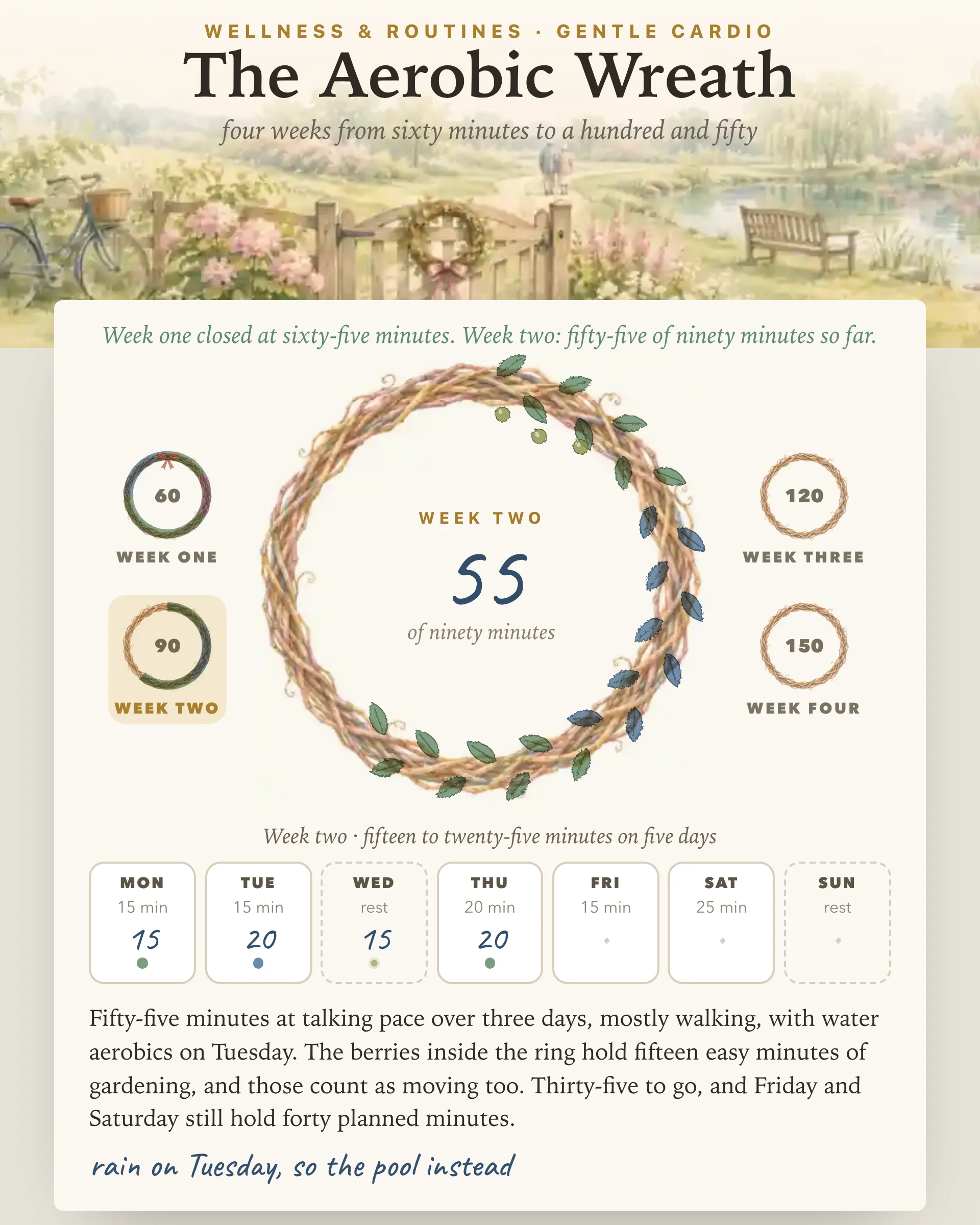
Aerobic exercise for seniors is any steady movement that warms you up and makes you breathe a little harder for a while: a brisk walk, a water aerobics class, a ride on a stationary bike, dancing in the kitchen, chair aerobics, raking leaves. This page turns a month of that movement into a wreath. Each session you log becomes a handful of leaves in its own color, and when the week reaches its aim, a bow ties the ring closed.
The Physical Activity Guidelines for Americans ask adults for at least 150 minutes a week of moderate aerobic activity, or 75 minutes of vigorous activity, or a mix of the two. For older adults they fold balance training and muscle strengthening into the same week. The report also notes that people who do the least gain the most from even a modest increase, and moving more while sitting less helps nearly everyone.
Moderate effort has a simple check. Partway through, try talking. If you can speak in full sentences but could not sing, you are at talking pace. If you could sing, the effort is light. If only a few words come out at a time, you are working hard. A review of the research found the talk test a valid and reliable way to gauge intensity, and it held steady across walking, cycling, stair stepping and other activities.
Few people go from very little activity to 150 minutes in one jump, so the plan climbs over a month:
Wednesday and Sunday are rest days on paper; if you feel like a stroll anyway, log it.
Tap the day, then what you did: walking, water aerobics, cycling, dancing, chair aerobics, gardening, or up to two activities of your own, such as pickleball or stairs. The minutes start at the plan's suggestion for that day and move in steps of five. Then answer the talk test.
Talking-pace minutes, and any harder ones, are woven onto the ring as leaves, clockwise from the top, so the colors show your week at a glance. Easy minutes, the ones you could have sung through, hang as berries just inside the ring. They do not move the ring toward its aim, but they are not wasted: light movement still beats sitting. The four small wreaths show each week's fill, and the reading underneath sums up your mix and what is left.
A day holds three sessions, and one session up to ninety minutes. Harder minutes count once each: the guidelines let a vigorous minute stand in for two moderate ones, but this ring keeps the arithmetic plain.
A meta-analysis of nine cohort studies that followed more than 120,000 people over 60 found that those who did even a low dose of moderate to vigorous activity, below the recommended amount, had a lower risk of dying during follow-up than those who did none, and more activity went with further benefit. These were observational studies. People who choose to move may differ in health and circumstances, so the figures show a link, not proof that the walking itself made the difference.
It also helps to know what aerobic exercise has not shown. A Cochrane review of twelve trials in healthy adults over 55 found no evidence that aerobic programs improved memory, attention or other thinking skills, even when those programs raised fitness. So the wreath makes no promise about a sharper mind or a longer life. What it offers is a steady habit of movement, the kind the guidelines connect with feeling, functioning and sleeping better.
If you have had a fall, dizziness, a joint replacement, a heart or blood pressure condition, or pain that has not settled, check with your doctor or a physical therapist before you start. Stop any session that hurts or leaves you lightheaded or tight in the chest. For anything done standing in place, like marching or dancing, keep a sturdy chair or the kitchen counter within reach. Open and close each session with a couple of easy minutes, and drink water on warm days.
Most of the wreath can come from walking, and the walking ribbon lays out walks that lengthen week by week. On days when standing for long is hard, The Chair Circuit adds seated strength moves, which the guidelines ask older adults to do on top of their cardio. When rain keeps you in, a slow indoor walk borrowed from tai chi makes fine easy minutes.
Open the sheet right after you move, while the talk test is still fresh, and check the day ribbon each morning. If a week does not close, start the next one anyway. An unfinished ring still holds every minute you put into it.
Any steady movement that keeps you breathing a little harder for several minutes at a stretch. Good cardio exercises for seniors include brisk walking, water aerobics, cycling, dancing, chair aerobics and energetic yard work such as raking leaves. The effort matters more than the setting.
The US Physical Activity Guidelines suggest at least 150 minutes of moderate effort a week, or 75 minutes of vigorous effort, along with balance and muscle work. They also note that people who move least gain the most from a small increase, so building up from a lower start is sensible.
Water aerobics, a stationary bike, brisk walking on level ground, seated aerobics and dancing with a chair close by all raise your breathing without jumping or pounding. Choose the one you would look forward to, because that is the one you will keep repeating.
Try the talk test partway through. At a moderate pace you can speak in full sentences but could not sing. If singing would be easy, the effort is light; if only a few words come out at a time, slow down a little. Research finds it tracks effort well across walking, cycling and similar activities.
Yes. The page shows a sample wreath partway through week two. Your own copy costs nothing to personalize, and it keeps every session you weave in, up to two activities of your own and a short line for each week.
By the team behind Fabulous, the science-based self-care app used by over 30 million people.


