
The Overwhelm Recovery ProtocolWellness & Routines · ~5 min
About this template · Updated November 2026
Barre classes trace back to Lotte Berk, a German-born dancer who opened a basement exercise studio in London in 1959 and built her routines around the ballet barre. This page is an independent practice sheet in that tradition. No studio, teacher or estate connected with her name has seen it, approved it or endorsed it.
Chair barre keeps the barre and swaps the studio for your kitchen. The back of a heavy chair becomes the rail you hold, and the moves stay small: soft knee bends, rises onto the balls of your feet, leg lifts a few inches off the floor, slow sweeps of the arms. Nothing goes down to the floor, and at least one hand stays on the chair for every move.
A quick word with a doctor or physical therapist comes first if you have had a fall, dizziness, a joint replacement, a heart or blood pressure condition, or ongoing pain. Stop any move that hurts, and if the chair shifts at all when you lean on it, move to a kitchen counter instead.
A studio barre sits around hip height and takes a light touch, never your full weight. A good chair does the same job if it is heavy, has no wheels, does not fold, and its back reaches between your hip and waist. Stand it on a floor or rug that grips, with room to lift a leg to the side and behind. Socks slide on wood, so bare feet or soft shoes are the safer choice.
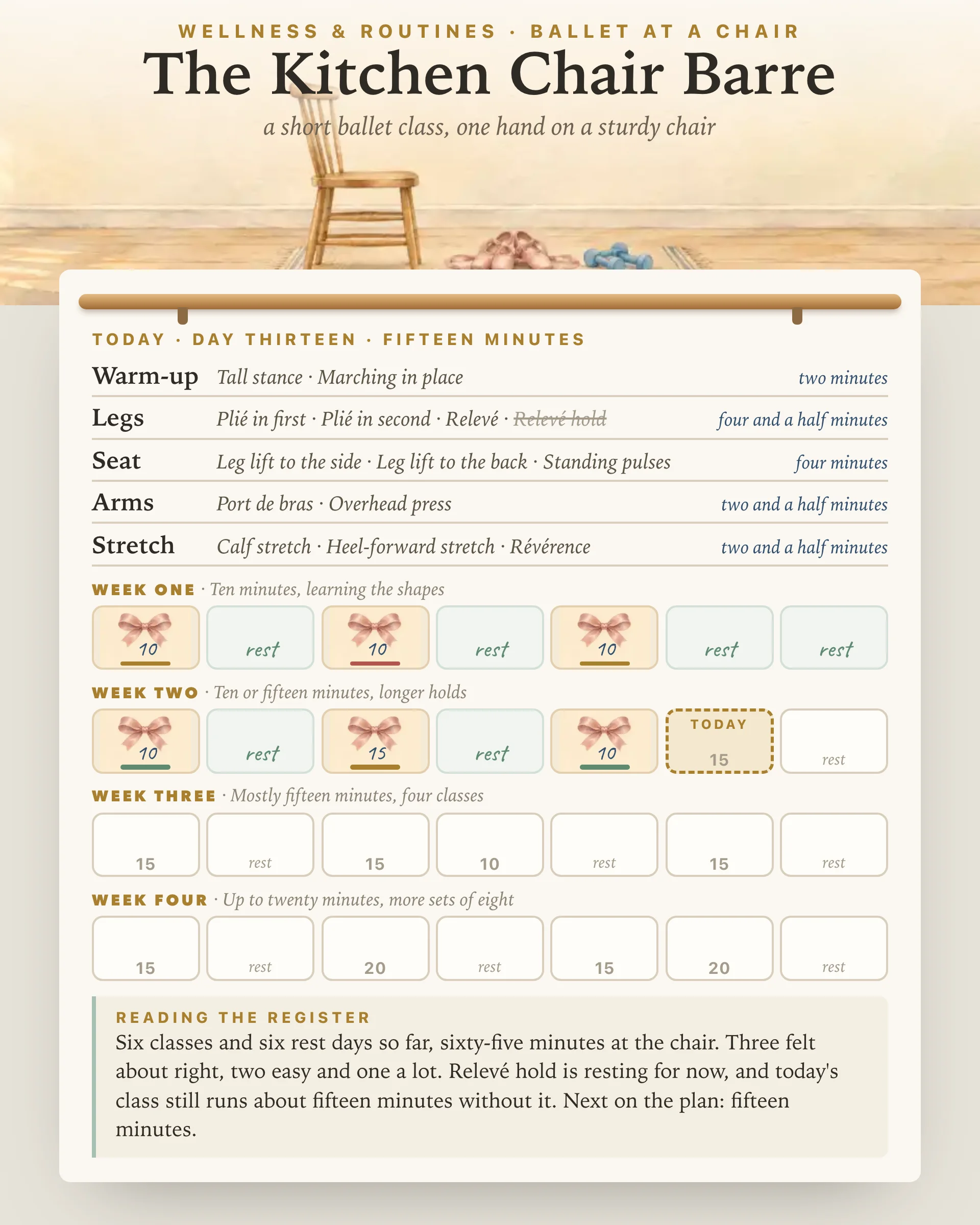
Choose ten, fifteen or twenty minutes and the page lays out a five-part class along the barre. The warm-up is tall breathing and marching in place. Legs bring pliés in first and second position, then relevés. The seat part has leg lifts to the side and back, then small standing pulses. Arms get port de bras, the slow carriage of the arms, and an overhead press. The stretch ends with a révérence, the small bow that closes a ballet class.
Each part owns a share of the minutes, and the builder turns that share into sets of eight and timed holds. Longer classes bring more sets and longer holds, from ten seconds up to twenty. Tap leave out beside a move you want to skip today, and the other moves in that part take up its time, as far as a sensible number of sets allows. The total under the list always says how long the class now runs.
Press begin and you get five seconds to find your place before each move. Then eight dots light up one count at a time, with the action written under them (bend, straighten, rise, lower), and holds count down in seconds. The page makes no sound, so prop it where you can see it. When you finish, or mark a class done without the counts, a satin bow goes on that day of the four-week register.
The plan holds fifteen classes and thirteen rest days:
The register has no dates. It moves when you do, so a missed Tuesday simply waits. The reading underneath adds up your classes and minutes, suggests staying with ten minutes when two of your last three felt like a lot, and offers a longer class after three easy ones in a row.
Barre itself has barely been studied. The one controlled study we found, a 2023 study of barre fitness, followed thirty-five women in their twenties and early thirties who already exercised. Women in the barre group improved on most measures of body shape and fitness, while the changes in a comparison group doing dance fitness were too small to count as significant. A study that small, in young women, says little about someone in their sixties at a kitchen chair.
For older adults, the firmest evidence concerns balance. A Cochrane review of exercise for preventing falls, which pooled more than a hundred trials in people living at home, found that programs built mainly on balance and functional exercises lowered the rate of falls by about a quarter. The same review was uncertain about dance programs, and barre was not among the exercise types it compared. So this page promises nothing about falls, posture or body shape.
What a short barre class can offer is regular, repeatable practice at standing strength work, and the World Health Organization's 2020 guidelines recommend muscle-strengthening activity for every age group. Treat it as a pleasant habit to build on rather than a treatment for anything.
Morning suits many people, as does the stiff hour after a long sit. If standing work is not for you yet, The Chair Pilates Abacus keeps you seated for slow core moves. Once the chair starts to feel like a formality, The 28-Day Wall Pilates Challenge trades it for a wall, and The Balance Ladder works on steadier single-leg holds at a counter.
It is a barre class with the back of a sturdy chair standing in for the ballet rail. You hold on for balance while you do small ballet-based moves: knee bends called pliés, rises onto the balls of the feet, leg lifts to the side and behind, slow arm sweeps and a few stretches, most of them counted in sets of eight.
It can be a gentle way in, because every move on this page keeps at least one hand on the chair and none goes down to the floor. Studies of barre itself are scarce, though. The one controlled study we found was small and enrolled women in their twenties and early thirties. Anyone who has had a fall, dizziness, a joint replacement, a heart or blood pressure condition, or ongoing pain should check with a doctor or physical therapist first.
This plan opens with three ten-minute classes in the first week and builds to two twenty-minute classes in the last, with rest days between them, for fifteen classes over twenty-eight days. A shorter class is fine on any day, and the register keeps the minutes you actually did.
No. The arm moves work with empty hands and long fingers. For a little more effort, hold a light weight, or a can of soup, in the free hand while the other hand stays on the chair.
No. Barre exercise grew out of the London studio the dancer Lotte Berk opened in 1959, and many teachers have reshaped it since. This page is an independent practice sheet, and no studio, teacher or estate tied to her name made it, reviewed it or endorsed it.
By the team behind Fabulous, the science-based self-care app used by over 30 million people.


