
The Overwhelm Recovery ProtocolWellness & Routines · ~5 min
About this template · Updated November 2026
Every move on this page traces back to Joseph Pilates, the German-born trainer who called his system Contrology, and Penelope Latey's history of the method and its philosophy tells where it came from. This sheet is an independent practice tool. No studio, teaching body or estate connected to his name has reviewed it or endorsed it.
Chair pilates takes the slow, breath-led core work of the mat and moves it onto a sturdy seat. You stay off the floor and off your feet, which makes it a reasonable place to begin if getting down to a mat is a problem, or if you came looking for chair pilates for seniors and want a routine you can follow without a class.
Before your first sitting, talk to a doctor or physical therapist if you have had a fall, dizziness, a joint replacement, a heart or blood pressure condition, osteoporosis, or pain. Stop whenever something hurts. Keep a counter or table close by to steady yourself when you get up at the end.
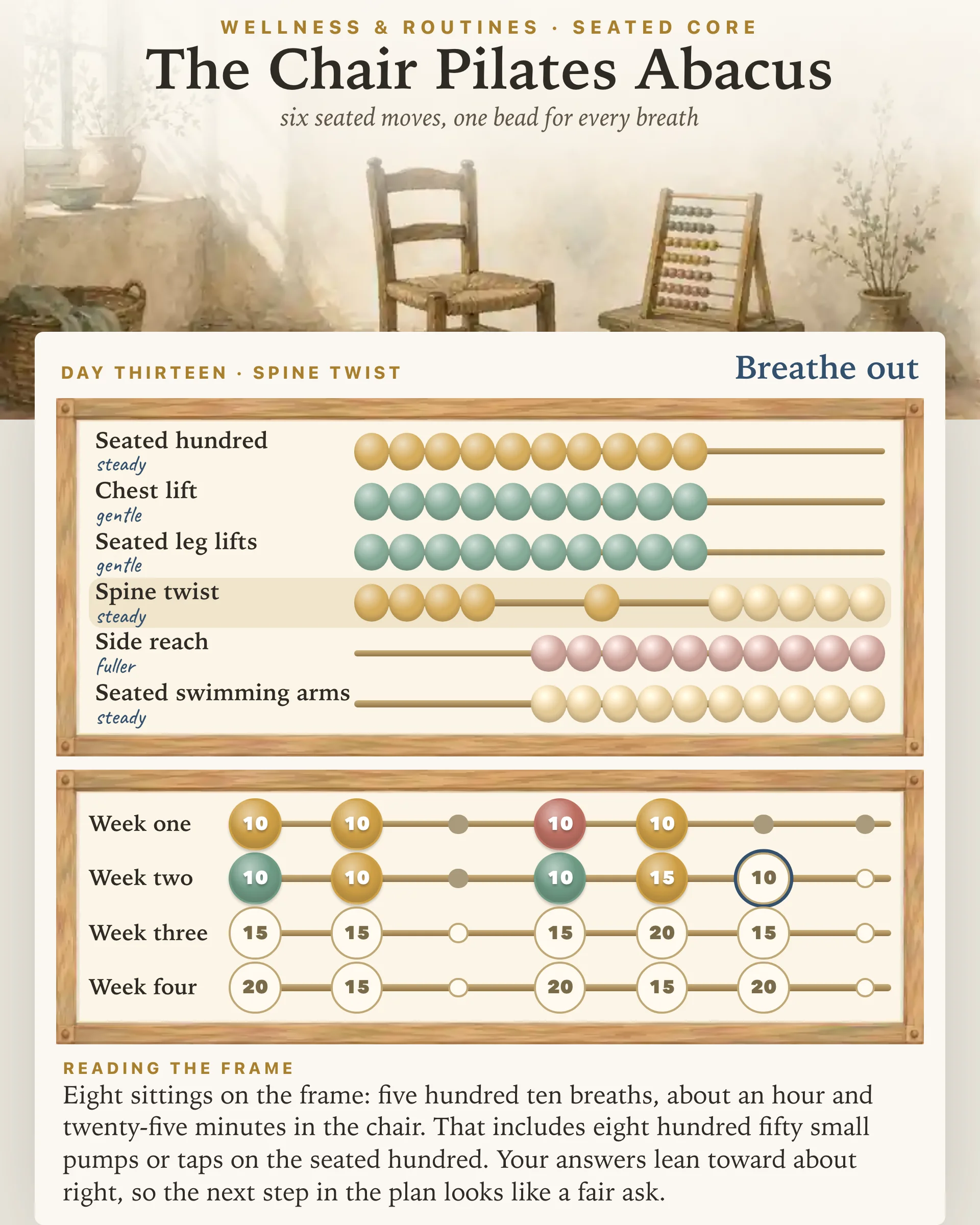
The opening exercise is called the hundred because it counts a hundred small arm pumps: five as you breathe in, five as you breathe out, ten breaths in all. Ten breaths is ten beads on a rod, and that is how this page became a counting frame. Holding your back long is hard enough, so the frame keeps the count.
Today's frame has six rods, one per move: seated hundred, chest lift, seated leg lifts, spine twist, side reach and seated swimming arms. Choose ten, fifteen or twenty minutes, and each rod carries that many beads.
Press begin and you get a moment to read the first move and settle into it. Then a bead swells for four counts while you breathe in, and slides along the rod for four counts while you breathe out. The page stays silent, so set it where you can glance at it.
Tap any rod to read its directions and choose a version. Gentle is where all six start, and the one to stay with until it feels easy. Steady and fuller ask more, and the beads change color with the version. Leave out takes a rod off the frame, and the day runs a little shorter. Changing a version later leaves counted beads and recorded days as they were, because they describe what you did at the time.
When you finish, say whether it felt easy, about right or too much, and that answer colors the day's bead on the four-week frame.
The plan holds nineteen sittings and nine rest days:
The plan advances when you do, with no dates attached. Miss a Tuesday and the same bead is still waiting, with nothing to make up.
A note under the frame adds up your sittings, breaths and minutes, then reflects your answers back. If two of your last three felt like too much, it points you toward the shorter count, the gentle versions, and your doctor or physical therapist if an ache stays. If they lean easy, it names a rod that could go up a version. It never scores you.
A review of chair-based exercise in adults over fifty covered twenty-five studies with nearly fourteen hundred people, and its pooled results showed better grip strength, arm curls and chair stands. Those programs were chair exercise in general, though, and not Pilates.
For Pilates itself, a review of six trials in older adults found better balance than in groups who stayed inactive. Its authors also warned that high-quality studies were lacking, that the effects may be overestimated, and that data on falls were limited. We could not find a trial of a seated Pilates routine like this one, so this page makes no promise about strength, posture or falls.
If you have osteoporosis or a past spine fracture, take special care with three rods. A fracture-prevention leaflet by physical therapist Sherri Betz advises avoiding forward bending, rapid twisting, side bending and curl-ups. The chest lift, spine twist and side reach come close to those shapes, so leave them out until a physical therapist who knows your bones has looked at your routine.
Pick a solid chair without wheels, ideally without arms, where both feet reach the floor. Sit toward the front of the seat so your back holds itself up. Breathe into the sides of your ribs, and never hold your breath. If you feel lightheaded, stop the count and breathe normally until it passes.
Morning suits many people, and so does the stiff hour after long sitting. To loosen up afterward, try The Daily Stretch Mat, and Belly Breathing slows the breath further on days when that is all you want. When the fuller versions feel easy and a physical therapist agrees you are ready, The 28-Day Wall Pilates Challenge gets you on your feet with a wall for support.
When you feel ready for the floor, The Beginner's Pilates Mat teaches the classic moves on a mat, and The Chair Circuit adds legs and arms from the same seat.
It is Pilates-style core work done on a sturdy seat instead of a mat: slow, small movements timed to your breath, with your back long and your belly drawn in. The six moves here are chair versions of mat exercises, including the hundred, named for its count of one hundred small arm pumps.
It can be a comfortable place for older adults to start, because nothing here needs the floor or standing balance. Research on chair-based exercise in people over fifty found better arm and leg function, but those programs were not Pilates, and we found no trial of a seated Pilates routine like this one. So treat it as a practice to try with care, and talk to a doctor or physical therapist first if you have had a fall, dizziness, a joint replacement, a heart or blood pressure condition, osteoporosis, or pain.
This plan opens with ten minutes on four days of the first week and reaches twenty minutes on some days of the last two weeks, with nine rest days across the month. Any day can drop back to the ten-minute count. No study has settled on one right amount for a seated routine, so read the plan as a sensible ramp and not a proven formula.
Ask your doctor or a physical therapist who knows your bones before you start. One fracture-prevention leaflet advises avoiding forward bending, rapid twisting, side bending and curl-ups, and the chest lift, spine twist and side reach come close to those shapes. This sheet lets you take any of those three rods off the frame.
No. It is an independent practice sheet. Joseph Pilates developed the original method, and no studio, teaching body or estate connected to his name made, reviewed or endorsed this page.
By the team behind Fabulous, the science-based self-care app used by over 30 million people.


