
The Overwhelm Recovery ProtocolWellness & Routines · ~5 min
About this template · Updated November 2026
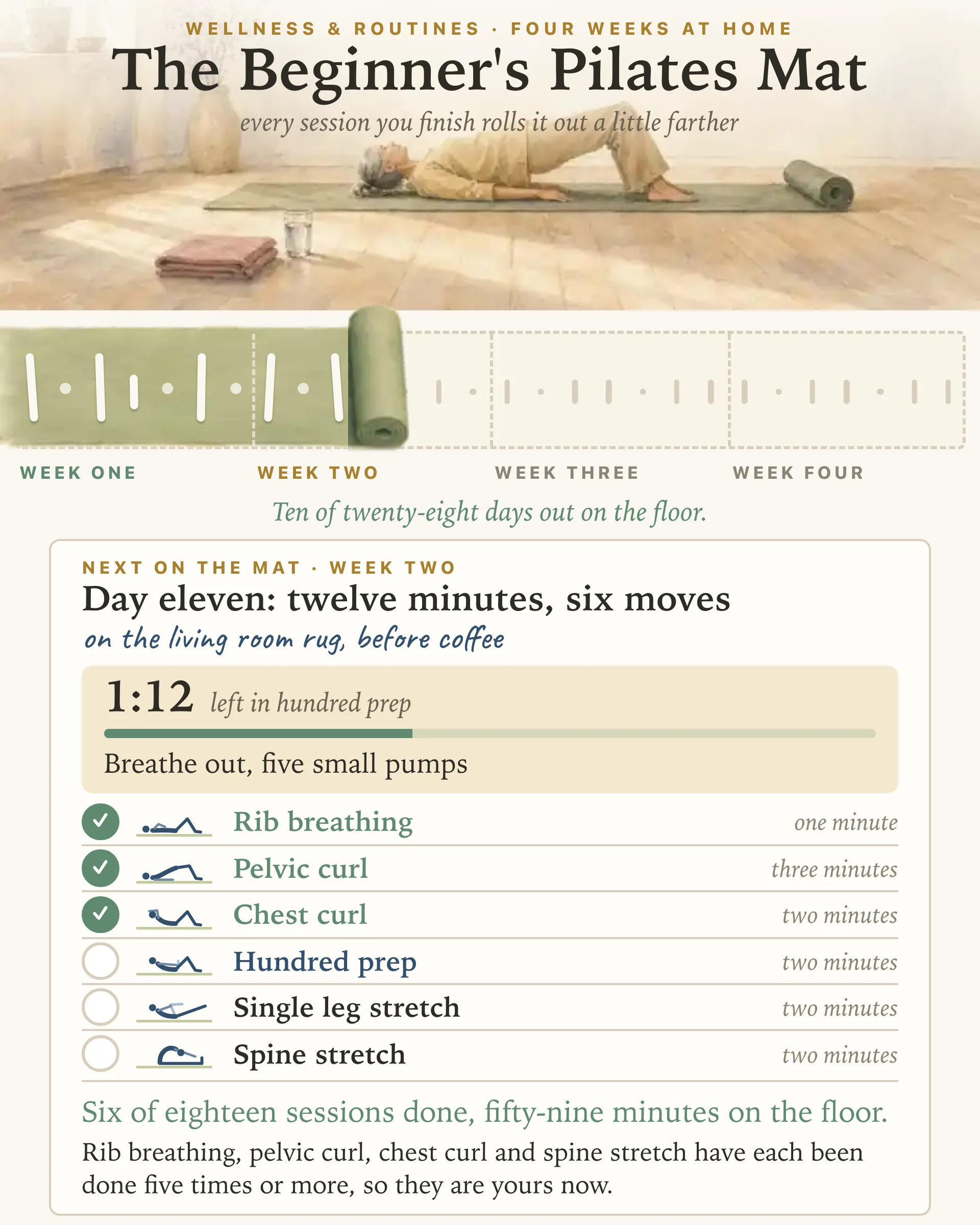
Credit first. The mat work you are about to try began with Joseph Pilates, a German-born trainer who called his system Contrology and taught it in New York with his wife, Clara. Penelope Latey's paper on the method's history and philosophy tells that story. This page is an independent plan built from long-familiar moves. No studio, teacher-training school or certifying body wrote it or signed off on it.
Pilates for beginners has a reputation problem. Most people meet it through a fast class where everyone else already knows what "the hundred" means. At home, on your own floor, you can go at a pace that lets you learn what each move is asking of you. Slow control is the point of the method, so going slowly costs you nothing.
The plan builds in the order your body can make sense of it.
That comes to eighteen sessions and a little over four hours in all. Rest days sit between them, since muscles new to this work appreciate a gap.
Under the painting, an exercise mat sits rolled up at the edge of a dotted outline. Each time you finish a session it rolls out farther, leaving a stitch for that day, and the roll itself gets thinner. It counts sessions in order, not dates on a calendar, so skipping Tuesday simply means Tuesday's session is still waiting on Wednesday.
Each session is a checklist. Open any move for two small drawings, where you begin and where you go, and a plain description. If it feels like too much, switch that move to its gentler version and the page keeps that choice until you change it. Stopping short is allowed as well: roll out whatever you did, and only those minutes are counted.
The clock is optional and silent. Press start and it gives each move its share of the session, with a breathing cue that changes as you go and the matching drawing lit up, then checks the move off when its time ends. Rest whenever you like, since the minutes include room for it.
The plan section keeps its own quiet score. Every drawing starts pale and darkens each time you do that move, and after five rounds the sheet writes "yours" beneath it. Nothing here grades your form, only which moves have become familiar.
A 2011 review pulled together sixteen trials of Pilates in healthy people and found strong evidence for better flexibility and dynamic balance by the end of training, with moderate evidence for muscular endurance. The authors also rated the rigor of those studies as low. For back pain, a Cochrane team looked at ten trials with 510 participants. Their low to moderate quality evidence favored Pilates over doing very little, while the comparison with other exercise gave no clear winner on disability, and mixed results on pain.
Read those findings modestly: they come mostly from longer, supervised programs, not four weeks alone on a living room floor. Nothing here promises a flatter stomach, weight loss or a pain cure. A fair hope is that by the last week the moves feel more familiar and you know which ones suit you.
Talk with a doctor or physical therapist first if you have a back, hip or joint problem, dizziness, a heart or blood pressure condition, or if you are pregnant or recently gave birth. Bone loss deserves a specific question: the Bone Health and Osteoporosis Foundation warns that exercises that bend you forward can raise the chance of breaking a bone in the spine. Chest curl, hundred prep, single leg stretch and spine stretch all round you forward, so ask which ones to keep or swap.
Muscles that tire or shake a little near the end of a minute are normal. Sharp pain, numbness or pain that lingers into the next day means stop and get it looked at. If getting down to the floor is hard, keep a sturdy chair beside the mat and use its seat on the way down and back up.
Use it when you want to find out whether pilates suits you, without a class or any equipment beyond a mat or a thick blanket. Once the whole mat is out, keep week four as a regular session or go through the plan again with fewer gentler versions.
If getting down to the floor stays uncomfortable, The 28-Day Wall Pilates Challenge does similar work with a wall taking some of your weight. For the days you want less, The Daily Stretch Mat is a short stretching routine, and The 30-Day Plank Challenge picks up where chest curls leave off if your middle wants more.
If getting down to the floor is hard today, The Chair Pilates Abacus works your middle from a seat instead.
Pick a patch of floor and begin on your back with slow breathing, pelvic curls and small head and shoulder curls. Ten minutes is enough for a first session. Hold off on harder moves until those feel familiar, which is why this plan adds new ones week by week.
No single routine has been shown to beat the rest, so look for one you will repeat, built from moves you can do with control. This one starts with four moves on the floor, each with a gentler version, and grows to eight over four weeks and eighteen minutes.
They are different more than easier or harder. A reformer is a sliding carriage with springs that can assist or resist you, while mat work uses only your body weight against the floor. Mat work needs no machine or studio, so it is the usual way to try pilates at home.
This plan asks for four sessions a week at first and five by week three, with rest days in between. Sessions run ten to eighteen minutes. If a week feels like too much, repeat it. The mat only moves when you finish a session, so a missed day costs nothing.
No. Nobody at a pilates studio, teacher-training school or certifying body wrote or reviewed this plan. It uses long-familiar mat moves named for the method Joseph Pilates developed, and it cannot watch your form the way an in-person teacher can.
By the team behind Fabulous, the science-based self-care app used by over 30 million people.


