
The Overwhelm Recovery ProtocolWellness & Routines · ~5 min
About this template · Updated September 2026
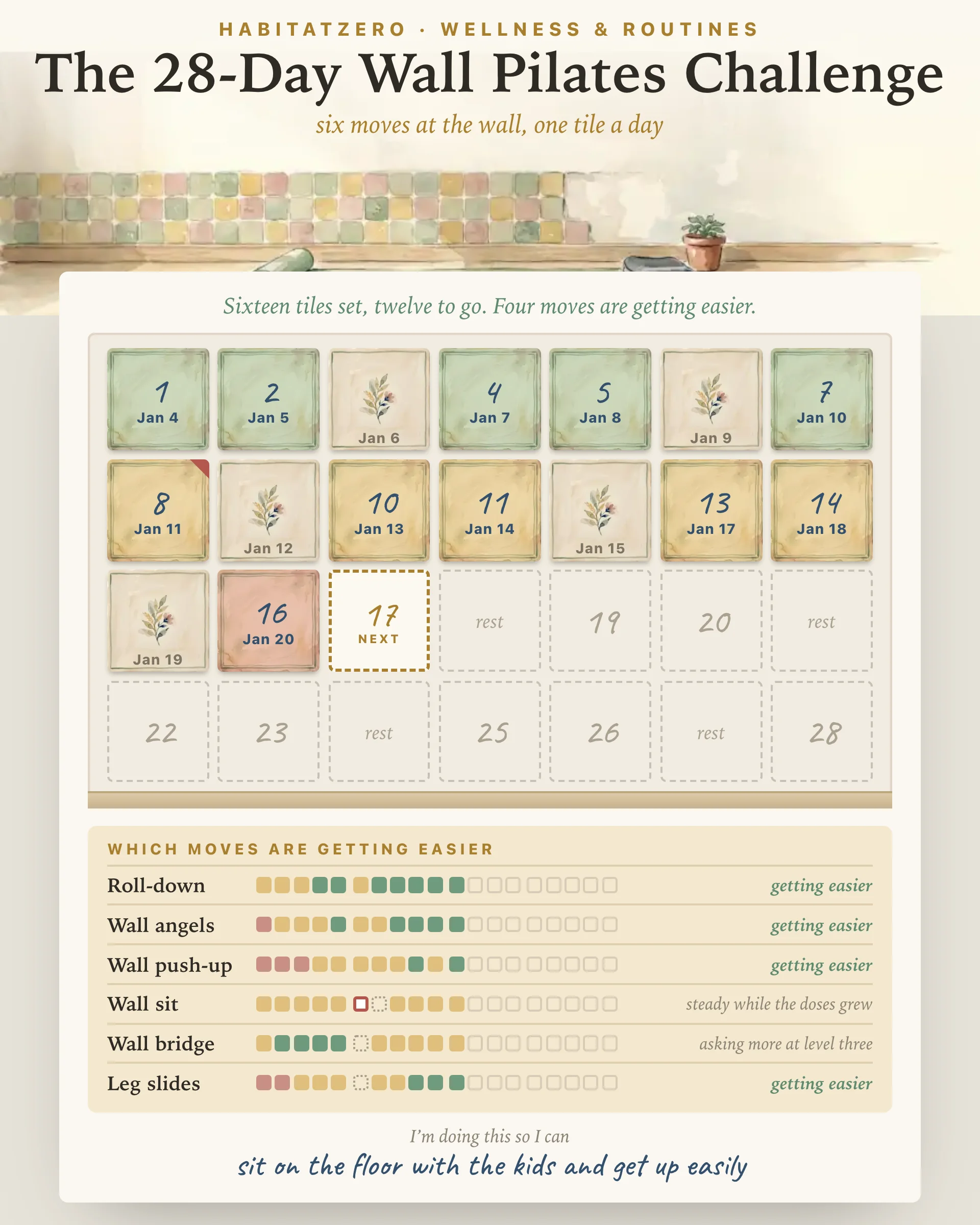
Credit first. Pilates is a method with a person behind it. Joseph Pilates, a German-born trainer, began shaping the mat exercises he called Contrology while he was interned in Britain during World War I, and from the mid-1920s he taught them in New York with his wife, Clara. Penelope Latey's history of the method and its philosophy is a good place to read that story. Wall pilates is a much newer label for Pilates-style moves done with a wall for support. This chart is an independent practice page: no Pilates studio, teacher-training body or wall pilates program made it, and none of them has reviewed or endorsed it.
The wall does two jobs. It takes some of your weight, so a push-up or a squat hold asks less than it would in open space, and it gives you a line to check against, so you can feel whether your head, back and hips sit where the cue says. That makes it a gentle way into strength and control work.
Every session is one slow round of the same six moves. Three are standing: the roll-down, where you peel your back off the wall and stack it back; wall angels, which slide your arms up and down the wall; and the wall push-up. The wall sit comes next, and the last two happen on the floor with your feet on the wall: the wall bridge and leg slides. A round takes about ten minutes, or longer if you rest between moves, which is always allowed.
The wall on the page has twenty-eight tiles in four rows of seven. Each row is a week and a level, and each level asks a little more: the wall sit grows from twenty seconds to fifty, and the push-ups from six to twelve. Every third tile is a rest day, which gives the month nineteen sessions and nine rest days. Rest days get a tile too, painted with a small sprig, because recovery is part of the plan.
After each move, tap how it felt: hard, okay or easy. Once all six have a mark, set the day's tile and it keeps the date. The chart counts days in order, not squares on a calendar, so a missed Tuesday costs nothing; the dates on the tiles just show where the gaps fell.
If a move hurts, tap it hurt, stop. The session ends there, the tile goes up with a small red corner, and that move sits out of your sessions until you choose to bring it back. A muscle that shakes or burns near the end of a set is working. Sharp pain, pinching in a joint, or pain that spreads or lingers into the next day is your signal to stop and talk with a doctor or physical therapist. If you set a tile by mistake, two taps take it back.
The part a printed chart cannot do starts after four sessions. For each move, the page compares how your first two sessions felt with how your latest two felt, and names the moves that are getting easier. Because the doses climb every week, a move that stays at okay while the hold gets longer is progress too, and the chart says so: steady while the doses grew.
Mat Pilates has real trials behind it. In one, fifty active middle-aged adults were split in two, and the half who took twelve weeks of twice-weekly mat classes gained abdominal endurance, hamstring flexibility and upper-body endurance over the half who did not, though their posture and balance did not change. For low back pain, a Cochrane review of ten trials found low to moderate quality evidence that Pilates eases pain and disability more than minimal treatment does, and no clear sign that it beats other kinds of exercise.
Wall pilates as a trend has very little research of its own. The moves here are familiar from Pilates classes and physical therapy clinics, so expect something modest: four weeks of short sessions can make these particular moves steadier and easier, which is what the chart is built to show. Nothing on this page promises weight loss, and ten gentle minutes a day are unlikely to move the scale much on their own.
If you are pregnant, the American College of Obstetricians and Gynecologists counts modified Pilates among the safer ways to exercise, and it advises against poses that keep you still or on your back for long periods. That bears directly on the wall bridge and the leg slides, so ask your clinician before you start. Do the same if you recently had a baby or live with a back, hip, knee, wrist or shoulder condition; they can tell you which of the six to keep and which to swap.
The chart suits the first week of January, or any Monday. You need a stretch of bare wall, a mat or rug, and ten minutes. On rest days a short walk is a good use of the time, and the Walking Challenge can keep track of those. When all twenty-eight tiles are set, carry the moves you liked into a longer plan with the 12-Week Fitness Planner, or log each session in a Workout Journal.
It is four weeks of short Pilates-style moves done with a wall for support, some standing with your back or hands on the wall and some on the floor with your feet up against it. This one uses six moves, raises the dose once a week, and rests every third day.
Mat Pilates has trial evidence for abdominal endurance, flexibility and low back pain, though a Cochrane review found it no better than other exercise for back pain. Wall pilates itself has almost no research of its own, so expect what steady practice gives: moves that feel stronger and more controlled, not a transformation.
Nothing on this page promises weight loss. Ten gentle minutes a day use modest energy, and changes on the scale come mostly from food and overall activity. What the chart can show you is which moves have become easier over the month.
Often, yes. The wall carries some of your weight and gives you a line to check your posture against. Start at level one, stop any move that hurts, and if you are pregnant or live with a back or joint condition, ask a clinician before day one.
Yes. The page shows a filled-in wall you can explore as an example. To set your own tiles and have your marks waiting at every session, personalize it in HabitatZero at no cost.
By the team behind Fabulous, the science-based self-care app used by over 30 million people.


