
The Overwhelm Recovery ProtocolWellness & Routines · ~5 min
About this template · Updated September 2026
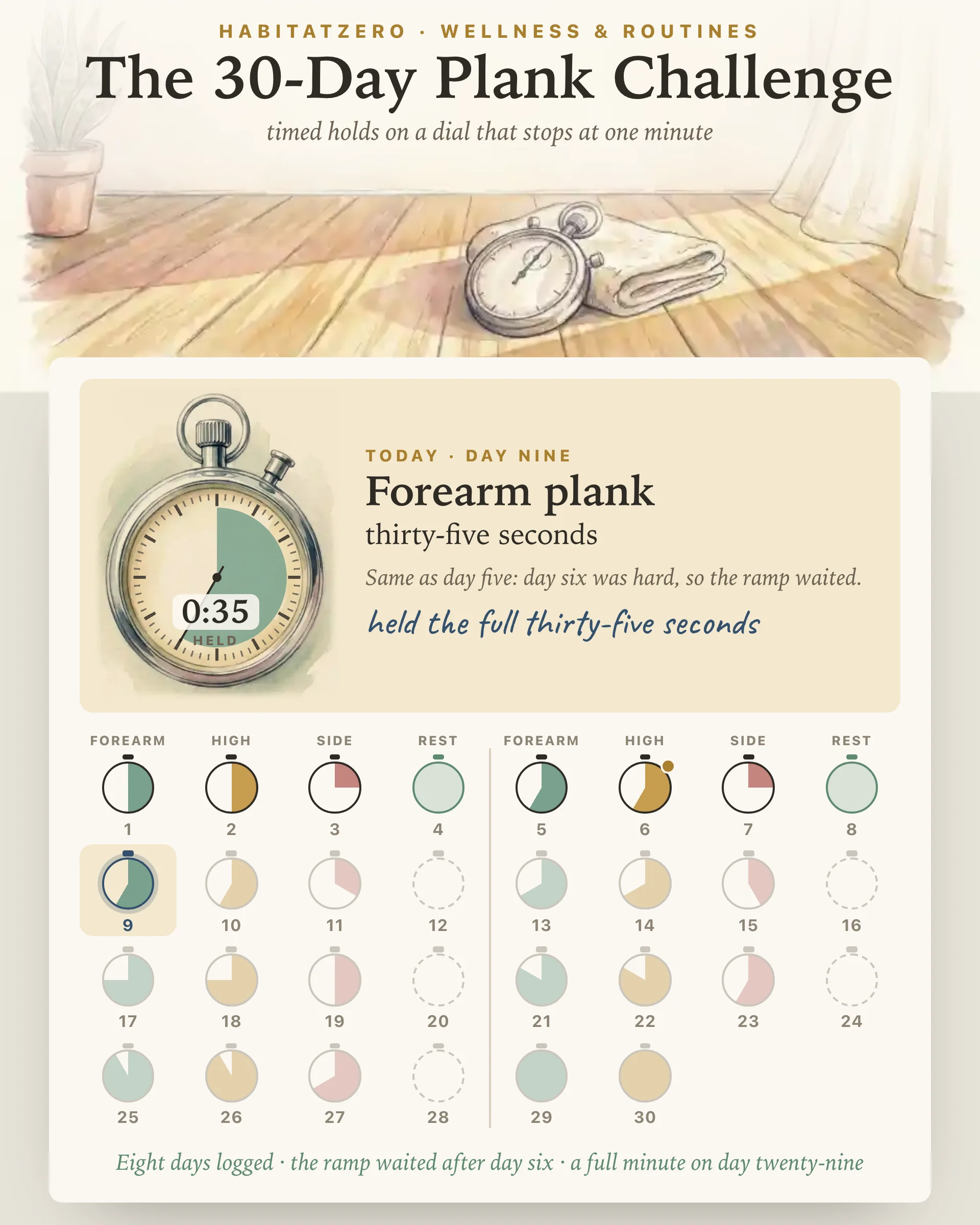
A plank asks one thing of you: hold a long, straight line and keep holding it. A 30 day plank challenge turns that into a month of short daily holds that grow a little at a time. The chart passed around online starts at twenty seconds on day one and ends with a five-minute plank on day thirty. This page keeps the slow climb and adds a ceiling: no front plank runs past one sweep of the stopwatch, a minute, and no side plank past forty-five seconds a side.
Five minutes is a strange finish line. In a study of 471 college students who held a forearm plank until they tired out or their form failed, the men averaged a little over two minutes and the women just under a minute and a half. The viral chart's last day asks for more than twice what those young adults managed on average.
Length also costs you form. In a small lab study of eleven teenage basketball players, a plank of only one minute was enough for their upper backs to round measurably more in the final ten seconds than in the first ten, while the long abdominal muscle down the front showed clear fatigue. Stretch a hold to five minutes and most of it happens in that tired, rounded stretch, a shape not worth rehearsing daily.
So the ramp climbs to the cap and stops there. After that, the work is a better minute: a firmer squeeze, a slower breath, a straighter line.
First you pick where you are starting: new to planks, about thirty seconds, or about a minute. Take the one just under your best. The month then moves in rounds of four days, a forearm plank, a high plank, a side plank on each side, then a rest, and every round adds five seconds to each kind of plank until it meets its cap.
The painted stopwatch keeps time so your eyes can stay on the floor. Press start, take ten seconds to get down, and the hand sweeps while a colored wedge fills behind it. It stops on its own at today's target, without a sound. If your form goes early, stop it yourself and the page keeps the seconds you did hold. In the final ten seconds, a few words you chose for that moment appear on the dial.
Below the watch, thirty small dials hold the month. Each wedge shows how long that day asks for, and a full dial is the cap.
When the hold is over, tell the page how it went: easy, steady, hard, or it hurt. Easy and steady keep the ramp moving. Each hard day holds the ramp back by one round, so your next forearm, high and side holds repeat their last times, and a second hard day takes them back a step. If it hurt, the next day turns into rest.
Trusting how a hold felt is not guesswork. When fifteen healthy, moderately active people held a plank to failure and rated their effort every five seconds, those ratings closely followed the fatigue measured in their front abdominal muscle. A day that felt hard is a fair reading of what your middle went through.
You can also say what gave out first: your hips sagged or piked up, or your shoulders, wrists or breath gave way. The page names the slip that keeps coming back and pairs it with a cue for it.
Breathe the whole way through. If you catch yourself holding your breath, count slow breaths instead of seconds.
Planks build the staying power of the muscles that keep your trunk steady. They will not burn fat off your stomach in particular, and this page makes no promise about how your body will look after thirty days. Measure the month by the holds themselves: a calmer minute near the end than the shaky twenty seconds you started with.
Stop the clock if your back or a shoulder hurts, and log the day that way. If you have a back condition, are pregnant, or had abdominal surgery recently, talk with a clinician before day one.
Any week works, though a new month or year gives the thirty days a clean edge, and most days take only a couple of minutes. For a broader month of small tasks, The 30-Day Challenge deals out a different one for every day. To see all your movement on one grid, keep a Workout Calendar, and when a session deserves more than a dial, the Workout Journal keeps the details in your own hand.
It is a month of short daily plank holds that grow a little at a time. This one rotates forearm, high and side planks with a rest day after each set of three, and adds five seconds to each kind of plank every four days until it meets its cap.
Form is what slips first as a hold drags on, and minutes spent sagging train the sag. Front planks stop at one sweep of the dial, a minute, and side planks at forty-five seconds a side. After that, the goal is a steadier hold rather than a longer one.
Yes. The new to planks start asks for twenty seconds on your forearms and ten seconds on each side, every plank has an easier version on your knees or with your hands on a chair, and a hard day pauses the climb instead of pushing on.
Planks build the staying power of the muscles around your trunk. They do not burn fat from one spot, so this page makes no promise about how your body will look. Judge the month by your holds, not the mirror.
The filled example on this page shows how the month looks once it is under way. To run the silent stopwatch, keep your own thirty days and let the ramp respond to them, open it in HabitatZero, which is free.
By the team behind Fabulous, the science-based self-care app used by over 30 million people.


