
The Overwhelm Recovery ProtocolWellness & Routines · ~5 min
About this template · Updated November 2026
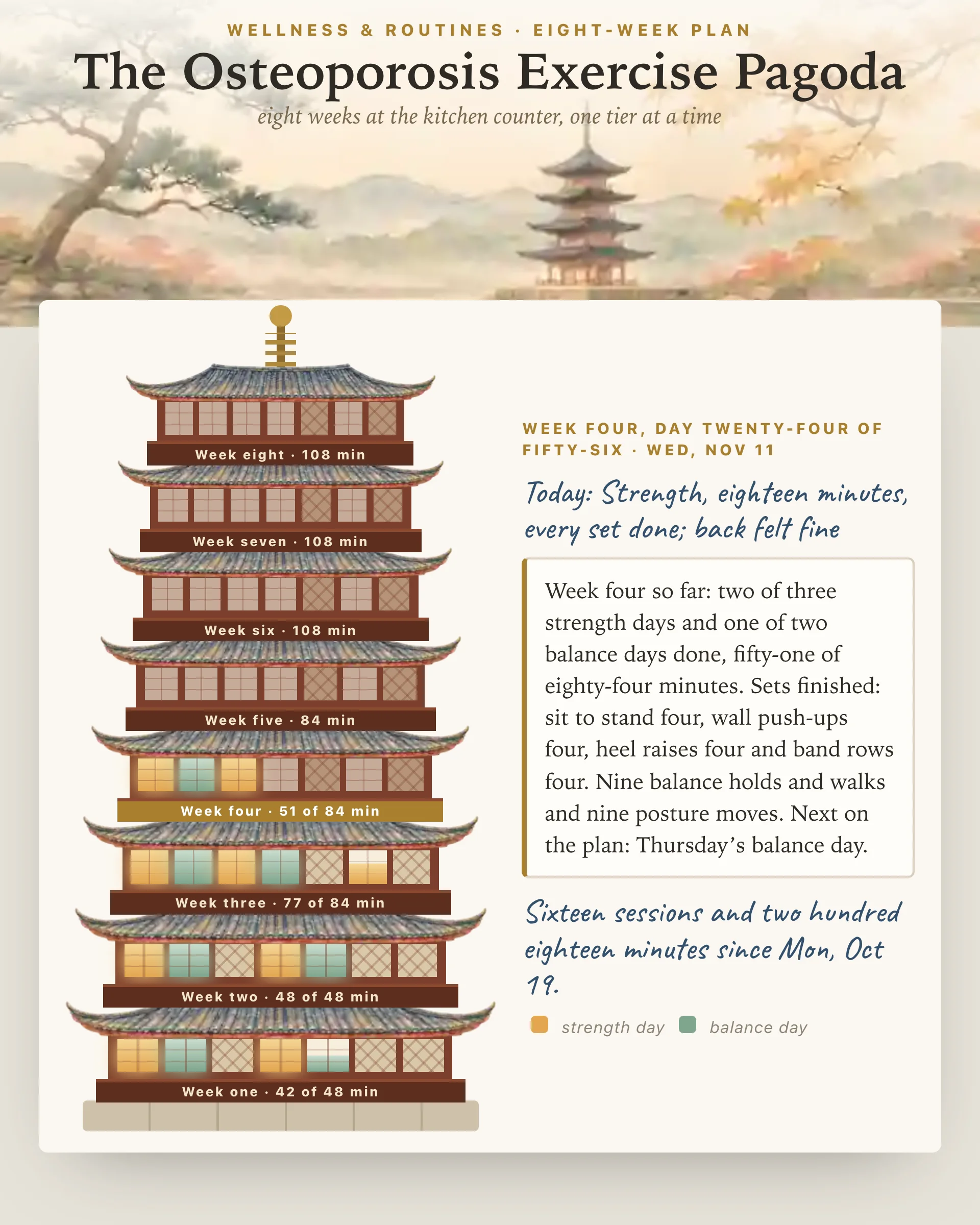
A bone density scan that shows osteoporosis or osteopenia often brings a muddle of advice about moving: do more, be careful, never bend. This page turns the published expert consensus into eight weeks you can follow at your kitchen counter. Strength moves, balance holds and posture work each have their place, a clock keeps the pace, and every week becomes one tier of a pagoda whose windows light up as you finish your sessions.
Show the plan to your doctor or a physical therapist first, above all if you have broken a bone, especially in your spine, if you have back pain, or if your upper back has started to round forward. Ask as well if you have had a fall, dizziness, a joint replacement, or a heart or blood pressure condition. Stop any move that hurts, and call your doctor the same day about sudden, sharp back pain. Exercise belongs alongside any medicine you are prescribed, never in place of it.
In 2022, physiotherapists, rheumatologists, researchers and patient representatives published a UK consensus statement on exercise for osteoporosis. For strength, it recommends muscle-strengthening work on two or three days a week, at an effort you could repeat eight to twelve times, building up to three sets once your technique is sound. For steadiness, it asks for balance and strength work at least twice a week. For posture, it suggests exercises for the back muscles, repeated three to five times and held for three to five seconds.
An international panel reached similar ground in a 2014 consensus on exercise for osteoporosis and spine fractures: a program mixing resistance and balance training rather than aerobic exercise alone, about two hours of balance training a week, and slow, controlled movement.
The UK statement also covers impact exercise such as stamping or brief jogging. It suggests moderate impact on most days for people without spine fractures, and nothing harder than a brisk walk for people who have had them. This page leaves impact out, so ask your physical therapist which level suits you.
Strength days and balance days alternate, and posture moves close every session. Weeks one and two hold two of each, twelve minutes apiece. From week three, a third strength day joins, with two sets of every move, and balance days grow to nine pieces. From week six, three sets and two full balance rounds take sessions up to twenty-four minutes.
Press begin and the clock leads you: eight slow reps of sit to stand, push-ups against the wall, heel raises and a band row, then minute-long holds and short walks at the counter, from feet together to a one-leg stand, holding on as much as you need. The clock keeps real time if your phone locks, a pause stops it, and you can skip any part your therapist has ruled out. Only finished work counts, never skipped seconds. Afterward, one tap records how your back felt, and back pain brings a plain note to rest and check in with your clinician.
The UK statement keeps its warnings short: modify or avoid sustained, repeated or end-range bending forward, and anything that curls your back over, particularly while you hold a weight. That rules out toe touches, sit-ups, curl-ups and deep folds or roll-downs in yoga and Pilates. Bend from the hips instead, a move called the hip hinge, with your upper back straight. Smooth, comfortable twisting is fine, the UK group says, while the international panel asks for care with twisting and bending when you handle a load or move between positions. So turn your feet rather than your back when you carry something.
Falls are where the evidence is strongest. A Cochrane review of 108 trials with 23,407 people living at home, average age seventy-six and mostly women, found that exercise cut the rate of falls by about a quarter. Its evidence on fall-related fractures was rated low certainty, and most of those volunteers were not chosen for osteoporosis.
Bone density is harder to move. In the LIFTMOR trial, 101 women past menopause with low bone mass, average age sixty-five, did supervised heavy lifting and jumping twice a week for eight months. Their spine density rose about three percent, while a group doing light exercise at home lost about one percent. The trial measured no fractures, and this page involves no heavy lifting, so do not expect the same change.
For posture, the SHEAF trial followed 99 adults aged sixty to eighty-eight with a markedly rounded upper back. Six months of spine strengthening led by a physical therapist, an hour three times a week, reduced the curve by about three degrees more than health education did, with no difference in walking or other physical tests.
Neither consensus statement could point to a trial built to test whether exercise prevents fractures. Treat the pagoda as a record of the work you did, not a reading of your bones.
For more steadiness, The Balance Ladder works through standing holds rung by rung. The Wall Push-Up Ladder builds the push-up at a gentle angle, and The Plumb Line Posture Plan adds posture work for the days in between.
The 2022 UK consensus on exercise for osteoporosis asks for three kinds: muscle strengthening on two or three days a week, balance work at least twice a week, and exercises for the back muscles that hold you upright. This plan covers all three at the kitchen counter with sit to stands, push-ups against the wall, heel raises, band rows, balance holds and gentle posture moves.
Leave out anything that curls your back forward, especially with a weight in your hands: toe touches, sit-ups, crunches and deep forward folds. Skip twisting while you carry or pick something up, too. Bend from the hips with a long back, keep every move slow and smooth, and check unfamiliar class moves with a physical therapist.
Osteopenia means bone density below average but not yet in the osteoporosis range, and the same building blocks apply: strength, balance and posture work, raised gradually. Your doctor can say whether your scan results or any past fracture call for changes, and whether jumping or jogging would suit you.
Do not count on it. In one trial, women with low bone mass who did supervised heavy lifting twice a week for eight months gained about three percent of spine bone density, while a lighter home group lost a little. No trial has yet been large enough to show that exercise prevents fractures, so keep it alongside any medicine your doctor prescribes.
Little and often works well. This plan asks for four sessions a week at first and five from week three, each twelve to twenty-four minutes, with rest days between the strength days. If you have fallen or feel unsteady, ask your doctor about a falls program or a physical therapist before exercising on your own.
By the team behind Fabulous, the science-based self-care app used by over 30 million people.


