
The Overwhelm Recovery ProtocolWellness & Routines · ~5 min
About this template · Updated November 2026
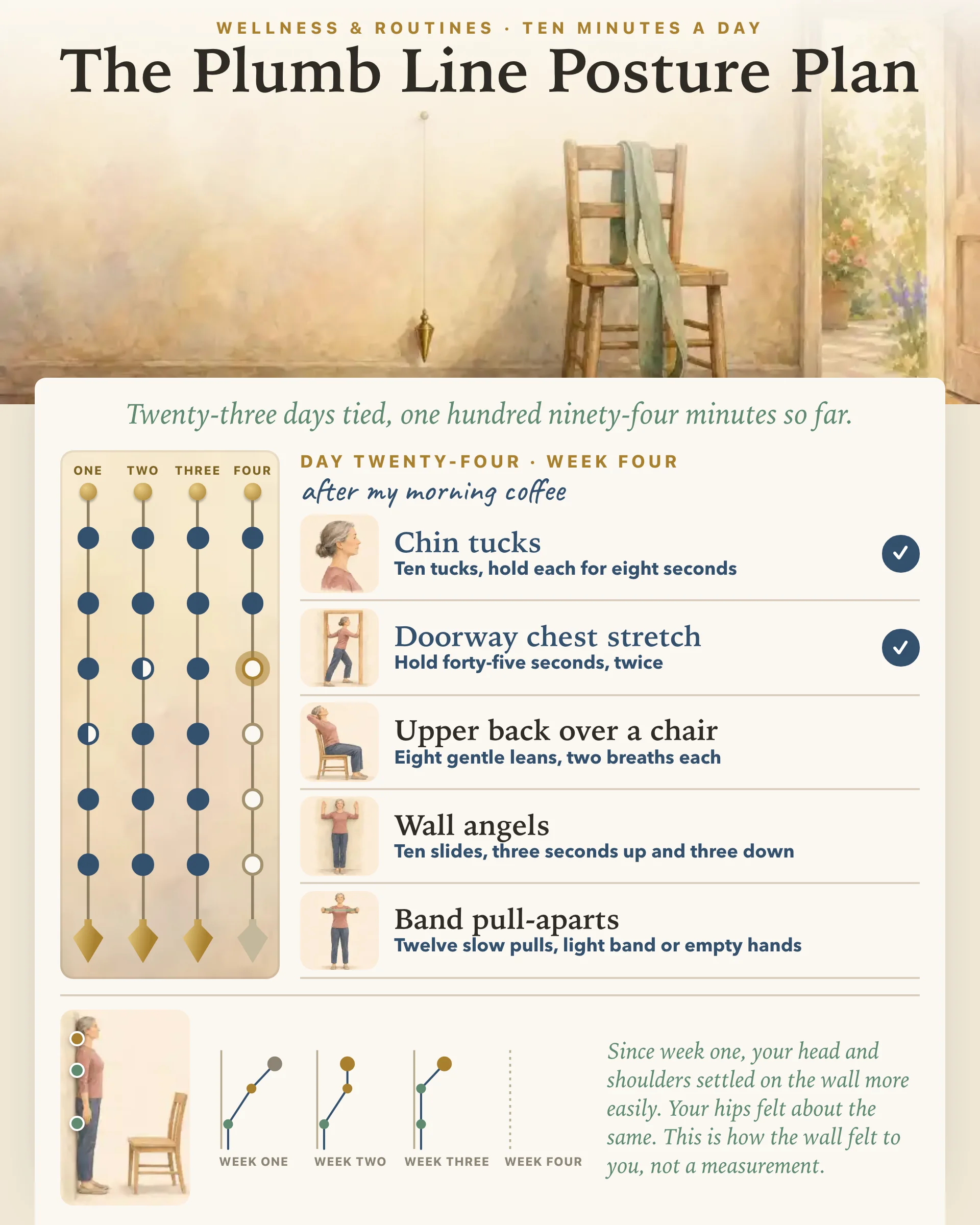
A plumb line is a small weight on a thread. Builders hold one beside a wall because the thread always falls straight, whatever the wall is doing. It passes no judgment on the wall. It only gives you something true to look at, and that is the spirit of this plan: five posture exercises, ten minutes a day for four weeks, and a weekly look at how your back meets a wall.
You need a door frame, a sturdy chair, a stretch of bare wall and, from week three, a light elastic band if you own one. No band is fine, because empty hands can make the same movement.
Each move gets two minutes, which is how the day adds up to ten.
Week one teaches the shapes, week two lengthens the holds, week three brings in the band, and week four slows everything down. The seventh day of each week is for rest.
Press start and a timer walks you through the five moves in order, with the instructions in front of you. Skip the timer and tick moves off yourself if you prefer.
When you finish, you tie the day's knot on one of four painted plumb lines, one line per week. A full session ties a solid knot. A short session ties a half-filled knot, and it still counts toward your total minutes. The sheet takes one knot per calendar day, which keeps the plan at its intended pace, and a missed day costs you nothing because the next knot simply waits.
Once a week, stand with your heels a few inches from a wall, knees soft, with a chair or counter within reach. Let your back settle, then answer for your head, shoulders and hips: does it rest there, does it take effort, or is it not happening today? Keep your eyes level, because tipping your chin up to reach the wall answers a different question.
Your answers draw a small shape, and the four shapes sit side by side. In plain words, the page then says what shifted since your first check. Treat it as a record of how the wall felt on one morning. It cannot measure your spine or judge it, and a long drive can change the answer for a day.
A 2026 review of ten randomized trials covering 550 people with forward head posture and neck pain linked exercise with a better head and neck angle, less pain and better neck function. Its authors rated the certainty of that evidence low to moderate, and their exploratory analysis pointed toward mixed exercise and programs of at least eight weeks. So four weeks is a beginning, and those results come from people who already had neck pain, which may not describe you.
For older adults with a pronounced upper back curve, a six-month randomized trial of 99 people offered hour-long classes led by a physical therapist, three times a week. On X-ray the curve came out about three degrees smaller than in the control group, with no difference on the physical function tests. That is a far bigger dose than ten minutes a day, and this plan makes no promise of matching it.
A 2019 viewpoint in a physical therapy journal argues that the popular belief in pain coming from sitting or standing incorrectly lacks strong evidence, even as a large industry sells ways to correct posture. You do not have to hold yourself like a soldier all day. Treat these moves as practice in moving your upper back and shoulders, with no perfect position to reach.
If you have had a fall, dizziness, a joint replacement, a heart or blood pressure condition, osteoporosis or a spine problem, or you have pain now, ask a doctor or physical therapist about this plan before your first session. Stop any move that hurts, and keep a sturdy chair or counter within reach whenever you are on your feet.
Start on a day you can spare ten unhurried minutes, and do your first wall check before your first session so you have a starting picture. For gentle stretching across the whole body, see The Daily Stretch Mat. For more work against a wall, try The 28-Day Wall Pilates Challenge after these four weeks, and the Workout Calendar can give this plan a place among your other exercise.
The Hip Compass turns the same daily habit to stiff hips, and The Chair by the Window offers something gentler from a seat.
Slow, simple moves for your neck and upper back that also open your chest: chin tucks, a doorway chest stretch, upper back extension over a chair, wall angels and pull-aparts with a band or empty hands. No study crowns one best list, so favor the ones you will keep repeating.
It varies, and nobody can honestly give you a date. In a 2026 review of trials in people with neck pain, programs of eight weeks or longer looked more helpful than shorter ones, though certainty was low to moderate. Four weeks is long enough to learn whether the routine fits your days.
This plan asks for ten minutes on six days a week, with the seventh for rest. That rhythm is chosen to make the habit easy to keep, and it is not a medical prescription. If a move leaves you sore, ease off it or ask a physical therapist to look at how you do it.
Stand with your heels a few inches from a wall and your knees soft, with a chair or counter within reach. Let your back settle and notice whether your head, shoulders and hips rest there, take effort or do not reach today. This is a self-check and no kind of diagnosis, so never force anything to touch.
Older adults have been studied directly. In a six-month trial of people aged 60 to 88 with a pronounced upper back curve, therapist-led strengthening classes reduced the curve slightly compared with a control group. That was far more exercise than this plan, so talk with a doctor or physical therapist first if you have osteoporosis or a spine condition.
By the team behind Fabulous, the science-based self-care app used by over 30 million people.


