
The Overwhelm Recovery ProtocolWellness & Routines · ~5 min
About this template · Updated November 2026
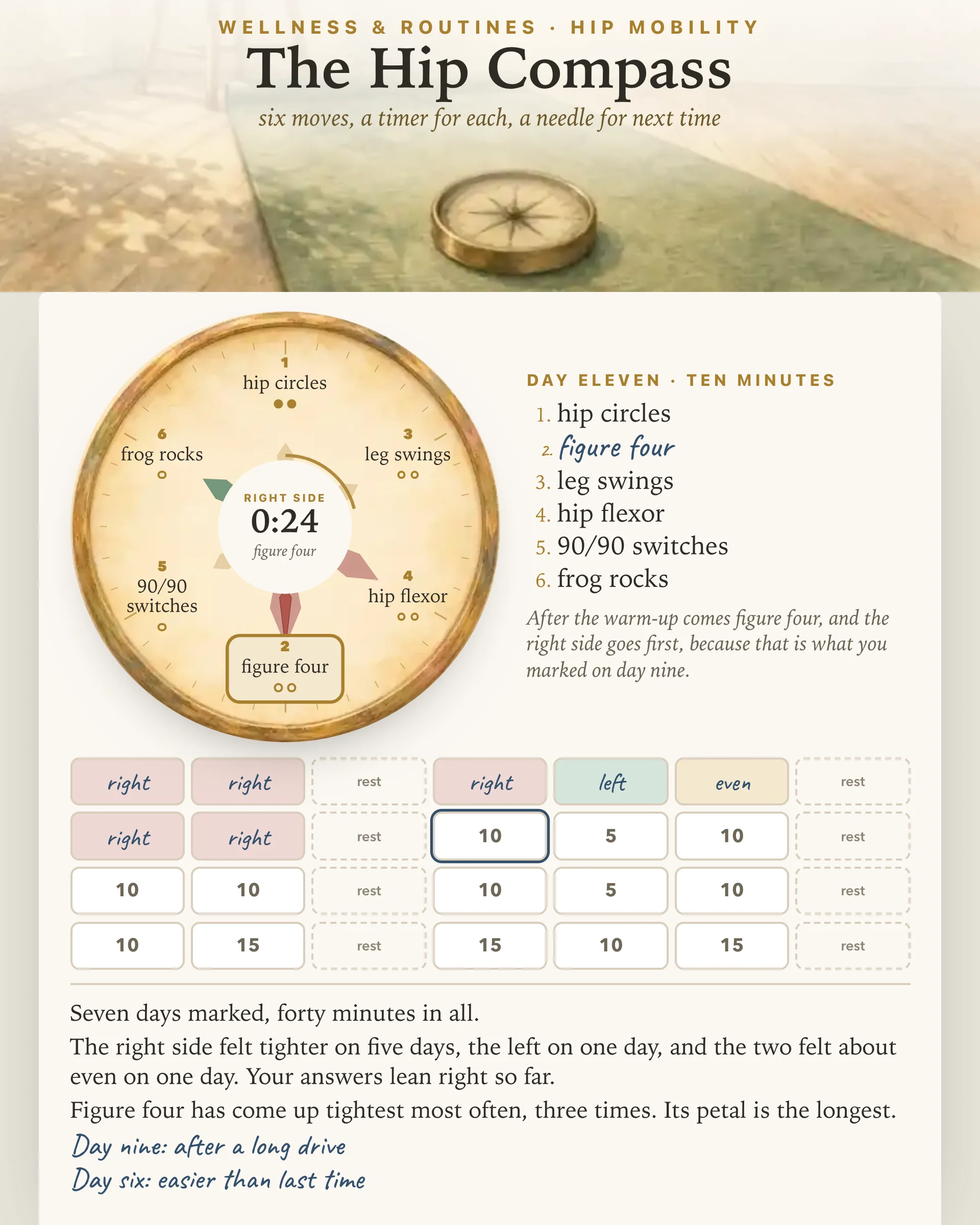
Most lists of hip mobility exercises stop at the list. You try two, forget which side felt odd, and a week later you are back at the same two. This page keeps what a list loses: a clock for each move, a version for the floor and a version for a chair and counter, and a short note after each session that decides what goes first next time.
A hip is a ball in a socket, so it moves forward and back, out to the side, and turning in and out. That is why the page is a compass: six stations around a dial, each asking your hip for something different, and a needle pointing at the one you are on.
Pick five, ten or fifteen minutes, and the floor or the chair and counter. Five minutes covers the warm-up and two more moves, at forty seconds a side. Ten minutes covers all six at the same pace. Fifteen gives each side a little over a minute. Every side begins with ten seconds to get into position, and those seconds count toward your total.
Press set off and the page runs silently, naming the side and counting down. A move that pinches can be skipped with one tap.
When it ends, you mark the day: which move felt tightest, and which side felt tighter. That note shapes your next hip mobility routine. The tightest move jumps to just after the warm-up, the tighter side goes first, and the others take turns so nothing waits too long. Each mark also grows a petal toward that move, so after a few weeks the dial shows where your attention keeps going.
The plan behind the tracker runs four weeks: five-minute days in week one, three ten-minute days in week two, ten minutes on most days in week three, and three days at fifteen in week four, with two rest days every week. Putting the tighter side first is a habit of attention. It has not been tested as a treatment.
Age alone may explain less stiffness than you would guess. A US national survey that measured hip motion in adults up to age 74 found differences of only three to five degrees between its youngest and oldest groups for most motions. The exception was moving the leg behind you, called hip extension, which is why the front-of-the-hip stretch has its own station here.
Regular stretching can increase how far a joint moves. A 2024 meta-analysis of 77 studies in healthy people found a moderate gain in range of motion compared with control groups, and slow static holds did better than swinging or bouncing. So treat leg swings as loosening up and give the slower moves more patience.
The gains can be small. One randomized trial asked healthy older adults to stretch their hip flexors at home twice a day for ten weeks. Their hip extension improved by under two degrees on average, and the changes measured during walking did not reach statistical significance.
If you live with hip osteoarthritis, guidelines still recommend exercise, but keep your expectations plain. The 2026 Cochrane review concluded that, compared with no treatment or usual care, exercise probably improves pain and function slightly, by amounts unlikely to be clinically meaningful. None of this research tested this page, and none of it can tell you why one side feels tighter.
Ask a doctor or physical therapist before you begin if you have had a fall, dizziness, a joint replacement, a heart or blood pressure condition, or pain. After a hip replacement, the position limits your surgeon gave you come first, because figure four, 90/90 switches and frog rocks all take the hip into deep positions. A mild pull is the most any move should feel like, so stop if anything hurts. Keep a sturdy chair or counter within reach for every standing move.
Good moments are a stiff morning, the end of a long drive, or a day spent mostly sitting. If you are tracking an ache, not just tightness, the Pain Journal gives you something concrete to bring to an appointment. For the rest of the body, The Daily Stretch Mat covers neck, chest and calves, and the Workout Calendar keeps a month of movement in view.
The Plumb Line Posture Plan turns the same daily habit to your upper back, and The Somatic Workout Map takes an even slower approach to tension.
Slow moves you can make smaller are a good place to begin: hip circles, leg swings at a counter, a hip flexor stretch, figure four, 90/90 switches and frog rocks. Each one here has a floor version or a chair and counter version, so you can choose by what your knees and balance allow that day.
The plan on this page asks for five days a week with two rest days, starting at five minutes and reaching fifteen on some days of the fourth week. If your hips are sore the next day, drop back a length or take the rest day early.
The main one on this page is the kneeling hip flexor stretch: one knee down on a towel, tailbone tucked, hips easing forward until the front of the back hip feels a mild pull. If kneeling bothers you, the standing version does the same job at a counter with a long step back. Leg swings also take the hip forward and back.
Yes. Tap chair and counter and every move changes. Hip circles, leg swings and the hip flexor stretch happen standing with one hand on a counter, while figure four, knee sways and wide-knee rocks happen sitting at the front of a sturdy chair.
Talk to a doctor or physical therapist first. After a hip replacement, the position limits your surgeon set come first, and some of these moves may fall outside them. Stop any move that hurts. The page records how tight a side feels, and it cannot tell you why.
By the team behind Fabulous, the science-based self-care app used by over 30 million people.


