
The Overwhelm Recovery ProtocolWellness & Routines · ~5 min
About this template · Updated September 2026
When a clinician asks how your pain has been, you answer from memory, and memory is a poor witness. In a study of patients who rated their pain as it happened during a colonoscopy or a kidney stone treatment, the total pain they reported afterward tracked the worst moment and the last few minutes, while the length of the procedure barely registered. A week of pain gets the same treatment: one bad evening stands in for all of it. A pain journal keeps the record while it is fresh, so the appointment starts from what happened rather than from what stuck.
Each entry is a handful of taps and, at most, two short lines of writing.
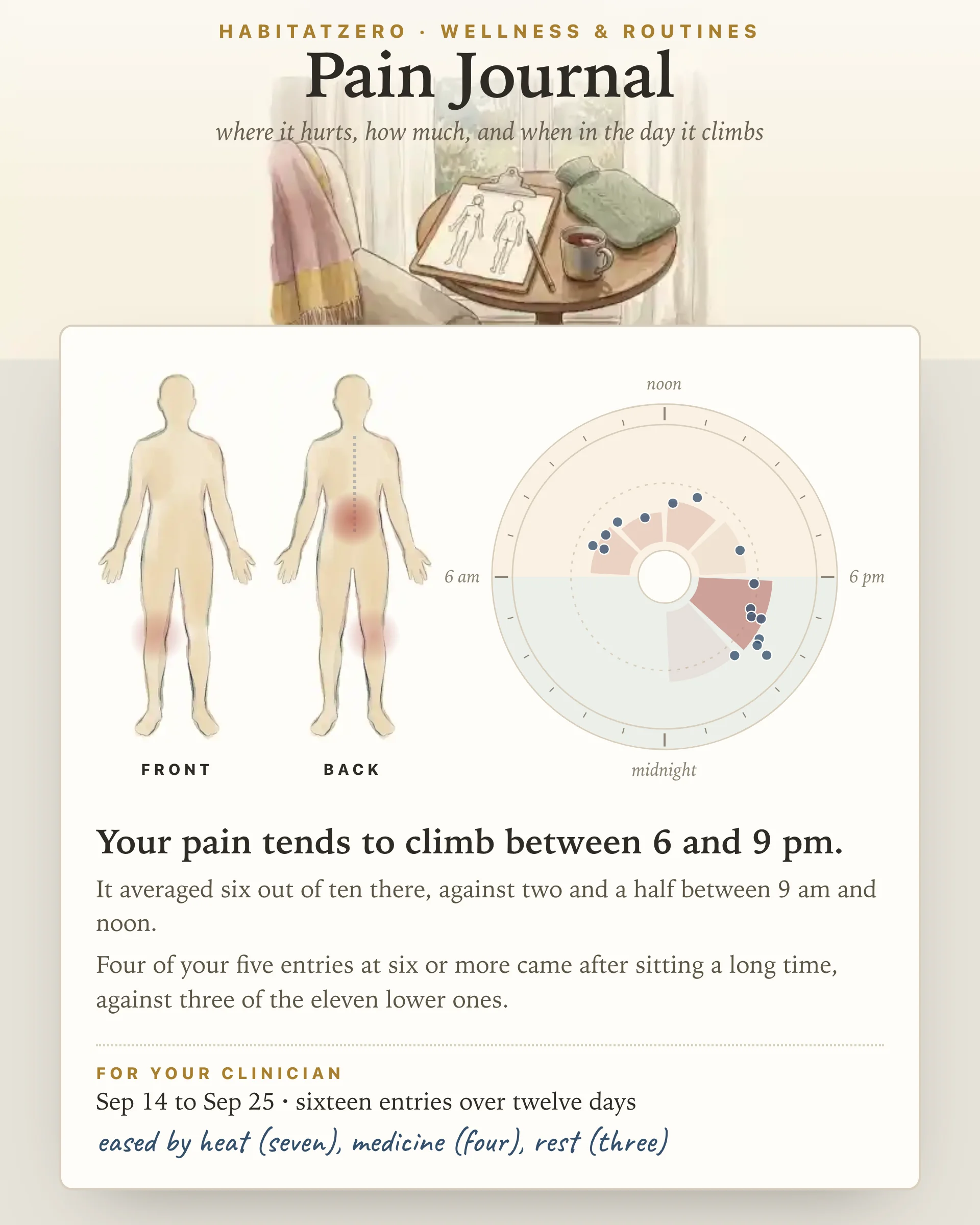
Every entry becomes a dot on a twenty-four-hour clock, noon at the top, placed at its hour and further from the center the more it hurt. Behind the dots, a petal for each three-hour stretch shows the average there, and a stretch holding a single entry stays faint.
Once you have six entries over two days or more, with at least two stretches of the day holding two entries each, the page compares them. When one runs two points or more above another, it names both in words: between 6 and 9 pm, say, six out of ten against two and a half in the late morning. Otherwise it tells you the pain holds about level.
It also looks at your higher entries, the ones a point or more above your own average, and checks what you marked before them. When one thing comes before at least half of them, and clearly less often before the lower ones, the page says so: four of your five entries at six or more came after sitting a long time. Change an entry or remove one, and the clock, the reading and the summary all follow.
The summary gathers the rest for your appointment, down to any medicine and the hour you usually took it. When you print, the entry form stays off the paper.
Pain often keeps a daily rhythm. When researchers went back through two drug trials in people with nerve pain from diabetes or after shingles, pain ratings rose from morning to evening, by about a third between 8 am and 8 pm in the newer trial. That is one kind of pain in one pair of trials, and yours may keep different hours, which is why the clock reads your own entries instead of borrowing a schedule from a study.
What a journal cannot do is tell you why. A pattern in your entries is a question worth raising, not a cause and not a diagnosis. Sitting may come before your worst evenings because it matters, or simply because evenings are when you sit. It also helps to log at one or two set times each day, the easier hours included: a journal kept only on the bad days will make every hour look bad.
Some pain calls for help now, not a pattern later. Call 911 for chest pain or discomfort that lasts two minutes or more, or for sudden, severe pain anywhere in your body; both are on the warning signs of a medical emergency that MedlinePlus lists. Do the same for sudden weakness, or numbness on one side of the body, which can be signs of a stroke. Pain that is new, or unlike your usual pain, deserves a call to your clinician rather than another week of entries.
Months of pain can wear down your mood as much as your body. If it ever has you thinking about ending your life, call or text 988 in the US, or your local emergency number, today.
Start two weeks or so before an appointment, or when a treatment begins or changes. If a poor night's sleep keeps turning up before your higher entries, a Sleep Log can show what your nights actually look like. If the pain lives mostly in your head, the Headache Diary is built around headaches instead. And when the day of the appointment comes, bring the summary along with your list of Questions to Ask Your Doctor.
Where it hurts, how much from zero to ten, what kind of pain it is, the time, what you were doing before it rose, and what eased it. If you took medicine, add its name, dose and the hour you took it. A few words about where you were can fill in the rest.
Mark each place that hurts on the front or the back figure. On the front view your right side is on the left, the way it would be on someone facing you. Here, places you mark often take on a deeper blush, so the chart shows where the pain keeps returning.
Yes. The journal is filled in on screen, and printing leaves the entry form off, so the page carries the body chart, the day clock, your entries and a summary written for your clinician.
Log it whenever the pain shifts, and at one or two set times each day, the easier hours included, for about two weeks before an appointment. Entries made only on bad days make the whole day look worse than it is.
This page shows a sample journal you can look through. To keep your own entries and see your own day clock build up over the weeks, personalize the template in HabitatZero, which costs nothing.
By the team behind Fabulous, the science-based self-care app used by over 30 million people.


