The Overwhelm Recovery ProtocolWellness & Routines · ~5 min
About this template · Updated September 2026
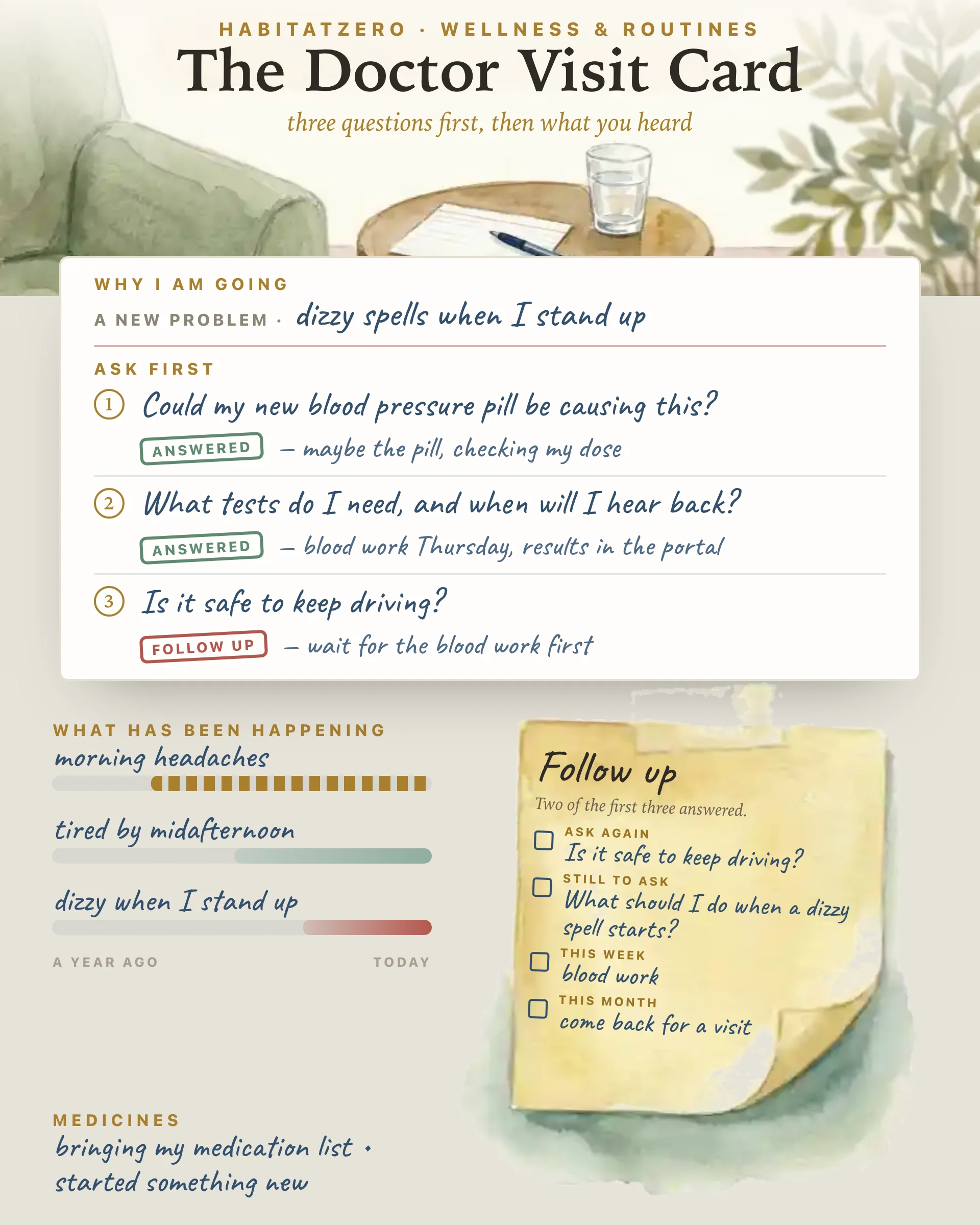
The shape of this card comes from the Agency for Healthcare Research and Quality. Its patient brochure, Be More Engaged in Your Healthcare, splits a visit into before, during and after, tells you to bring every medicine you take, and asks you to list the top three questions you want to be sure to ask. The agency had no part in building this interactive version and has not reviewed or endorsed it.
In a study of 112 recorded clinic visits, clinicians asked for the patient's full agenda in only 40, and in 27 of those 40 they interrupted after a median of eleven seconds. Patients who were allowed to finish needed a median of six seconds to say what brought them in. The lesson for you is short: say the reason and your three questions at the start, before the talk turns to the exam.
Three is a working limit, not a rule: it is what the AHRQ sheet asks for, and about as many as you can list in one breath. The rest wait under if there is time.
Pick the question you would regret leaving unasked on the drive home, then the ones you need before you can act. By situation:
The card offers these and more as taps in six topics, so you can borrow the wording.
Expect questions back: what brings you in, when it started, whether it is getting better or worse, and what you take. The middle of the card holds the answers. Each symptom gets a bar that ends at today and reaches back to when it began, the oldest on top, colored by whether it is easing, steady, worsening or coming and going.
For medicines, the card does not copy your whole list. It asks you to bring the list, or the bottles themselves, and to mark what changed since the last visit: something new, something stopped, missed doses, a side effect, a supplement. The AHRQ brochure spells out that non-prescription medicines, vitamins and herbal supplements count too.
Before the visit, tap the reason, put it in a few words, and order your questions with the arrow. The top three sit in the ask first box, up to five more wait below, and the card refuses a ninth. When you are called in, switch to in the room. As the doctor answers, stamp each question answered, follow up or not asked, and write what you heard in a few words. Add next steps as they come up, such as blood work or a referral, and tap each one to give it a when.
The follow-up note then fills itself: questions that need another try, questions you never got to, and every next step, under a count of how many of your first three were answered. Cross items off as you book the test or make the call.
Lists like this one are known as question prompt lists, and a review of 42 studies found some evidence that a prompt list, particularly one the doctor endorsed, increased how many questions patients asked, and some evidence that doctors gave more information in return. It found no consistent effect on what patients remembered, on anxiety, on satisfaction or on how long the visit ran.
Memory is the weak spot. When researchers interviewed patients a week after specialty visits, 49 percent of decisions and recommendations were recalled accurately without a prompt, 36 percent only with a prompt, and 15 percent wrongly or not at all, and visits with more to remember fared worse. That is why every answered question gets a line for what you heard, and why asking the doctor to write something down is a fair request.
It gives no medical advice and passes no judgment on your symptoms; it keeps your words and the doctor's. Nothing on it goes to your clinic unless you show it or print it. Chest pain, trouble breathing and anything else that cannot wait belong with 911, not on a list for later. If low mood has turned into thoughts of hurting yourself or ending your life, do not hold that for the appointment: call or text 988 in the US, or your local emergency number.
Start the card a day or two ahead and add to it in the waiting room. Bring any numbers you keep at home: readings from a Blood Sugar Log, nights from a Sleep Log, or a few weeks of a Mood Tracker tell the story better than memory can. If someone comes with you, hand them the card so one of you listens while the other writes. On the way home, the follow-up note shows what is still open.
Lead with the question you would regret leaving unasked on the drive home. Then add the ones you need before you can act: what might be causing the problem, which tests come next and how the results reach you, what the options are including waiting, and which signs mean you should call sooner.
Visits are short and their direction is set early. In one study of recorded clinic visits, doctors who asked for the patient's concerns cut in two times out of three, after a median of eleven seconds, so a reason plus three questions said at the start is the part most likely to be heard. AHRQ's own question sheet asks for a top three.
Bring every medicine you take or a complete list of them, including over-the-counter products, vitamins and herbal supplements, as AHRQ advises. Add any readings or logs you keep at home, your insurance card, and this card with your three questions at the top.
Ask how the office handles messages and test results, how soon you can be seen for something new, who covers when the doctor is away, and how they like to work with someone managing an ongoing condition. Bring your history and medication list so the first visit is not spent rebuilding them.
You can read the sample card on this page without signing in. Writing your own card, stamping it in the exam room and keeping its follow-up note all happen in HabitatZero, which costs nothing.
By the team behind Fabulous, the science-based self-care app used by over 30 million people.