The Overwhelm Recovery ProtocolWellness & Routines · ~5 min
About this template · Updated September 2026
A glucose meter gives you a number and then forgets it. A log is where the number goes to become useful: next to the day, the moment, and a few words about what was happening around it. The American Diabetes Association's own advice on checking is exactly that plain: write your results down and note what may have affected them, such as food, activity and stress. This page is that logbook, with the arithmetic done for you.
It is a record, not a referee. Nothing on it turns a reading red or green, and it never tells you what a number means. That part of the job belongs to you and the people who know your history.
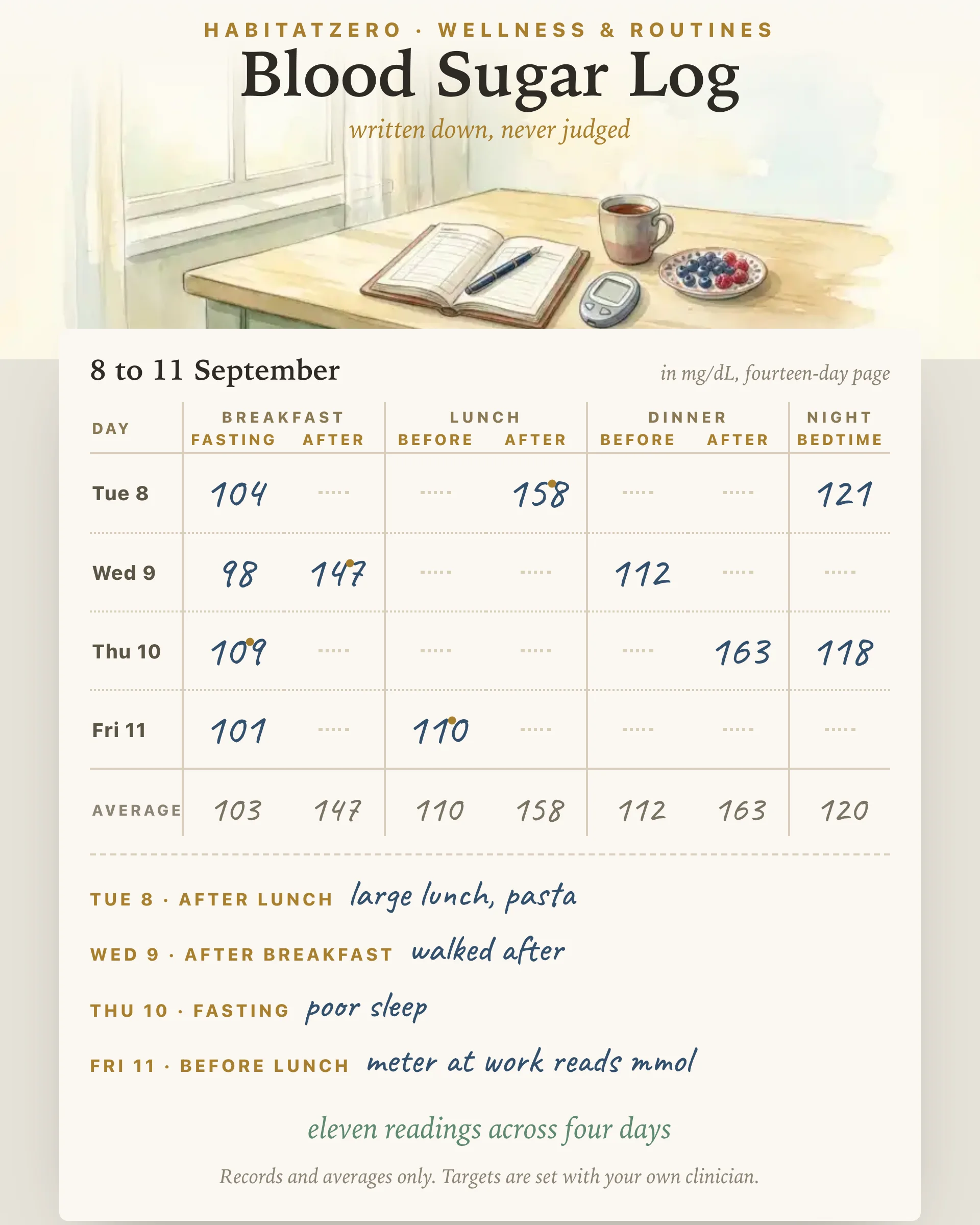
Open any paper meter logbook and you will find the same grid: fasting, after breakfast, before lunch, after lunch, before dinner, after dinner, bedtime. Seven moments, one row per day. The layout has lasted because it answers two questions at once. Read across a row and you see one day from waking to bed. Read down a column and you see how one moment behaves across the week, which is often the more telling view: fasting numbers that drift, or after-dinner numbers that sit apart from the rest.
Which of those columns you fill, and how often, is not something a worksheet decides. Some people check twice a day, some seven times on a few chosen days, some only when a clinician asks for a structured stretch before a visit. The grid holds whatever pattern you and your care team have agreed.
The entry slip at the top asks for one thing first: what the meter says. Type it in mg/dL or mmol/L, whichever your meter uses, and the line underneath shows the same number in the other unit as you type. Then tap the moment and the day, and the reading lands in its cell in handwriting. If something stands out, a tap adds a few words: large meal, walked after, poor sleep. Notes gather beneath the grid with the reading they belong to.
The page covers fourteen days. Each cell holds one reading, so writing into a cell that is already full is refused until you clear it, and a date outside the two weeks is refused with a suggestion to start a fresh copy. At the bottom, every column keeps a running average across the days you have logged, in whichever unit the page is showing. Switch the unit and every number on the page, averages included, converts with it. A meter at work that reads in mmol/L and a meter at home that reads in mg/dL can share one page.
Writing readings down is only worth the effort if someone reads them. The clearest test of that came from a twelve-month trial of people with type 2 diabetes who were not using insulin: those who kept a structured seven-point profile on a few days before each visit, and went through it with their clinician, lowered their A1C more than those who checked without a structure. The log mattered because it fed a conversation. A logbook that nobody opens at the appointment is just a diary.
The same caution runs the other way. The ADA's Standards of Care set out glycemic goals as something to be individualised, shaped by age, other conditions, how long someone has had diabetes and their risk of low readings. The general figures the ADA lists for most nonpregnant adults, 80 to 130 mg/dL before meals and under 180 mg/dL one to two hours after, are a reference point, not a verdict on any one person's number. The footer of this page quotes them with the source named and leaves your own targets where they belong, with your clinician.
That is why the page draws no bands and colors no cells. A logbook that flags readings is quietly making a clinical judgment with no knowledge of who is holding it.
The two units describe the same thing. Milligrams per deciliter is the convention in the United States; millimoles per liter is used in the United Kingdom, Canada, Australia and much of the rest of the world. One mmol/L is a little over eighteen mg/dL, so 126 mg/dL and 7.0 mmol/L are the same reading. The page keeps each reading in the unit you typed and converts on display, so nothing is rounded twice.
Keep it in the two weeks before an appointment, when a full page is worth the most to whoever reads it with you. Use it when a routine changes, when meals or activity shift, or whenever your care team asks for a structured look. And use it alongside the things that shape the numbers: the Sleep Log if nights have been rough, the Meal Planner if the after-meal column is the one you are curious about, and the Water Tracker on days you suspect you have been running dry.
When the two weeks are full, take the page with you, talk it through, and start a clean one. The averages will be waiting at the bottom of the next page too.
Four things per entry: the day, the moment (fasting, before or after a meal, bedtime), the reading itself, and a short note about what surrounded it, such as the meal, a walk or a poor night. The American Diabetes Association suggests writing results down together with the food, activity or stress that may have shaped them.
Divide mg/dL by about eighteen to get mmol/L, and multiply mmol/L by about eighteen to get mg/dL. So 126 mg/dL is 7.0 mmol/L and 5.6 mmol/L is about 100 mg/dL. This page converts every reading for you, whichever unit was typed.
Paper meter logbooks have used the same layout for decades: fasting, after breakfast, before and after lunch, before and after dinner, and bedtime. Reading down a column shows one moment across the days; reading across a row shows one day. Which moments you check, and how often, is something you agree with your care team.
No. It records, converts and averages, and it never colors or labels a number. Target ranges are individual; the sheet quotes the general adult figures from the ADA Standards of Care for reference only and leaves your own targets to you and your clinician.
The page here is a filled example you can look at. To write your own readings into it and have them kept between visits, open it in HabitatZero, which is free to use.
By the team behind Fabulous, the science-based self-care app used by over 30 million people.