The Overwhelm Recovery ProtocolWellness & Routines · ~5 min
About this template · Updated September 2026
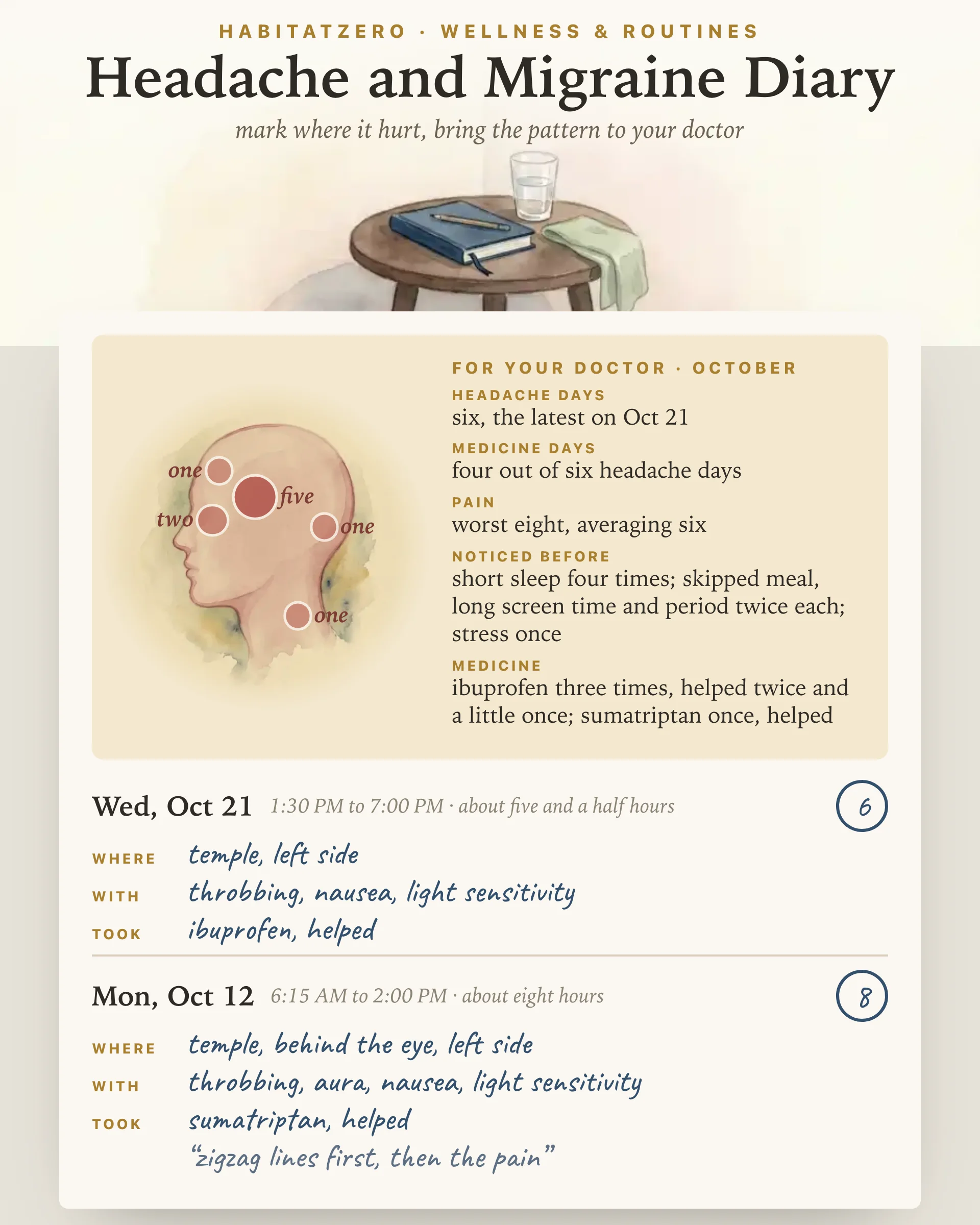
Ask someone with regular headaches how last month went and you usually get an impression: a lot, maybe twice a week, mostly bad. A doctor can do little with an impression. What helps is the record itself: which days, how long, how bad, where it sat, what came with it and what you took. A headache diary is that record, kept one page per headache, so the pattern is on paper before the appointment.
MedlinePlus, from the National Library of Medicine, suggests writing down the day and time the pain began, what you ate and drank, how much you slept, what you were doing just before, and how long the headache lasted and what made it stop, then reviewing the diary with your health care provider. This diary turns most of that into taps, with short sleep, skipped meals, caffeine and alcohol in one row, and adds what the same page uses to tell headache types apart: one side or both, throbbing or squeezing, and whether aura, nausea or sensitivity to light and sound came along.
Each headache gets its own page, and nearly everything is a tap.
Press write it in and the page joins the diary. Above the pages, a summary for your doctor adds up the latest month in plain words: headache days, medicine days, worst and average pain, typical length, where it sat, what came beforehand and which medicines worked. A second painted head darkens where the pain turns up most. Earlier months get a line each, and the print button puts it all on paper.
Pain relievers taken often enough can cause headaches of their own. The same MedlinePlus page explains that people who take pain medicine more than three days a week on a regular basis can develop rebound headaches, also called medication-overuse headaches, and it advises talking with your provider once you need pain medicine three or more days a week.
So the summary counts medicine days on their own, with a plain sentence beside the number, and says so when three land inside one week. That is not a diagnosis, and not a reason to stop a prescribed medicine on your own; it is a number for your doctor, who can plan how often each medicine is safe for you.
Writing it down beats remembering. When Mayo Clinic researchers compared a one-time questionnaire with the daily diaries of 209 people with migraine, recall matched the diaries on how many headaches there had been over four weeks, but remembered pain came out worse than what the diaries recorded. For an individual patient, they concluded, the daily diary is still the better tool.
Go carefully with triggers. The row is called noticed before it on purpose. When researchers at the Danish Headache Center exposed 27 people with migraine with aura to the bright or flickering light and hard exercise they had named as their triggers, only three went on to have an aura attack. Something that keeps showing up beforehand might be a cause, a coincidence, or an early sign of the attack already starting. The counts tell you what to raise with your doctor; they do not settle it.
Nor can it name the kind of headache you have; that takes a clinician, a full history and sometimes tests.
Some headaches need care now, not a page. MedlinePlus lists the danger signs that call for 911 or an emergency room, among them a headache that comes on suddenly and explosively, the worst headache of your life even if you get them often, a headache with fever, stiff neck, nausea and vomiting, one with slurred speech, a change in vision, trouble moving your arms or legs, confusion or memory loss, and a headache that follows a head injury. The sheet keeps the same warning in a box.
Open a page when a headache starts, or fill it in once it eases while the details are fresh. Keep writing for at least a month before an appointment, since headache and medicine days are counted by the month, and bring the printout along.
If short nights keep turning up under noticed before it, the Sleep Log records bedtimes and wake times to lay beside these pages. The Water Tracker does the same for how much you drink, and the Caffeine Calculator shows how much caffeine is still in your system at bedtime.
For each headache, note the date, when it started and ended, how bad it got from zero to ten, where on your head it hurt, what came with it such as aura, nausea or sensitivity to light and sound, what you noticed in the hours before, and what medicine you took and whether it helped. A few words on what finally eased it round out the page.
Aim for at least one full calendar month, since headache days and medicine days are counted per month. If the appointment is further off, keep writing until then, so the doctor sees every headache since the last visit rather than the few that stand out in memory.
Yes. Each page records aura, throbbing pain, nausea and sensitivity to light and sound, and the print button puts the month summary and every page on paper for an appointment. The diary never decides whether a headache was a migraine; sorting out the type is a job for your doctor.
MedlinePlus advises talking with your provider once you need pain medicine three or more days a week, because frequent use can bring on rebound headaches. The classification headache specialists use counts overuse as fifteen or more days a month for plain pain relievers such as ibuprofen or acetaminophen, or ten or more for triptans and combination pills, kept up for over three months. Talk to your doctor before changing a prescribed medicine.
Call 911 or go to an emergency room for a headache that comes on suddenly and explosively or is the worst of your life, one with fever and a stiff neck, one with confusion, weakness, numbness, slurred speech or a change in vision, or any headache after a head injury. Those need care right away, not a diary page.
By the team behind Fabulous, the science-based self-care app used by over 30 million people.