
The Overwhelm Recovery ProtocolWellness & Routines · ~5 min
About this template · Updated November 2026
The word somatics belongs to Thomas Hanna, a philosophy professor and movement theorist who coined it and built a method of slow, attentive movement around it. This sheet borrows that slow pattern in plain versions of its own. It is independent of his family, his students and the groups that teach his work, and none of them has reviewed or approved it.
A somatic workout can seem strange if you expect to sweat. You lie down, move an inch or two, and pay close attention to how that inch feels. When nothing is straining, you have room to notice which muscles were already working before you asked them to.
Each repetition has three parts. You tighten slowly for about seven seconds, let go for about eleven, and rest for about six. The letting go runs longer on purpose, since that slow release is what this kind of practice is built around.
The formal word is pandiculation, the stretch-and-yawn a cat does on waking. A paper on pandiculation explores the idea that this reflex helps muscle and connective tissue keep working together. Its title ends in a question mark, so treat it as a hypothesis, not a settled finding.
Every session lasts ten minutes, on all twenty-eight days, and ends with a minute of lying still.
Press begin and a small drawn figure moves at the speed to aim for, with a cue beside it such as let it sink and flatten. You can pause, skip to the next move or stop early, and one tap skips the timer if you would rather move on your own.
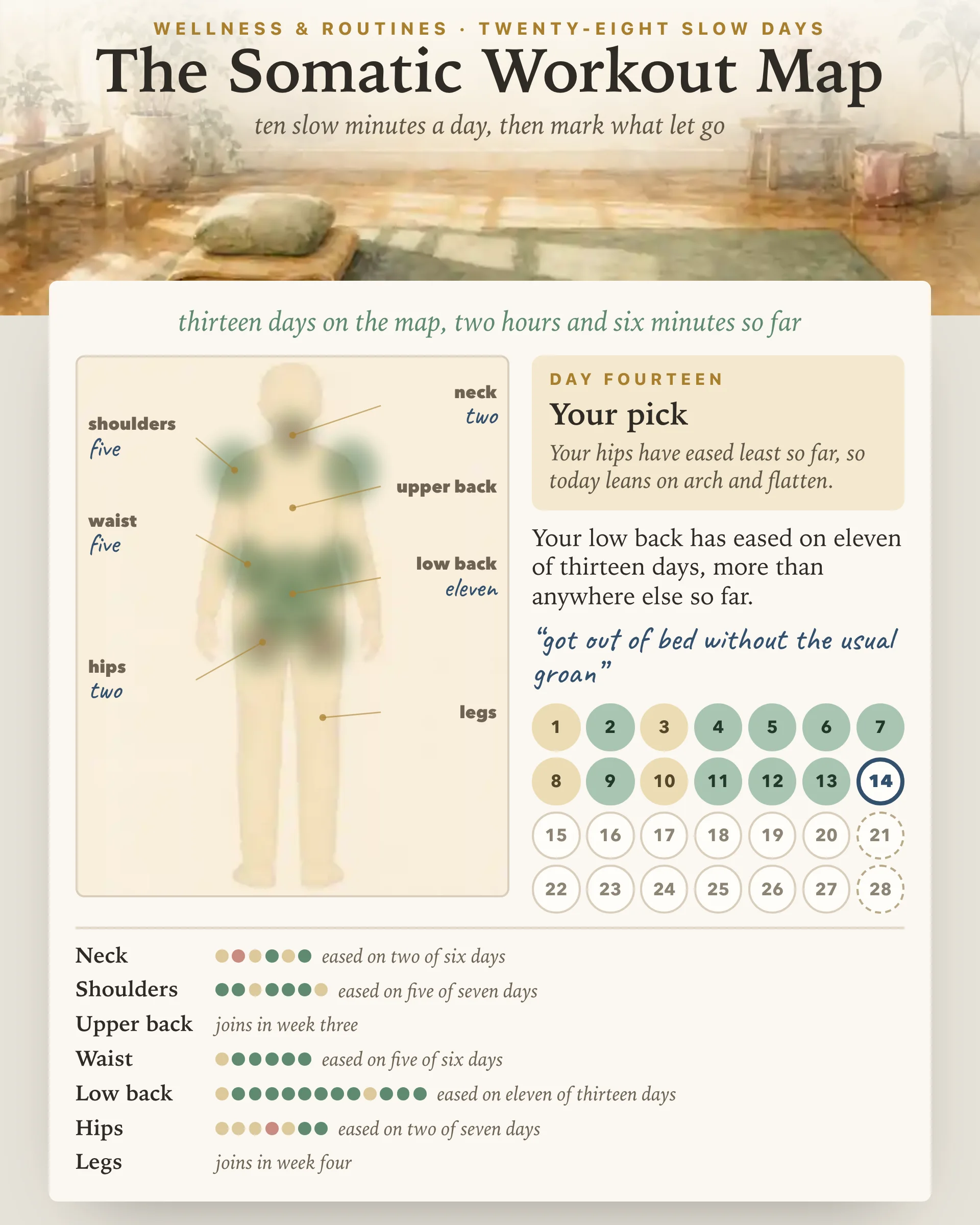
Afterward comes the part a printed plan cannot do. The page asks how each place feels compared with when you lay down: looser, same or tighter. Each looser mark deepens a wash of green on a painted figure, and a tighter mark leaves a small touch of rose. The map holds only what you told it, so a pale patch is simply a place you have not felt change yet.
Every seventh day is a pick day. The sheet finds the place that has eased least so far and builds the session around a move that reaches it, though you can overrule it with one tap. If a place reads tighter on two of its last three days, the page suggests going smaller and slower. Days run in order and carry no dates, so missing a Wednesday costs you nothing.
The research here is thin. The closest study is a look back at 103 patients with neck or low back pain who had one-to-one sessions with a practitioner of Hanna's method. Their pain ratings dropped after about three sessions, and fewer of them were using pain medication six months on. That is encouraging, but the study had no comparison group, its patients worked with a trained teacher, and pain often eases with time anyway. It says little about ten minutes alone at home.
Slow floor work also does not raise your heart rate or build much strength, so treat it as an addition to walking and muscle work, not a replacement.
Many people come to this practice hoping to lose weight, but nothing here is built for that and no one has shown it works that way. A Cochrane review of exercise for overweight found that exercise brought small losses, larger with harder effort or a change in eating, and better blood pressure and blood fats even where weight barely moved. Movement helps alongside food, sleep and time, and a gentle routine is one small part of that.
Somatic stretching means tightening first and lengthening as you release, which differs from holding a stretch still. For the held kind, try The Daily Stretch Mat. Somatic pilates has no single definition; if you want firmer work for your middle, The 28-Day Wall Pilates Challenge asks more of you.
Go only as far as feels easy, and stop if anything hurts. If you have had a recent injury or surgery, a joint replacement, dizziness, or a heart or blood pressure condition, talk with your doctor or physical therapist first. Getting down to the floor and back up is part of the session, so a firm bed works just as well. Roll onto your side before you stand.
Mornings suit many people, when stiffness is easy to notice, and so does the wind-down before bed. If what you are after is settling a racing, anxious body more than loosening a stiff one, Somatic Exercises for Anxiety is built as that calming practice.
If this slow pace suits you, The Tai Chi Starter Scroll teaches one new move a week standing up, and The Chair by the Window keeps a similar pace from a seat.
It is a session of slow, small movements, usually done lying down, where the aim is to feel each movement instead of pushing through it. You gently tighten a group of muscles, let go more slowly than you tightened, and rest long enough to notice the difference.
Here it means ten minutes a day for four weeks, with new moves joining each week and every seventh day shaped by your own marks. Days run in order, not by calendar date, so a missed Tuesday leaves nothing to catch up on.
A regular stretch usually holds a lengthened muscle still. A somatic stretch starts by lightly tightening that muscle, then lets it lengthen slowly as you release, the way a cat unfolds after a nap. Somatic pilates is a looser label that teachers use for slow pilates-style work, so ask what a given class means by it.
Nobody has shown that they do, and this plan makes no such promise. A Cochrane review of exercise for overweight found small changes that grew with harder effort and with changes in eating, and slow floor work is about as gentle as movement gets. Treat it as one small part of a picture that also takes in food, sleep and time.
No. Thomas Hanna gave somatics its name, and this free sheet borrows the slow pattern from that tradition, but nobody connected with his work made, reviewed or endorsed it.
By the team behind Fabulous, the science-based self-care app used by over 30 million people.


