
The Overwhelm Recovery ProtocolWellness & Routines · ~5 min
About this template · Updated November 2026
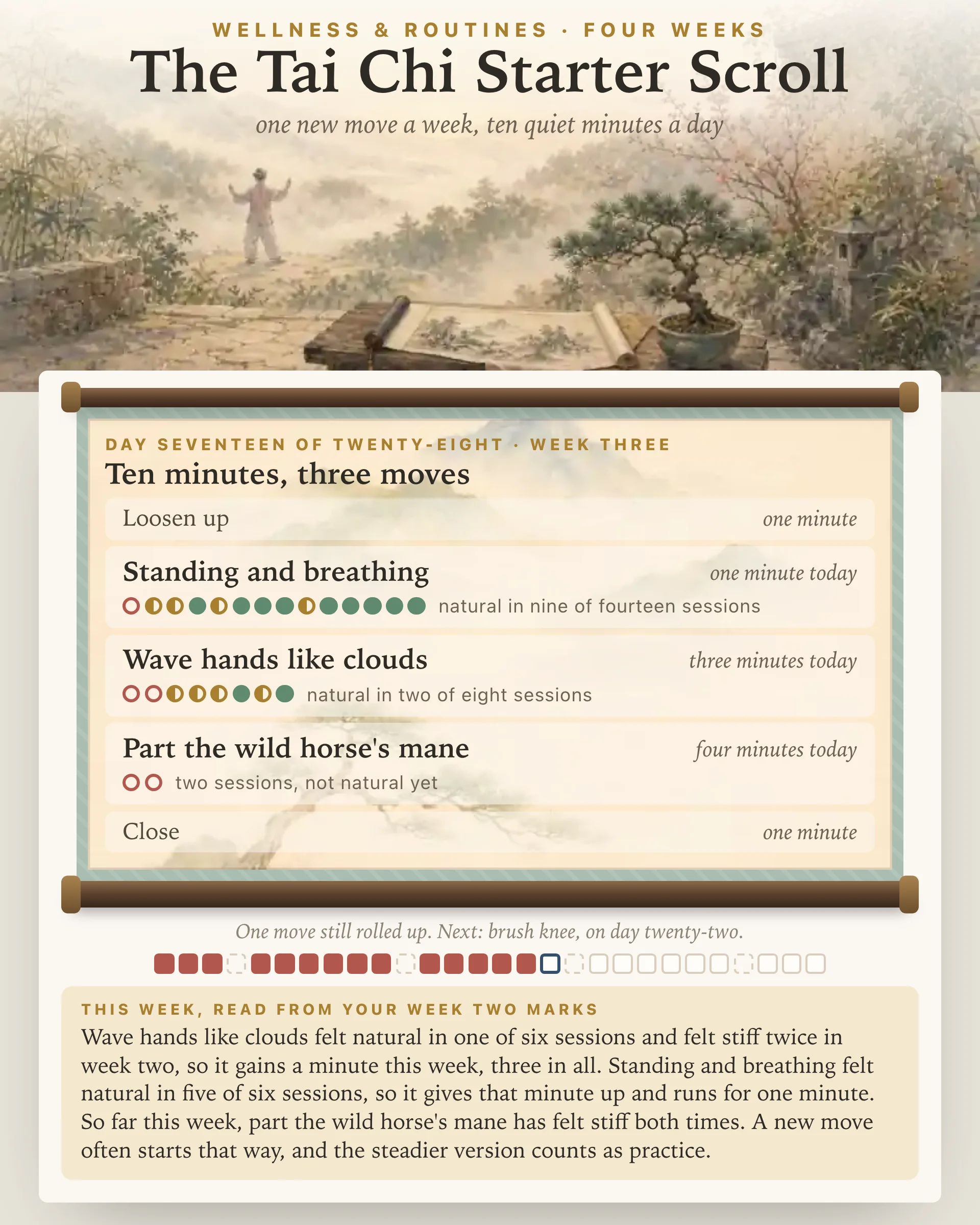
Most people who look up tai chi for beginners find a video of someone moving beautifully through a long sequence, or a list of twenty names they cannot picture. Neither tells you what to do in your living room this morning. This page answers that: learn one move a week for four weeks, practice for ten minutes, and let your own notes decide where next week's minutes go.
Tai chi is a slow practice of gentle movements and physical postures that began as a martial art and has since moved toward health and rehabilitation. You need no special shoes or mat, only space for one long step and a sturdy chair or counter close by.
Week one: standing and breathing. Feet hip-width apart, knees soft, your wrists floating up to shoulder height as you breathe in and sinking as you breathe out. It looks like nothing much, yet every later move depends on those two habits, slow breath and soft knees.
Week two: wave hands like clouds. A slow side-to-side sweep of the arms as your waist turns. Traditional versions step sideways too; here your feet stay put, so your attention can go to your hands.
Week three: part the wild horse's mane. You step forward heel first, let your weight follow, and draw your hands apart, one rising to chest height while the other settles by your hip. This is the first week your weight travels.
Week four: brush knee. Another forward step, while one hand sweeps past your front knee and the other pushes slowly ahead.
Arms come before steps on purpose, so balance and coordination never both arrive as new demands on one day. If you later join a class, expect a different order. In the widely taught 24-move Yang form, the horse's mane and brush knee come early and the clouds arrive later on.
Every move has a steadier version on the sheet: sitting down, a hand on the counter, a shorter step. Taking it counts as doing the move.
On day one the hanging scroll shows a single row, with three moves still rolled up beneath it. Each new week opens one more row, the bottom roll gets thinner, and more of the painting shows on the silk.
Press begin and a silent timer works down the rows, lighting each in turn with a short cue. One minute goes to loosening up, one to closing, and your moves share the eight in between. When you finish, tap stiff, okay or natural beside each move, then stamp the day. One day in each week is a rest, and a missed Tuesday simply means day nine happens on Wednesday.
Those taps are the useful part. Each adds a dot to that move's trail, so you can watch the oldest move turn green while the newest is still mostly outlines. From week three on, the sheet reads the week before and moves one minute from the older move that felt most natural to the one that felt least. The new move keeps its full share, and the card below the scroll says what changed and why, so you can disagree with it.
The research people cite most concerns older adults and falls. An abridged Cochrane review of exercise in people aged sixty and over reported that tai chi may reduce the rate of falls, drawing on seven studies and rating that evidence low certainty. Balance and functional exercise had the firmer result in the same review. The US National Center for Complementary and Integrative Health says tai chi appears to be safe, and also warns against using it to put off seeing someone about a medical problem.
None of that tells you what these four weeks will do for you, because this plan has never been studied. Tai chi is also hard to study, being a complex practice with physical, cognitive and ritual parts, so a ten-minute home routine and a long supervised class share a name, not necessarily a result. What you can fairly expect from four weeks is to know four moves and whether you like doing them.
A written page also cannot see your knee drifting past your toes or your weight stuck on your back foot. If you want corrections, find a teacher and ask about their training, since US instructors need no license.
If you have had a fall, dizziness, a joint replacement, a heart or blood pressure condition, or pain, ask your doctor or a physical therapist whether these moves suit you before you begin. Stop anything that hurts. Whenever you are standing, keep the chair or counter within arm's reach, and sit down if you feel unsteady.
First thing in the morning suits many people, before the day has opinions, but any regular ten minutes will do. If the slow breath is the part you like, Belly Breathing gives it a page of its own. If stiff shoulders make the arms hard work, try The Daily Stretch Mat on your rest days. Once four weeks of moves feel familiar and you would like to take the slowness across the room, the Tai Chi Walking Plan picks up where the stepping leaves off.
When all four moves feel familiar, Tai Chi Move Cards adds the rest of the set, and The Indoor Tai Chi Walk gives your feet something to do on days you stay in.
Begin with quiet standing and slow breathing, then add wave hands like clouds, part the wild horse's mane and brush knee, one a week. That order brings in the arms before the steps, so you are not sorting out balance and coordination for the first time on the same morning.
You can learn simple moves at home with space for one long step and a sturdy chair close by. A sheet cannot see your knees or your stride, though, so a qualified teacher is worth finding if you want corrections. US instructors need no license, so ask about their training.
Ten minutes is plenty on this plan: one minute to loosen up, eight on your moves in order, and one of slow breaths to close. Six days a week carry a session and one is a rest. Each week the newest move gets the most time.
It varies from person to person, and no one can honestly promise a date. Four weeks is enough here to meet four moves and run them in order. A new move often feels stiff in its first week, which is why the plan keeps returning to the earlier ones.
Tai chi is generally described as safe, and every standing move on this plan has a steadier version with a chair, a counter or a seat. If you have had a fall, dizziness, a joint replacement, a heart or blood pressure condition, or pain, ask your doctor or a physical therapist first, and stop anything that hurts.
By the team behind Fabulous, the science-based self-care app used by over 30 million people.


