
The Overwhelm Recovery ProtocolWellness & Routines · ~5 min
About this template · Updated November 2026
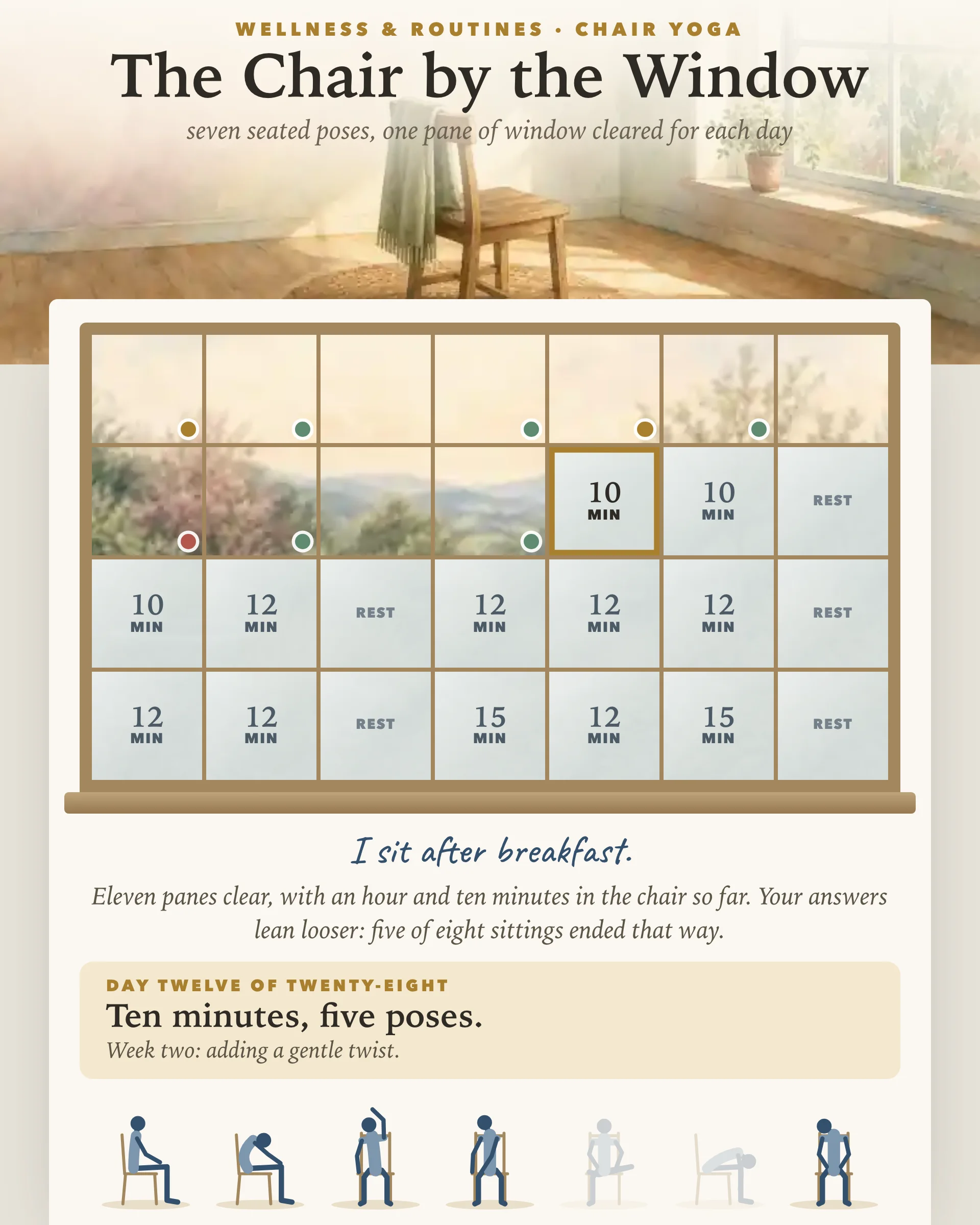
Chair yoga for seniors is yoga with the floor taken out of it. You stay on a sturdy chair, keep your feet down, and move your spine, hips, shoulders and neck in time with slow breathing. Nobody asks you to get down onto a mat or back up again, which suits people whose knees, balance or confidence have made a regular class feel out of reach.
This page gives you seven poses and twenty-eight days to learn them, with a clock and a breath to follow so you never have to count.
Each has a gentler version beside it, and all but seated mountain can be left out.
Press the button on the day's card and a small figure on a chair starts moving with two words, breathe in and breathe out, at an easy pace or a slower one. A clock runs for each pose. The holds come from the day's minutes, so the settling breath, the poses and the closing breath add up to exactly what the plan says. A pose you leave out hands its time to the closing breath.
At the end, the sheet asks how your body feels next to when you sat down: looser, about the same, or go gentler next time. That last answer switches every pose to its gentler version until you switch it back.
Then a pane of frosted glass clears. Behind the twenty-eight panes waits a painted backyard. Rest days clear too, once you say the day has passed. Miss a day and nothing breaks: there are no dates and no streak to lose.
Week one is four easy poses for eight minutes, five days out of seven. Week two adds the twist at ten minutes. Week three adds figure four, with most sittings at twelve. Week four brings in the forward fold, held for the shortest time because it is the pose most likely to leave you lightheaded, and two sittings reach fifteen minutes.
The closest match is a randomized trial of chair yoga in older adults with osteoarthritis in the legs who could not do standing exercise. After eight weeks of twice-weekly classes, the yoga group did better than a health education group on how much pain interfered with daily life, and that gain lasted three months. Improvements in pain scores, walking speed and fatigue faded once the classes ended, and balance did not change at all. Those were 45-minute group classes, so the trial cannot tell you what ten minutes alone at home will do.
For yoga in general, a review of six trials in people over sixty found small gains in balance and medium gains in mobility, and its authors say more research is needed to learn whether those gains mean fewer falls. A large Cochrane review of exercise in older people found that the programs that reduce falls mainly use balance and functional exercise, and it found no trials testing flexibility work against a control group. So treat this plan as a daily habit of moving and breathing, and not as a falls program. If falls worry you, ask a physical therapist about balance training.
Talk with a doctor or physical therapist before you begin if a fall, dizzy spells, a joint replacement, a heart or blood pressure condition, or pain is part of your story. Stop any pose that hurts. Everything here stays seated, and if you add standing balance work on another day, keep a sturdy chair or counter within reach.
Low bone density calls for care with rounding and folding: a small case series described three people with low bone mass who developed pain or fractures after yoga flexion poses. Three people cannot tell you how common that is, but it is reason enough to ask first, about twists as well, and to stay gentler until you have an answer. And if you have had a hip replaced, check with your surgeon or therapist before crossing your leg into figure four.
Pick one moment you already have, after breakfast or while the coffee brews, and write it on the sheet. If you want a few extra minutes on a rest day, The Daily Stretch Mat has a set done from a chair. For the end of a long day, Yoga Nidra on Still Water asks you only to lie down and listen.
For seated moves with more work in them, The Chair Circuit builds a session by goal, and Chair Tai Chi offers another slow way to follow your breath from the same seat.
This plan opens with four: seated mountain, seated cat-cow, a side stretch and a neck release. They ask little of your hips and nothing of your balance. A gentle twist joins in week two, figure four in week three, and a forward fold in week four.
Yes. All twenty-eight days, the pose timers, the breath pacing and the gentler version of each pose are free to personalize. The only equipment is a chair that stays put, plus a firm cushion or a thick book if your feet do not reach the floor.
Here a sitting begins at eight minutes and reaches fifteen by the fourth week, on five days out of seven. One randomized trial of chair yoga used two forty-five minute classes a week, so nobody can promise that a short daily sitting does the same.
A sturdy dining or kitchen chair without wheels or rockers, ideally with no arms so your elbows can swing wide. Sit where your feet reach the floor, or put a firm cushion or thick book under them. A wheelchair with its brakes on works too.
Anyone who has had a fall, dizzy spells, a joint replacement, a heart or blood pressure condition, or pain should check with a doctor or physical therapist first. Low bone density calls for care with folds and twists, and glaucoma with head-down poses. Stop any pose that hurts.
By the team behind Fabulous, the science-based self-care app used by over 30 million people.


