Wind-Down Routine BuilderSleep & Evenings · ~4 min
About this template · Updated September 2026
Yoga nidra means yogic sleep, and the phrase is far older than the practice that now carries it. As the yoga scholars Jason Birch and Jacqueline Hargreaves show in their history of the term, in the Mahabharata it names the god Vishnu's sleep on the waters between ages of the world, and medieval hatha yoga texts use it for the deepest meditative absorption. The guided, lying-down practice that most scripts follow is modern. Swami Satyananda Saraswati, founder of the Bihar School of Yoga, set out its stages in his book Yoga Nidra, first published in 1976, drawing, he said, on tantric rites that place sacred syllables on parts of the body. The yoga scholar Mark Singleton has also traced much of modern yoga's relaxation to Western relaxation therapy of the late 1800s and early 1900s. This script was written independently for HabitatZero; the Bihar School of Yoga has no tie to it and has not reviewed or endorsed it.
Most yoga nidra scripts follow the same arc, and this one keeps it in six parts.
The quick body tour is what sets it apart from The Body Scan Cord, which lingers in each region to notice what is there. Here each place gets a moment and the voice moves on, busy enough to quiet the planning mind and loose enough to let you sink.
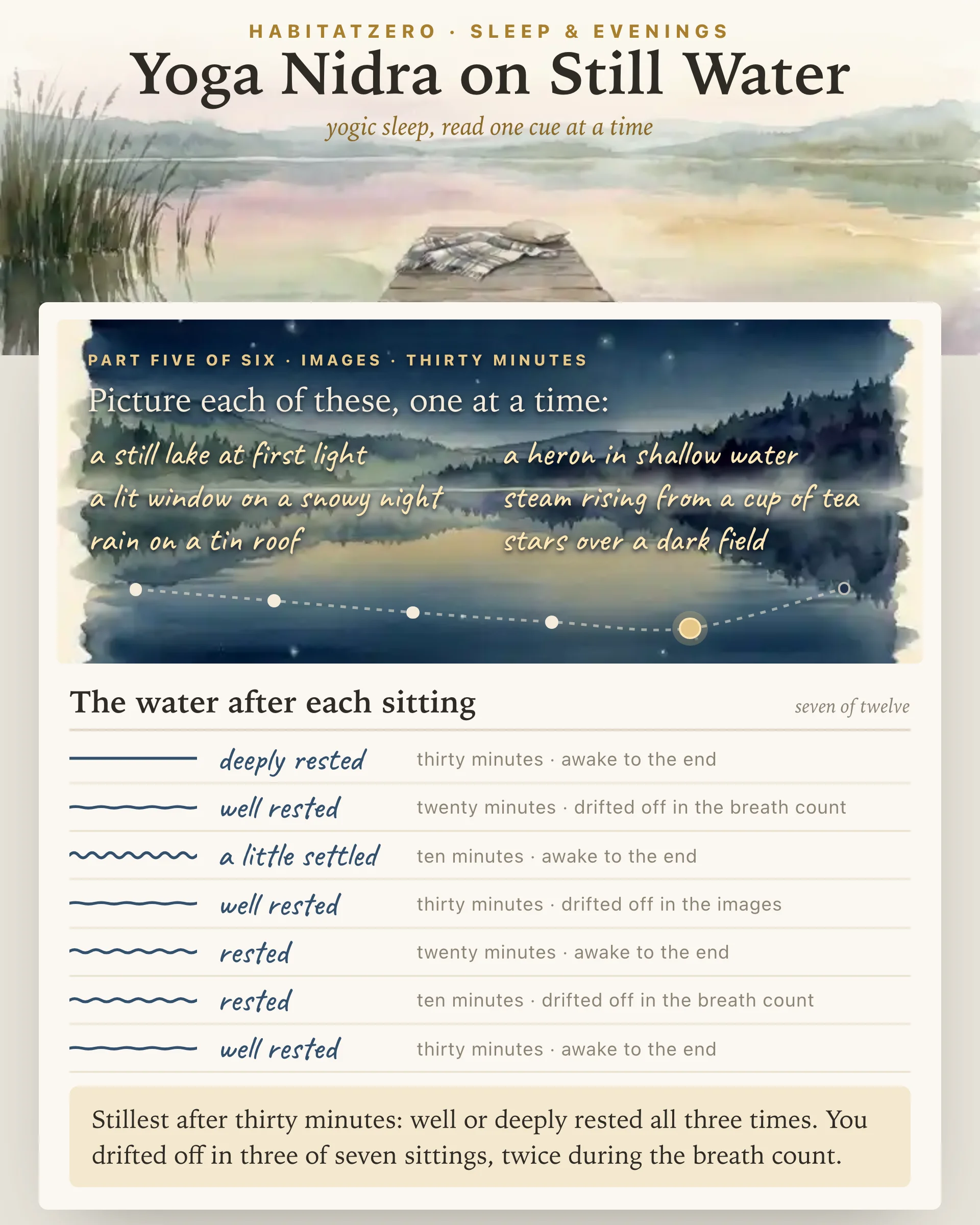
The script sits on a painted lake at night. Choose ten, twenty or thirty minutes and the page assembles the matching version: the short one names the limbs in broad strokes and counts nine breaths, while the long one visits every finger and toe, counts down from twenty-seven, and adds warmth and cold to its images. Your intention appears in your own handwriting at the start and the end, and the pictures you choose replace the page's own.
On your own, read a cue, close your eyes, and open them when you are ready for the next; the note under each cue says roughly how long to stay. If someone reads to you, switch to reading aloud and the notes become pause marks for them. A dotted line along the lake's lower edge shows where you are: down through body and breath, then back up, or staying down with the sleep ending.
When the practice ends, the page asks how still the water is, from choppy to glassy, and whether you drifted off and where. Each sitting leaves its own water line in the log, which holds twelve. From the third sitting, a short reading compares the lengths you have tried at least twice and notices where you tend to slip away, such as the breath count.
Yoga nidra has been studied more than its low profile suggests and less than its fans would like. In a large online study, more than three hundred people who used an eleven-minute recording for thirty days reported less stress, more well-being and better sleep quality than a waitlist group, though the effects were very small to small. For sleep problems, a 2026 meta-analysis found only five studies to pool, most of them small and many run in India, and judged the certainty of the evidence very low. Treat yoga nidra as a restful practice with modest, promising evidence, not a treatment for insomnia, anxiety or anything else, and take sleep trouble that lasts to a clinician.
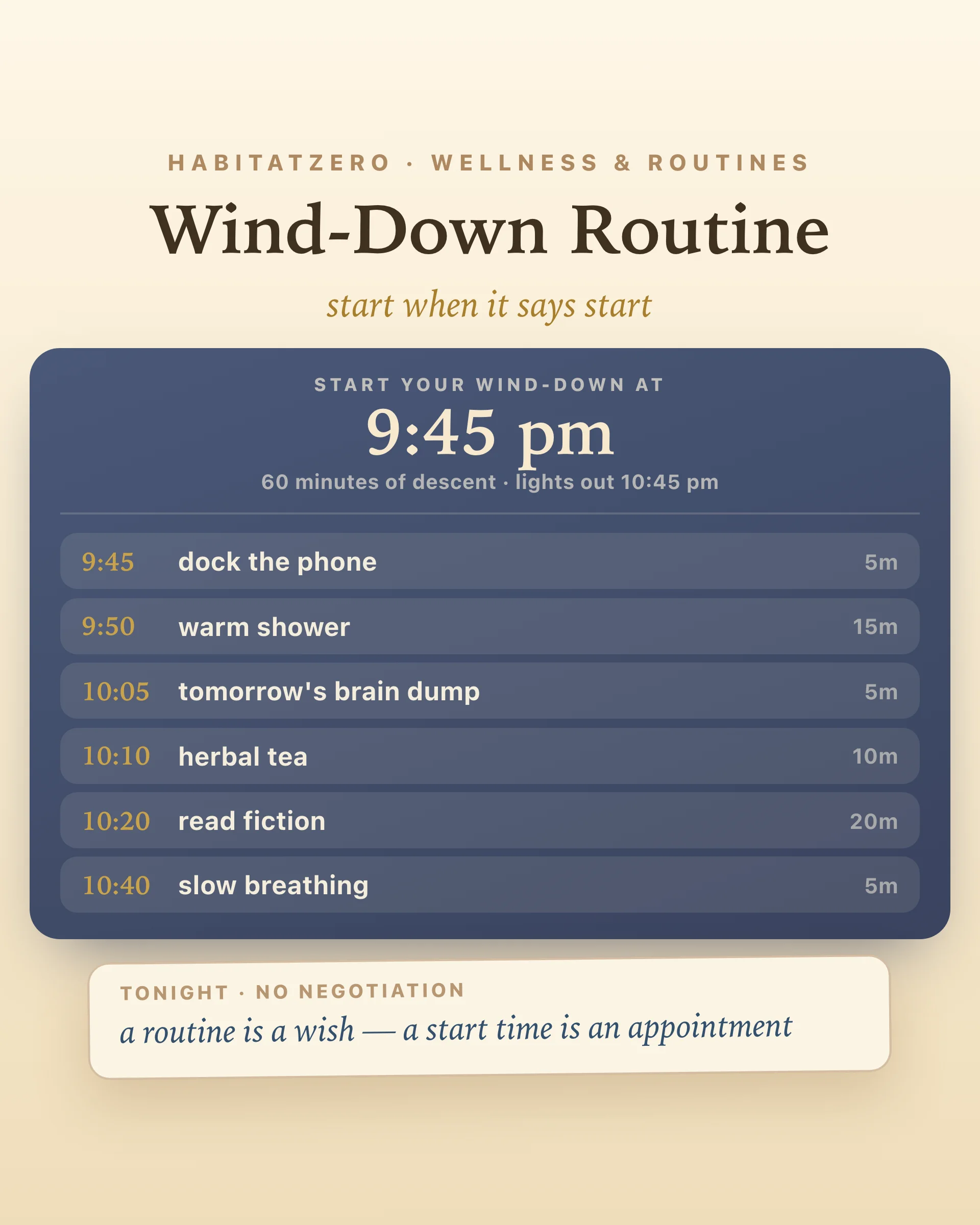
Yoga nidra suits the end of a long day, the slow hour after lunch when a nap would leave you groggy, and the minutes after lights-out when your thoughts will not settle. At night, choose the sleep ending and let the last cue be the last thing you hear, perhaps as the closing step of a Wind-Down Routine Builder plan. In the daytime, choose the ending that brings you back up, and lie somewhere less cozy than your bed if you want to stay awake.
If your body is too wound up to lie still, try a round of Progressive Muscle Relaxation first. If closing your eyes ever stirs up distress instead of rest, open them, look around the room, and stop. Nothing here asks you to push through.
Keep the same intention for a while: a sentence repeated across sittings gives them a thread, while a new one each night hands you a decision just when you meant to rest.
Yoga nidra, Sanskrit for yogic sleep, is a guided practice done lying down. A voice leads your attention through a set order: settling in, an intention, a quick tour of the body, the breath, a run of images, and a return. The aim is to rest very deeply while a thread of awareness stays switched on.
A sankalpa is the short resolve you repeat silently near the start of yoga nidra and again near the end. Keep it brief, positive and in the present tense, such as I rest easily, I meet the day with patience, or I am at home in my body, and let it stay the same for many sittings.
Yes. The classic aim is to stay aware while the body rests, but dozing off is common, especially early on. At bedtime drifting off is the whole point, which is why this script offers a sleep ending. In the daytime, practice earlier or with your head propped a little higher if you want to stay with the voice.
A handful of small trials, many of them run in India, report better sleep quality after regular practice, and a large online study found small drops in stress. Reviews still call the evidence preliminary, so treat yoga nidra as a restful habit rather than a treatment, and see a clinician about sleep trouble that lasts.
A body scan lingers in each region and notices what is there. Yoga nidra moves attention quickly through many small points in a fixed order, then wraps that tour in an intention, breath counting and images, all while you lie still and let the script do the leading.
By the team behind Fabulous, the science-based self-care app used by over 30 million people.