Leaves on a StreamEmotional Fitness · ~3 min
About this template · Updated September 2026
Progressive muscle relaxation began with the American physician Edmund Jacobson, who set out the idea in a 1925 paper titled Progressive Relaxation and built a long, patient training program around it. In 1973 Douglas Bernstein and Thomas Borkovec condensed that program in their manual Progressive Relaxation Training, standardizing a sixteen-group tense-and-release sequence along with shorter seven- and four-group versions. This page is our own practice tool, built independently, and none of these authors or their publishers had a hand in it or endorse it.
The method rests on contrast: tighten one muscle group firmly for a few seconds, release it all at once, then stay with the difference for longer. Tension that has crept in over a day, the raised shoulders or the clamped jaw, is hard to feel because it never changes. Squeezing on purpose and then dropping it gives you a clear before and after, and in time you catch the tight version sooner.
Bernstein and Borkovec advocated holding each squeeze for about five to seven seconds, an interval most studies adopted, with a far longer release. Here the squeeze runs about six seconds and you choose a let-go of twenty or thirty seconds.
Read it slowly, record it, or let the mat pace it. After every squeeze, let go all at once and rest in the difference before moving on.
For the seven-part version, squeeze each whole arm at once, then the whole face, the neck, the shoulders and stomach together, and each whole leg.
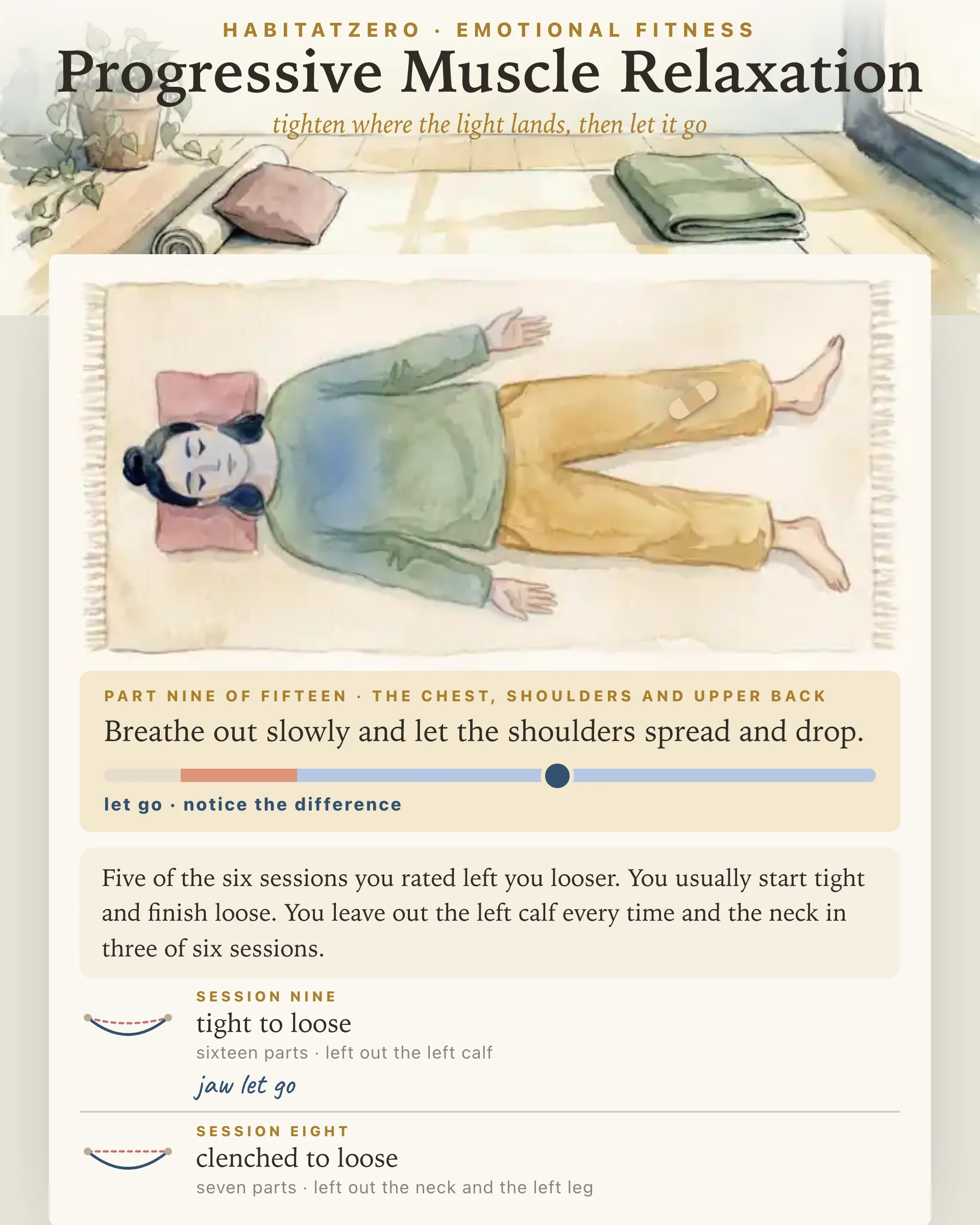
The painted figure on the mat runs the session. Pick seven parts or sixteen, and tap any injured or sore part first: a small bandage marks it and every session skips it. Choose the cord that matches how tight you feel, then follow the light. The part glows warm while you squeeze and turns cool blue when you let go, and a thin bar paces both so you never count. Pause, skip a part that starts to hurt, or end early whenever you need.
Afterward you pick a cord again, and the log draws both readings side by side. From the third session it tells you how often you finished looser and which parts you leave out most. A part you skip every week is worth mentioning to a clinician.
The honest summary is encouraging but modest. A review in the Journal of Anxiety Disorders found that shortened versions of Jacobson's protocol help people with panic disorder and generalized anxiety, yet it could not show that the body's physical arousal actually drops over training, even when people report feeling calmer (Conrad and Roth, 2007). The relief is real; the reason is less settled. That is why this page asks how tight you feel instead of pretending to measure your muscles.
For sleep, the American Academy of Sleep Medicine's guideline for chronic insomnia in adults suggests relaxation therapy as a conditional recommendation, a notch below its strong endorsement of cognitive behavioral therapy for insomnia (Edinger and colleagues, 2021). PMR makes a sensible part of a wind-down, not a cure for insomnia that has lasted months.
Tighten until you can clearly feel the muscle work, and stop well short of pain. Calves and feet cramp easily, so curl the toes gently. Keep breathing through each squeeze; the chest is the only part where holding the breath belongs to the exercise. If you have an injury, recent surgery, or any condition that muscle tension affects, check with a clinician before you start. If squeezing leaves you more wound up than before, soften the effort and use the longer let-go.
The full version suits the last half hour before sleep, as one step in a Wind-Down Routine Builder plan; the short one works seated at a desk. When anxiety sits mostly in the body, Somatic Exercises for Anxiety pairs well with it. And on days when tensing anything feels like too much, Box Breathing gives you a gentler way into the same quiet.
Work through the body one muscle group at a time, usually starting with the hands and ending with the feet. Tighten the group firmly for a few seconds, release it all at once, and spend a longer stretch noticing how different it feels when loose.
The standard protocol from Bernstein and Borkovec holds each squeeze for about five to seven seconds, with a much longer release afterward. This page uses a six-second squeeze and lets you pick a twenty or thirty second release.
It can be a useful part of winding down. For chronic insomnia in adults, the American Academy of Sleep Medicine gives relaxation therapy a conditional recommendation, weaker than its backing for cognitive behavioral therapy for insomnia, so persistent sleep trouble deserves a proper assessment.
Studies of shortened muscle relaxation protocols report benefits for panic disorder and generalized anxiety, though a major review could not confirm that lower muscle tension is the reason. Treat it as a skill to practice, and see a professional if anxiety is shaping your days.
The full script is readable on this page at no cost. Running the paced session on the figure and keeping a before-and-after log happens when you personalize the template in HabitatZero, which is also free.
By the team behind Fabulous, the science-based self-care app used by over 30 million people.