Leaves on a StreamEmotional Fitness · ~3 min
About this template · Updated September 2026
The body scan most people learn today comes from Mindfulness-Based Stress Reduction, which Jon Kabat-Zinn founded at the University of Massachusetts Medical School in 1979, as his official biography notes. It is still one of the three core practices taught in that course, alongside sitting meditation and gentle yoga. Every line of the script on this page was written fresh for it, and the page is an independent worksheet: it has no connection to Kabat-Zinn, to MBSR programs or to UMass Memorial Health, and none of them has endorsed it.
You lie down or sit supported and move your attention through the body one place at a time, noticing whatever is there: warmth, pressure, tingling, tightness, the weight of a blanket, or nothing you can put a name to. You are not trying to relax any of it. That is the real difference from progressive muscle relaxation, where you tighten each muscle group on purpose and then let it go. Here nothing gets tightened, and a place that feels like nothing much is a finding in its own right.
Your mind will wander, often within the first few stops. Noticing that it has drifted and coming back to the stop you were on is not a lapse in the practice. It is most of the practice.
Choose the short scan, about five minutes, or the long one, about fifteen, where each stop has more to notice. Say whether this is a daytime scan or one before sleep, then begin at the crown.
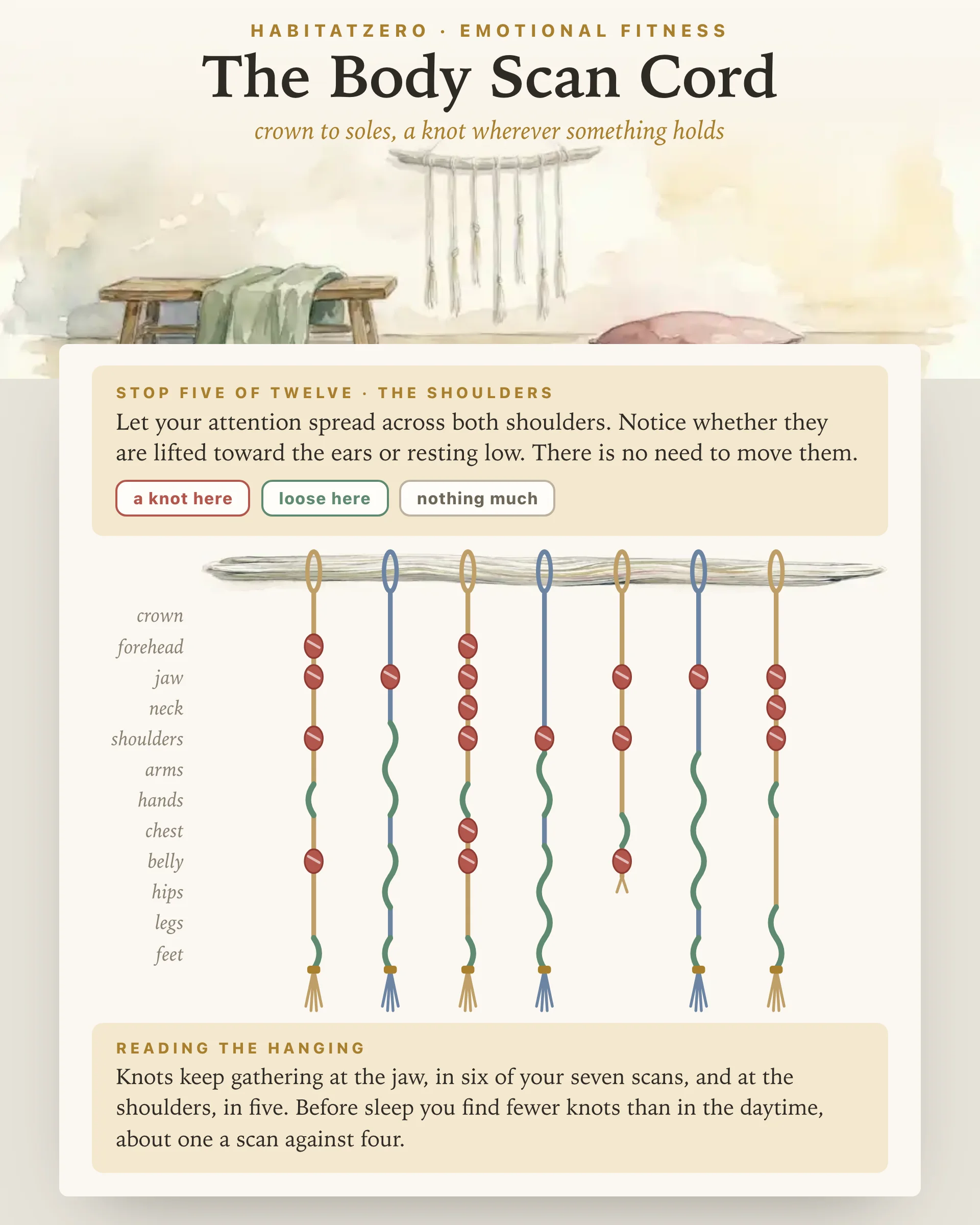
The script moves through twelve stops, from the top of the head down to the soles. Each line appears on its own. Read it, notice, and tap what you found: a knot here, loose here, or nothing much. The cord beside the text takes a knot for tension and a slack loop for ease, and it stays straight for nothing much. If you tapped too soon, step back one stop. If you need to stop early, end there, and the cord simply ends there too. At the close you hold the whole body for a few breaths, add a short line if you want one, and hang the cord.
The hanging keeps twelve cords, oldest on the left. Because every cord marks the same twelve places at the same heights, knots that keep coming back line up across the cords, and you can see your pattern before you read it. After three scans the page names where knots gather and which places are usually loose. Once you have two scans before sleep and two in the daytime, it sets them side by side, so you can tell whether the body you meet at night carries its tension in different places.
The classic MBSR scan usually starts at the feet and travels upward. This one runs from the crown down, so that each scan hangs like a cord. The direction matters less than the pace.
The program the body scan grew up in began with people living with chronic pain. Kabat-Zinn's first report described the meditation as training "detached observation" of body sensation, a way of attending that seemed to loosen the link between the feeling of pain and the alarm that rides along with it. That study had no control group, and its participants followed a whole ten-week program, not the body scan alone.
Studied on its own, the body scan looks modest. A 2022 meta-analysis of fourteen randomized trials found only a small effect on mindfulness compared with passive control groups, rated the studies as low in quality, and concluded that a body scan by itself is not enough to improve health outcomes.
So treat this page as practice in paying attention, not as treatment. What it can honestly give you is information: a record of where your own tension tends to sit, which is worth bringing to a stretching routine, a physical therapist, or the next moment your shoulders start creeping toward your ears.
Scan in bed before sleep, at your desk in the middle of the afternoon, or after a conversation that left you braced. If one place keeps knotting and you suspect a feeling lives there, the Emotions Body Map helps you look for its name. If you would rather sit with no script at all, the Meditation Timer keeps time with a bell. When anxiety is loud in the body and noticing is not enough, Somatic Exercises for Anxiety gives it something active to do.
If turning toward the body stirs up distress rather than calm, open your eyes, shorten the scan or skip a place. That is allowed, and a therapist can help you adapt the practice. Pain, numbness or a sensation that is new and worrying is a question for a clinician, not something to scan your way past.
It is the wording that guides your attention through the body one region at a time, usually lying down, asking you to notice each sensation without trying to change it. You can follow it silently at your own pace or read it slowly aloud for someone else.
The formal body scan taught in Mindfulness-Based Stress Reduction runs about forty-five minutes. Everyday versions of five to fifteen minutes are common, which is why this script comes in a short length and a long one with more to notice at each stop.
No. Progressive muscle relaxation has you tighten each muscle group on purpose and then release it. A body scan asks for no tensing at all; you only notice what each place already feels like, including when it feels like nothing much.
Yes. Lying in bed is a fine place for it, and drifting off partway through is nothing to worry about. Mark the scan as before sleep and the hanging keeps those cords apart from your daytime ones, so you can see whether night and day feel different in the body.
You can read the whole script on this page and look over the example cords. To keep your own scans and watch where your knots gather over the weeks, personalize the page in HabitatZero at no cost.
By the team behind Fabulous, the science-based self-care app used by over 30 million people.