Leaves on a StreamEmotional Fitness · ~3 min
About this template · Updated September 2026
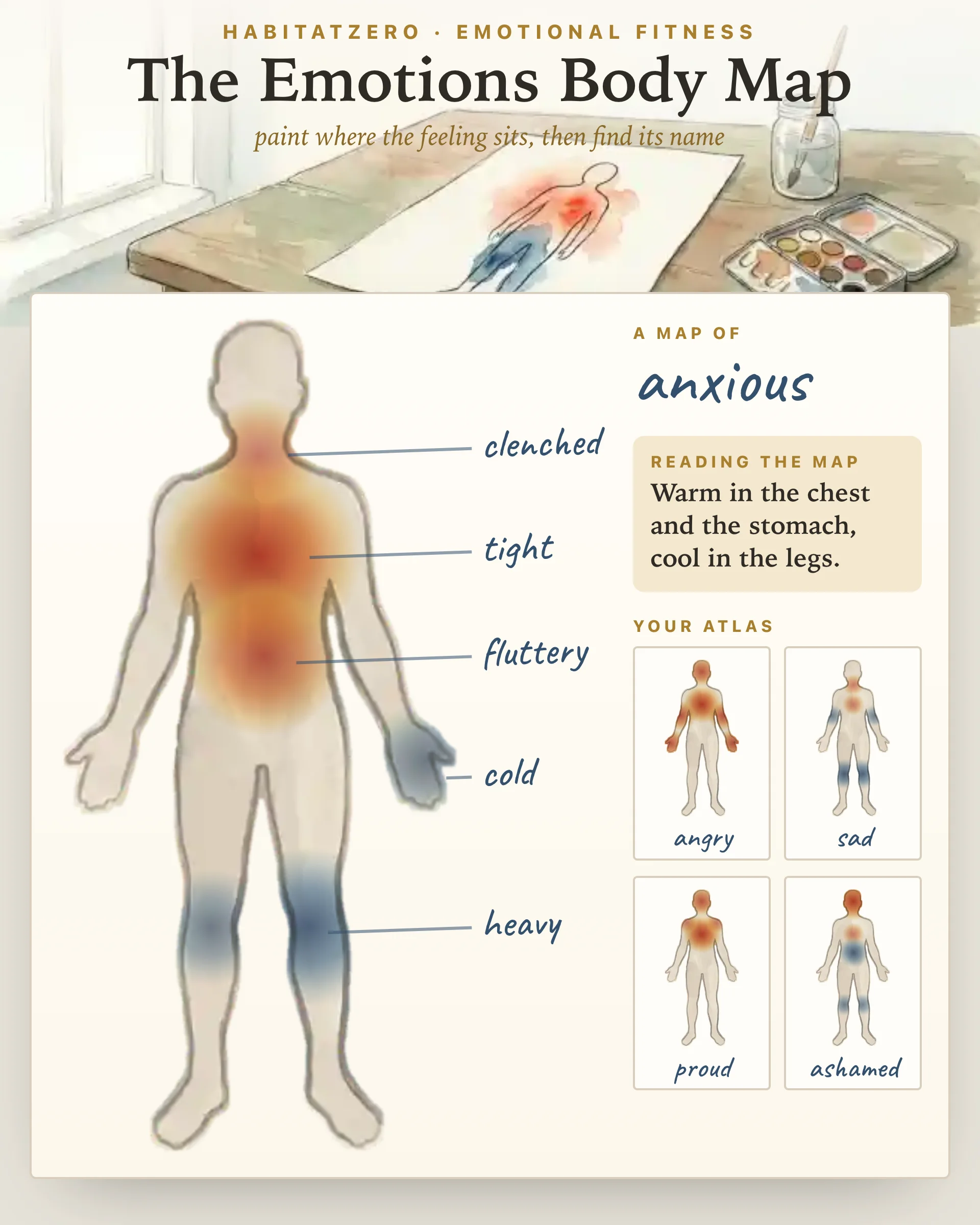
Ask someone what they feel and you often get "fine" or a shrug. Ask where they feel it and the answer comes faster: a band across the chest, a fist in the stomach, legs gone heavy. The body is usually ahead of the vocabulary. An emotions body map starts from that fact: you color a blank figure where the feeling registers, and only afterward go looking for the word.
The version most people have seen is a grid of glowing silhouettes from a study led by Lauri Nummenmaa, published in PNAS at the turn of 2014. Around seven hundred people in Finland, Sweden and Taiwan were shown two blank bodies alongside an emotion word, a story, a film clip or a face, and asked to paint the regions where they felt activity rising on one body and falling on the other. Averaged together, the paintings produced a distinct map for each emotion, and the maps looked much the same across the three countries.
Some of what they found matches folk wisdom, and some does not. Almost every basic emotion warmed the upper chest, which the authors read as breathing and heart rate changing. The head lit up for everything, so a head sensation on its own tells you little. Arms and hands came alive mostly in anger and happiness, the two emotions that move toward something. Sadness was the one feeling defined by a drop, a dimming of the arms and legs. Disgust gathered around the throat and the gut. Happiness was the outlier, painted warm from head to feet, and NPR's write-up of the study noted that love came close to the same whole-body glow. A later replication by the same group found the maps held up across cultures.
Two honest caveats. These are self-reports, not thermometers: the maps show where people say they feel things. And they are averages. Your own anger may sit nowhere near the average anger, which is precisely why a personal map is worth drawing.
The sheet is a painted body outline on a taped-down piece of paper. You pick one of two brushes. Warm is for places that feel faster, hotter or tighter than usual. Cool is for places that feel slower, dimmer or numb. Then you tap the figure wherever the feeling shows up. One tap lays a soft wash; tapping the same spot again deepens it, up to three times, which is how the original study's painting tool worked as well. The map holds twelve marks and says so if you try for a thirteenth.
Every mark asks for a word. Warm marks offer tight, racing, fluttery and prickly; cool marks offer heavy, hollow, sinking and far away. Pick one or write your own. This is the somatic half of the exercise, and the half people skip on paper.
Underneath, the reading writes itself. It says in plain words where your map runs warm and where it runs cool, then adds what the research maps showed for those places. If your marks sit in the throat and stomach, it will mention disgust. If your limbs run cool, it will mention sadness. It never tells you what you feel. Instead it lends a few emotion words that people painted in a similar pattern, and you choose one, or ignore them all and write the word that fits.
When the map is done, keep it. It shrinks into an atlas of small figures, one per feeling, and after a few the sheet starts counting: the chest carries a mark in four of your five maps, say. That count is the part a printed worksheet cannot do, and it is where the pattern of your own body begins to show.
The order matters. Naming an emotion changes how it lands, and there is a mechanism behind that. In a brain imaging study by Matthew Lieberman and colleagues, putting feelings into words while looking at emotional images dampened the amygdala's response compared with other ways of engaging with the same pictures. But a label picked too early can be wrong, and a wrong label is hard to dislodge. Going body first gives you evidence before the verdict. Tight chest, fluttery stomach, cold hands: that pattern might be fear, might be excitement, might be the third coffee. The map lets you hold the question open a little longer.
Reach for it when you know something is going on but "fine" is the only word available, or during a feeling that keeps returning, so the atlas can show whether it always lands in the same place. Parents and teachers can sit beside a child and do the tapping together, with the child describing sensations out loud.
If the map gives you a word and you want to sharpen it, the Feelings Wheel turns one word into a more precise one. If the map runs hot and you need the charge to come down before you can think, 5-4-3-2-1 Grounding works through the senses rather than the vocabulary. And once you can see the pattern, Steadying Practices is where you plan what to do with it.
One boundary. A body map notices; it does not diagnose. A sensation that is intense, unfamiliar or frightening, especially in the chest, is a question for a doctor before it is a question for a worksheet.
It is a body outline you color to show where an emotion registers physically: heat in the chest, a knot in the stomach, heavy legs. Therapists use it as a somatic exercise because sensations are often easier to locate than a feeling is to name. This page turns it into a figure you paint by tapping.
In a study published in PNAS at the turn of 2014, Lauri Nummenmaa and colleagues asked around seven hundred people from Finland, Sweden and Taiwan to color where activity rose or fell during different emotions. Most basic emotions lit the upper chest, anger and happiness reached into the arms, sadness dimmed the limbs, disgust gathered around the throat and gut, and happiness warmed nearly the whole body.
Close your eyes for a moment and scan from head to feet, noticing any place that feels different from neutral. Mark it warm if something is speeding up or tightening and cool if it is slowing or fading. Give each spot a sensation word, and only then look for the emotion word. Doing it in that order keeps you from deciding what you feel before you have checked.
This one is built for tapping rather than printing, but the print view keeps your painted figure, its words and the reading while hiding the buttons, so a finished map prints cleanly as a single sheet.
You can explore the filled example on this page for free. Painting your own figure and keeping an atlas of maps happens inside HabitatZero, which costs nothing to join.
By the team behind Fabulous, the science-based self-care app used by over 30 million people.