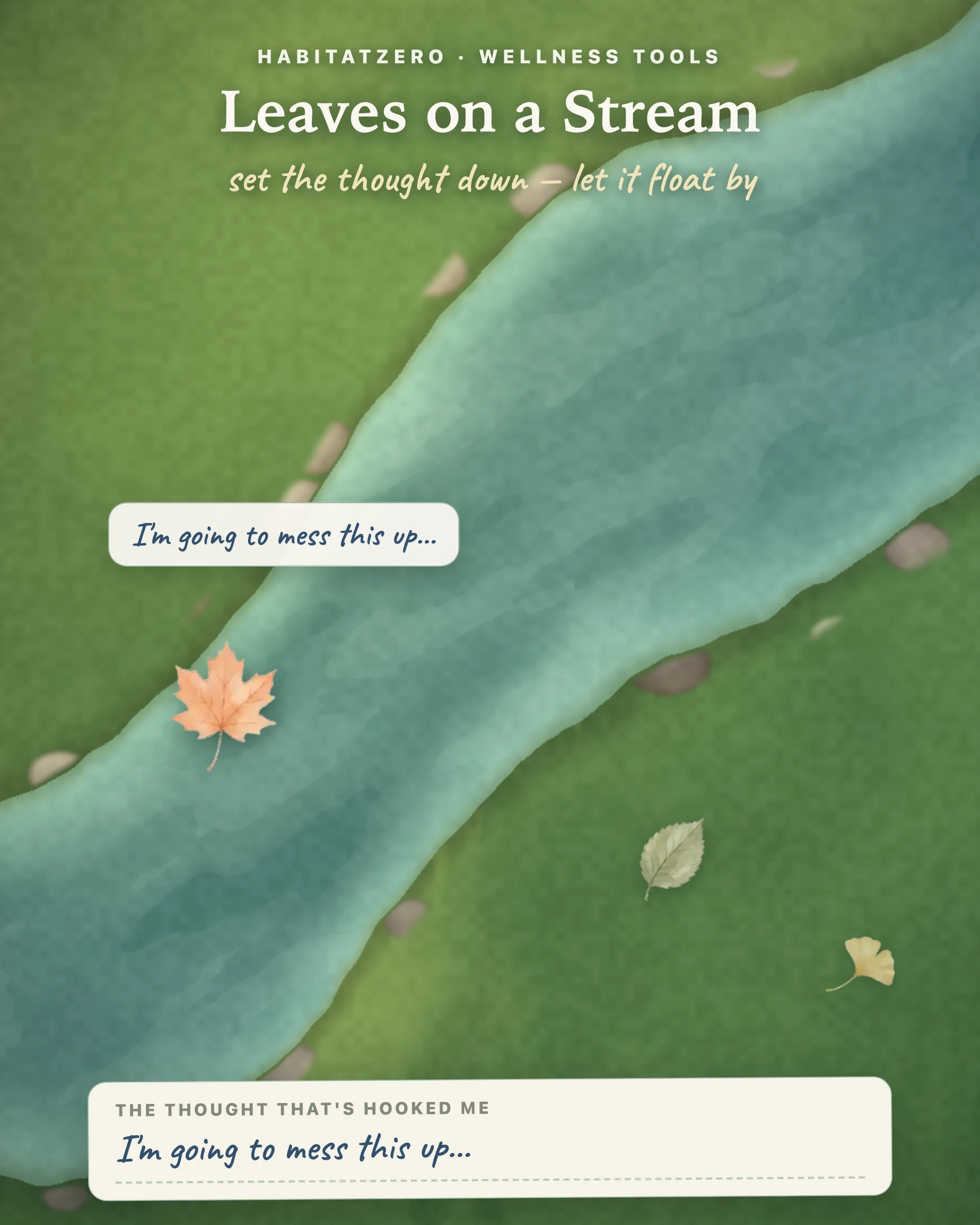
Leaves on a StreamEmotional Fitness · ~3 min
About this template · Updated July 2026
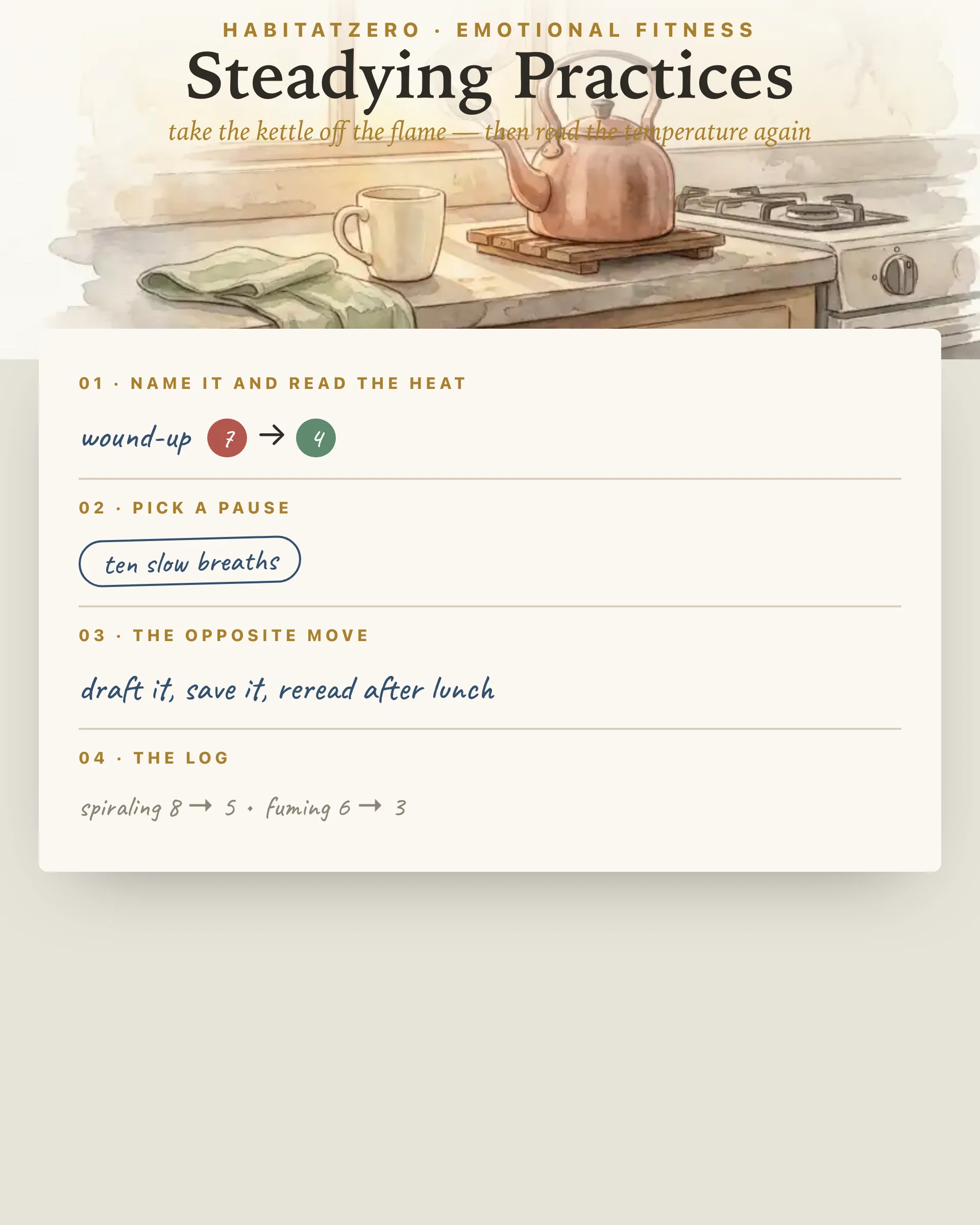
Every kitchen has the move: the kettle screams, you take it off the flame, and the scream thins into steam. Nobody argues with a boiling kettle, and nobody fixes it either — you just change its relationship to the heat. That's the entire premise of this worksheet. Feelings at full boil don't need analysis; they need the flame turned down long enough for the person holding the kettle to make a choice.
01 — Name it and read the heat. Your own word first — fuming, spiraling, wound-up — then a number, one to ten. The word starts the cooling; the number tells you what you're dealing with. James Gross's integrative review of emotion regulation laid out the insight the whole field is built on: emotions unfold as a sequence, and you can step in at different points along it. A four and a nine are different points. The dial is how you find out which one you're at.
02 — Pick a pause. Five interrupters, all body-first, all doable in about ninety seconds: ten slow breaths, cold water on the wrists, two minutes outside, counting backward from one hundred by sevens, naming five things you can see. Slow breathing has the deepest evidence file — a systematic review of breath-control studies links slow techniques with increased calm and reduced arousal — but the best pause is the one you'll actually do with shaking hands. The pause solves nothing. It buys the minute in which a choice becomes possible, which is everything.
03 — The opposite move. Write the urge in one honest line: fire off the reply right now. Then write what the opposite would look like, concretely: draft it, save it, reread after lunch. Hot feelings arrive with instructions, and the instructions are usually written by the heat rather than by you. Acting opposite — kindly when the urge says cut, slowly when it says now, toward when it says away — is the oldest trick in the self-command playbook precisely because the urge's instructions are so reliably wrong at a seven or above.
04 — Read the heat again, and log it. Second dial, same scale. Then log the practice: date, your word, the before → after. This last step looks like bookkeeping and is actually the engine. A log that reads spiraling 8 → 5, fuming 6 → 3 is personal, handwritten evidence that the boil passes — and that evidence is the thing your next hot moment will try hardest to make you forget.
It's a practice, not a program. It borrows the everyday versions of well-studied ideas — naming, physiological pauses, acting against the urge — and puts them on one page you can reach while the kettle is still loud. Use it in the moment when you can, and in the aftermath when you can't; a practice logged an hour late still counts, and still teaches.
It is not a substitute for professional help. If the heat regularly hits levels that frighten you or runs your days, that pattern belongs with a licensed professional — and the practice log is a genuinely useful thing to bring to that first conversation.
For the quieter work between hot moments, the same family holds the slower tools: the emotion processing sheet for walking a moment through once it's cooled, and the feelings wheel for finding the precise word when wound-up isn't quite it.
Kettle off the flame. Ninety seconds. The opposite of the urge. Read the dial again — it came down, and now you have it in writing.
A structured page for the moments when a feeling is running the show. This one walks a single hot moment through four moves: name the feeling in your own word, read its intensity on a one-to-ten dial, interrupt it with a ninety-second pause you choose, and write the opposite of what the urge is demanding. Each practice gets logged with its before-and-after heat, so the sheet slowly becomes proof that the temperature does come down.
Three moves cover most hot moments: name it, pause it, oppose it. Putting the feeling into a word of your own starts the cooling; a short physical interrupter — slow breaths, cold water, stepping outside — settles the body enough for a choice, and research on slow breathing links it with measurable calming of the stress response; then doing the concrete opposite of the urge breaks the loop the feeling wanted to run. The worksheet is exactly this sequence with a pen.
Because in a hot moment the thinking is exactly what is compromised. The sheet externalizes it: the word, the number, the chosen pause, and the opposite move sit on paper where the heat cannot edit them. The one-to-ten dial also does quiet work over time — a log of sevens that became fours is hard-won personal evidence that the boil passes, which is easier to believe when it is your own handwriting.
Yes — the page ships a print stylesheet, so printing or saving to PDF produces a clean paper version: the four numbered steps, the heat dials, and the pause list, ready for a desk drawer or the fridge. Signed-in HabitatZero users keep the interactive layer everywhere: tappable dials, the pen-circled pause, and the running practice log.
No. This is a self-help practice for the ordinary hot moments of a normal life — the email that spikes you, the comment that lands wrong. If emotions regularly reach intensities that frighten you, take over for hours, or interfere with work and relationships, that pattern deserves a licensed professional rather than a worksheet, and bringing your practice log to that conversation is a genuinely useful head start.
By the team behind Fabulous, the science-based self-care app used by over 30 million people.