
The Overwhelm Recovery ProtocolWellness & Routines · ~5 min
About this template · Updated November 2026
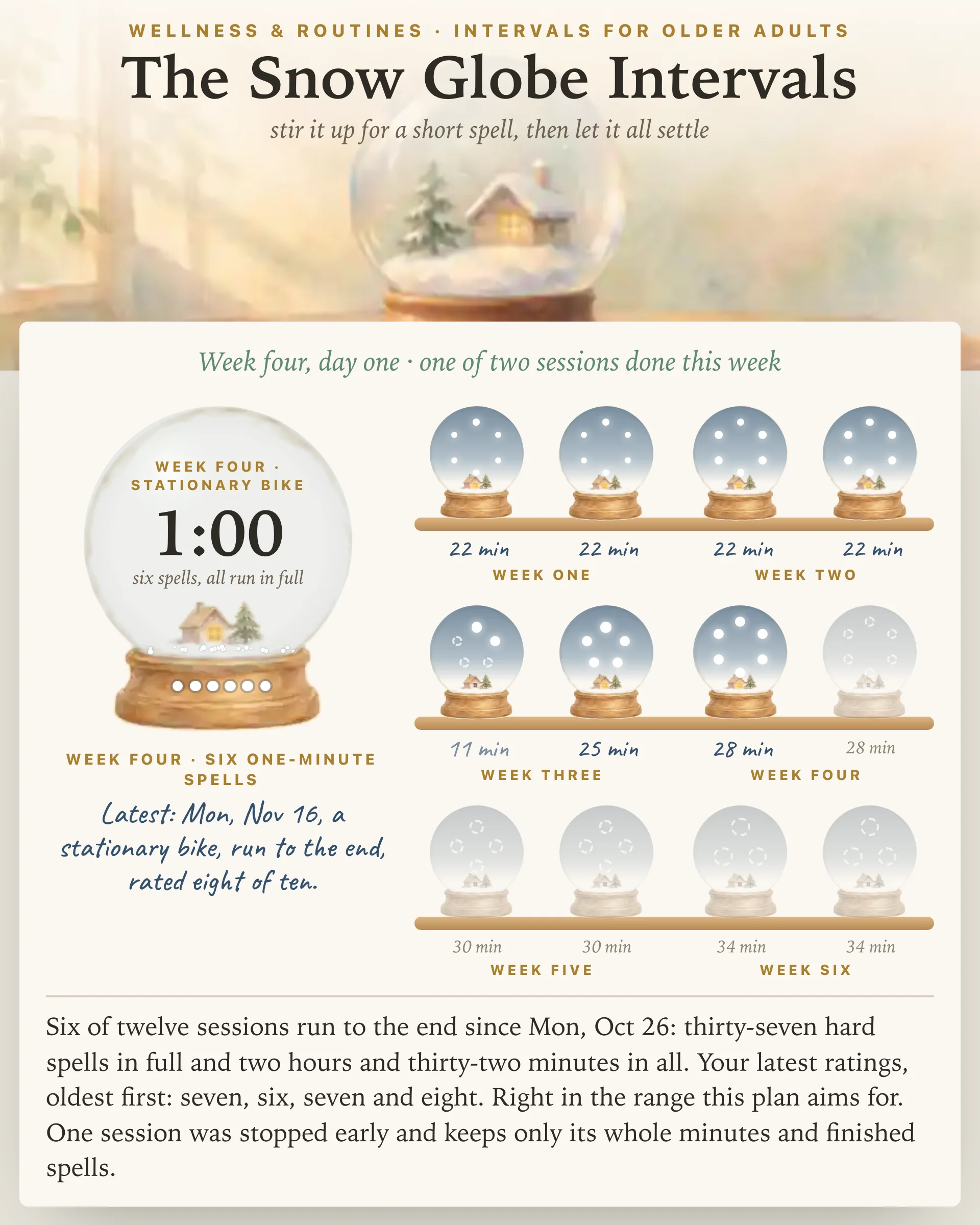
Interval training has a reputation built on sprints and burpees, but the idea is gentler: push hard for a short spell, ease off to recover, and repeat a few times. This page builds HIIT for older adults the way research supports it, with nothing to jump over: marching in place, step-ups on a low step, a stationary bike or a brisk walk, about half an hour twice a week.
Each session opens with five easy minutes building toward brisk and closes with five of slowing down. Between them come the hard spells, each followed by an easy spell at least as long. Week one asks for six hard spells of twenty seconds, with a minute and forty seconds of easy marching after each. By week six there are three four-minute spells, each with four easy minutes after.
Or build your own: pick a spell from twenty seconds to four minutes, and the page sets a sensible count and easy time. The plan runs two sessions a week for six weeks, the weekly dose the largest trial in older adults gave its interval group.
The CDC's page on measuring activity intensity describes a talk test: at a moderate effort you can talk but not sing, and at a vigorous one you manage only a few words before pausing for breath. On its zero-to-ten scale, moderate is five or six and vigorous starts at seven or eight.
The hard spells aim for six or seven in weeks one and two, while you can still talk in short phrases, then seven or eight. If you cannot speak at all, ease off. By the end of each easy spell you should manage a full sentence; if not, pause the timer and keep moving gently until you can.
Inside the painted globe, the snow swirls in a hard spell and settles in the easy one, roughly as your breathing should. A hard spell counts only once it runs its full time, and each one adds a pip to the globe's base. The clock reads real time, so a locked phone keeps your place, and an early end keeps only whole minutes and finished spells.
A session run to the end lights the cottage window and joins a shelf of twelve globes, and you rate its hard spells from one to ten. One nine or ten is enough to suggest easing off, while a nudge to push harder waits for two whole sessions in a row at five or under.
The largest is Norway's Generation 100 trial: 1,567 adults aged 70 to 77, most in good health and already fairly active. One group swapped two weekly moderate sessions for a ten-minute warm-up and four rounds of four minutes at about ninety percent of peak heart rate, with supervised sessions offered twice a week and an effort check every sixth week. After five years, deaths did not differ between the exercise groups combined and people following national activity advice. The interval group kept slightly more fitness and showed a trend toward fewer deaths that the trial could not confirm. About half kept up the intervals as prescribed.
A small trial in Minnesota put nine sedentary but healthy adults aged 65 to 80 through twelve supervised weeks of interval cycling, three days a week, plus two days of walking. Their aerobic capacity rose by about seventeen percent (Robinson and colleagues). People with heart disease or diabetes could not take part.
A 2024 meta-analysis pooled 44 randomized trials with 1,863 people whose average ages ran from about sixty to eighty-one. Against no exercise, intervals improved aerobic fitness, resting heart rate, systolic blood pressure and muscle strength. Most ran in a lab, and nearly a third did not report side effects, so the authors could not settle how safe intervals are for older people.
So intervals improve fitness in later life, mostly in supervised, healthy volunteers. A home plan cannot copy that supervision, so this one starts small and keeps its recoveries long.
Get your doctor's okay before the first session if you have a heart condition, high blood pressure or diabetes, if you have had a heart attack, a stent or heart surgery, or if hard effort is new to you. Talk to a doctor or physical therapist too after a fall, dizziness or a joint replacement, or with ongoing pain. Keep a counter, rail or sturdy chair within reach, and stop any move that hurts.
Stop at once and sit down for chest pain or pressure, dizziness, breathlessness that does not settle in the easy spell, or a racing or uneven heartbeat. Call 911 for chest pain or pressure that does not ease within a few minutes of rest.
The Beginner HIIT Pinwheels is a five-move circuit, with jumps or without, three times a week. The HIIT Timer is a plain work-and-rest clock for intervals you already know. This page is narrower: low impact only, effort set by how well you can talk, recoveries longer than the work, and a plan paced for older bodies. For walking intervals with no step or bike, Japanese Interval Walking Timer alternates brisk and easy three-minute stretches. For steady low-impact sessions with no hard spells, The Windsock Cardio Plan sets each block's effort by the same talk test.
For many healthy older people it is, when the hard spells are short, low impact and followed by long recoveries. Most trials ran under supervision, so get your doctor's okay first if you have a heart condition, high blood pressure or diabetes, or have had a heart attack, a stent or heart surgery. Stop at once for chest pain, dizziness or breathlessness that does not settle, and call 911 for chest pain that does not ease with rest.
One with no jumping and plenty of recovery: five minutes of easy warm-up, then six short spells of fast marching, quicker step-ups on the bottom stair, harder pedaling or a faster walk, each followed by easy movement at least as long, and five minutes of cooling down. The spells can grow from twenty seconds toward four minutes over several weeks.
Twice a week is a sensible ceiling to start, with at least a day of easy activity between sessions. The largest trial in people in their seventies asked for two interval sessions a week, alongside their usual moderate activity on other days.
Hard enough that you can say a few words but not a full sentence during the hard spells, which is about seven on a scale of one to ten. In the easy spells you should get back to talking comfortably. Being unable to speak at all means you have pushed past what a home plan needs.
Often yes, if you choose the stationary bike or brisk walking and skip the step. Keep the hard spells short at first, and stop any move that causes sharp pain. If your knees hurt during ordinary walking, ask a physical therapist which option suits you before you add hard spells.
By the team behind Fabulous, the science-based self-care app used by over 30 million people.


