
The Overwhelm Recovery ProtocolWellness & Routines · ~5 min
About this template · Updated November 2026
Pelvic floor exercises are often called Kegel exercises, after Arnold Kegel, the American gynecologist who described a program of progressive exercise for these muscles in 1948. This page is an independent practice log built on his idea and on public guidance, and is not affiliated with or endorsed by anyone connected to his work.
Your pelvic floor is a layer of muscle slung across the bottom of the pelvis, from the pubic bone to the tailbone, a little like a hammock. It holds up the bladder and bowel, and the uterus in women, and it closes around the openings through it so you can hold urine, stool and gas until you choose. Pregnancy, birth, prostate surgery and years of straining or coughing can weaken it, and like any muscle it can be trained.
Relax your thighs, buttocks and belly, then squeeze as if holding in gas and stopping the flow of urine at once, and let go. Women usually feel the vagina and anus draw in and up. Men usually feel the base of the penis pull toward the body and the scrotum rise a little. If your buttocks clench or your breath stops, ease off: the squeeze you want is smaller and deeper.
Use the stop-the-flow idea only to find the feeling: stopping your urine midstream as a regular exercise can keep the bladder from emptying fully. If the squeeze is hard to feel at first, that is common, and a pelvic floor physical therapist can check it with you.
Each set has two parts. Slow squeezes build endurance: draw up, hold while you breathe, then rest as long as you held. Quick squeezes train the fast response a cough or a sneeze calls for: one second in, two seconds of letting go. You do three sets a day, lying, sitting and standing, so the muscles learn to work as you come upright.
Week one asks for five slow holds of three seconds and five quick squeezes, about a minute a set. The holds grow by about a second a week until week ten reaches ten of each, held for ten seconds, about four minutes a set. Week eleven adds a habit physical therapists often teach: a quick squeeze just before you cough, sneeze or pick up something heavy.
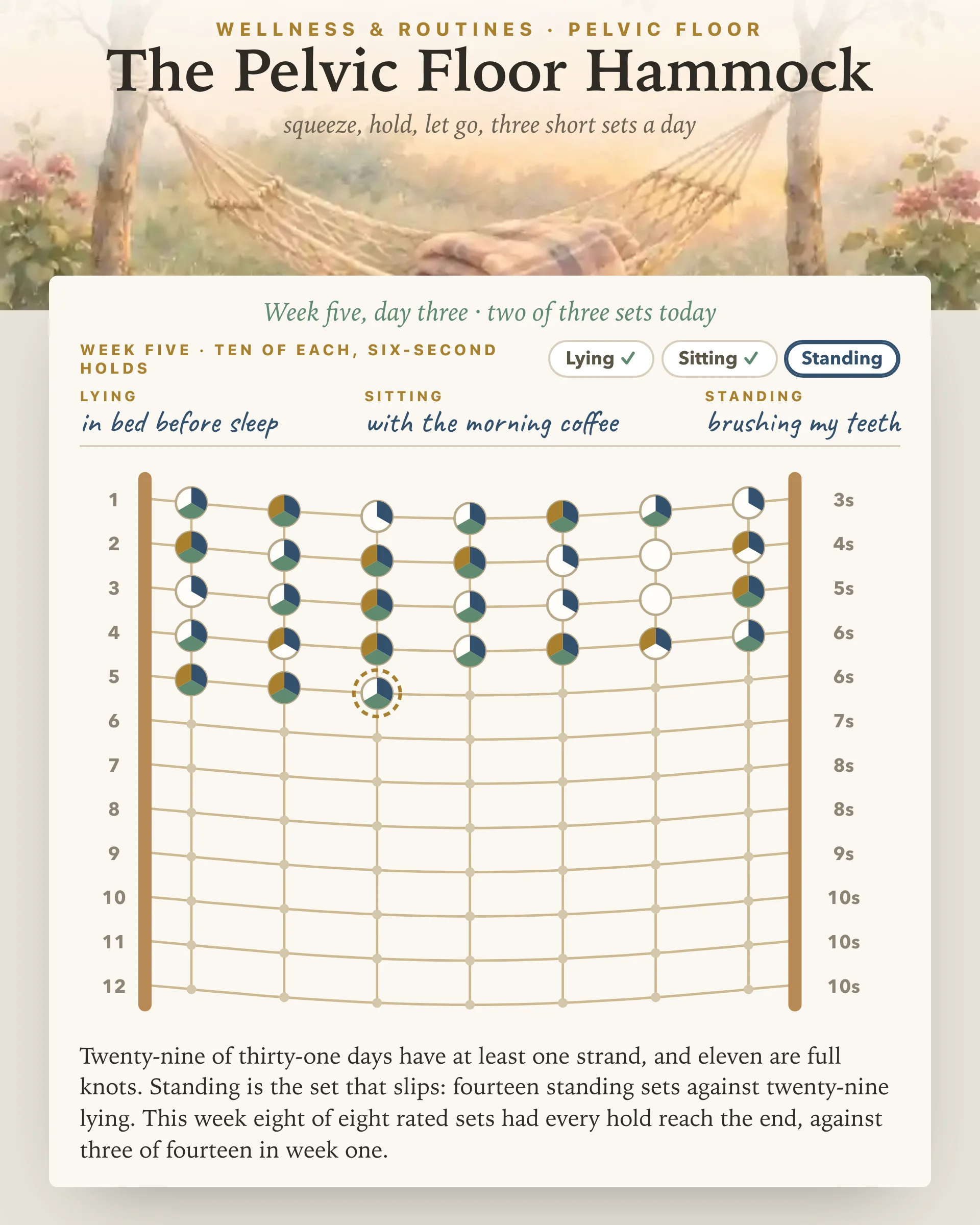
The painted hammock is the pacer. When it is time to squeeze, the hammock draws up and the count runs down; when it is time to rest, it settles. It reads the clock rather than counting beats, so a phone that locks halfway through still knows where you are.
Each finished set ties a strand into that day's knot on a twelve-week net: blue for lying, green for sitting, gold for standing. Sets done away from the page can be marked by hand. After a set you note whether every hold reached the end, some faded early, or something hurt, and the reading under the net says how many days carry a strand, which position slips most, and how this week's holds compare with week one. Note pain and it tells you to stop and get checked.
For women with stress leakage (leaks when you cough, sneeze or exercise), the evidence is strong. A Cochrane review of 31 trials found that those who trained these muscles were about eight times more likely to report a cure than women who did not, 56 percent against 6 percent, with rare and minor side effects. The NICE guideline on urinary incontinence in women recommends a supervised program of at least three months as the first treatment, with at least eight contractions three times a day. That is why this plan lasts twelve weeks and asks for at least ten squeezes in every set.
That guideline also asks for an examination to confirm the squeeze before training. A page can neither examine nor supervise, so treat this log as a way to keep practicing, not a stand-in for that care.
For men the picture is less clear. A Cochrane review of care after prostate surgery found no clear benefit from pelvic floor training over usual care for men already leaking in the year after radical prostatectomy, and called the value of such treatment uncertain; if your surgical team gave you a program, follow theirs. Nor does anything here show that training without symptoms prevents problems later.
See a doctor or a pelvic floor physical therapist before you start if you leak urine or stool, have pelvic pain, feel heaviness or a bulge in the vagina or the anus, are pregnant or gave birth recently, or have had prostate or pelvic surgery. Some pelvic pain comes from muscles that are already too tight, and more squeezing does not help that. Stop if anything hurts, and keep breathing through every hold.
Twelve weeks is long for something nobody can see. Tie each set to a moment you already have, such as brushing your teeth, which is the stacking move from the Habit Loop Worksheet, and let the net do the remembering. For the let-go half of each squeeze, Belly Breathing teaches a slow, low breath that pairs well with softening.
Sit, stand or lie with your thighs, buttocks and belly relaxed. Tighten the muscles you would use to hold in gas and stop the flow of urine, draw them up, and hold for a few seconds while breathing normally. Then let go completely for the same length of time. Follow the slow holds with a few quick one-second squeezes, and repeat the whole set three times a day.
The squeeze is the same, because both sexes have a pelvic floor holding up the bladder and bowel. What you notice differs: women tend to feel the vagina and anus draw inward and up, while men feel the base of the penis pull in and the scrotum rise slightly. In women the uterus also rests on these muscles, which is part of why pregnancy and birth can strain them.
Give them about three months of daily practice before you judge. For women with stress leakage, the NICE guideline asks for at least eight contractions three times a day over a supervised program lasting at least three months, and advises carrying on with the exercises once they help. Some people notice a change sooner.
They can when the muscles are already too tight, which is one cause of pelvic pain, because more squeezing adds to the strain. Pain, pressure, heaviness or a bulge during or after a set is a reason to stop and see a doctor or a pelvic floor physical therapist. Stopping your urine midstream as a regular exercise can also keep the bladder from emptying fully, so use that idea only to find the muscles.
No. Arnold Kegel described a program of progressive exercise for these muscles in 1948, and his name stuck to the squeeze, but no official version exists today. This hammock log is independent and is not affiliated with or endorsed by anyone connected to his work.
By the team behind Fabulous, the science-based self-care app used by over 30 million people.


