The Overwhelm Recovery ProtocolWellness & Routines · ~5 min
About this template · Updated July 2026
First, credit where it is due: the vocabulary on this sheet — the habit loop, habit stacking, the two-minute rule, identity-based habits, the four laws of behavior change — comes from James Clear's book Atomic Habits. This page is an independent worksheet for practicing those ideas and is not affiliated with, endorsed by, or connected to the author or his publishers. If the method earns its keep in your week, the book is where it lives in full.
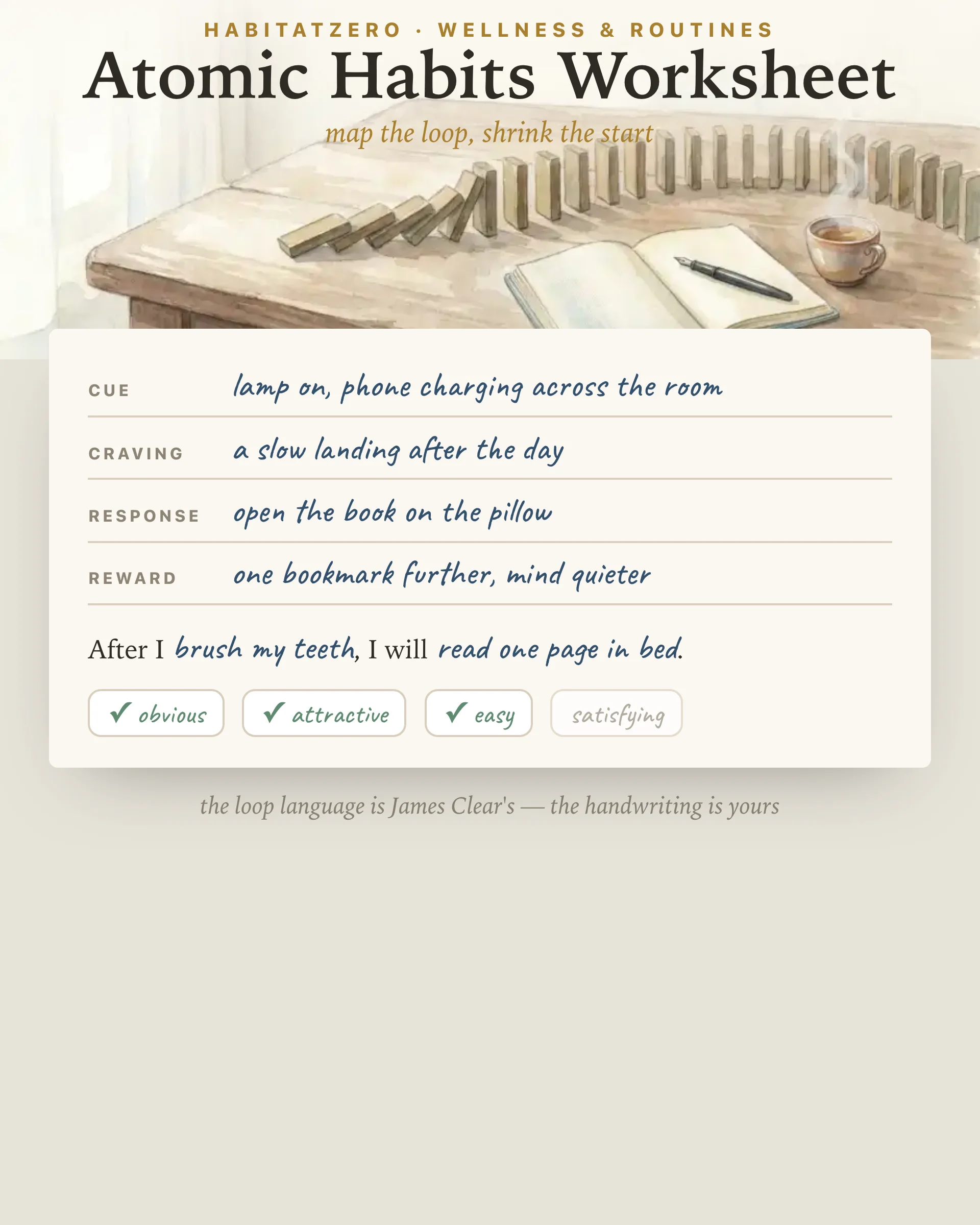
What the worksheet adds is the part a book cannot do: your handwriting. Reading about a habit loop changes nothing; writing down the actual cue that fires in your actual hallway is where the redesign starts. The sheet walks one habit through four moves.
The loop comes first because the loop is the diagnosis. Cue, craving, response, reward — when a habit refuses to stick, one of those four lines is usually blank in real life, and seeing which one is the whole game. The reward line trips people most: if nothing closes the loop, tomorrow has no reason to answer the cue.
The stacking sentence and the two-minute starter are both borrowed schedules. "After I brush my teeth, I will read one page" works because it attaches the new behavior to one that already survives your worst days — a formalized version of the implementation intentions Peter Gollwitzer showed to be strikingly effective across nearly a hundred studies (Gollwitzer, 1999). And the two-minute line exists because repetition, not intensity, is what automates a behavior: in Phillippa Lally's field study, habits took anywhere from 18 to 254 days to become automatic, and missing a single day made no measurable difference to the curve (Lally et al., 2010). A start small enough to repeat beats a start impressive enough to skip.
The identity line is the quiet one, and the one worth writing slowly. A habit that is only a task competes with every other task; a habit that is evidence — I am becoming the kind of person who ends the day reading — gets defended differently.
When the sheet is filled, the design work is done and the repetition work begins. Track the showing-up wherever you track your days — the daily habit tracker gives every repetition a stamp — and come back to this map whenever the habit wobbles, to see which of the four lines broke.
A one-page working sheet for the habit-building method popularized by James Clear's book Atomic Habits: you map one habit's loop, write a stacking sentence, shrink the start to two minutes, and name the identity the habit votes for. The method vocabulary is his; the filled-in page is entirely yours.
No. This page is independent and is not affiliated with, endorsed by, or connected to James Clear or his publishers. It credits the book for the ideas it exercises, and the research underneath — habit formation timelines and implementation intentions — is cited in the article below.
Plain words beat textbook words. The cue is whatever reliably happens right before — a time, a place, a feeling, the previous action. The craving is what you actually want in that moment, the response is the behavior itself, and the reward is whatever makes tomorrow-you willing to repeat it.
The smallest version that still counts as showing up: read one page, put on the running shoes, fill the water glass. If the starter version ever feels hard, it is still too big — shrink it again.
This sheet is the blueprint you fill once per habit rather than a daily journal. Design the habit here, then track the repetitions wherever you log your days — the loop map stays useful every time the habit wobbles and you need to see which part broke.
By the team behind Fabulous, the science-based self-care app used by over 30 million people.