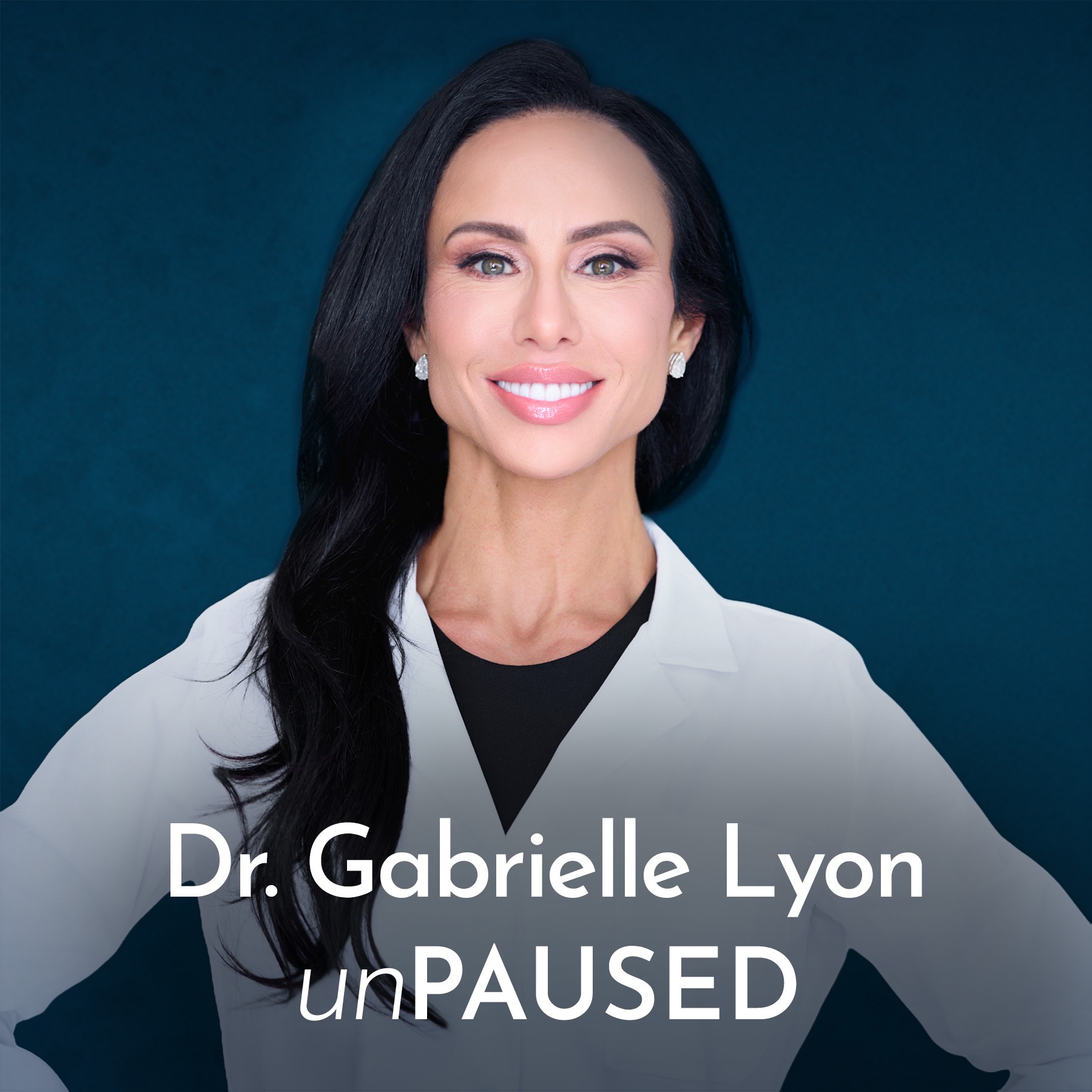
unPAUSED with Dr. Mary Claire Haver
Protein Needs for Muscle in Menopause: Dr. Lyon's Guide
Building Muscle in Menopause: Protein, Creatine and Strength Training with Dr. Gabrielle Lyon
▶ Listen to the full episode More from unPAUSED with Dr. Mary Claire Haver
The brief
Dr. Gabrielle Lyon says women need 30 to 50 grams of protein in their first meal after an overnight fast to switch on muscle building. She explains why aging muscle grows resistant to protein and exercise, why resistance training beats hormone therapy for long-term independence, and why suppressing mTOR is the wrong longevity strategy.
Ask this episode anything
Pod's AI answers from the episode itself, with the minute mark so you can hear it yourself.
Or start with one of these
Ask this episode
Pod's AI listens to the whole episode to answer, and points you to the minute it comes from.
The rest of this answer, and any question after it
Answers come from the episode itself, never from a summary of it.
Continue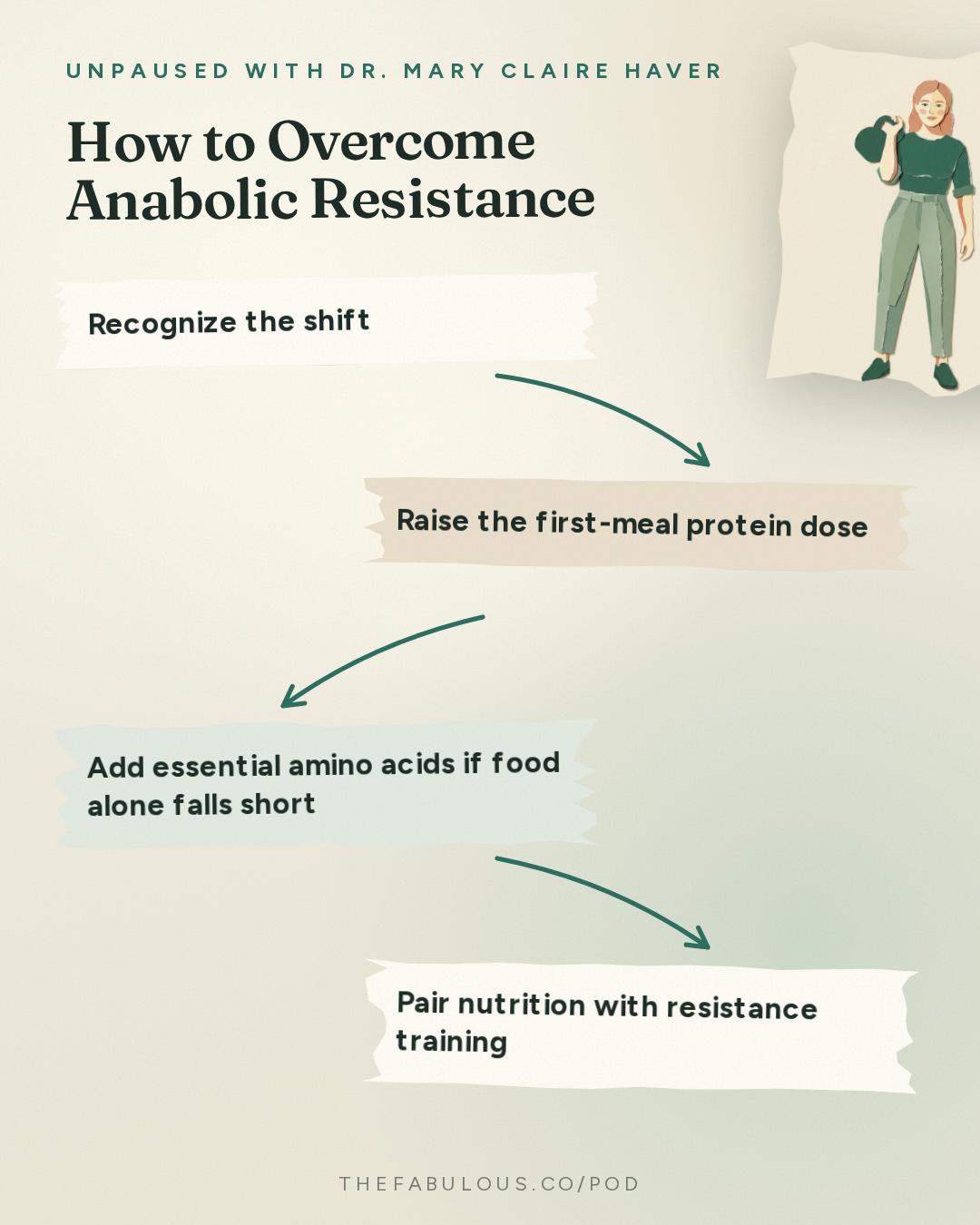
Key takeaways
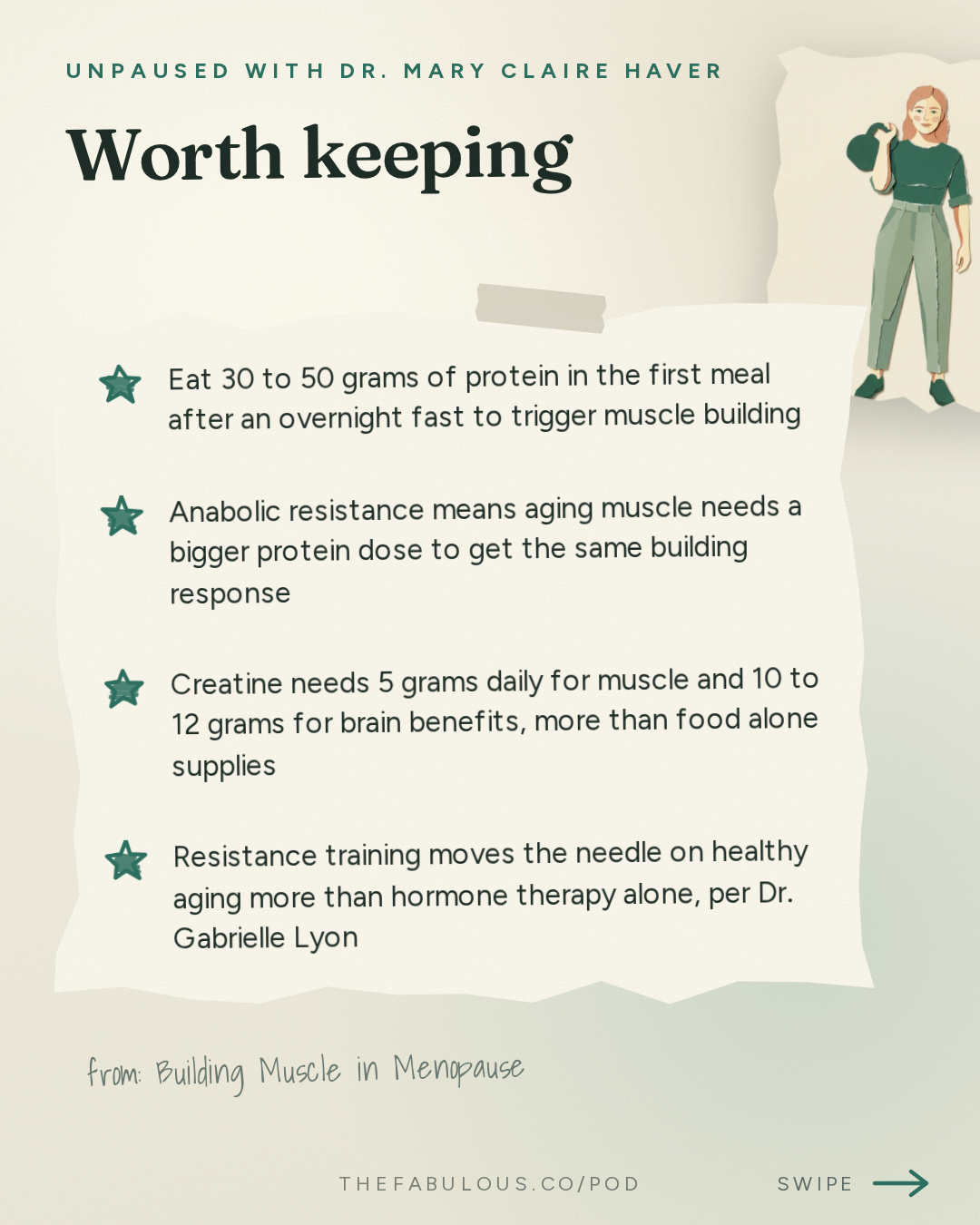
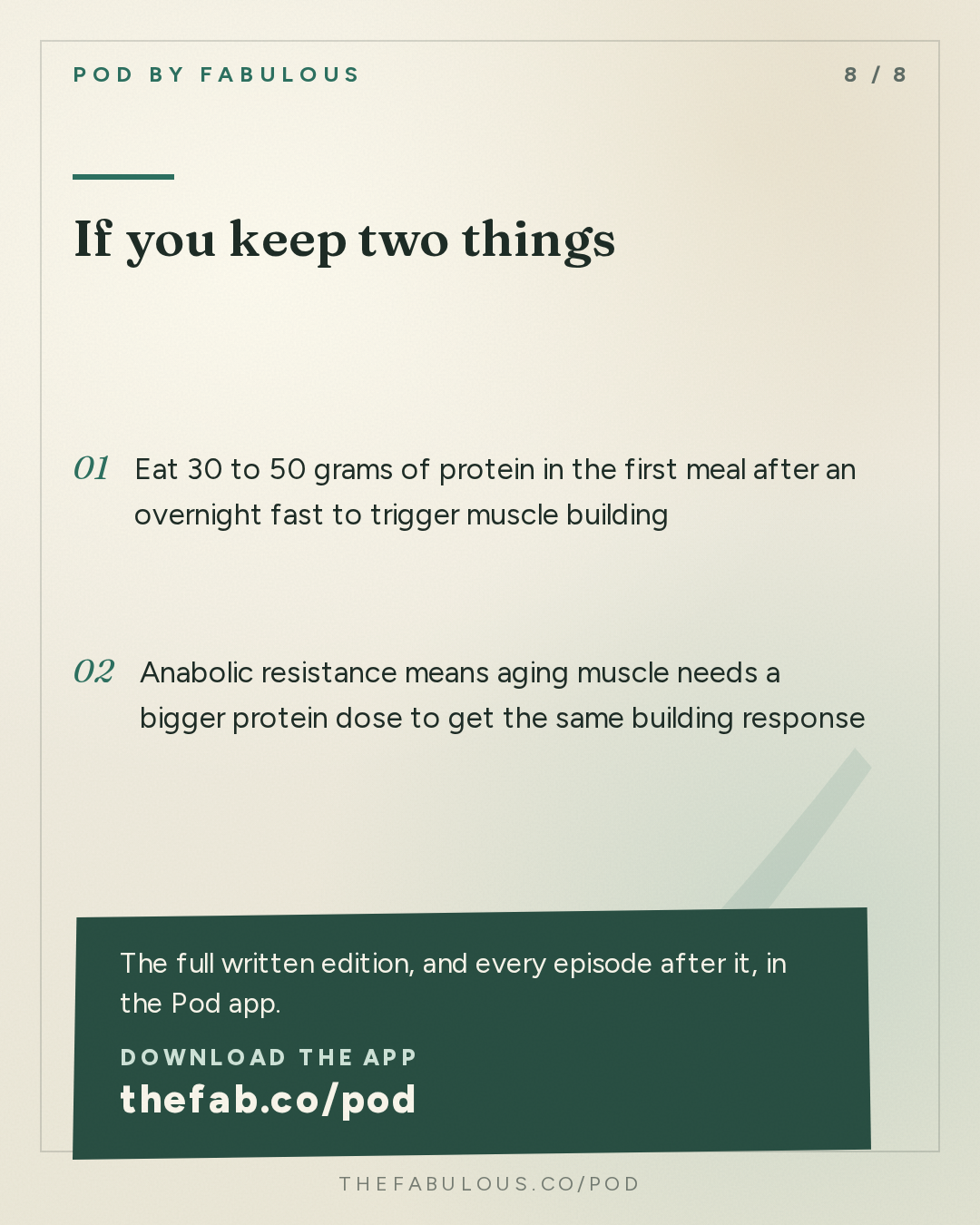
- Eat 30 to 50 grams of protein in the first meal after an overnight fast to trigger muscle building
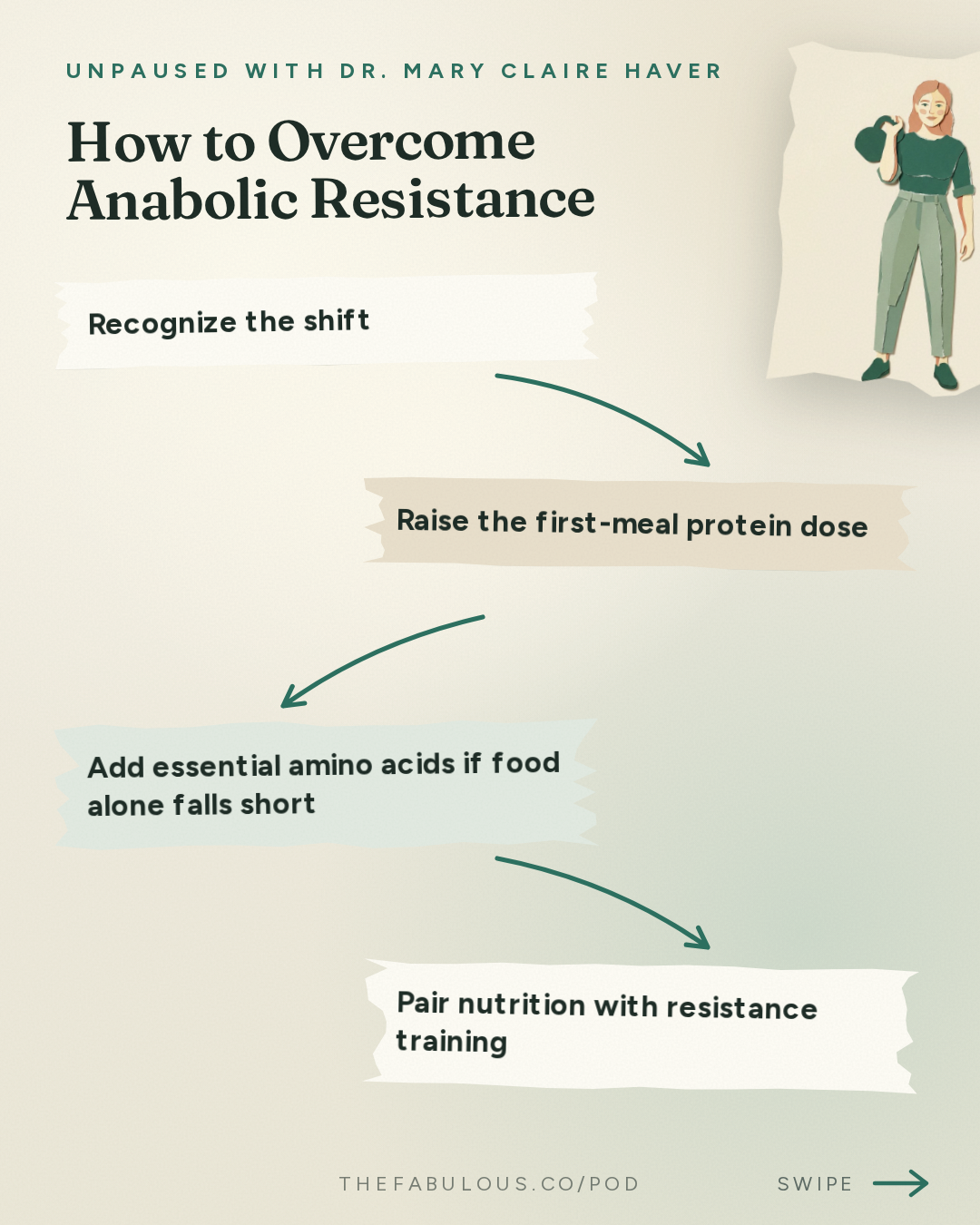
- Anabolic resistance means aging muscle needs a bigger protein dose to get the same building response
- Creatine needs 5 grams daily for muscle and 10 to 12 grams for brain benefits, more than food alone supplies
- Resistance training moves the needle on healthy aging more than hormone therapy alone, per Dr. Gabrielle Lyon
- GLP-1 medications do not cause extra muscle loss beyond normal weight-loss percentages, but skipping strength training while on them raises sarcopenia risk
The episode in cards
A pound of red meat contains about half a gram of creatine. To hit five grams a day, the minimum that family medicine physician Dr. Gabrielle Lyon considers useful for muscle, someone would need to eat roughly ten pounds of steak (07:40). Nobody does that. It is a small, almost absurd fact, but it captures the argument running through this conversation between Lyon and Dr. Mary Claire Haver, an OB-GYN and certified menopause practitioner: the body's real requirements for staying strong are often larger, and stranger, than what food alone can deliver.
This is the second half of a two-part conversation. The first explained why skeletal muscle deserves attention as its own organ system. This one is the manual: what to eat, when to eat it, how much resistance training is enough, and where hormone therapy and newer weight-loss drugs fit into the picture.
Lyon starts with timing. The first meal after an overnight fast matters because the body has spent the night in what she calls a catabolic state, a breakdown state, rather than a building one (02:10). Hit that first meal with 30 to 50 grams of protein, she says, and you switch on mTOR, a cellular pathway inside muscle that triggers growth. Miss it, and the meal does little. "That first meal of the day when you're coming out of an overnight fast is really important... getting that first meal right at 30 to 50 grams is going to be critical," she says (02:33). The nuance: timing only matters this much if total daily protein is on the low side. Someone already eating 1.2 to 1.6 grams of protein per kilogram of body weight across the day does not need to obsess over the clock (17:02).
Why the Same Workout Stops Working
The reason timing and dose both creep upward with age has a name: anabolic resistance. Lyon defines it plainly as the normal aging process in which muscle becomes less sensitive to the usual triggers, protein and exercise (09:12). The specific signal inside protein that muscle listens for is an amino acid called leucine, and as muscle ages, it needs a louder version of that signal to respond at all (12:04). A younger person can eat 15 grams of protein and get a measurable muscle-building response. Past 60, that same 15 grams produces nothing. Bump the dose to 30 grams, and the older muscle responds like the younger one did (14:15).
The useful part of this finding is that anabolic resistance is not fixed. Lyon says old muscle can be made to act like young muscle by raising protein quality, meaning complete amino acid profiles, and adding resistance training (13:05). She also pushes back gently on how absolute the aging story is: most of the research behind anabolic resistance comes from sedentary, often unhealthy study populations, not from people who have stayed physically active their whole lives, so how much of it is age and how much is disuse remains an open question (10:48).
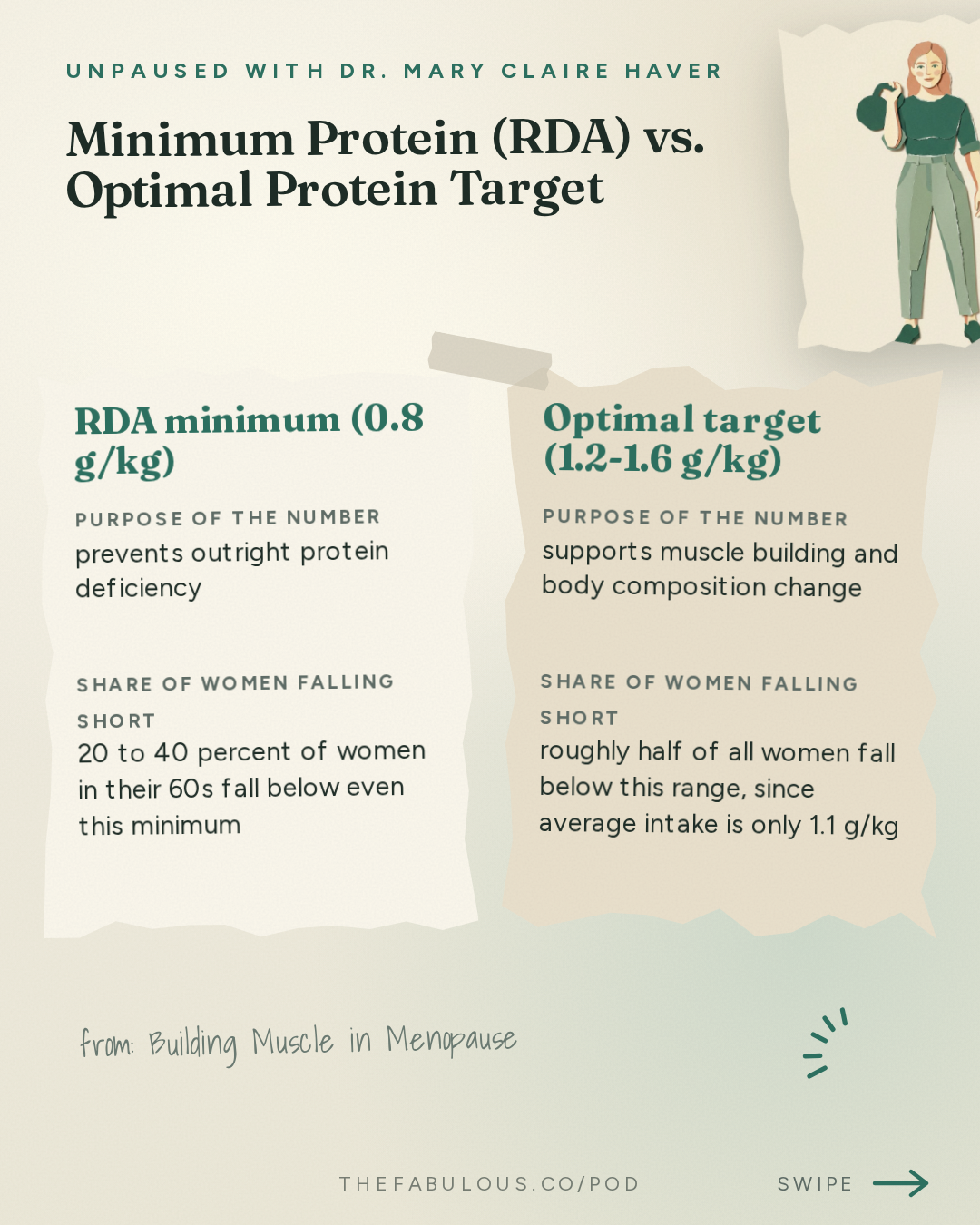
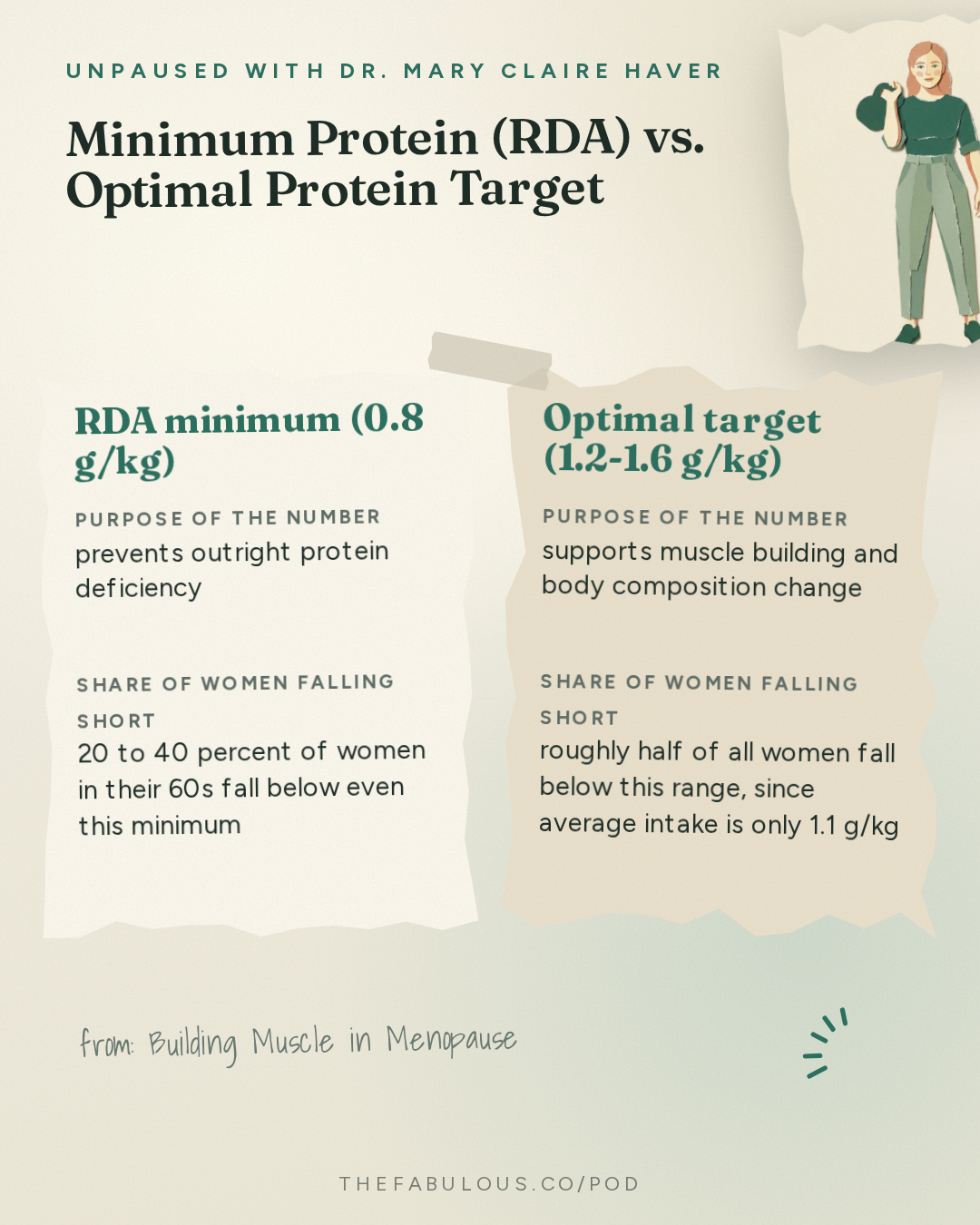
This is where the official protein guidelines come in for criticism. The Recommended Dietary Allowance sets protein at 0.8 grams per kilogram of body weight, a number Lyon says has not changed and was never meant to define health, only to prevent outright deficiency.
"The RDA hasn't changed. It is set at the minimum. Last time I checked, Mary Claire, you and I are not looking for how not to be worse than yesterday." Dr. Gabrielle Lyon [15:06]
The practical gap is wide. The average woman gets about 1.1 grams of protein per kilogram a day, close enough to the newer 1.2 to 1.6 gram guidance that people assume they are covered. They are not: roughly half the population falls short of even that range, and among women in their 60s, 20 to 40 percent fall below the RDA itself (15:58). Lyon's clinical target is simpler: no less than 100 grams of protein a day, closer to one gram per pound of target body weight when possible (18:52). Muscle deficiency does not announce itself. It takes about a decade to show up as a visible problem, not as an abnormal blood test but as falls, fractures, and lost independence (15:29).
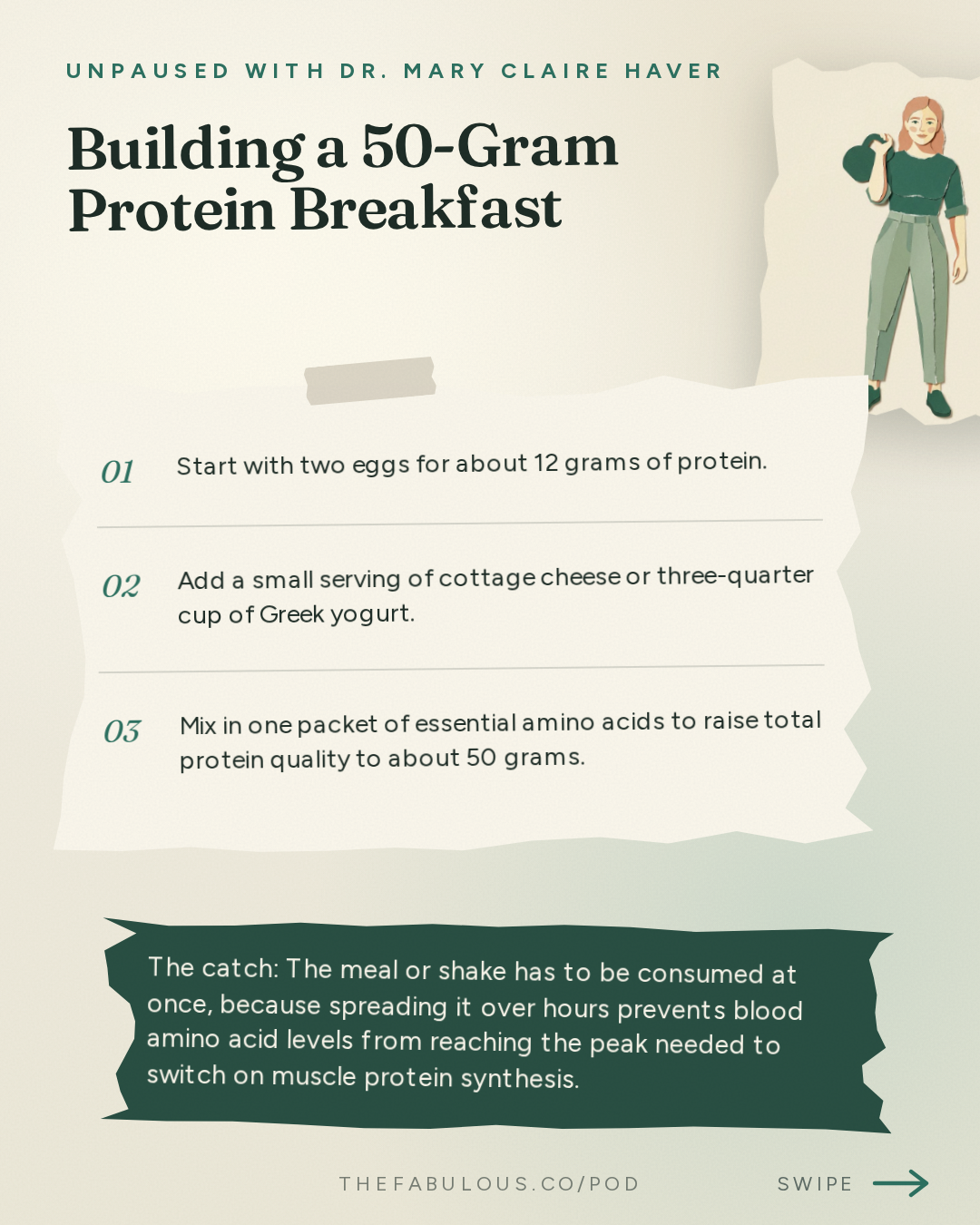
Food quality matters too. Lyon argues against a common women's health habit of cutting red meat, noting that almost half its fat is monounsaturated, the same category found in olive oil (22:58), and that collagen, despite its popularity, scores essentially zero for building muscle mass because it lacks the full amino acid profile muscle needs (21:55). For anyone eating a lower-protein meal, such as two eggs at 12 grams, she recommends adding a packet of essential amino acids, a supplement containing all nine amino acids the body cannot make on its own, to raise the effective signal to muscle up to the equivalent of 30 grams (20:01). The one rule: drink or eat that dose in one sitting. Spread it across a morning and blood amino acid levels never peak high enough to start the muscle-building process (22:13).
Muscle Over Hormones
Given how much of this podcast focuses on hormone therapy, Lyon's ranking of tools is notable. Haver tells patients directly that hormone therapy will not keep them out of a nursing home.
"Hormone therapy will not keep you out of a nursing home. It will not. The biggest needle mover is resistance training." Dr. Mary Claire Haver [28:30]
Her clinical observation is that resistance training paired with adequate protein changes body composition largely regardless of whether a woman is on hormone therapy. Hormones are a tool, she says, not a substitute for the fundamentals (28:15). She is also cautious about the mechanistic story linking estrogen loss directly to muscle loss during the menopause transition. Estrogen receptors do exist on skeletal muscle, but Lyon says the human data connecting estrogen levels to actual muscle-building outcomes is not solid enough yet to draw firm conclusions (31:41).
The same caution about overclaiming applies to GLP-1 medications, the newer weight-loss drugs including semaglutide and tirzepatide. Lyon predicts an accelerated wave of sarcopenic obesity, a condition where someone loses muscle while remaining overweight, if people use these drugs without resistance training or adequate protein (38:45). But she is careful to separate hype from mechanism: the drugs do not "magically" cause muscle loss beyond what any weight loss produces; muscle loss on GLP-1s tracks the same percentages seen with any calorie deficit (39:40). The risk is not the drug itself, in her view, but using it without the muscle-preserving basics in place.
That same skepticism toward oversimplified mechanisms surfaces again when the conversation turns to longevity science. A popular idea in that field holds that suppressing mTOR, the same pathway that resistance training activates, extends lifespan, based largely on studies of a drug called rapamycin in mice. Lyon argues this logic falls apart on inspection. A landmark 2013 mouse study found that rapamycin barely touched conventional biological markers of aging; its apparent lifespan benefit came from suppressing the specific cancers that kill lab mice, animals that do not die of the same diseases humans do (54:36). Chronic mTOR suppression, she notes, also worsens glucose tolerance and lipid profiles, hardly a formula for healthy aging (52:42). And a widely cited 2014 study linking lower dietary protein to longer life turned out, once researchers examined the full data set rather than a self-selected slice, to show the opposite: people eating less protein died earlier (56:07). "If you believed that suppressing mTOR was going to extend lifespan, then you would also have to believe that resistance training is going to decrease lifespan," she says, pointing out the contradiction at the center of that argument (55:11).
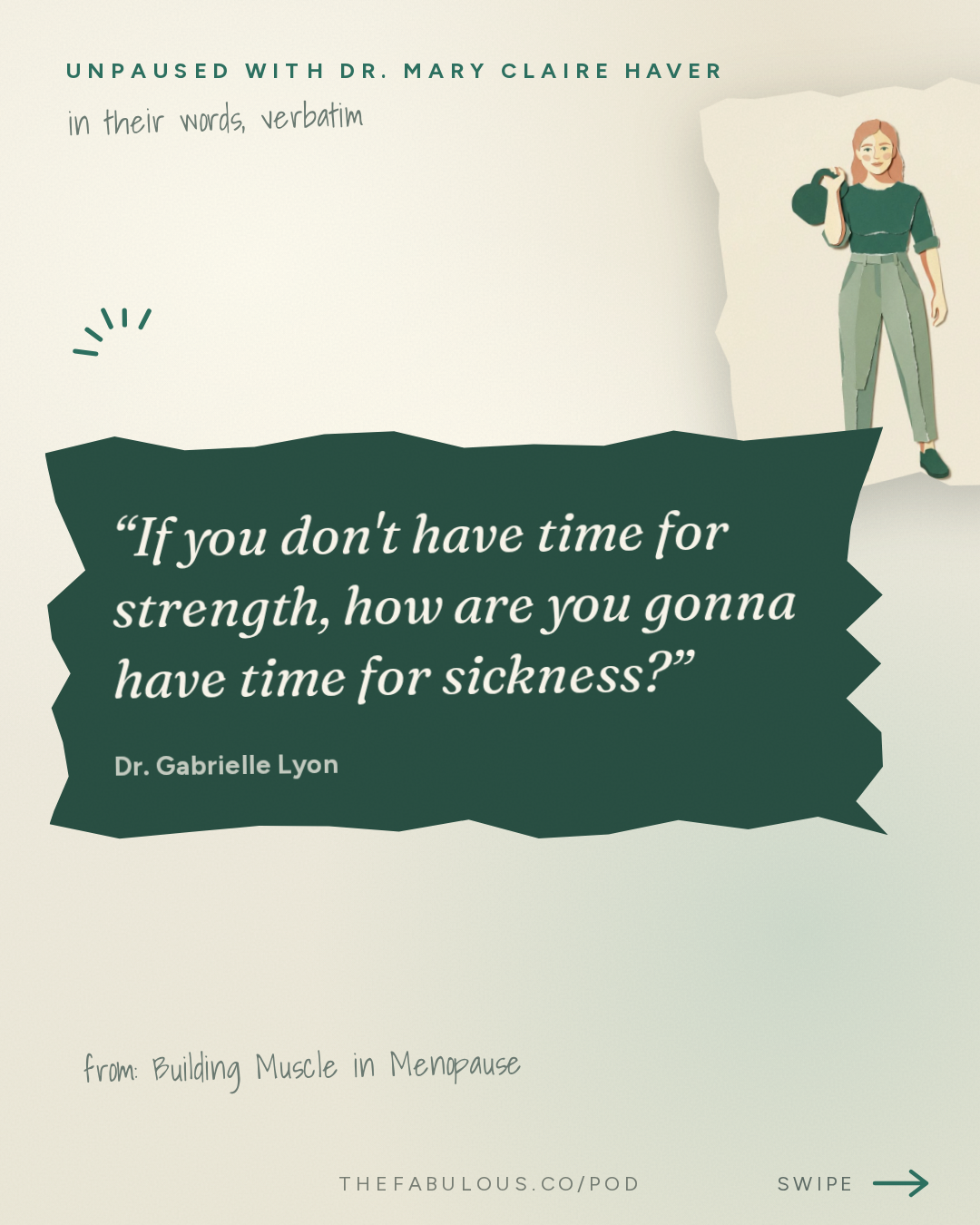
For anyone starting from zero, Lyon keeps the entry point small. Beginners start with body weight movements or resistance bands, then move to machines, which carry a lower injury risk than free weights before someone has built a base of strength (45:13). Her line for the woman who says she does not have time: "If you don't have time for strength, how are you gonna have time for sickness?" (45:40). It is a blunt trade, but the data behind it, the 30 to 50 gram meals, the twice-weekly training, the modest but real gains even at 70 or 80, suggests the trade is a fair one.
By the numbers
- 1% muscle mass lost per year during aging
In their words
“Hormone therapy will not keep you out of a nursing home. It will not. It will not. The biggest needle mover is”
“If you don't have time for strength, how are you gonna have time for sickness?”
“The greater risk is becoming frail. Becoming bulky is not a real risk.”
Protocols
-
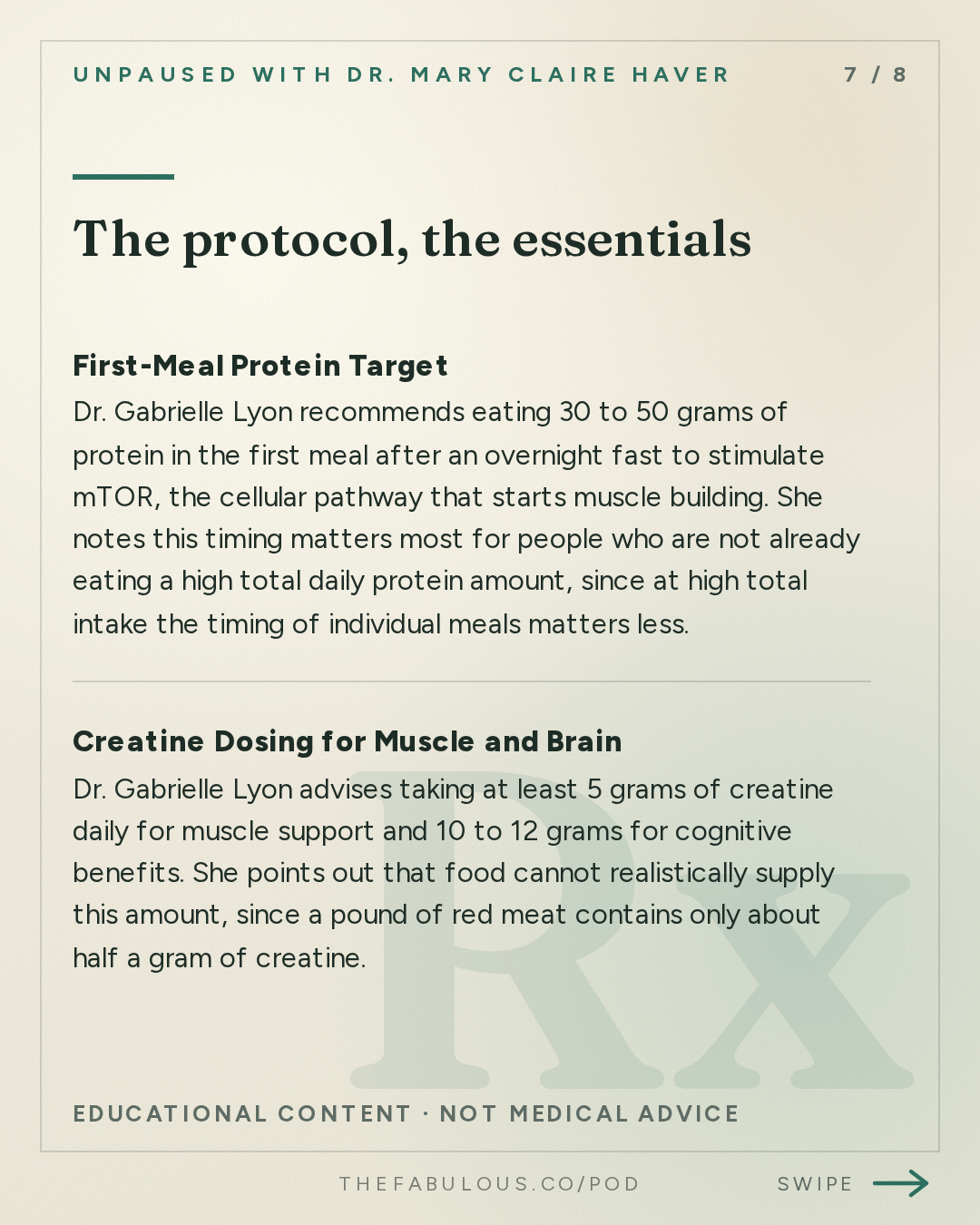
First-Meal Protein Target
Dr. Gabrielle Lyon recommends eating 30 to 50 grams of protein in the first meal after an overnight fast to stimulate mTOR, the cellular pathway that starts muscle building. She notes this timing matters most for people who are not already eating a high total daily protein amount, since at high total intake the timing of individual meals matters less.
once daily, at the first meal of the day
-
Creatine Dosing for Muscle and Brain
Dr. Gabrielle Lyon advises taking at least 5 grams of creatine daily for muscle support and 10 to 12 grams for cognitive benefits. She points out that food cannot realistically supply this amount, since a pound of red meat contains only about half a gram of creatine.
daily
-
Boosting a Low-Protein Meal With Essential Amino Acids
Dr. Gabrielle Lyon suggests adding a packet of essential amino acids to a lower-protein meal, such as two eggs providing about 12 grams of protein, so the body registers the meal as roughly 30 grams and starts the muscle-building process. She cautions that the amino acid dose must be consumed in one sitting, because spreading it out over hours keeps blood amino acid levels from reaching the peak needed to trigger muscle protein synthesis.
with meals that fall short of 30 grams of protein
-
Starting Resistance Training as a Beginner
Dr. Gabrielle Lyon starts new lifters with body weight movements or resistance bands, then progresses them to machines, which carry a lower injury risk than free weights because they involve less movement variability. She only introduces free weights and varied movement patterns once a person feels comfortable and has built a base.
twice weekly to start
Questions this episode answers
How much protein should women eat during menopause?
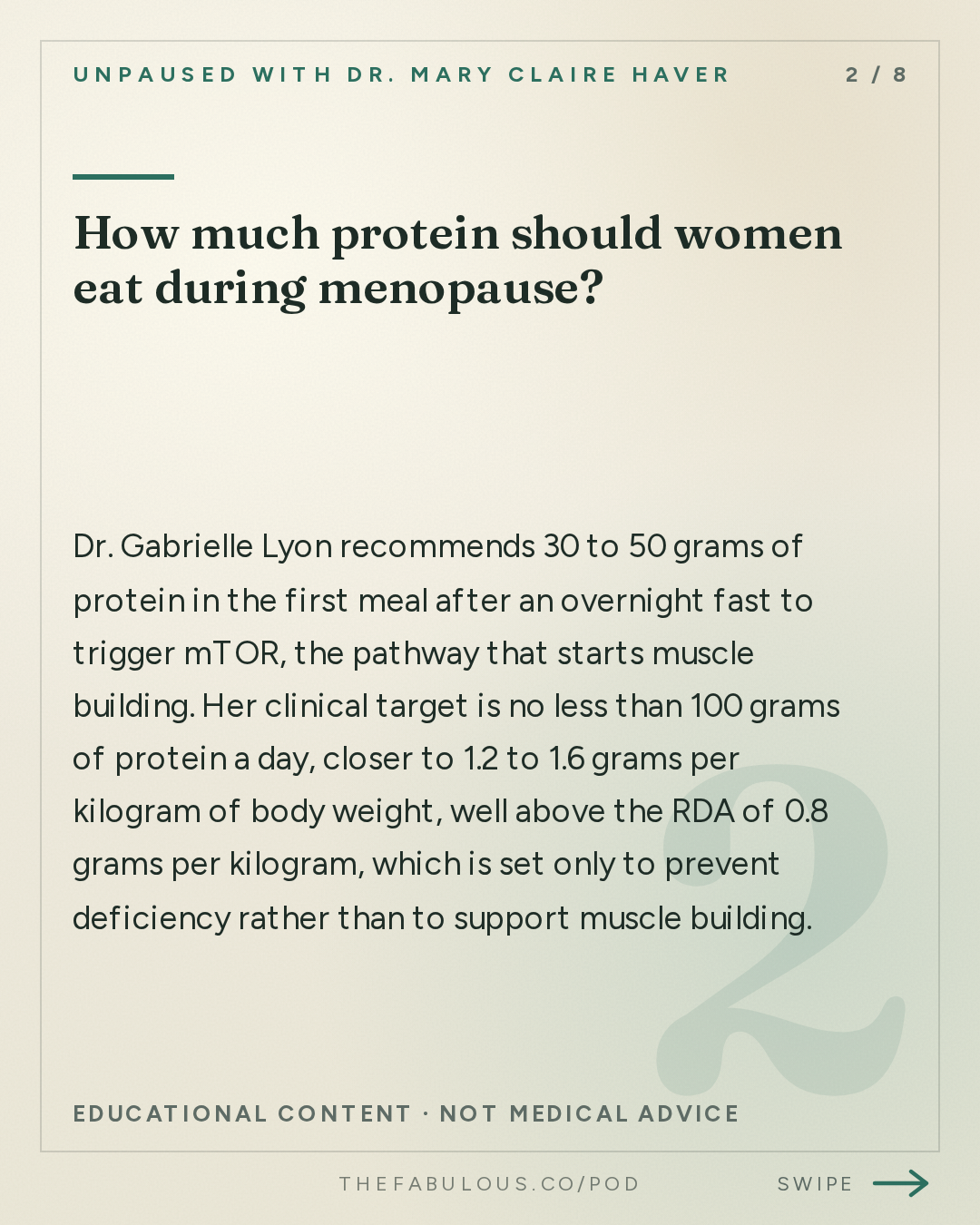
Dr. Gabrielle Lyon recommends 30 to 50 grams of protein in the first meal after an overnight fast to trigger mTOR, the pathway that starts muscle building (02:33). Her clinical target is no less than 100 grams of protein a day, closer to 1.2 to 1.6 grams per kilogram of body weight, well above the RDA of 0.8 grams per kilogram, which is set only to prevent deficiency rather than to support muscle building (14:42).
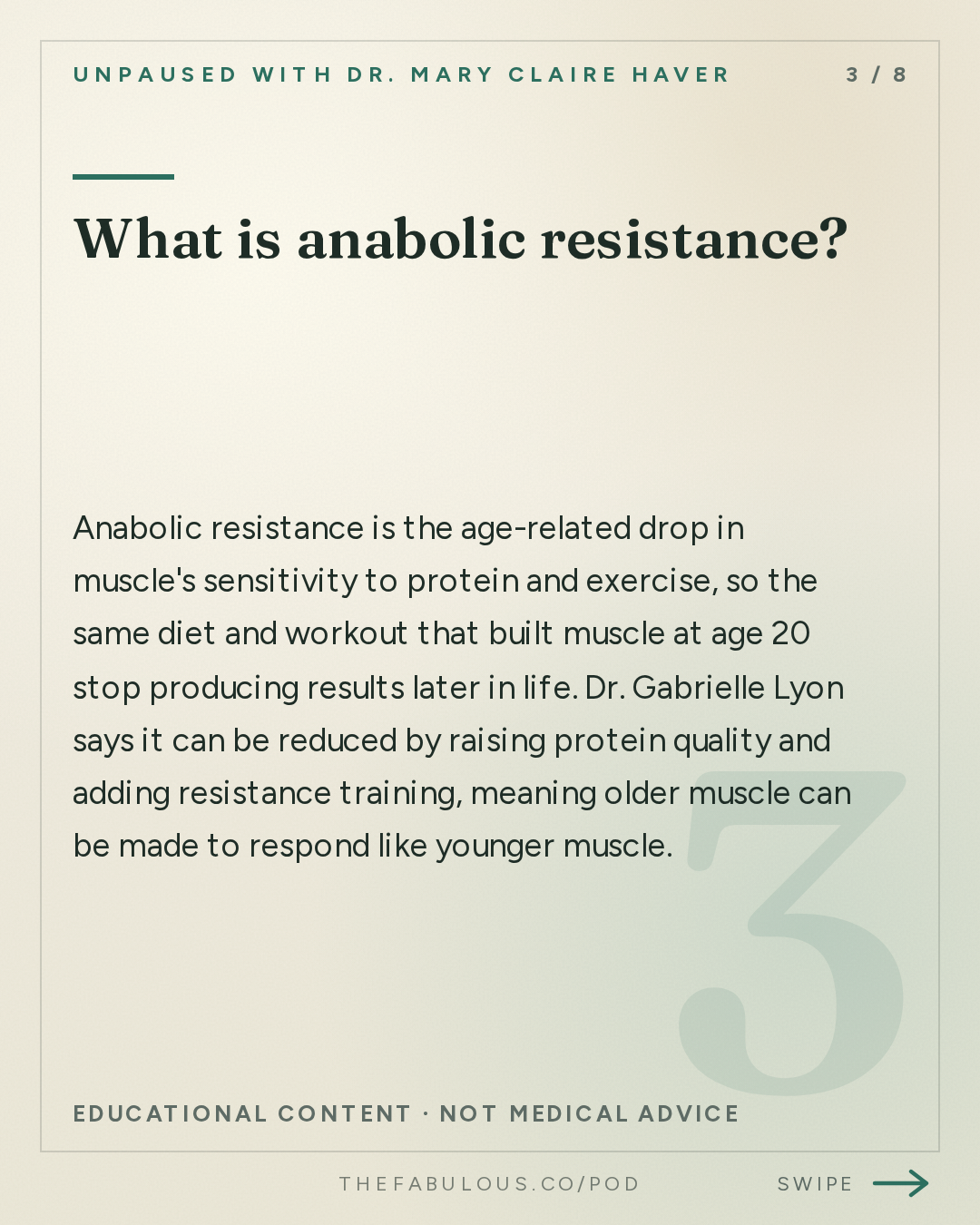
What is anabolic resistance?
Anabolic resistance is the age-related drop in muscle's sensitivity to protein and exercise, so the same diet and workout that built muscle at age 20 stop producing results later in life (09:12). Dr. Gabrielle Lyon says it can be reduced by raising protein quality and adding resistance training, meaning older muscle can be made to respond like younger muscle (13:05).
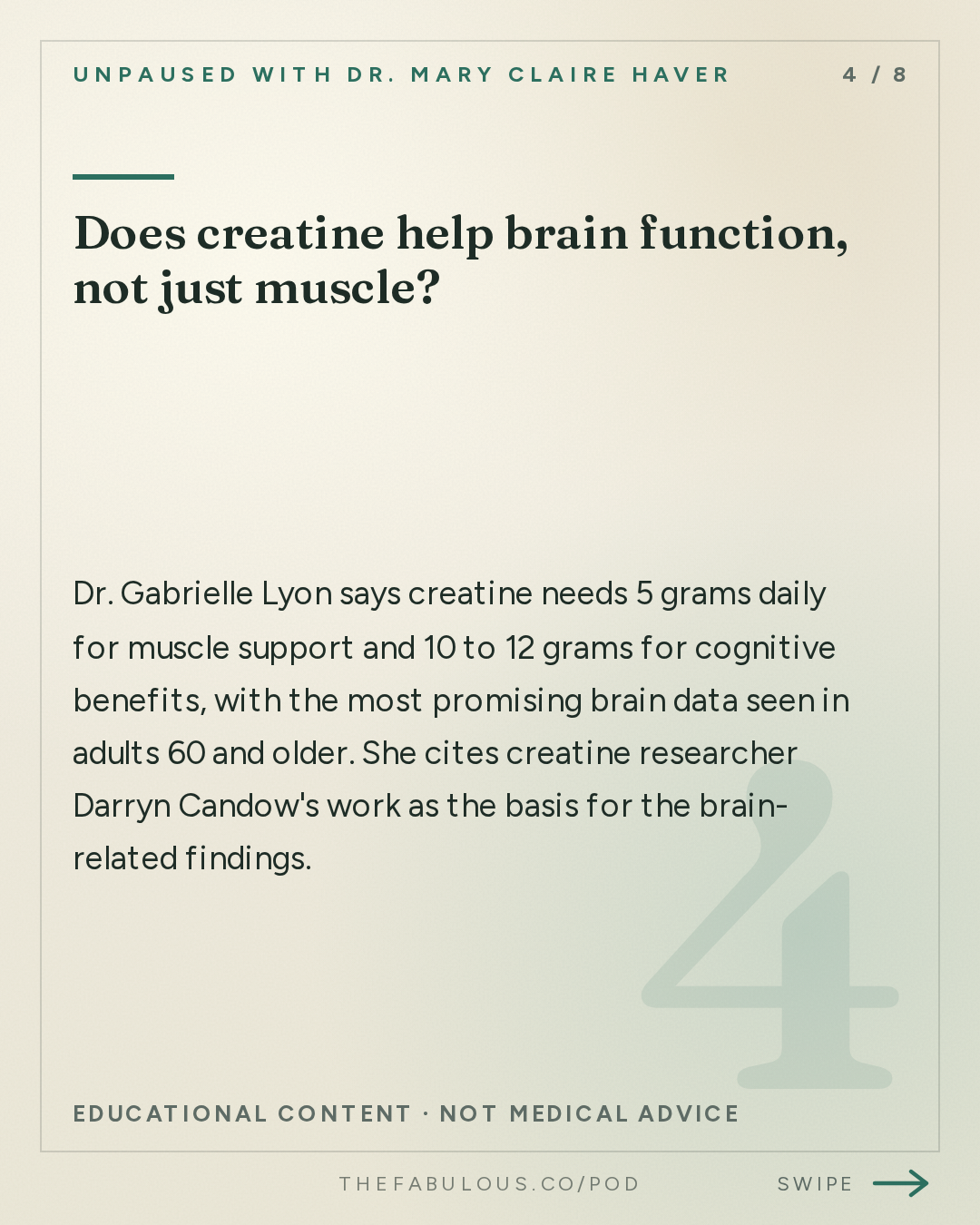
Does creatine help brain function, not just muscle?
Dr. Gabrielle Lyon says creatine needs 5 grams daily for muscle support and 10 to 12 grams for cognitive benefits, with the most promising brain data seen in adults 60 and older (07:55). She cites creatine researcher Darryn Candow's work as the basis for the brain-related findings (08:15).
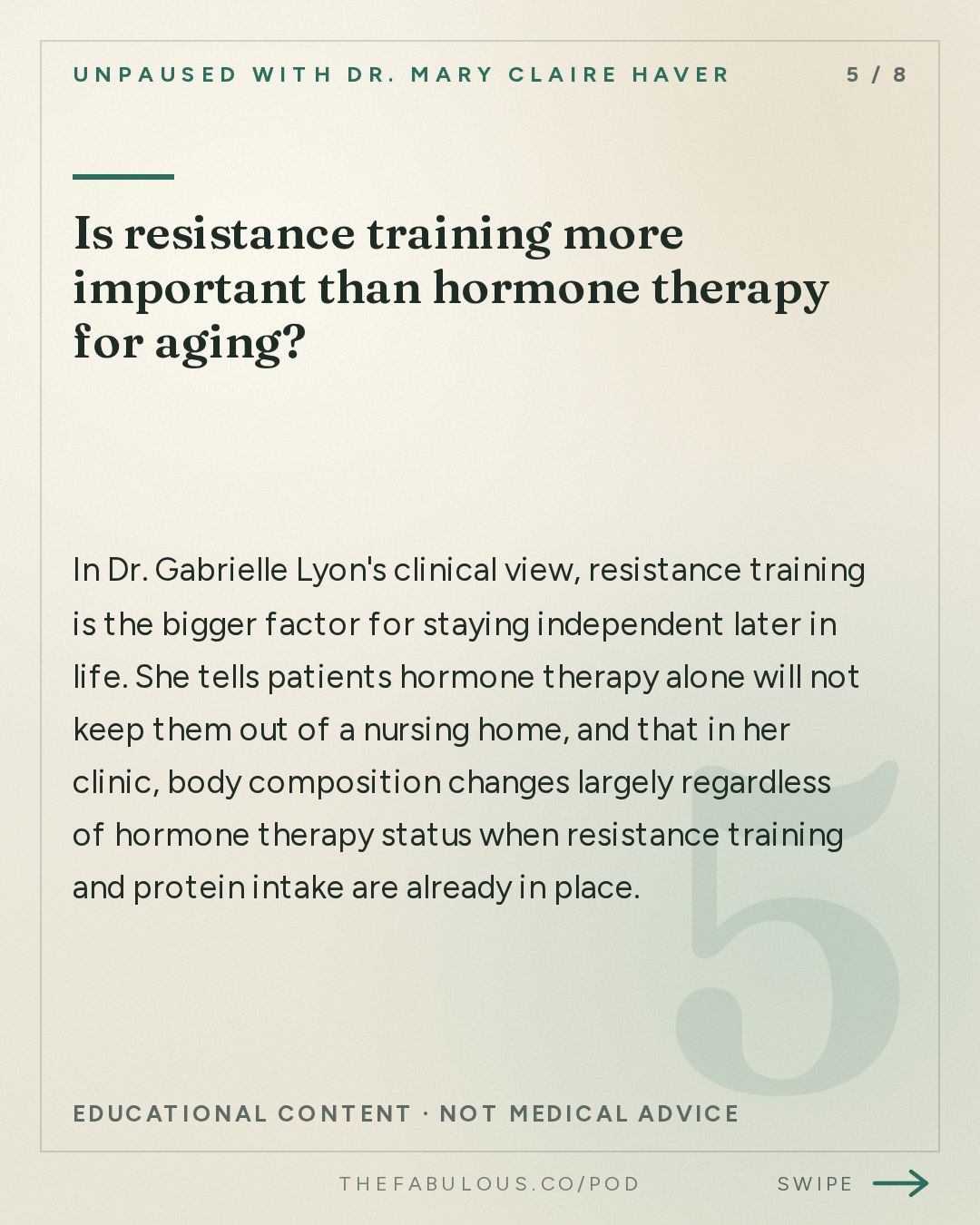
Is resistance training more important than hormone therapy for aging?
In Dr. Gabrielle Lyon's clinical view, resistance training is the bigger factor for staying independent later in life. She tells patients hormone therapy alone will not keep them out of a nursing home, and that in her clinic, body composition changes largely regardless of hormone therapy status when resistance training and protein intake are already in place (28:30).
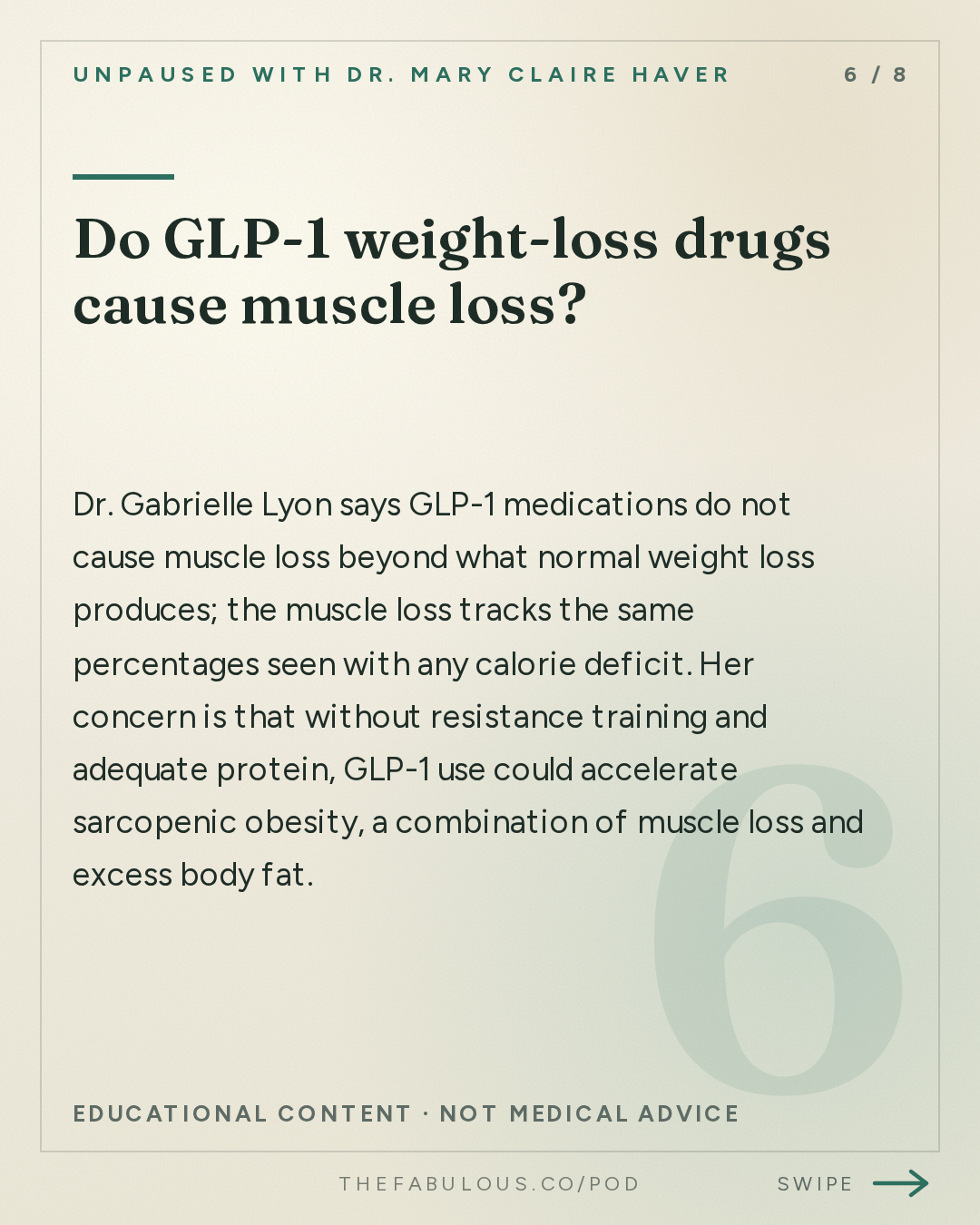
Do GLP-1 weight-loss drugs cause muscle loss?
Dr. Gabrielle Lyon says GLP-1 medications do not cause muscle loss beyond what normal weight loss produces; the muscle loss tracks the same percentages seen with any calorie deficit (39:40). Her concern is that without resistance training and adequate protein, GLP-1 use could accelerate sarcopenic obesity, a combination of muscle loss and excess body fat (38:45).
Does suppressing mTOR extend lifespan?
Dr. Gabrielle Lyon argues the popular longevity claim that suppressing mTOR extends life does not hold up. A 2013 mouse study found rapamycin barely affected standard aging markers and instead worked by suppressing specific cancers common in lab mice, not by reversing aging broadly (54:36). She also notes chronic mTOR suppression worsens glucose tolerance and lipid profiles (52:42).
The full read, in cards
Go deeper
- Lift More Trial — found that lifting to about 85 percent of one-rep max for two to three challenging reps, twice weekly for 30 minutes, builds strength effectively
- 2013 rapamycin mouse longevity study — found rapamycin barely affected standard aging markers in mice and instead extended life mainly by suppressing the specific cancers that commonly kill lab mice
- 2014 dietary protein and mortality study — a reanalysis of the full data set showed people with lower protein intake died earlier, reversing an earlier self-selected finding
Mentioned
Dr. Gabrielle Lyon · Dr. Mary Claire Haver · Darryn Candow · Forever Strong · BodyHealth · Perfect Aminos · DEXA · Institute for Muscle-Centric Medicine
More from this show and category
Gabrielle Lyon: Muscle Is the Longevity Organ
Dr. Gabrielle Lyon argues that skeletal muscle, not body fat, is the organ that determines how well women age. She explains that muscle drives glucose disposal, releases hormone-like myokines, and needs at least 100 grams of daily protein plus resistance training to stay healthy after midlife.

ED as an Early Predictor of Heart Attack Risk
Erectile dysfunction predicts a future heart attack better than chest pain does, especially in younger men (11:11). Urologist Tobias Kohler describes two cheap early-warning tests, a coronary calcium scan and a Mayo Clinic ceramide blood test, plus the cardiac damage caused by high-dose testosterone abuse (12:49, 44:55).
Vaginal Estrogen for UTI Prevention
Urologist Dr. Kelly Casperson explains that genitourinary syndrome of menopause (GSM) affects 50% to 90% of postmenopausal women. Vaginal estrogen cuts recurrent urinary tract infections by half, lowers hospitalization and death risk, and is safe for most breast cancer survivors, yet only 9% of women diagnosed with GSM get a prescription.
Physiology of Grief and Heart Attack Risk
Grief is not just an emotion, it is a measurable physiological event: a 21-times spike in heart attack risk in the first 24 hours after a loss, elevated cortisol for months, and a brain that keeps treating the dead as still out there somewhere.
