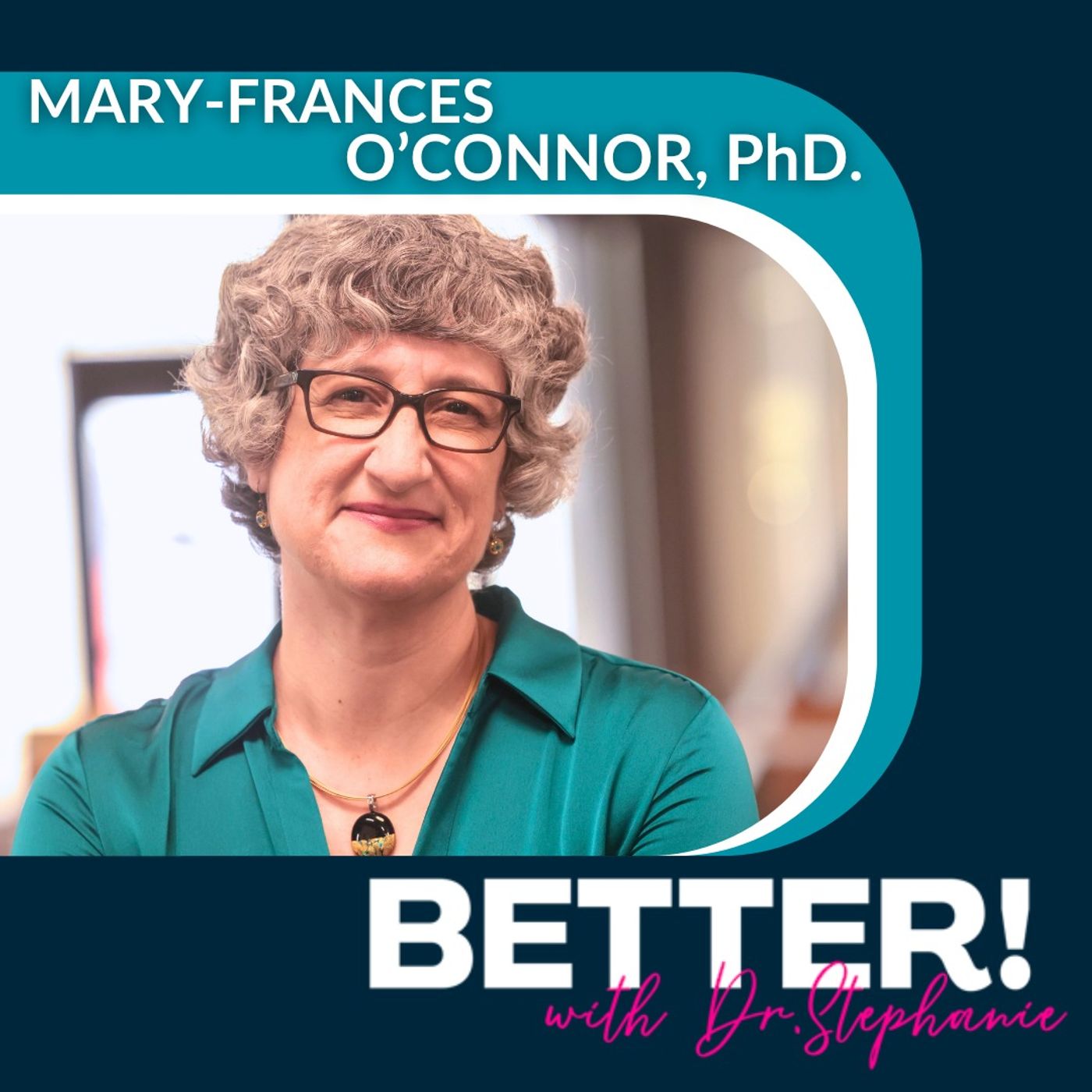
BETTER! with Dr. Stephanie Estima
Physiology of Grief and Heart Attack Risk
The Physiology of Grief: What Loss Actually Does In Your Body with Mary-Frances O'Connor, PhD.
▶ Listen to the full episode More from BETTER! with Dr. Stephanie Estima
The brief
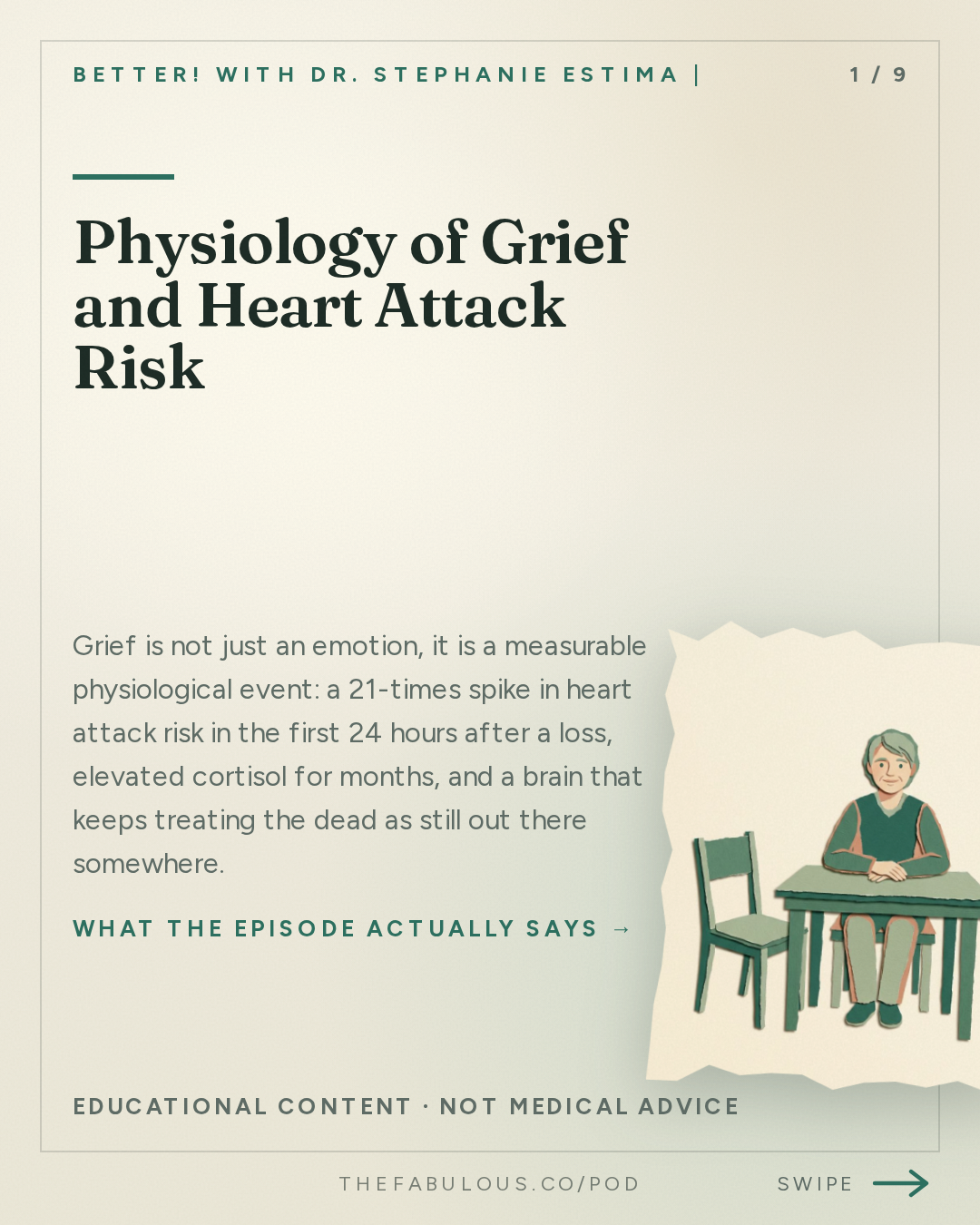
Grief is not just an emotion, it is a measurable physiological event: a 21-times spike in heart attack risk in the first 24 hours after a loss, elevated cortisol for months, and a brain that keeps treating the dead as still out there somewhere.
Ask this episode anything
Pod's AI answers from the episode itself, with the minute mark so you can hear it yourself.
Or start with one of these
Ask this episode
Pod's AI listens to the whole episode to answer, and points you to the minute it comes from.
The rest of this answer, and any question after it
Answers come from the episode itself, never from a summary of it.
Continue
Key takeaways
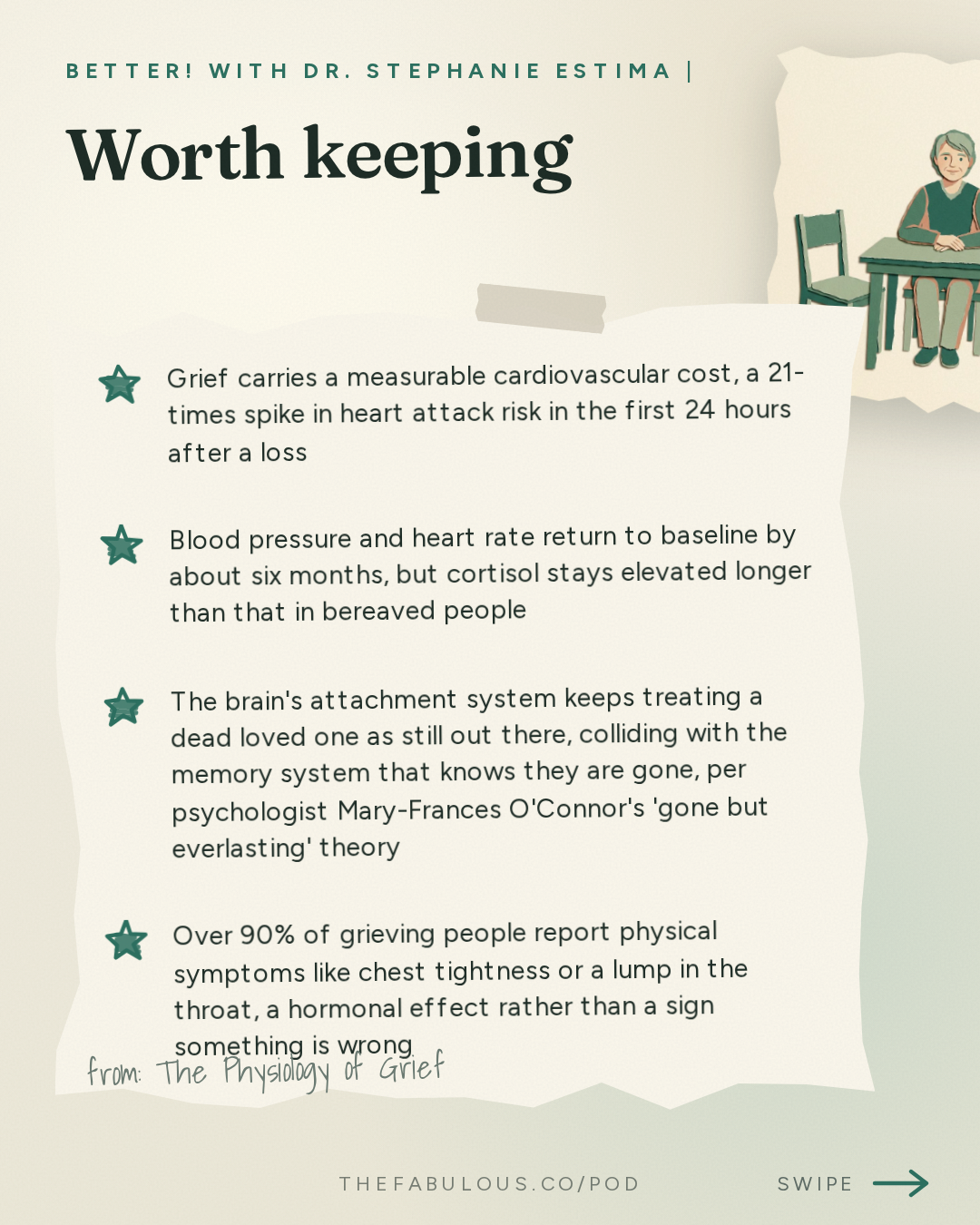
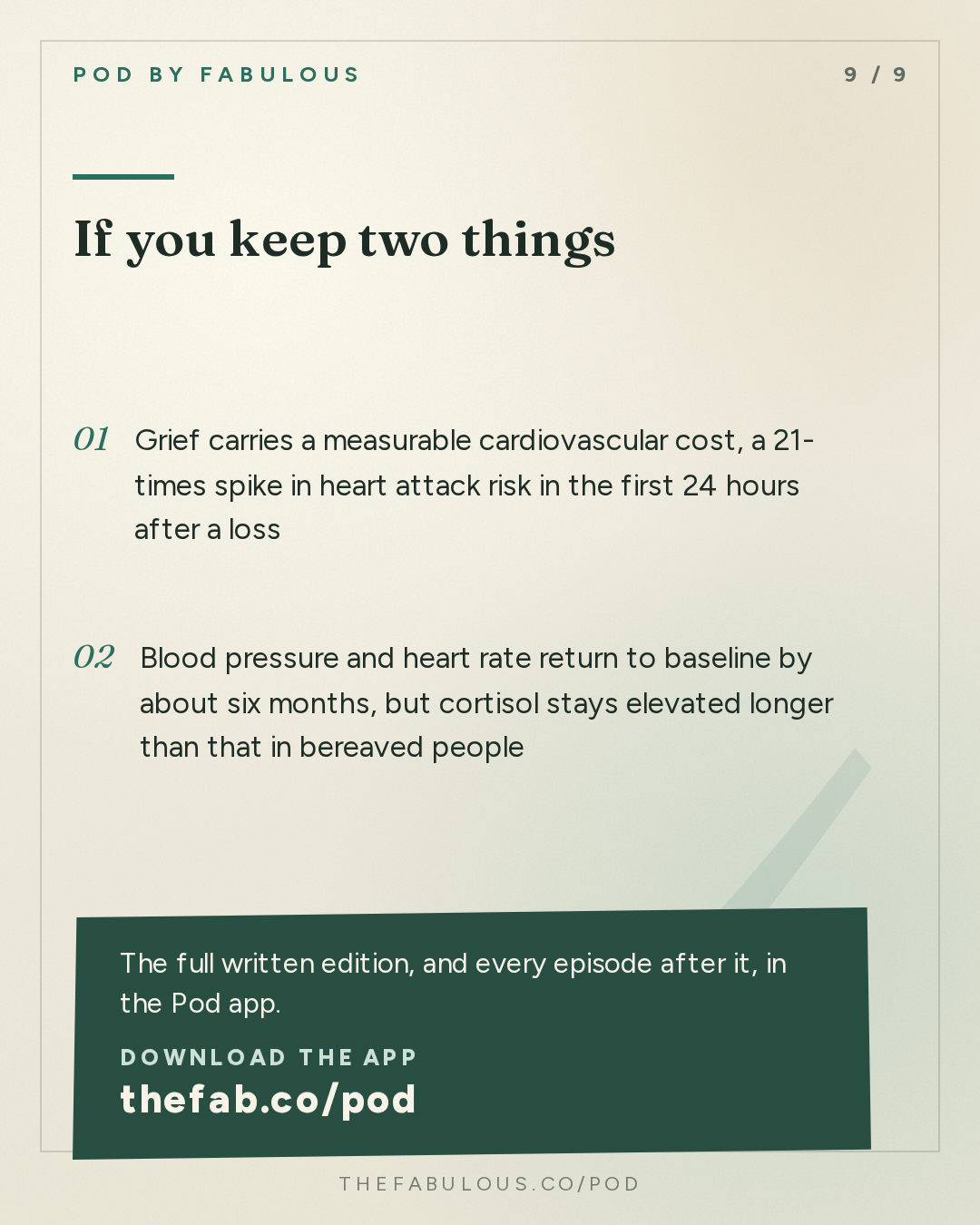
- Grief carries a measurable cardiovascular cost, a 21-times spike in heart attack risk in the first 24 hours after a loss (15:18)
- Blood pressure and heart rate return to baseline by about six months, but cortisol stays elevated longer than that in bereaved people (16:19, 16:47)
- The brain's attachment system keeps treating a dead loved one as still out there, colliding with the memory system that knows they are gone, per psychologist Mary-Frances O'Connor's 'gone but everlasting' theory (43:52)
- Over 90% of grieving people report physical symptoms like chest tightness or a lump in the throat, a hormonal effect rather than a sign something is wrong (59:34)
- Resilience means building a meaningful life after loss, not the absence of pain, according to O'Connor's immune-system analogy (28:32)
The episode in cards
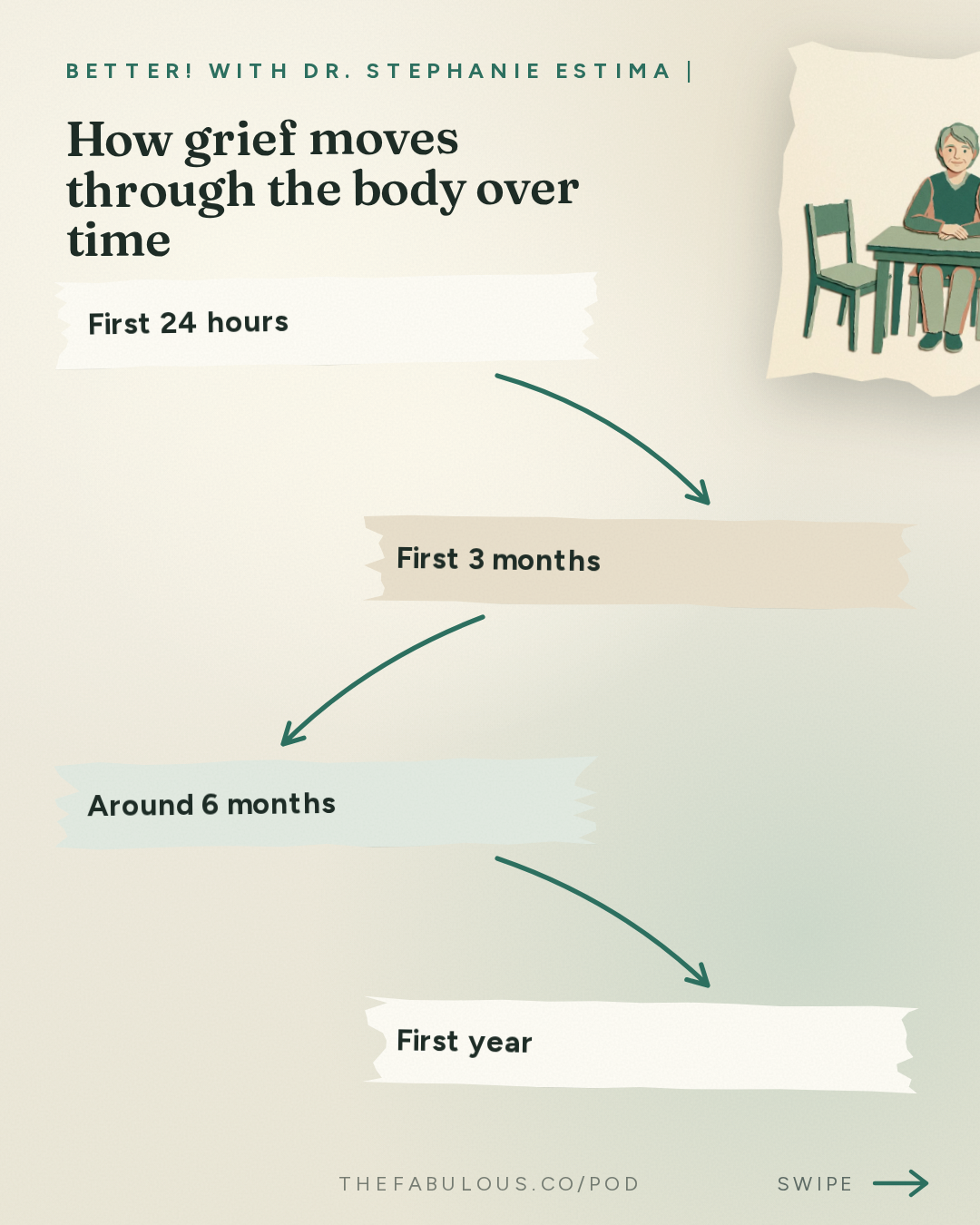
In an old movie trope, one spouse dies and the other follows within days, a coincidence the script treats as romantic proof that two people had become a single soul. Psychologist Mary-Frances O'Connor, who directs the Grief, Loss, and Social Stress Lab at the University of Arizona, has spent her career showing that the trope is not folklore. It is measurable physiology. In the first 24 hours after a loss, a person is 21 times more likely to have a heart attack than on any other day of life (15:18). Widowers are almost twice as likely to die of a heart attack in the first three months of bereavement compared with married men of the same age (15:46).
"In that first 24 hours, for example, you are 21 times more likely to have a heart attack than any other day of your life." — Mary-Frances O'Connor [15:18]
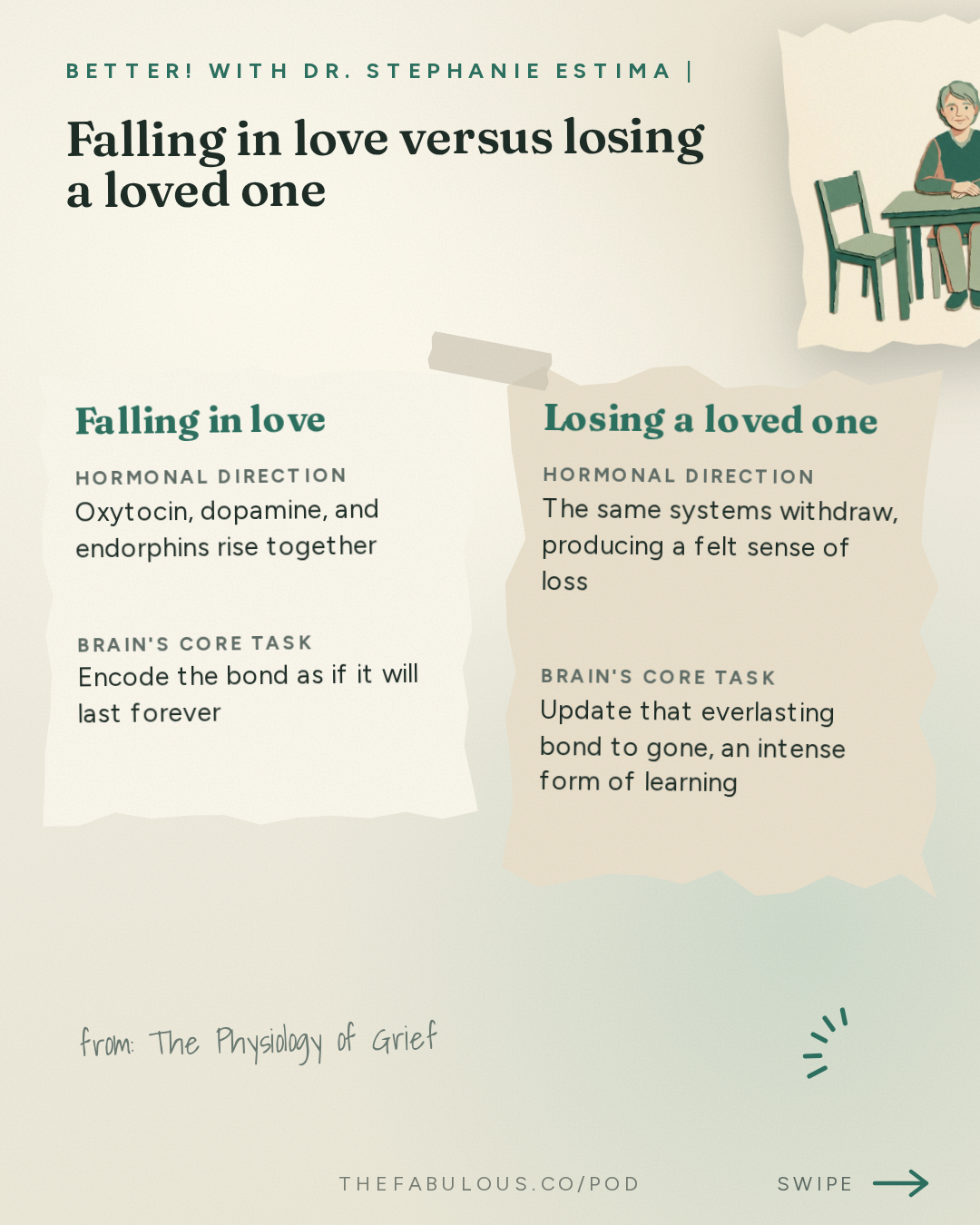
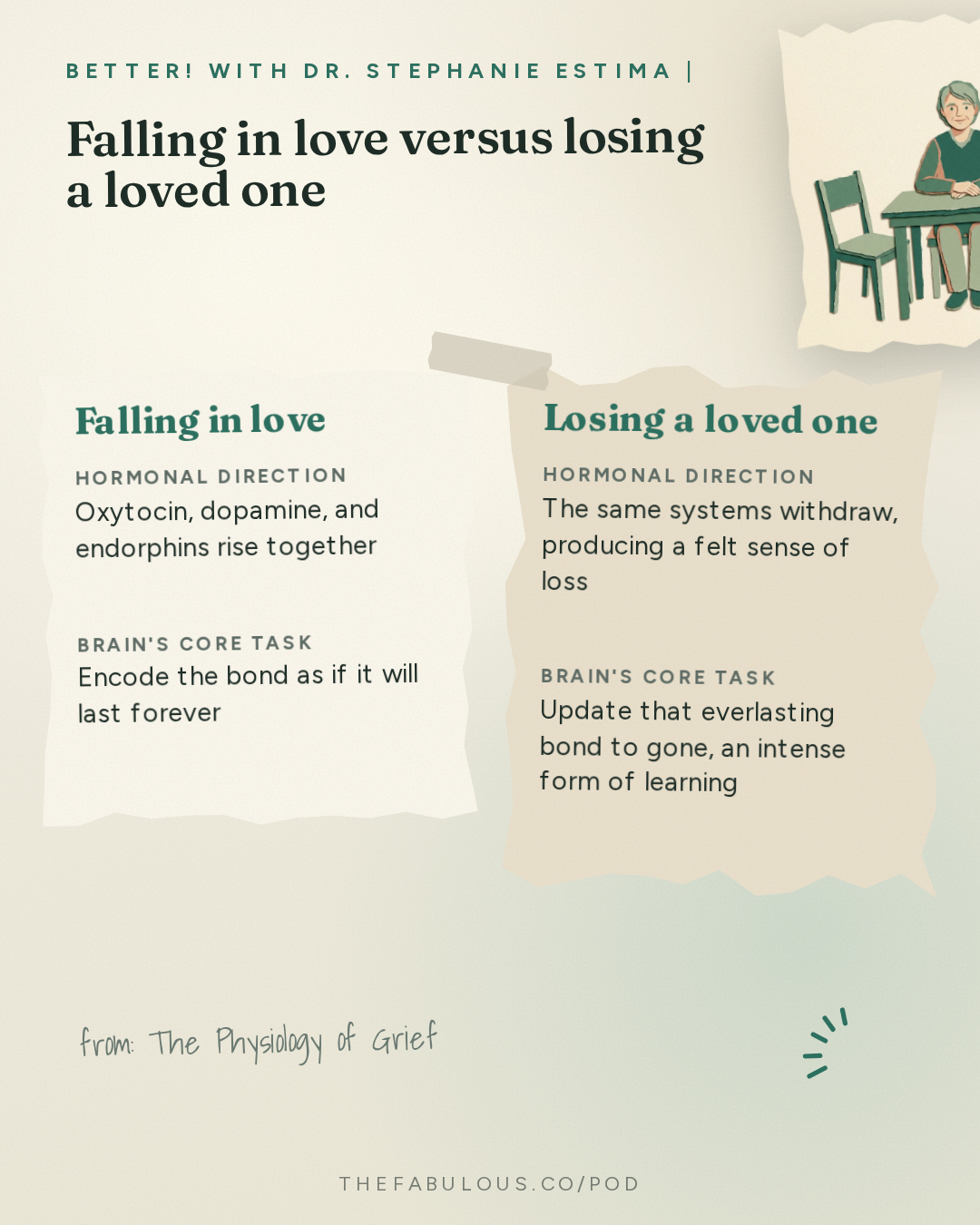
O'Connor's point is not that grief is dangerous in some vague sense. It is that the body treats the loss of a close person the way it treats the loss of oxygen or food: as an emergency. She draws the comparison directly, agreeing when her host, Dr. Stephanie Estima, suggests grief looks like withdrawal, the same hormonal cascade that built the bond (oxytocin, dopamine, endorphins) running in reverse (11:50). Falling in love changes the brain. Losing that person changes it back, and the body reacts accordingly.
The Body's Ledger
The acute crisis does not last forever, but it does not resolve quickly either. Drawing on research by Australian bereavement scientist Tom Buckley, O'Connor explains that blood pressure and heart rate return to baseline, on average, by six months after a loss (16:19). Cortisol, the stress hormone, is slower: it stays elevated in bereaved people well past that six-month mark (16:47). Even after the visible symptoms calm down, the immune system is still paying a bill. In the first year after a loss, older adults face a higher risk of dying from pneumonia or sepsis, because the same stress hormones that flood the body during acute grief also suppress immune function over time (17:43).
O'Connor uses an analogy that reframes the whole conversation: pregnancy. "Pregnancy is not a disease," she says, "but no one would suggest that pregnancy isn't physiological" (23:32). Nobody thinks it strange that a pregnant woman gets regular checkups, blood pressure monitoring, and a plan for what counts as an emergency. O'Connor argues bereavement deserves the same kind of structured care, not because it is a disorder but because it is a known, temporary, high-risk physiological state. Her proposal is modest: a baby aspirin for people not otherwise contraindicated, a reminder to keep the mammogram appointment that got missed during a parent's final illness, a nurse or friend who treats the person standing at the bedside as, briefly, a patient too (24:35, 27:08).
This reframing changes what resilience means. It is not toughing it out or returning to who someone was before. O'Connor recalls an analogy she once heard, borrowed from immunology, to explain it.
"Your immune system isn't there so you'll never get sick. The immune system is there because you will get sick, and you will return to health." — recalled by Mary-Frances O'Connor [28:32]
Resilience, in her framing, is the capacity to build a life with meaning after loss, not the absence of pain. The most common response to losing a loved one is, in fact, resilience of exactly this kind, even though the population-level cardiovascular risk numbers are real and worth taking seriously at the same time (23:03).
An Intense Kind of Learning
The strangest part of O'Connor's research is what happens in the brain once the acute crisis passes and grieving, the long trajectory of change, begins. She calls it the "gone but everlasting" theory. The memory system (the hippocampus, a brain structure that stores and retrieves personal memories) knows perfectly well that a loved one has died. But the attachment system, the older neural wiring that lets a person feel securely connected to someone even when that person is out of sight, does not update the same way. It evolved so a child could sit calmly in a kindergarten classroom knowing a parent, though absent, still exists in the world (42:14). When a loved one dies, that same wiring keeps signaling that they are still out there. The two signals collide, and the collision is felt as a wave of grief (43:52).
O'Connor describes grieving as a kind of intense learning, an updating of the brain's working model of the world, closer to relearning a language than to simply feeling sad.
"Grieving really is like an intense form of learning because what we are doing in a way is we are updating our software." — Mary-Frances O'Connor [44:53]
She ran a neuroimaging study of women who had lost a mother or sister to breast cancer, showing them a photograph of the deceased loved one alongside a photo of a stranger while they lay in a scanner. The more yearning a woman reported in a pre-scan interview, the more activity showed up in her nucleus accumbens, a small brain region rich in dopamine, oxytocin, and opioid signaling that is also active during bonding (63:05, 63:33). O'Connor is careful about what this does and does not mean. People sometimes describe yearning for a lost loved one as an addiction, but she prefers a different comparison: a hiker in the Arizona desert who forgot her water bottle cannot stop thinking about water, yet no one calls that an addiction. It is a survival system doing its job (64:31).
That same hormonal machinery shows up as physical sensation. Research O'Connor cites finds that more than 90% of bereaved people report physical symptoms they were not expecting, most commonly in the chest, though also in the head, throat, and stomach (59:34). She has felt it herself: a lump in the throat during her own divorce, and again years later during menopause, which sent her searching for a throat cancer risk calculator that put her odds at roughly 2%, a number that let her breathe easier (61:38). The lesson she draws is not to dismiss every symptom as "just grief," but to recognize that heartache is normal and hormonally real, while still checking in with a doctor if something feels genuinely off.
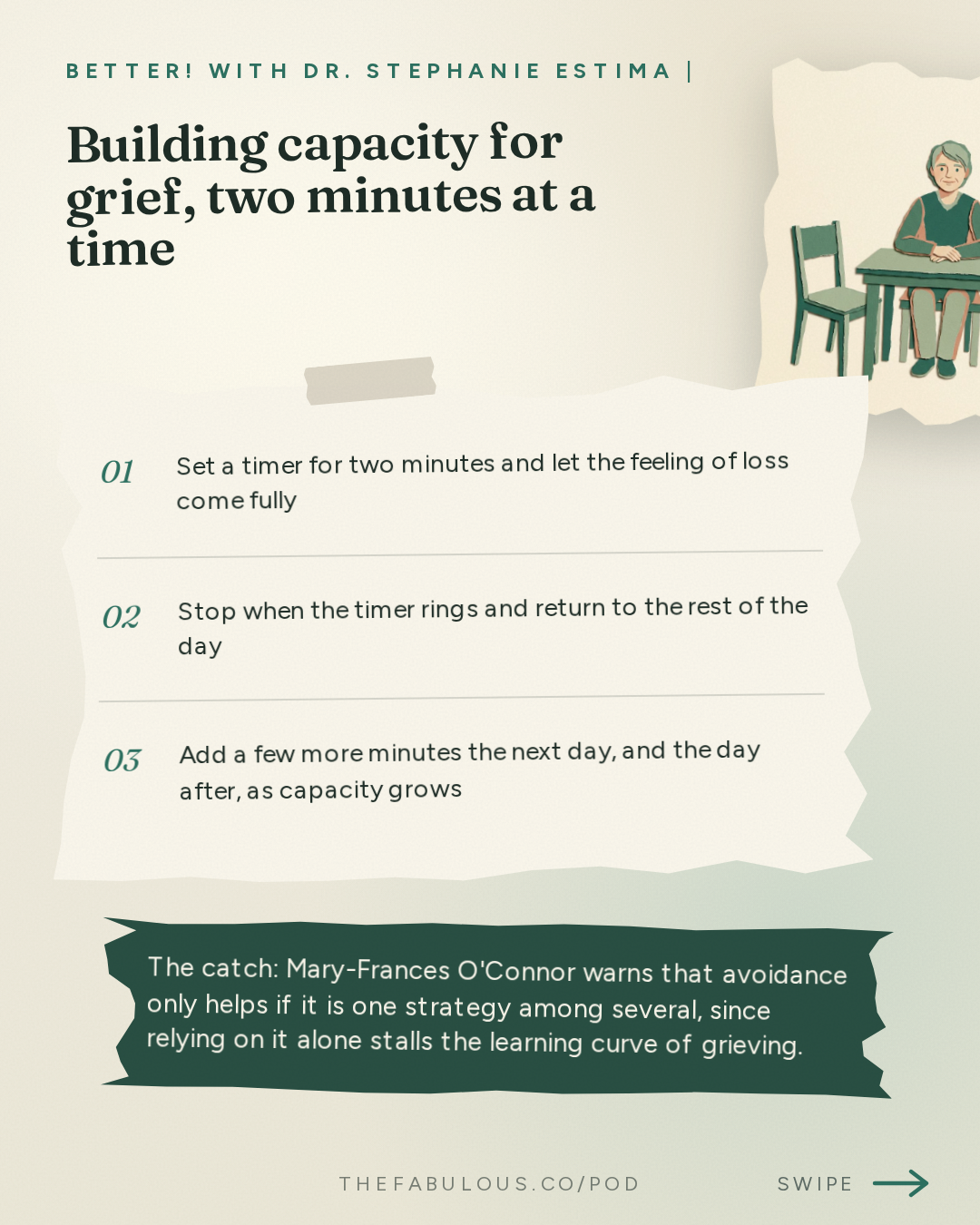
What to do with all this, practically, is where the conversation turns useful rather than merely explanatory. O'Connor describes a young widow who could not let herself think about her husband's death at all, until one day she set a timer for two minutes and let the feeling in, then stopped when the timer rang. The next day she tried four minutes. Slowly she built capacity (54:17). O'Connor is equally clear that avoidance itself is not a failure. "If avoidance is the only strategy you have in your toolkit, that's not gonna really help on the learning curve over time, is it?" she asks (57:43). The goal is a toolkit, not a single approach: sometimes cheering at a soccer game and ignoring the sympathetic looks from other parents is exactly the right move.
Perhaps the most comforting idea in the conversation is what O'Connor calls continuing bonds. The relationship with someone who has died does not end, she argues; it just stops living in the external world.
"So it turns out that the relationship doesn't actually go away. It just stops being a relationship with someone in the external world." — Mary-Frances O'Connor [48:29]
She and her sister run an annual book giveaway for kindergartners in their hometown, named for their educator parents, a way of carrying their values forward (67:48). A father who repainted a yellow bathroom purple after his wife's death was not erasing her memory; he was discovering, slowly, who he still was without her (47:07). None of this erases the pain, and O'Connor is honest that trying to protect the people we love from future grief over our own deaths is not really possible. What is possible, she suggests, is being honest now, together, about the fact that life is bounded, which is exactly what gives urgency and meaning to how it gets spent.
By the numbers
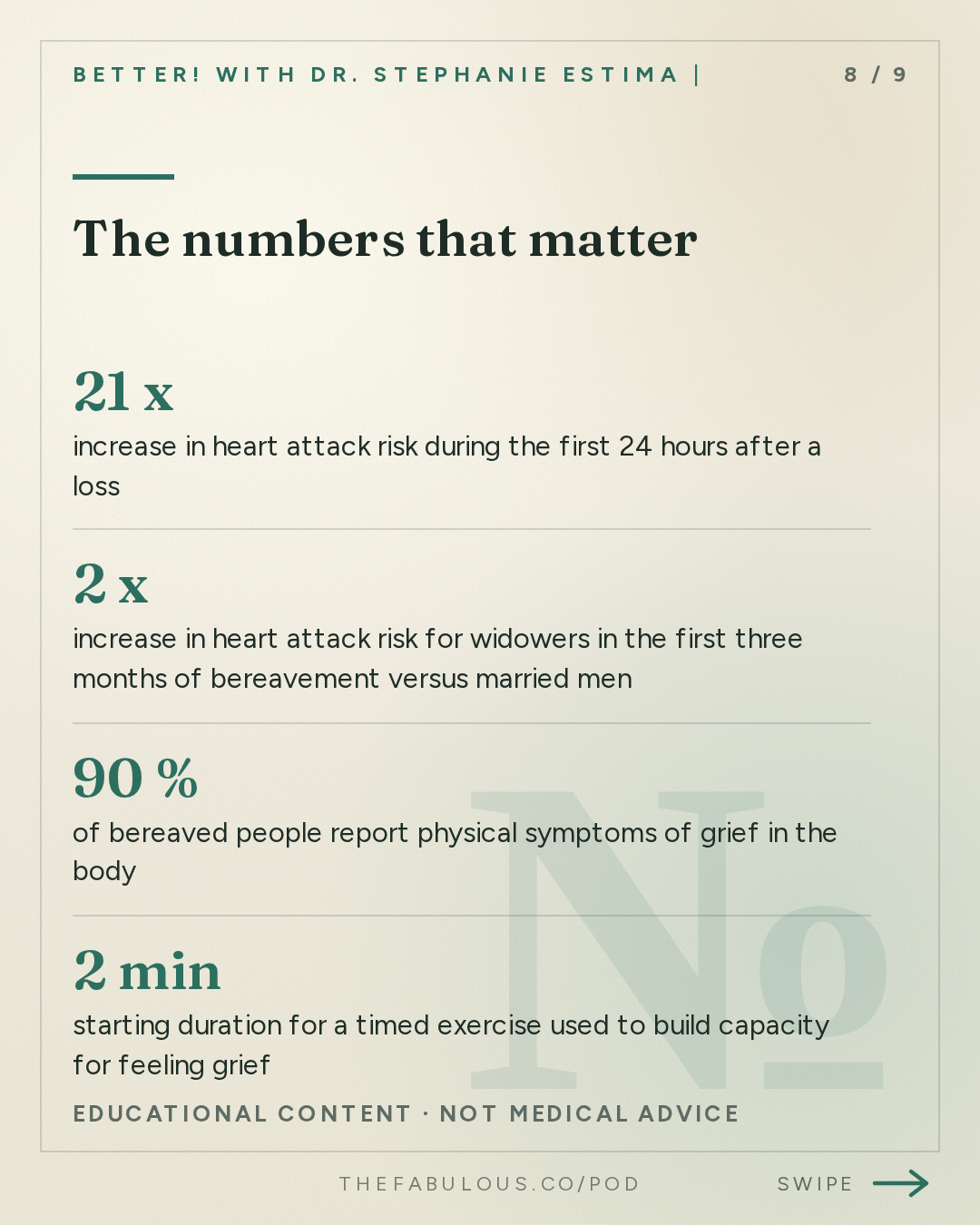
- 21 x increase in heart attack risk during the first 24 hours after a loss
- 2 x increase in heart attack risk for widowers in the first three months of bereavement versus married men
- 90 % of bereaved people report physical symptoms of grief in the body
- 2 min starting duration for a timed exercise used to build capacity for feeling grief
In their words
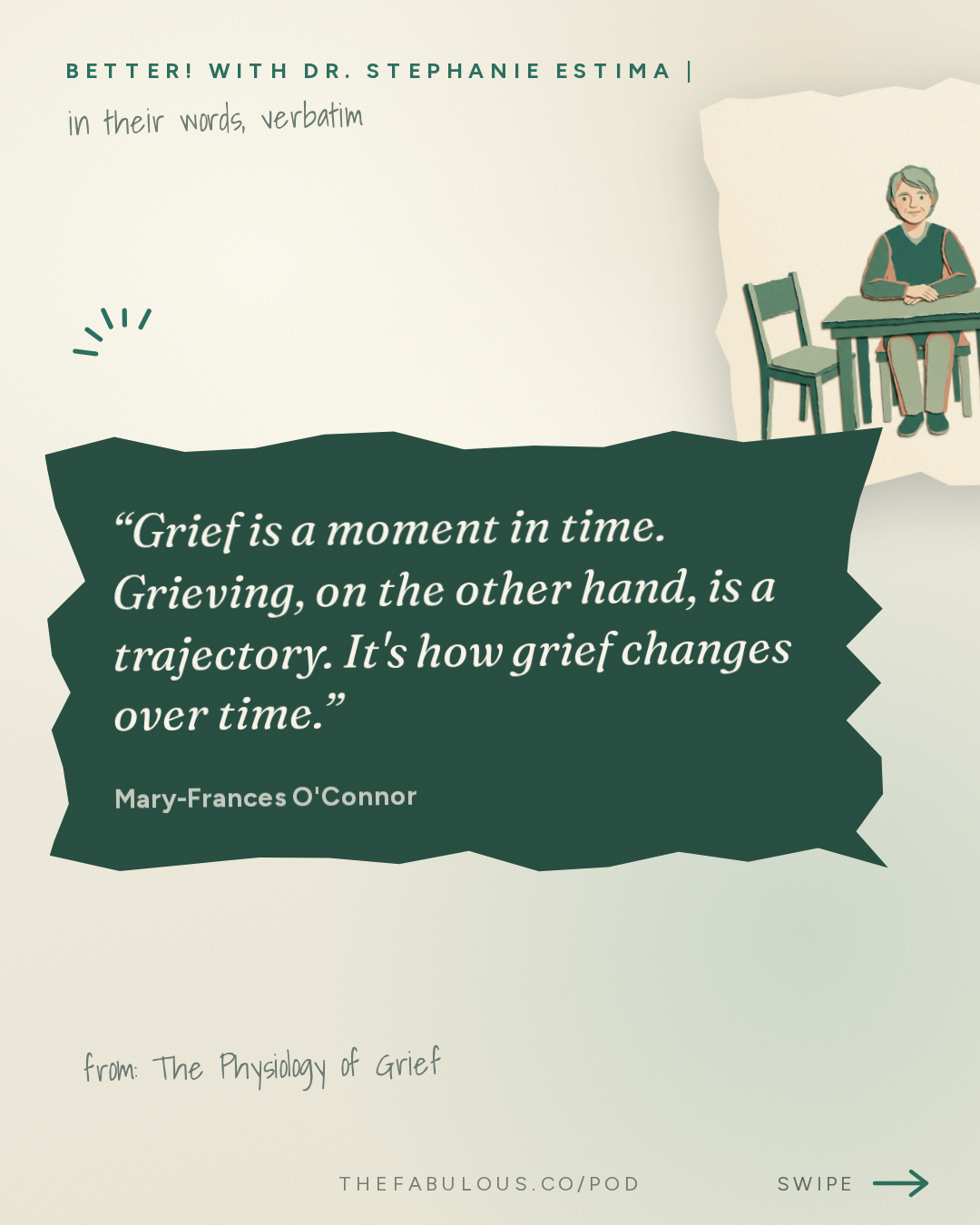
“Grief is a moment in time. Grieving, on the other hand, is a trajectory. It's how grief changes over time.”
“In that first 24 hours, for example, you are 21 times more likely to have a heart attack than any other day of your life.”
“Your immune system isn't there so you'll never get sick. The immune system is there because you will get sick, and you will return to health.”
“So it turns out that the relationship doesn't actually go away. It just stops being a relationship with someone in the external world.”
“If avoidance is the only strategy you have in your toolkit, that's not gonna really help on the learning curve over time, is it?”
Protocols
-
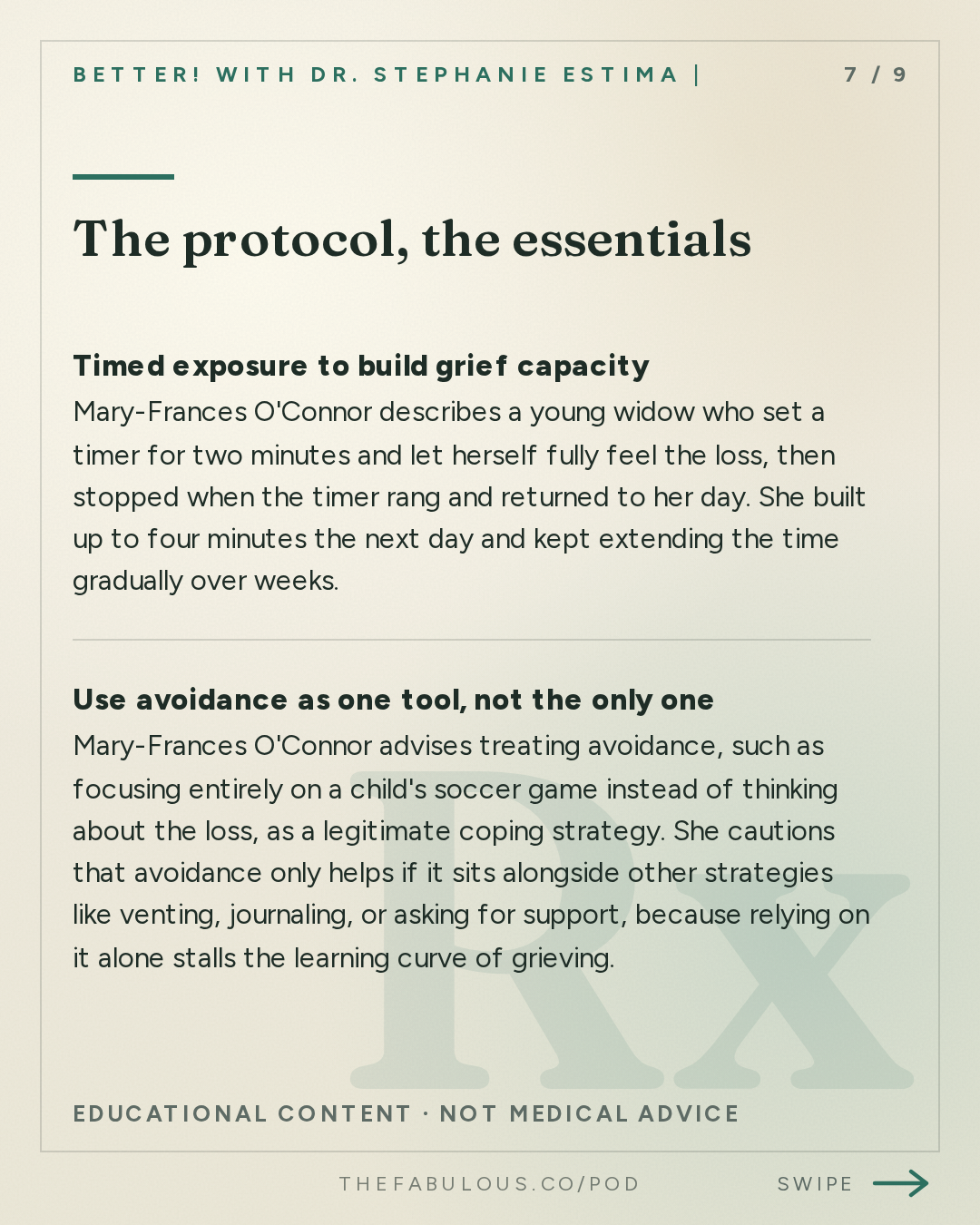
Timed exposure to build grief capacity
Mary-Frances O'Connor describes a young widow who set a timer for two minutes and let herself fully feel the loss, then stopped when the timer rang and returned to her day. She built up to four minutes the next day and kept extending the time gradually over weeks.
Daily, increasing by a few minutes as capacity grows
-
Use avoidance as one tool, not the only one
Mary-Frances O'Connor advises treating avoidance, such as focusing entirely on a child's soccer game instead of thinking about the loss, as a legitimate coping strategy. She cautions that avoidance only helps if it sits alongside other strategies like venting, journaling, or asking for support, because relying on it alone stalls the learning curve of grieving.
As needed, alongside other coping strategies
-
Check on a grieving friend's preventive health, not just their emotions
Mary-Frances O'Connor recommends that friends of a bereaved person actively remind them about routine care they may have skipped, such as a mammogram or dentist appointment, since caregiving and mourning often crowd out basic self-care. She frames this as a different but equally important form of support from asking how someone feels emotionally.
Periodically during the bereavement period
Questions this episode answers
Does grief actually increase heart attack risk?
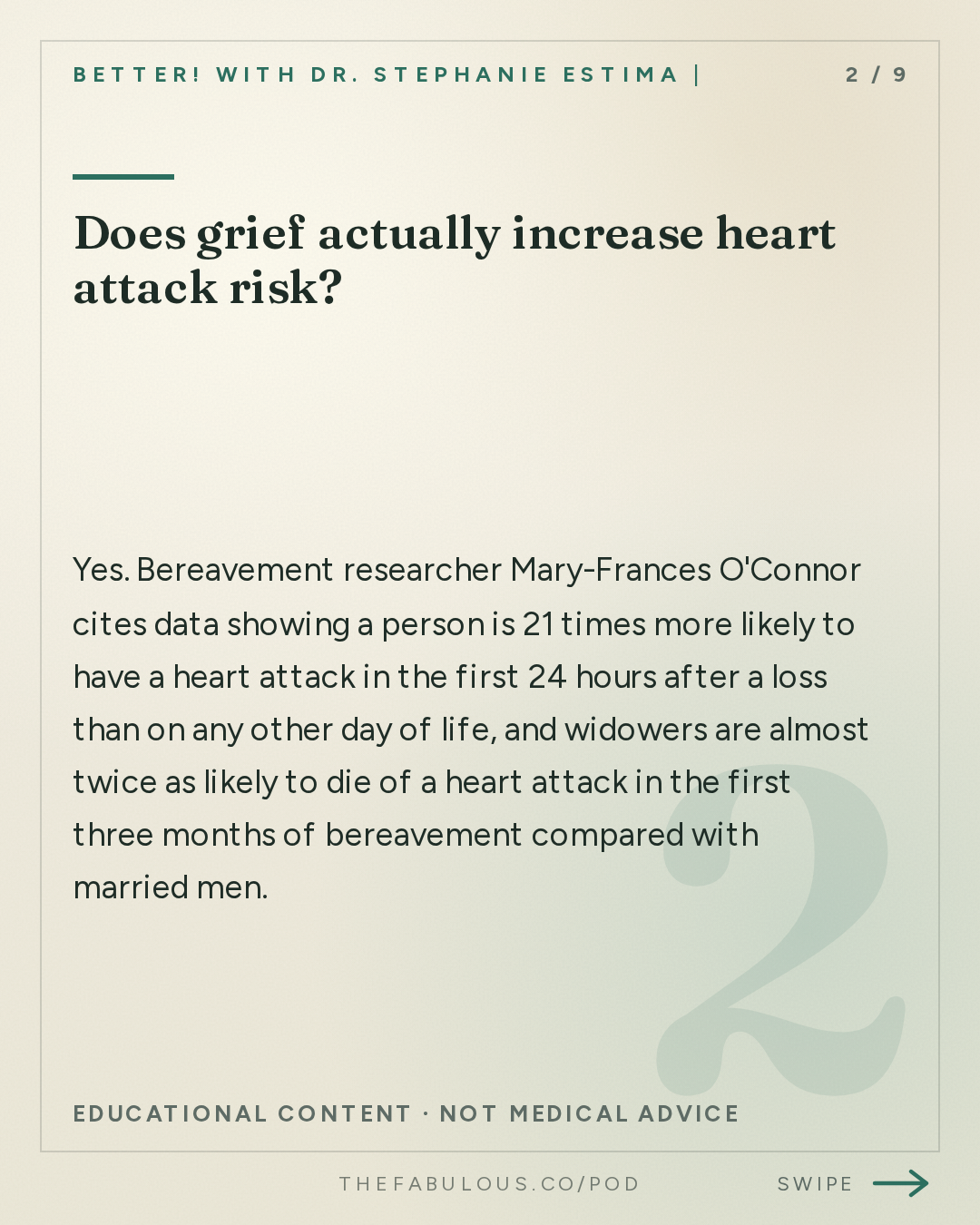
Yes. Bereavement researcher Mary-Frances O'Connor cites data showing a person is 21 times more likely to have a heart attack in the first 24 hours after a loss than on any other day of life (15:18), and widowers are almost twice as likely to die of a heart attack in the first three months of bereavement compared with married men (15:46).
How long do the physical effects of grief last?
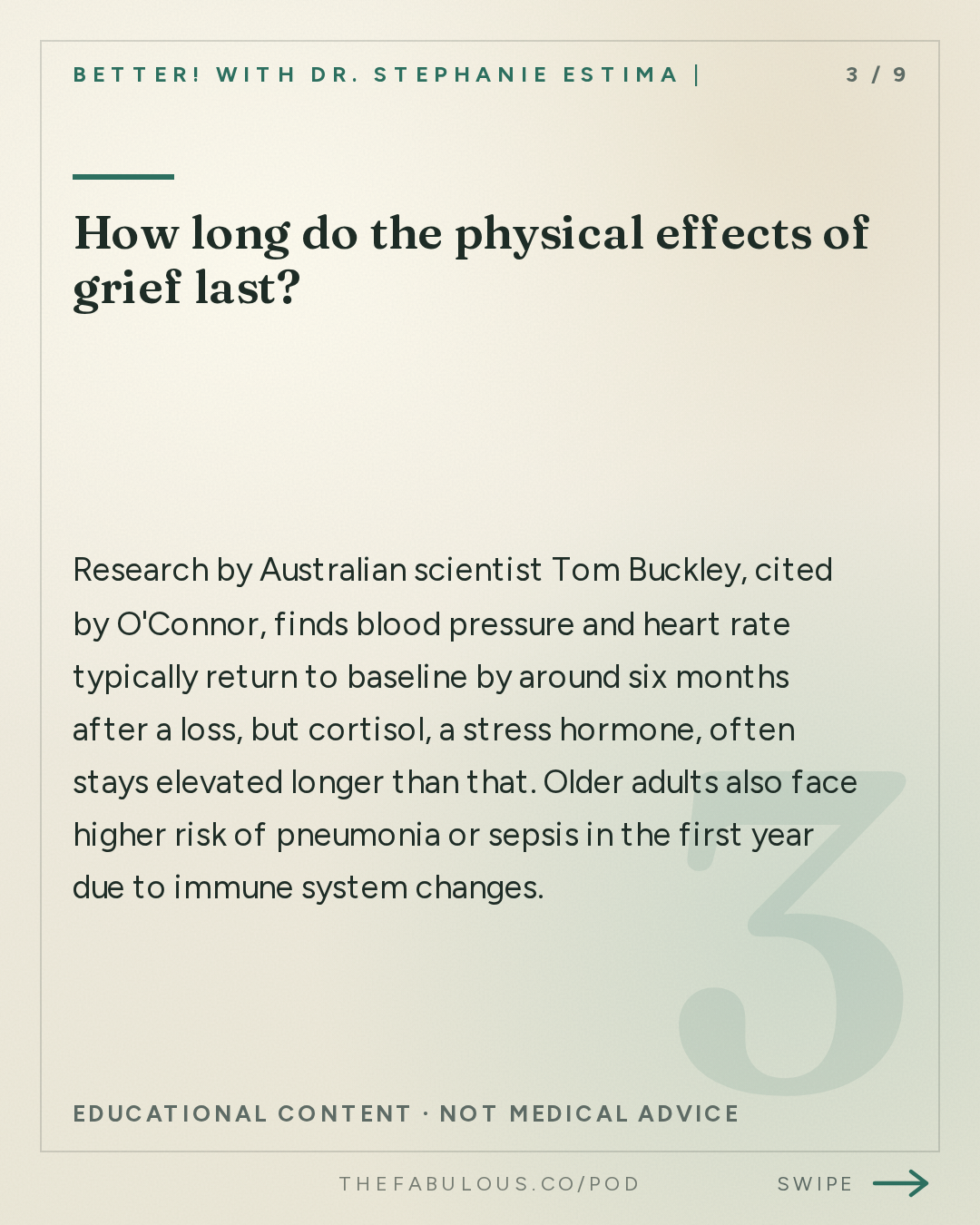
Research by Australian scientist Tom Buckley, cited by O'Connor, finds blood pressure and heart rate typically return to baseline by around six months after a loss, but cortisol, a stress hormone, often stays elevated longer than that (16:19, 16:47). Older adults also face higher risk of pneumonia or sepsis in the first year due to immune system changes (17:43).
Why does the brain feel like a dead loved one is still alive?
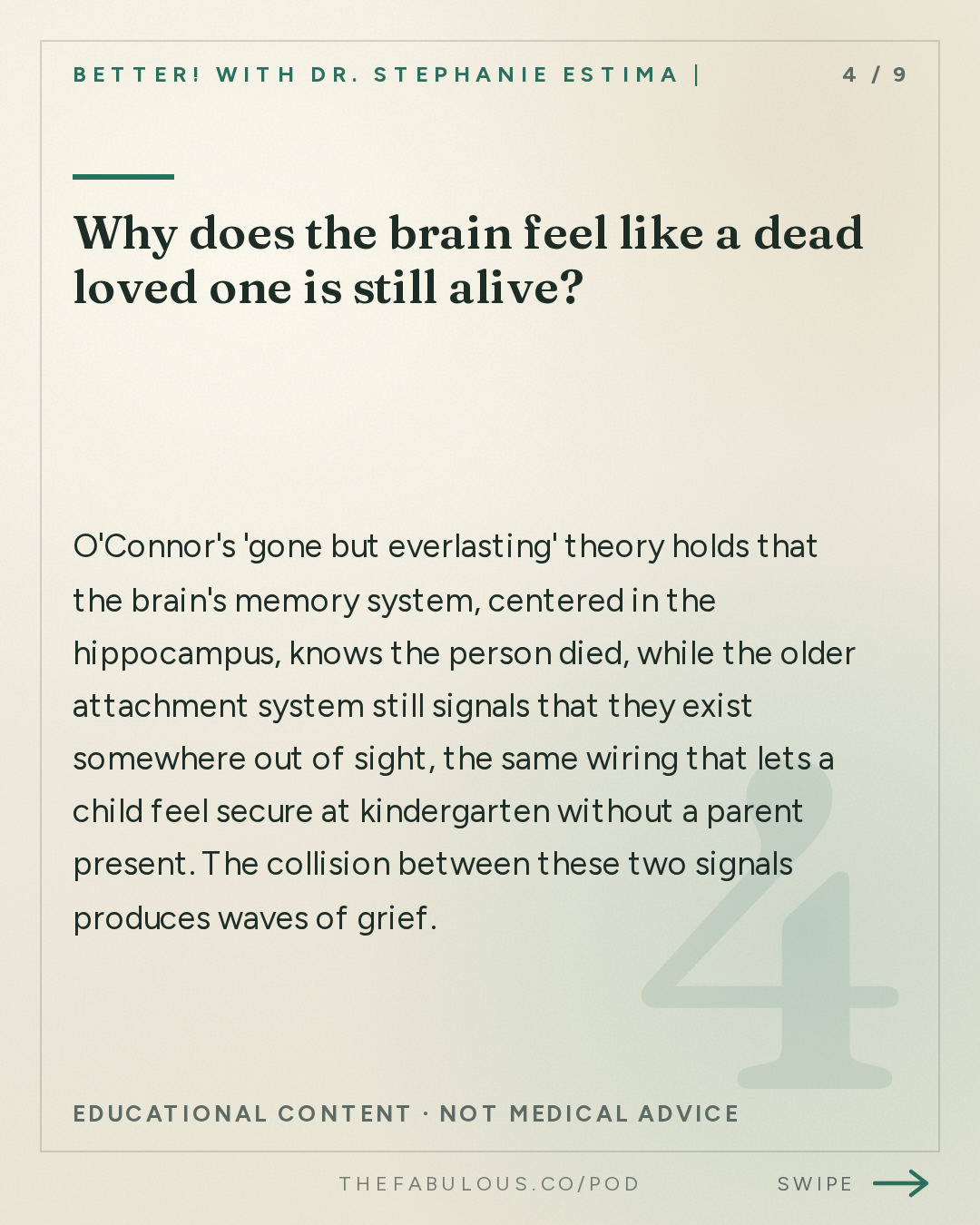
O'Connor's 'gone but everlasting' theory holds that the brain's memory system, centered in the hippocampus, knows the person died, while the older attachment system still signals that they exist somewhere out of sight, the same wiring that lets a child feel secure at kindergarten without a parent present. The collision between these two signals produces waves of grief (42:14, 43:52).
Is it normal to feel physical symptoms like a lump in the throat when grieving?
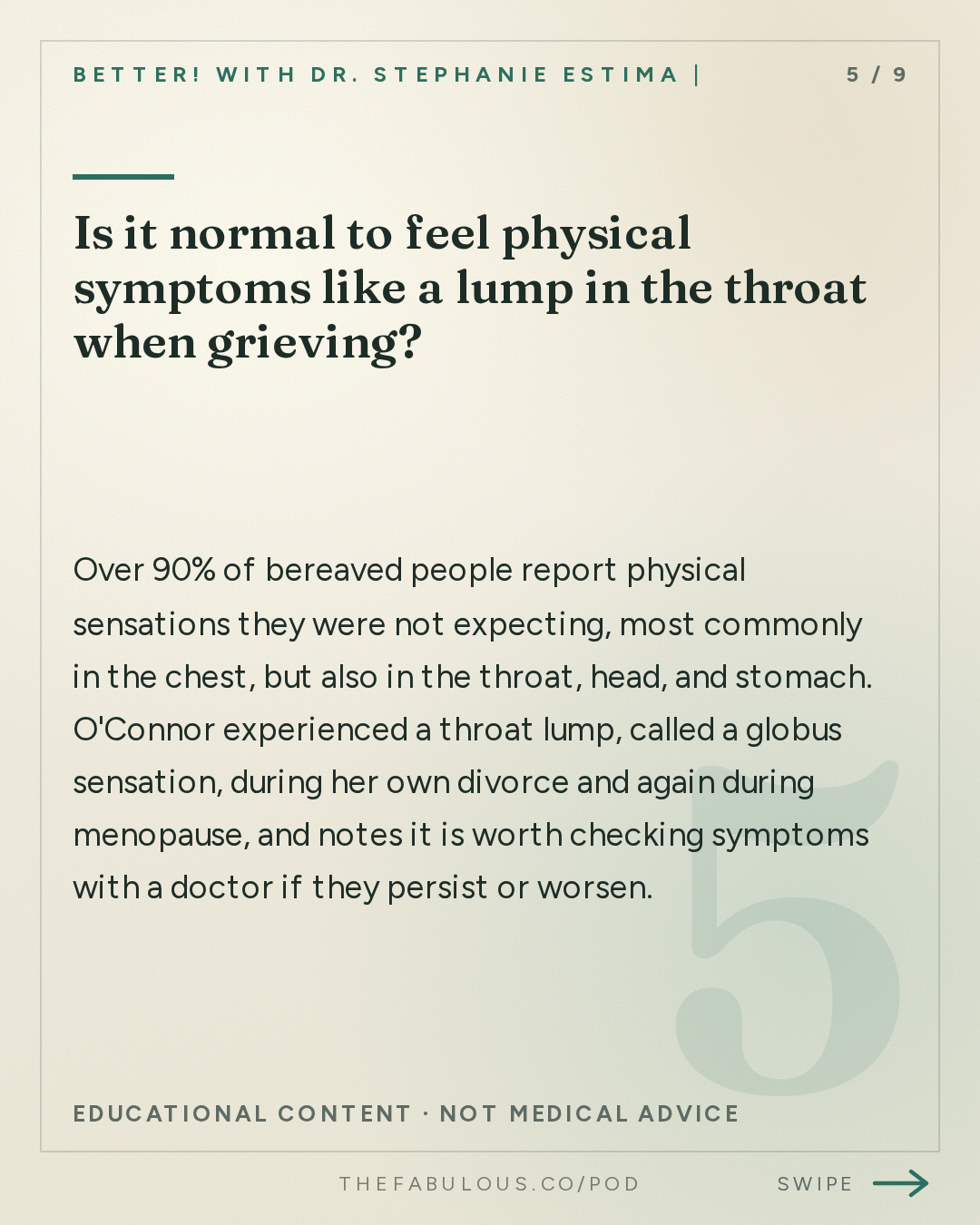
Over 90% of bereaved people report physical sensations they were not expecting, most commonly in the chest, but also in the throat, head, and stomach (59:34). O'Connor experienced a throat lump, called a globus sensation, during her own divorce and again during menopause, and notes it is worth checking symptoms with a doctor if they persist or worsen (61:15, 61:38).
What is a healthy way to cope with waves of grief in the moment?
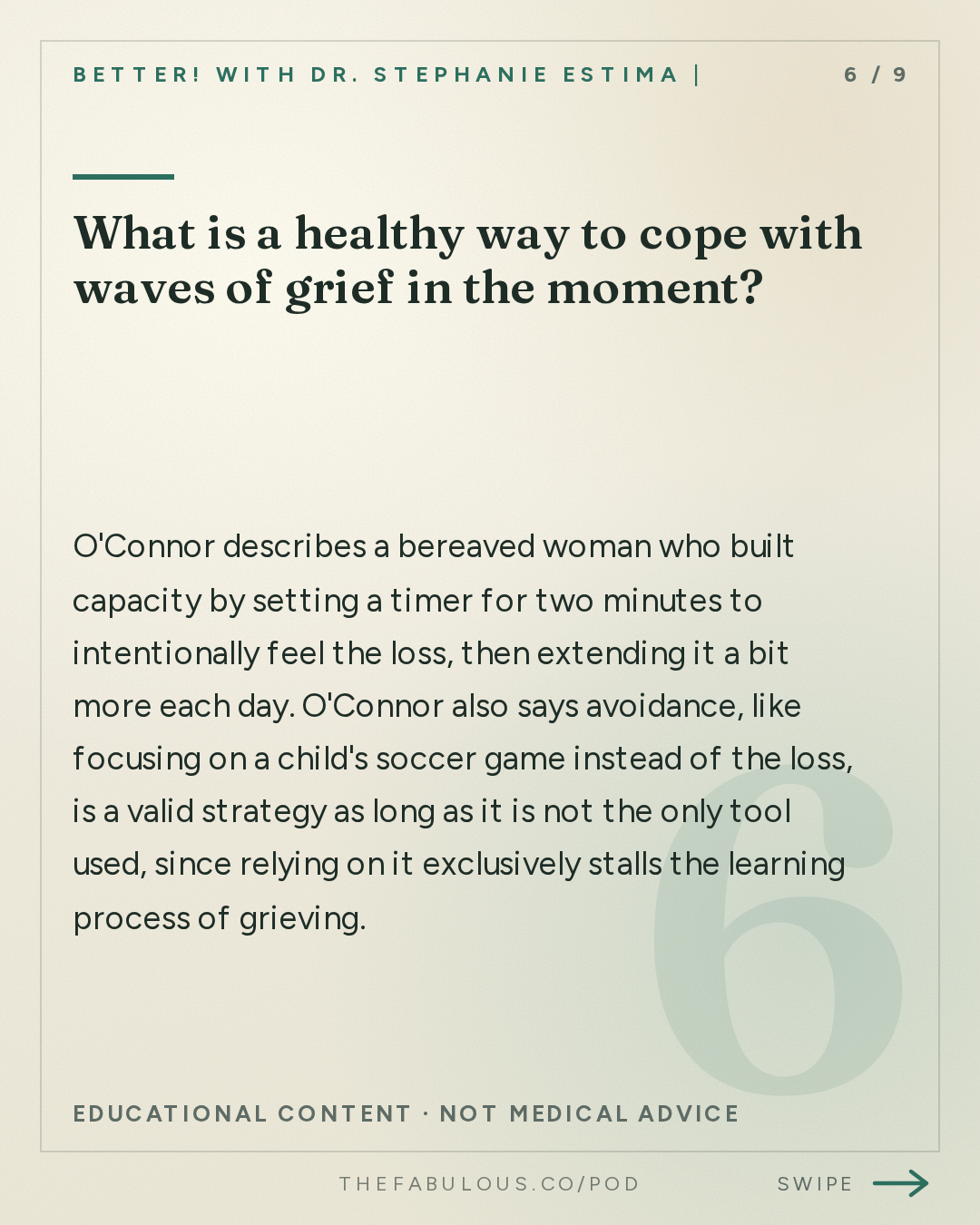
O'Connor describes a bereaved woman who built capacity by setting a timer for two minutes to intentionally feel the loss, then extending it a bit more each day (54:17). O'Connor also says avoidance, like focusing on a child's soccer game instead of the loss, is a valid strategy as long as it is not the only tool used, since relying on it exclusively stalls the learning process of grieving (57:43).
Does grief ever fully go away?
O'Connor argues the relationship with a lost loved one does not disappear, it shifts from an external relationship to an internal one, continuing through practices like honoring their values or talking to them internally (48:29, 67:48). She distinguishes this healthy continuing bond from cases where grief prevents basic functioning, such as not eating or leaving the house, which call for additional support (36:56).
The full read, in cards
Go deeper
- The Grieving Brain — Mary-Frances O'Connor's book explaining the 'gone but everlasting' theory of attachment neurobiology
- The Grieving Body — Mary-Frances O'Connor's book on the hormonal and physical manifestations of grief, including the globus sensation
- Tom Buckley's bereavement research (Australia) — Found blood pressure and heart rate normalize by about six months post-loss while cortisol stays elevated longer
- Of Course, I'm Here, Right Now — Shelby Forsythia's book offering a three-part framework for comforting a grieving person
- O'Connor's neuroimaging study of bereaved women — Found that self-reported yearning for a deceased mother or sister correlated with nucleus accumbens activity while viewing their photograph
Mentioned
Mary-Frances O'Connor · University of Arizona · The Grieving Brain · The Grieving Body · Shelby Forsythia · Tom Buckley · nucleus accumbens · hippocampus
More from this show and category

Katy Bowman: Movement as Nutrition, Not Exercise
Biomechanist Katy Bowman argues movement is a nutrient the body requires daily, not a scheduled workout, and that modern convenience saves movement rather than time. She maps a movement pyramid from floor-sitting to sprinting, links bone strength to changing direction, and traces midlife foot pain to decades of repeated gait patterns.

ED as an Early Predictor of Heart Attack Risk
Erectile dysfunction predicts a future heart attack better than chest pain does, especially in younger men (11:11). Urologist Tobias Kohler describes two cheap early-warning tests, a coronary calcium scan and a Mayo Clinic ceramide blood test, plus the cardiac damage caused by high-dose testosterone abuse (12:49, 44:55).
Vaginal Estrogen for UTI Prevention
Urologist Dr. Kelly Casperson explains that genitourinary syndrome of menopause (GSM) affects 50% to 90% of postmenopausal women. Vaginal estrogen cuts recurrent urinary tract infections by half, lowers hospitalization and death risk, and is safe for most breast cancer survivors, yet only 9% of women diagnosed with GSM get a prescription.
Gabrielle Lyon: Muscle Is the Longevity Organ
Dr. Gabrielle Lyon argues that skeletal muscle, not body fat, is the organ that determines how well women age. She explains that muscle drives glucose disposal, releases hormone-like myokines, and needs at least 100 grams of daily protein plus resistance training to stay healthy after midlife.
