BETTER! with Dr. Stephanie Estima
Joint Health in Menopause: Train, Don't Avoid
Deep Squats Don't Wreck Knees -This Does | Joint Pain & Strength Training in Menopause
▶ Listen to the full episode More from BETTER! with Dr. Stephanie Estima
The brief
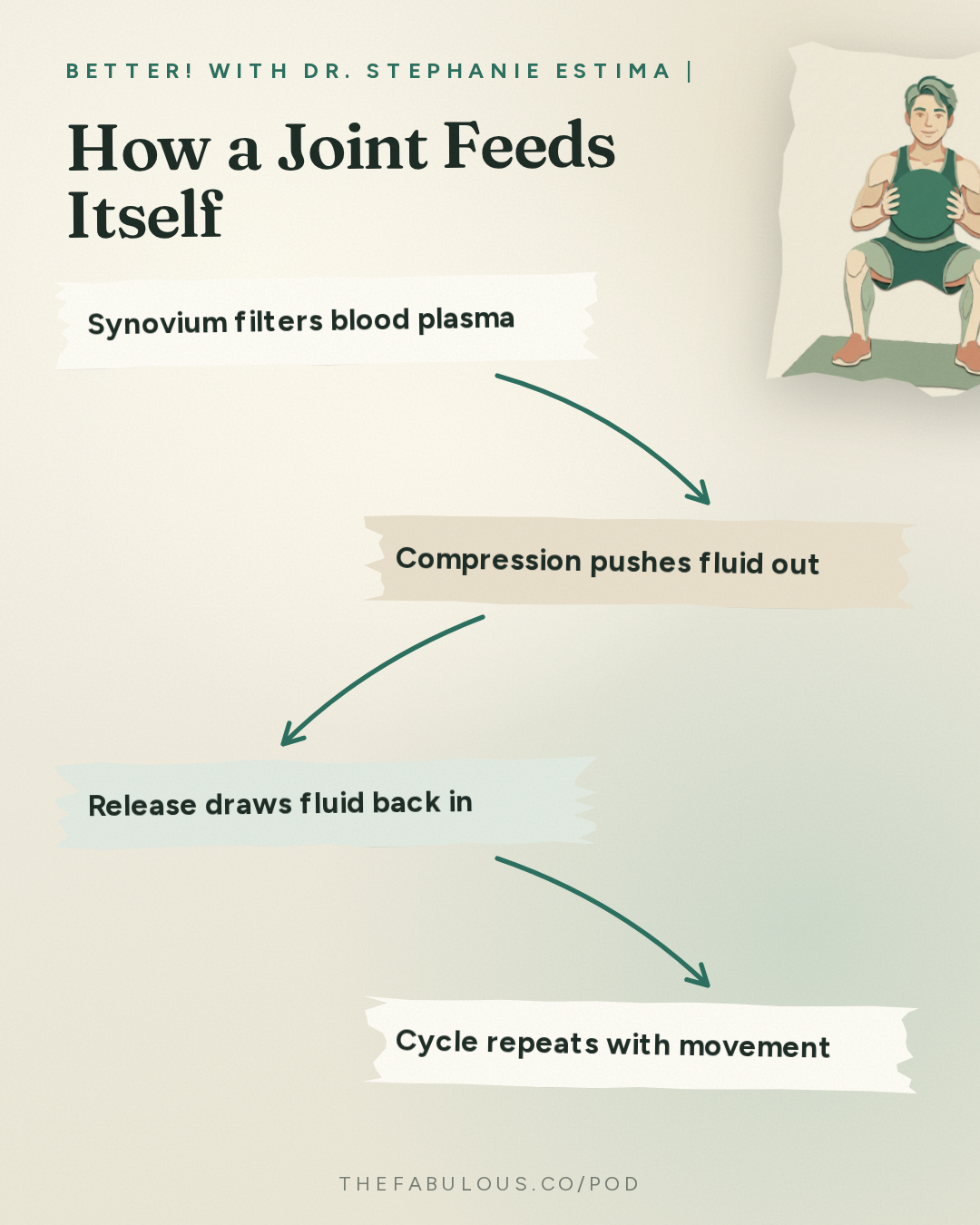
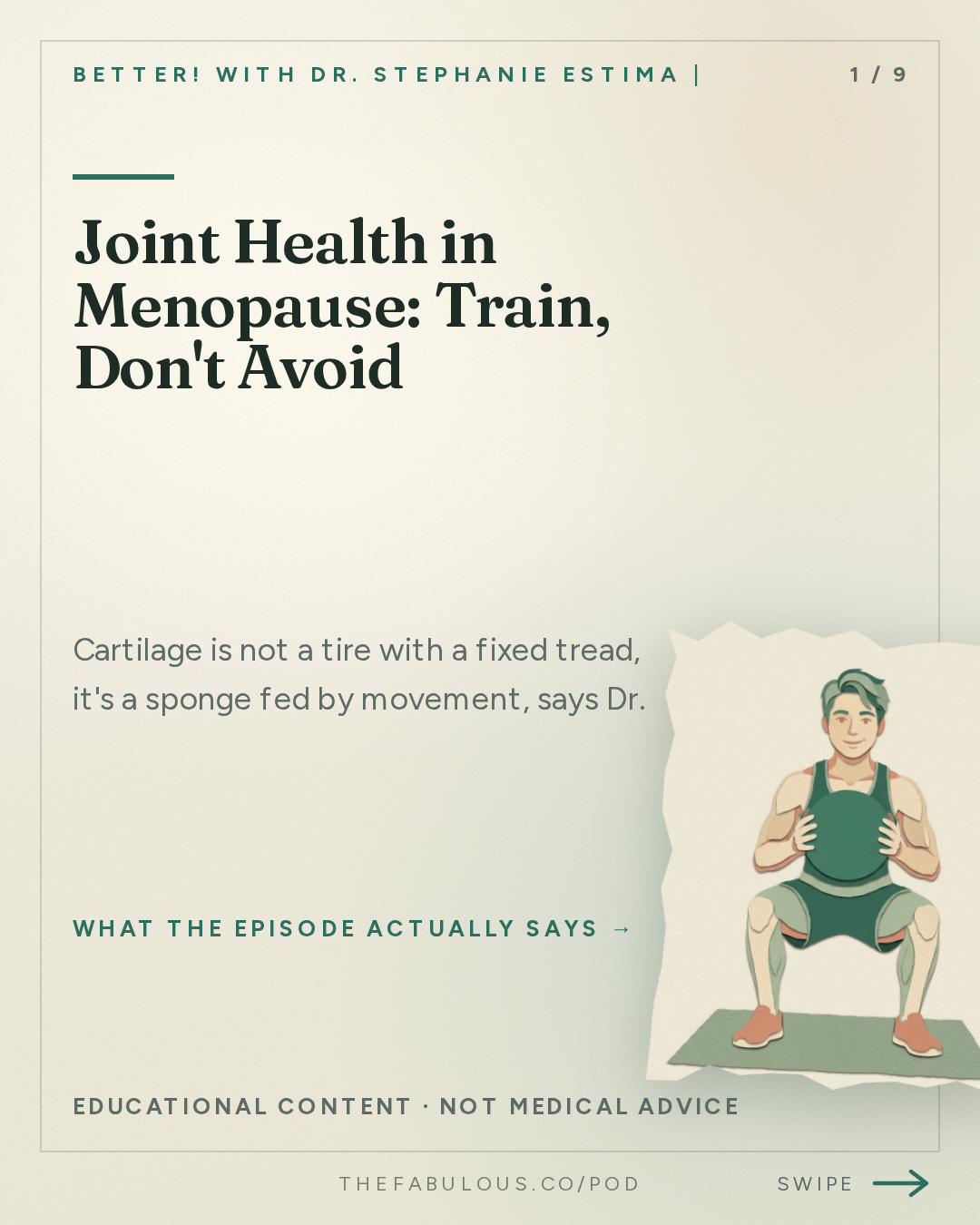
Cartilage is not a tire with a fixed tread, it's a sponge fed by movement, says Dr. Stephanie Estima. Joint cartilage has no blood supply, so compression and release during movement pump nutrients in and waste out. She argues declining estrogen drives what researchers now call Musculoskeletal Syndrome of Menopause, and that strength training, done without ego, protects joints better than avoidance or stretching alone.
A tire wears down with every mile until the tread is gone. For years, that has been the story patients hear about their knees: a fixed budget of cartilage, spent one squat at a time, so the smart move is to drive less. Dr. Stephanie Estima, host of the podcast Better, spends an hour taking that story apart. The habit of protecting a joint by moving it less, she argues, is often the very thing that wears it out (04:41).
"Your cartilage is not like a tire. It doesn't have a set amount of tread to it. Your cartilage is actually much more like a sponge." — Dr. Stephanie Estima [05:06]
The sponge image is not just a nice turn of phrase. It describes real biology. The smooth white cap on the end of every bone, called articular cartilage, has no blood vessels, no nerves, and no lymph vessels running through it (23:24). Doctors call this avascular, aneural, and alymphatic. The rest of the joint, the capsule, the lining, the bone underneath, all have blood supply. The working surface does not.
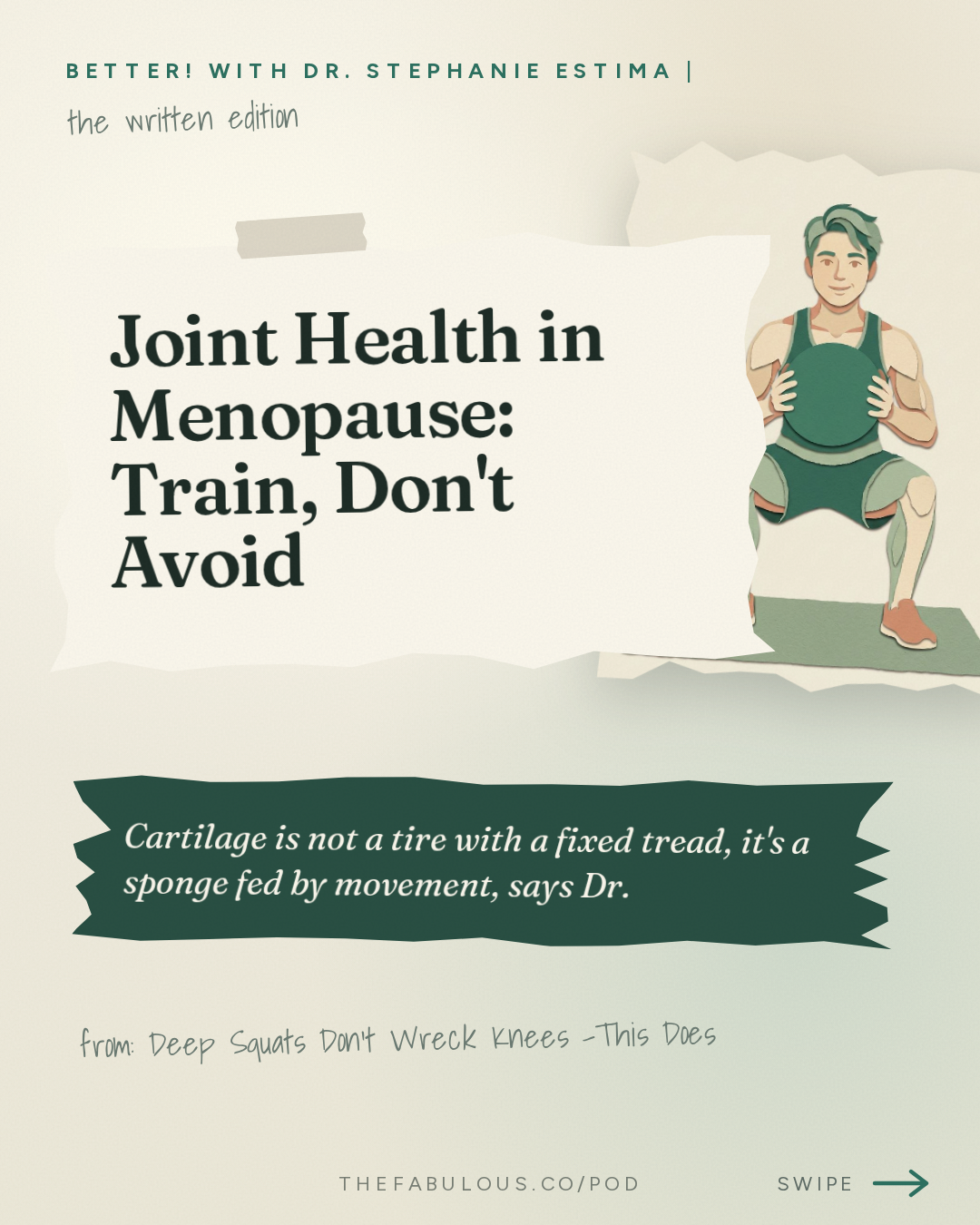
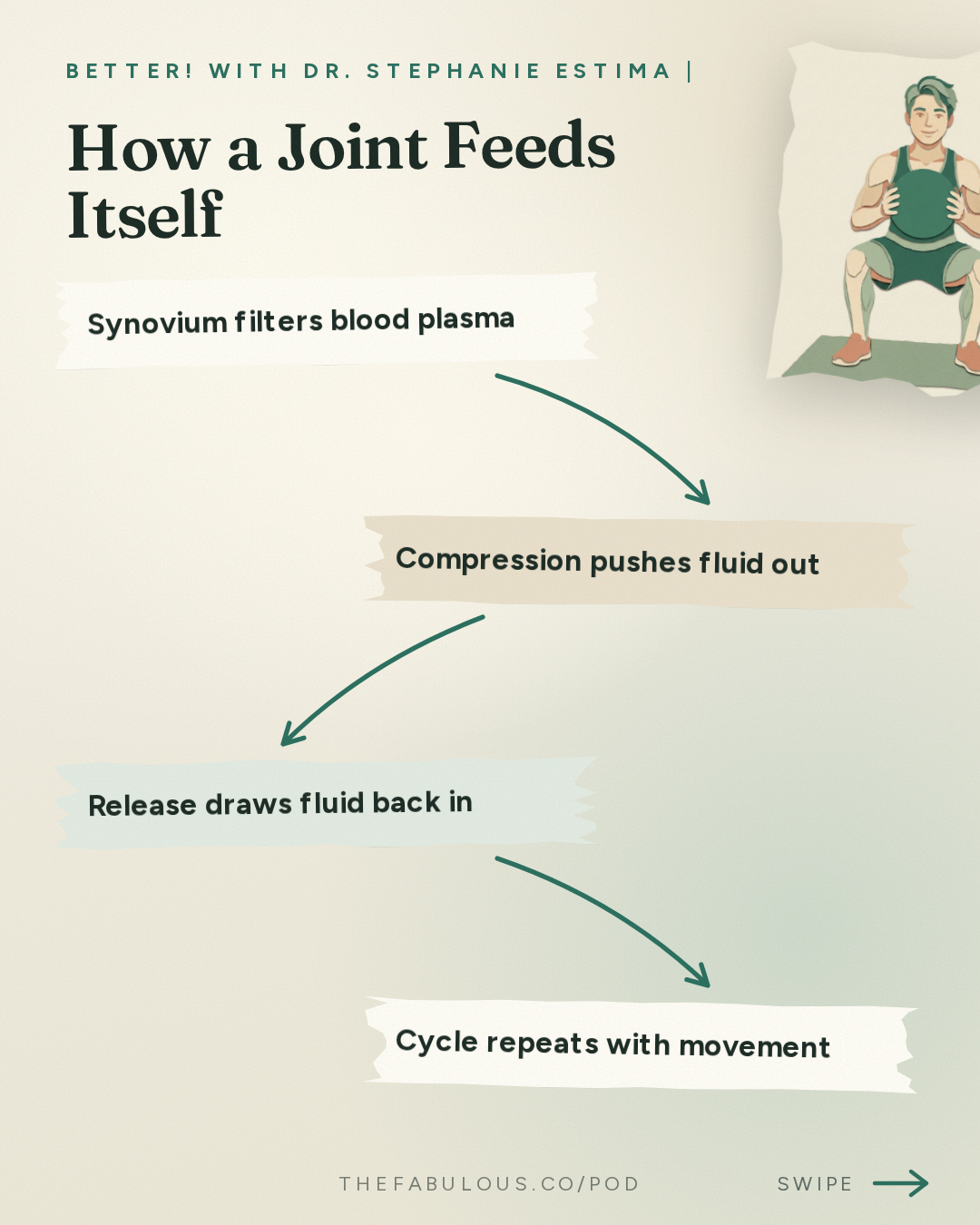
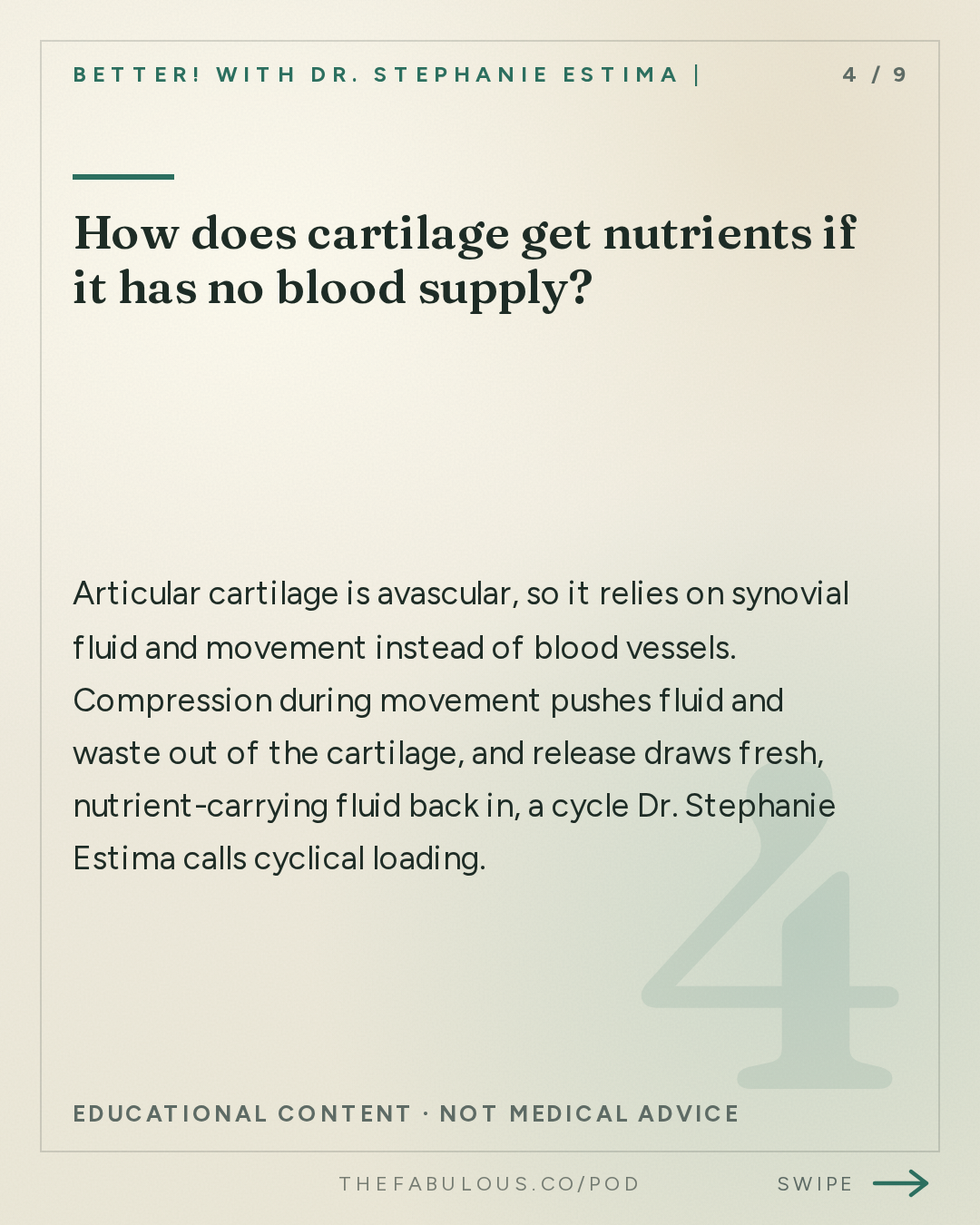
That raises an obvious question: if the tissue has no blood supply, how do its cells, called chondrocytes, get fed? The answer is synovial fluid, a lubricant produced by the joint lining, plus movement itself. Nutrients can creep into cartilage by plain diffusion, but diffusion through dense tissue is slow, especially for larger molecules (25:28). What actually drives the exchange is cyclical loading: stepping, squatting, walking. Each compression squeezes old fluid and waste out of the cartilage; each release lets the tissue re-expand and draw fresh fluid, carrying glucose and electrolytes, back in (25:57).
"Motion is actually groceries. Motion is the nutrients. It's how you get the nutrients in and how you take the waste out." — Dr. Stephanie Estima [26:57]
Flip the process around and the logic holds. A kitchen sponge left sitting in standing water goes moldy. Cartilage left unloaded for long stretches, through bed rest, a cast, or simply a desk job, thins out and loses water-binding capacity (26:26). The fix is not rest. It is the right amount of squeeze.
There is a catch, though, and it explains why joint injuries take so long to heal compared with a pulled muscle. A Dutch research team, using a chemical method that tracks slow age-related changes in a single amino acid, estimated that the collagen network in human knee cartilage has a half-life of about 117 years (32:58), compared with roughly 15 years for skin collagen. In plain terms, the structural collagen in an adult's knee was largely built in childhood and adolescence and will likely outlast the rest of the body's cells many times over. That same long lifespan has a cost: related work from the same research group found that advanced glycation end products, sugar-driven cross-links that stiffen collagen, rise roughly 50-fold in cartilage between age 20 and 80 (34:49), and that higher levels of these cross-links reduce how well the tissue turns over. Steady blood sugar, Estima notes, is therefore part of a joint conversation most people never think to have.
What Changes at Menopause
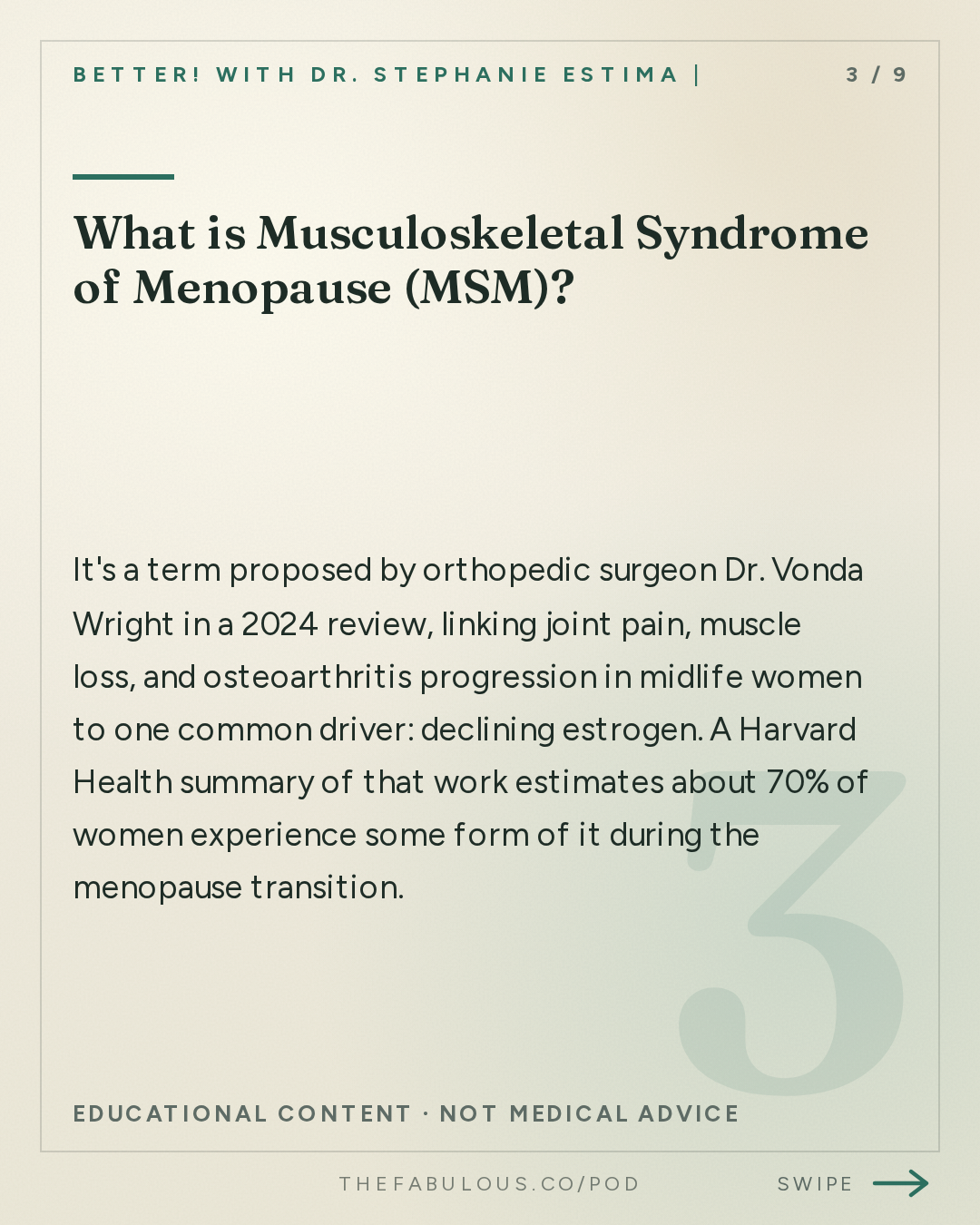
Osteoarthritis is more common in women than men, and the gap widens after age 50 (49:20). In 2024, Dr. Vonda Wright and colleagues published a review proposing a name for the cluster of problems many women notice in midlife: joint pain, muscle loss, and osteoarthritis progression, bundled together as Musculoskeletal Syndrome of Menopause, or MSM. Their argument is that these are not separate complaints but share one driver, the loss of estrogen (50:06). A Harvard Health summary of that work estimates that 70% of women experience some form of this syndrome during the menopause transition (50:37). Estrogen receptors sit in cartilage and in the synovial lining, and estrogen influences collagen turnover, inflammation, and how hydrated connective tissue stays. When estrogen swings and then declines, that support changes too.
But Estima adds a complication worth sitting with: estrogen also affects ligament compliance, meaning how much a ligament stretches under tension. Without enough mechanical loading, women starting hormone therapy sometimes feel better at first and then feel their joints getting looser and worse.
"Estrogen is not a substitute for lifting." — Dr. Stephanie Estima [52:26]
Strong, Not Greedy
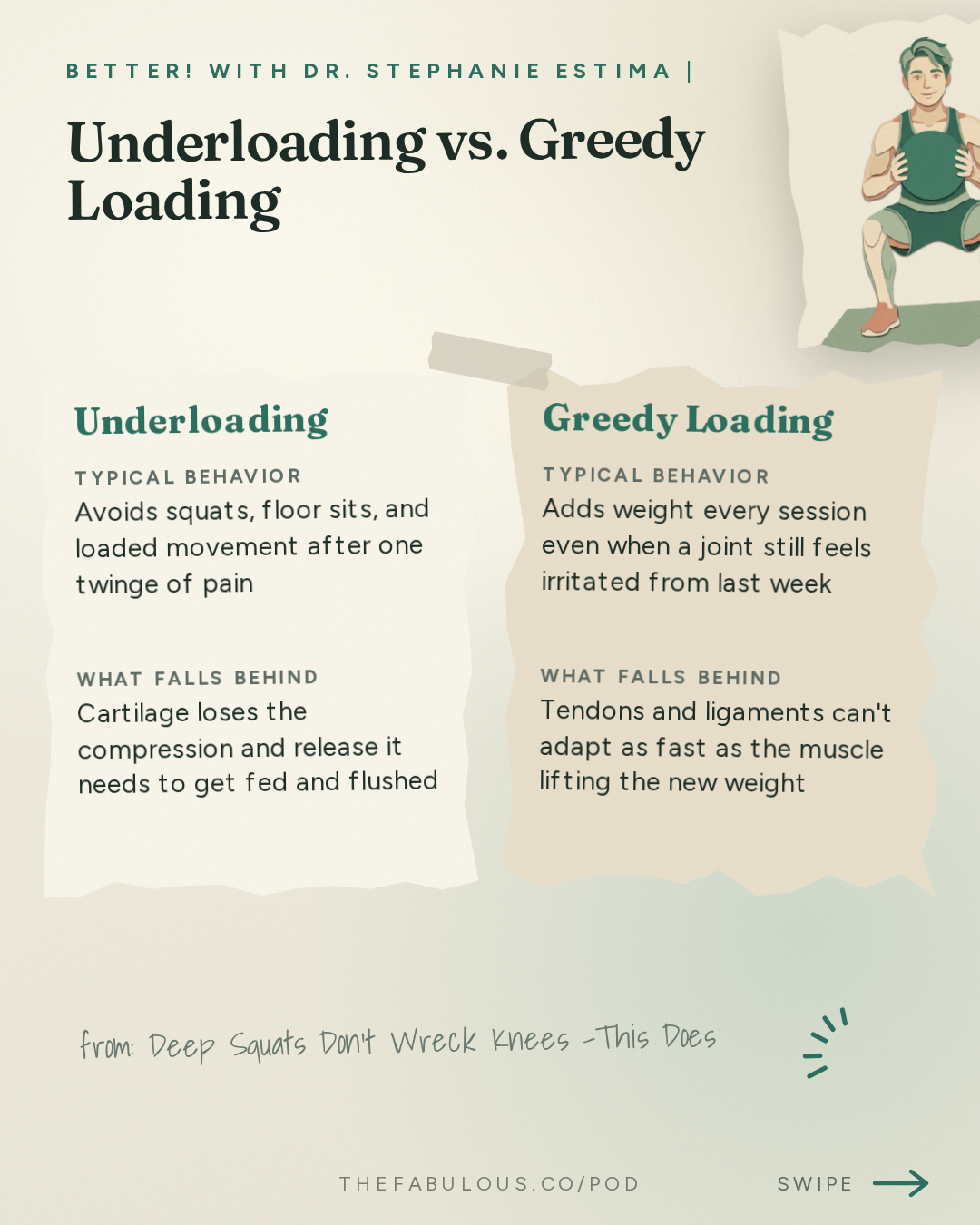
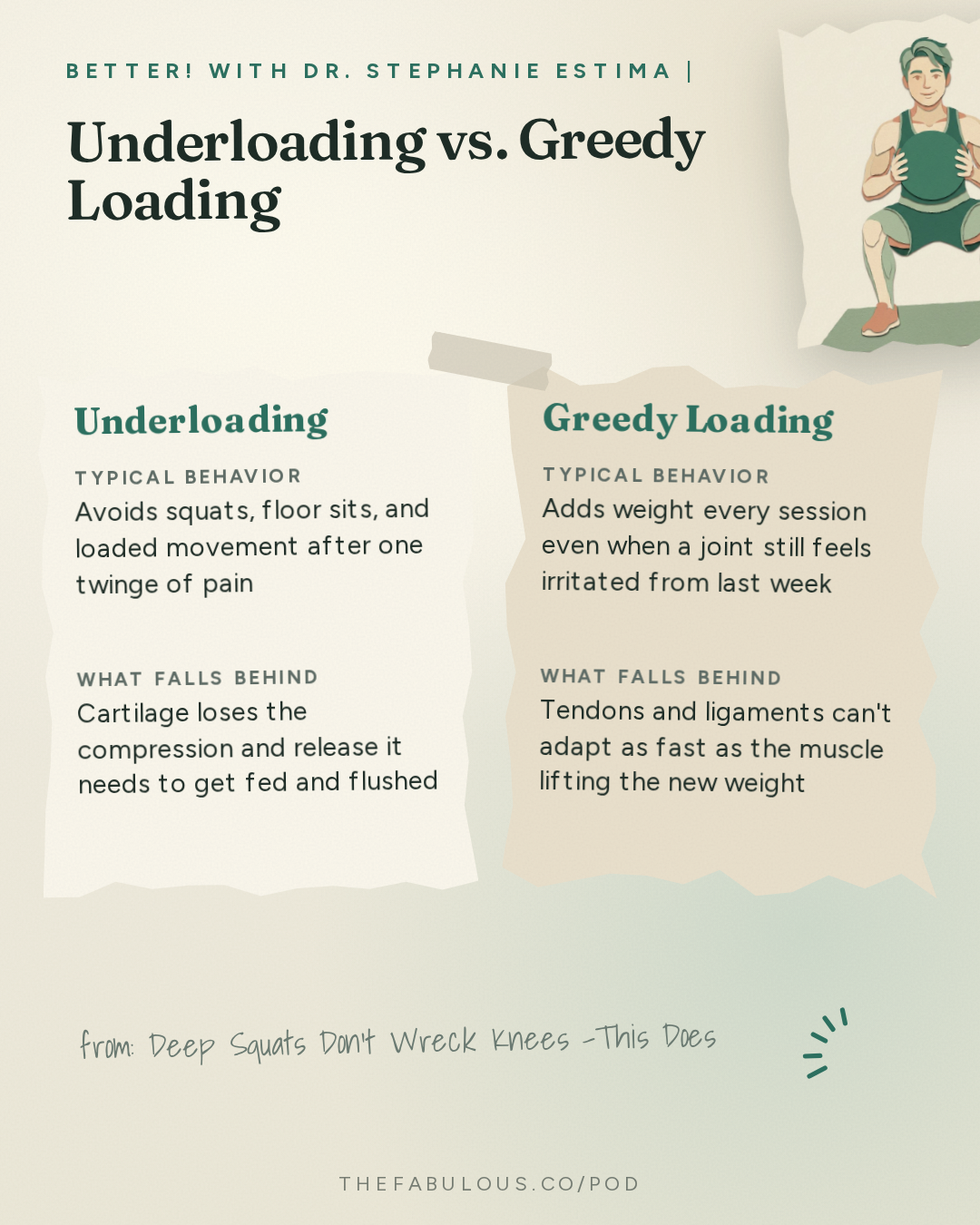
The rest of the episode is a tour of how to load joints well. Estima frames two failure modes sitting on opposite ends of one spectrum. One is underloading: avoiding a movement pattern entirely after one bad day, never training near full range. The other is what she calls greedy loading: adding weight every session regardless of how a joint feels, grinding every set to failure, never taking a deload. Both end at the same place, a joint that cannot do what is asked of it at 70 or 80 (06:22).
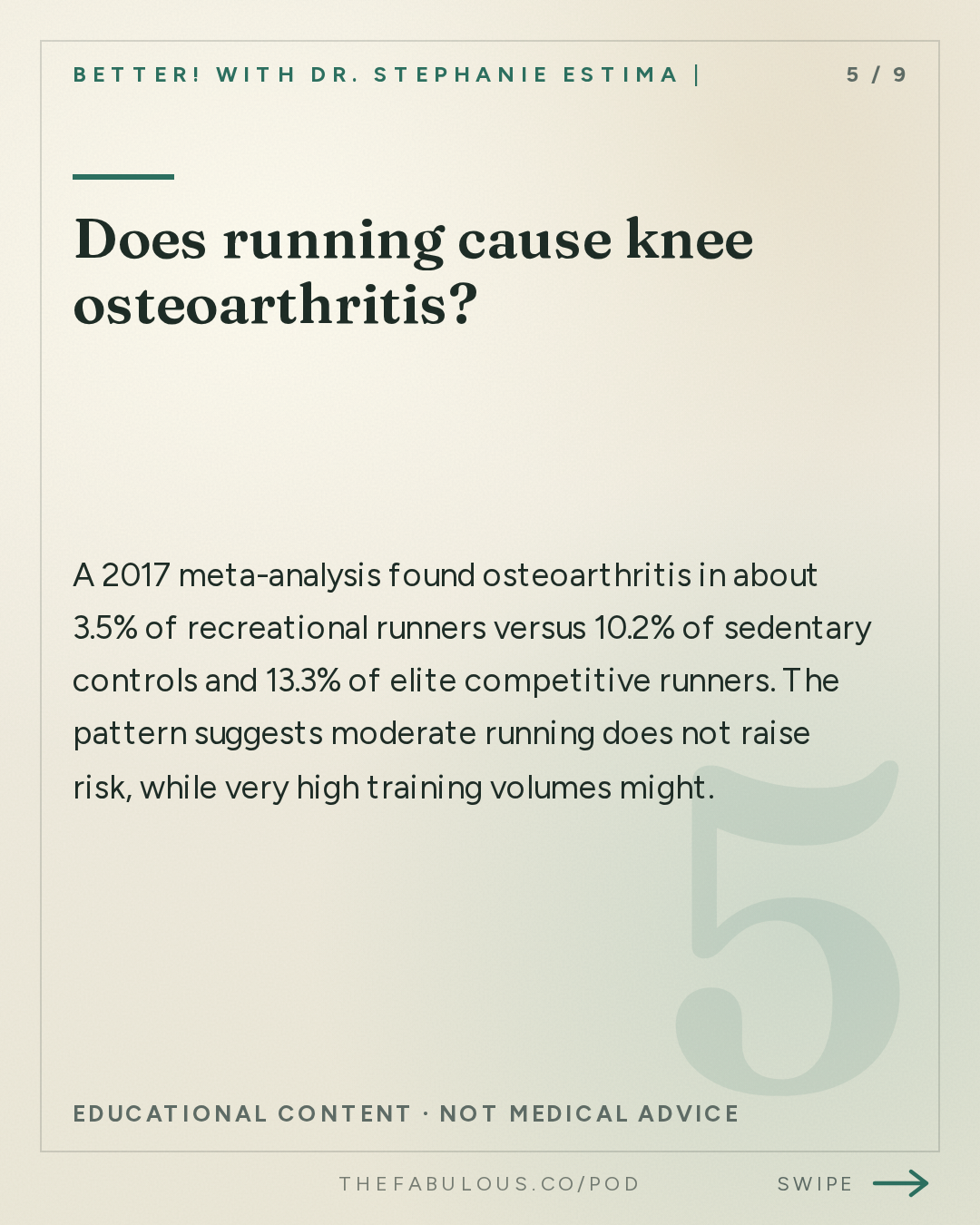
The data back a middle path. A 2019 systematic review in the British Journal of Sports Medicine, led by researcher Alessio Bricca, used MRI to track knee cartilage in people with or at risk for knee osteoarthritis and found that knee-loading exercise did not harm cartilage (52:59). A 2017 meta-analysis on running found hip or knee osteoarthritis in about 3.5% of recreational runners, 10.2% of sedentary controls, and 13.3% of elite competitive runners (54:28). Sedentary people were not protected; the highest-volume runners fared worst; the moderate, recreational group did best of all. Squat depth gets the same treatment. A review by researcher Hartmann and colleagues found that deep squats spread load over a larger contact area at the kneecap than shallow, heavily loaded partial squats, undercutting a popular claim that deep squats are harder on the knees (56:13).
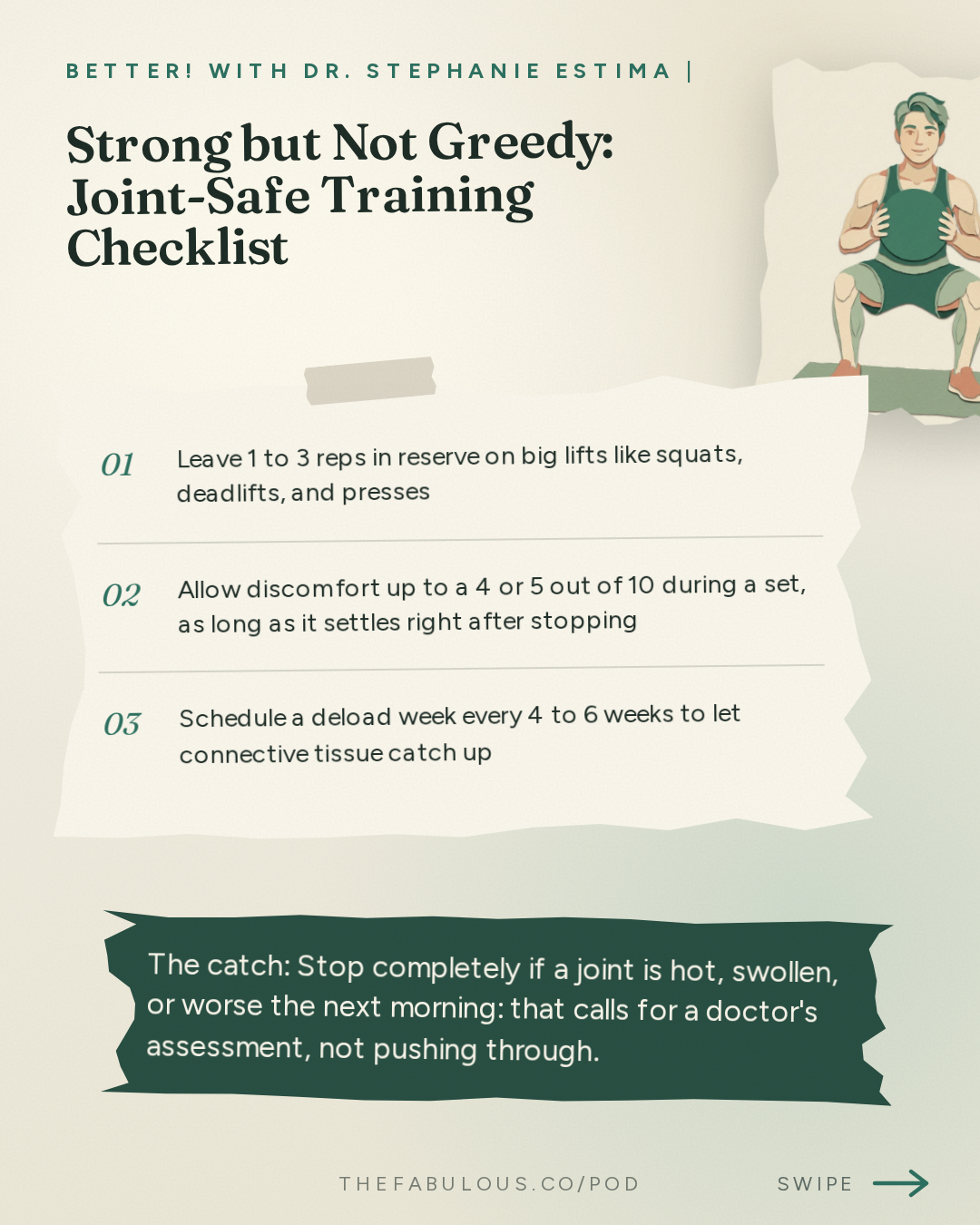
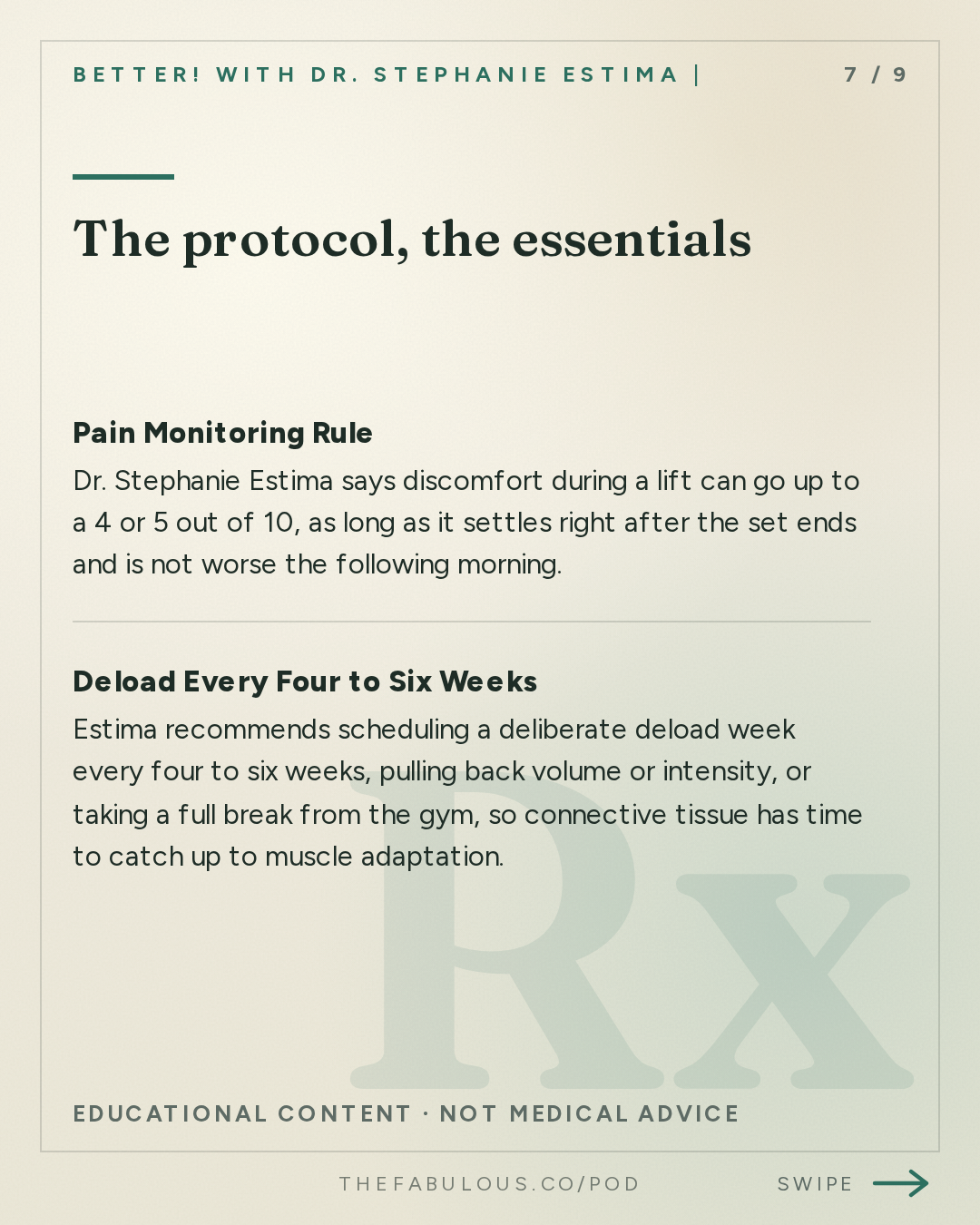
From this, Estima builds a practical checklist. Finish most sets on big lifts, squats, deadlifts, presses, with one to three reps left in reserve rather than training to failure (59:15). Let some discomfort happen, up to a 4 or 5 out of 10, as long as it settles immediately after the set and is not worse the next morning (60:21). Modify the movement rather than deleting it: a box squat, a heel lift, a goblet hold. And build in a deliberate deload week every four to six weeks, pulling back volume or intensity so tendons and ligaments, which adapt on a much slower timeline than muscle, can catch up (63:04).
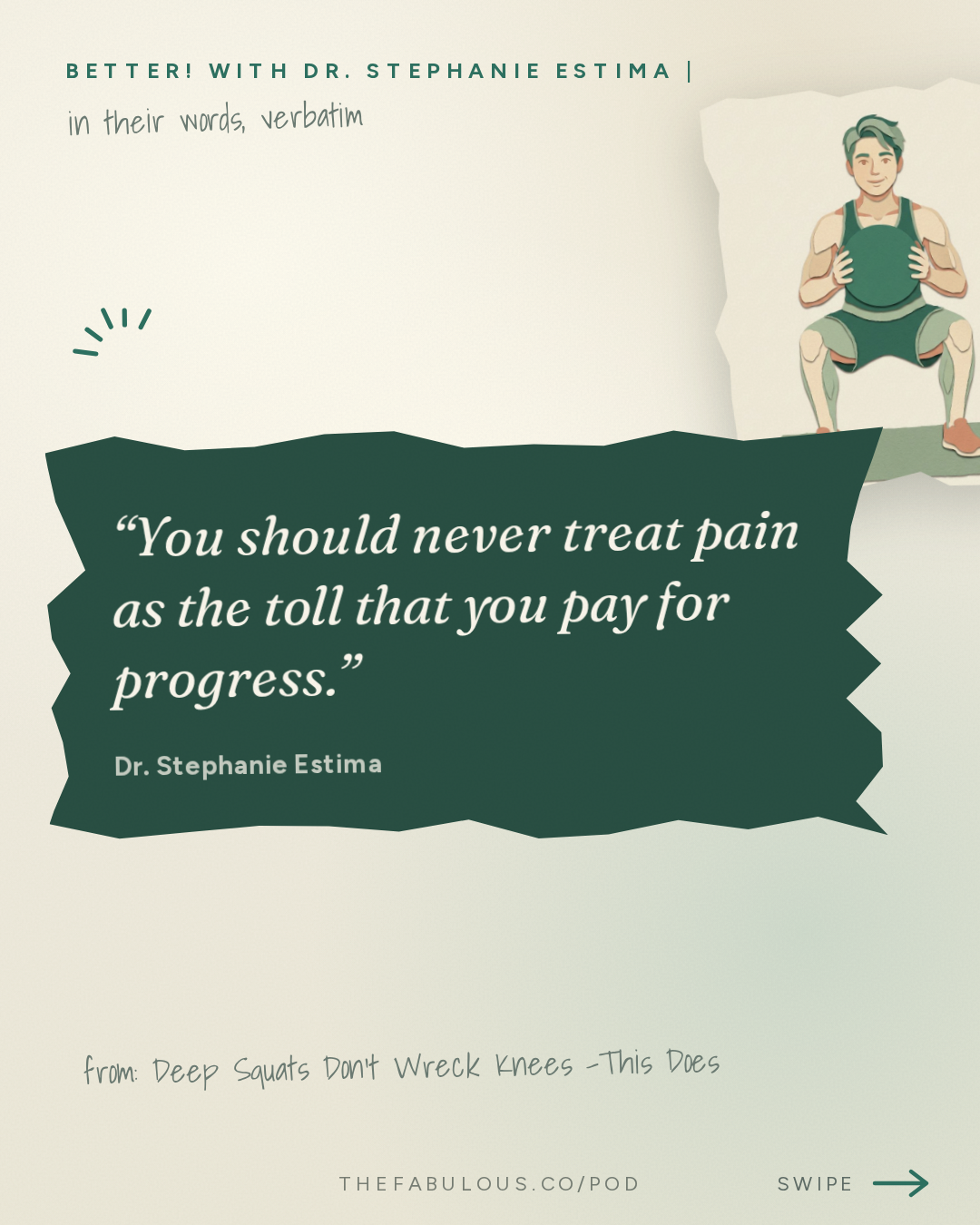
"You should never treat pain as the toll that you pay for progress." — Dr. Stephanie Estima [58:48]
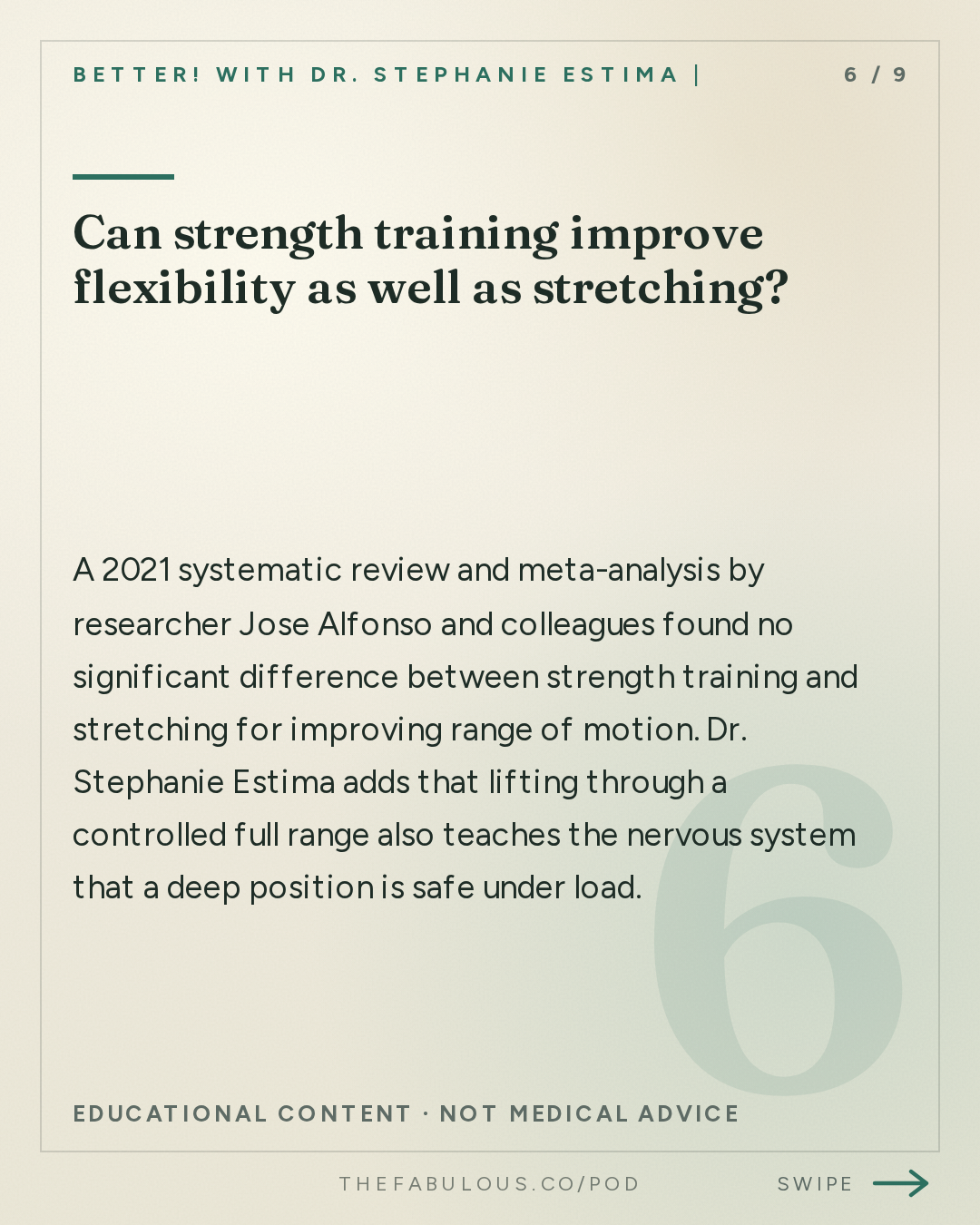
One more myth falls along the way. A 2021 systematic review and meta-analysis by researcher Jose Alfonso and colleagues compared strength training head to head with stretching for improving range of motion and found no significant difference (65:34). Lifting through a controlled full range, Estima argues, teaches the nervous system that a deep position is safe to enter under load, which is a different kind of flexibility than simply hanging off a stretch.
None of this requires heroics. Getting up and down off the floor, walking daily, building muscle around the knees and hips, and losing excess weight if carrying it (each pound lost removes roughly four pounds of force from the knee per step, according to a 2005 study by exercise scientist Steven Messier's group) (46:08) all nourish the same sponge. The joint does not need to be protected from load. It needs load, delivered on a timeline that matches how slowly its tissue actually heals.
Ask this episode anything
Pod's AI answers from the episode itself, with the minute mark so you can hear it yourself.
Or start with one of these
Ask this episode
Pod's AI listens to the whole episode to answer, and points you to the minute it comes from.
The rest of this answer, and any question after it
Answers come from the episode itself, never from a summary of it.
ContinueKey takeaways
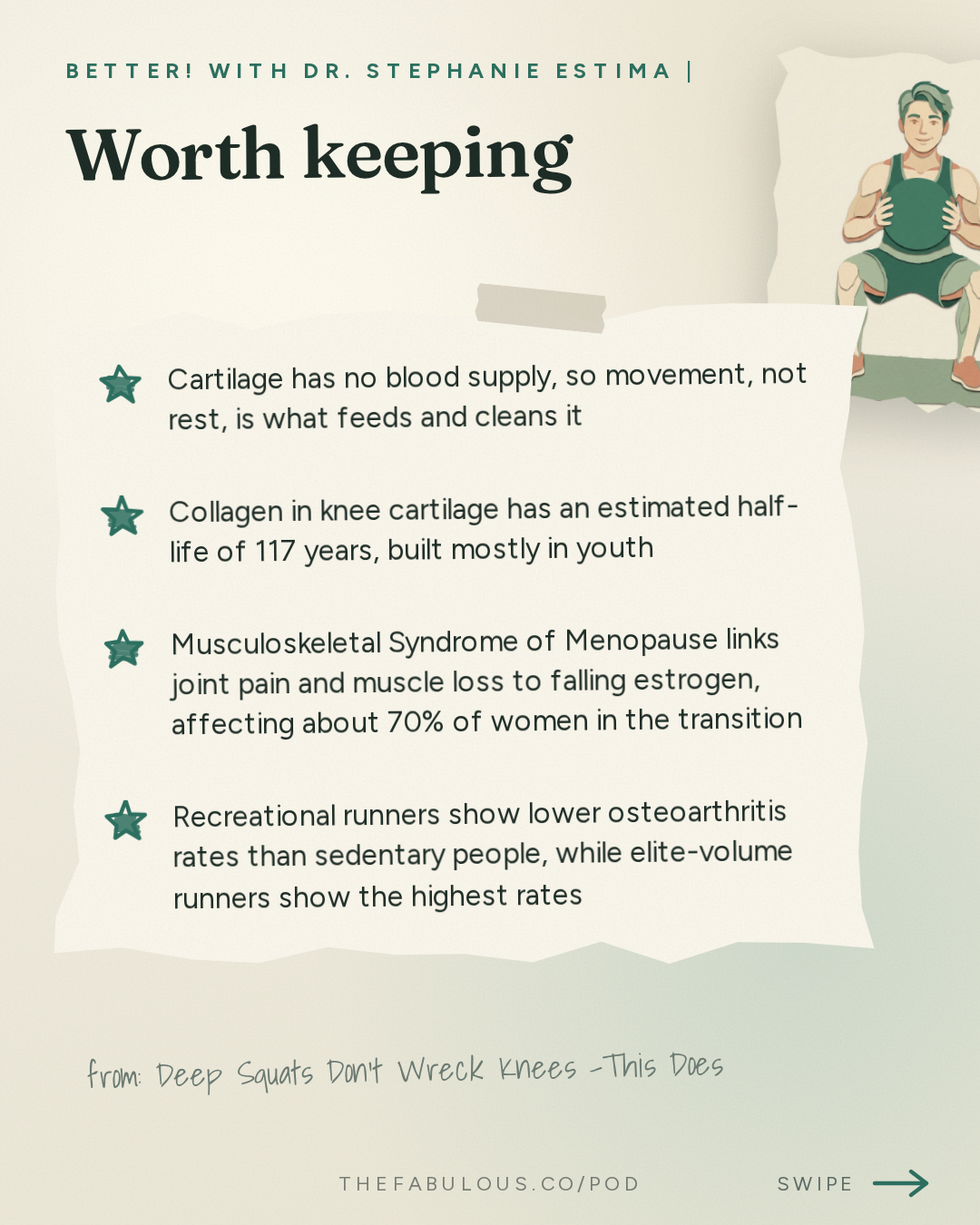
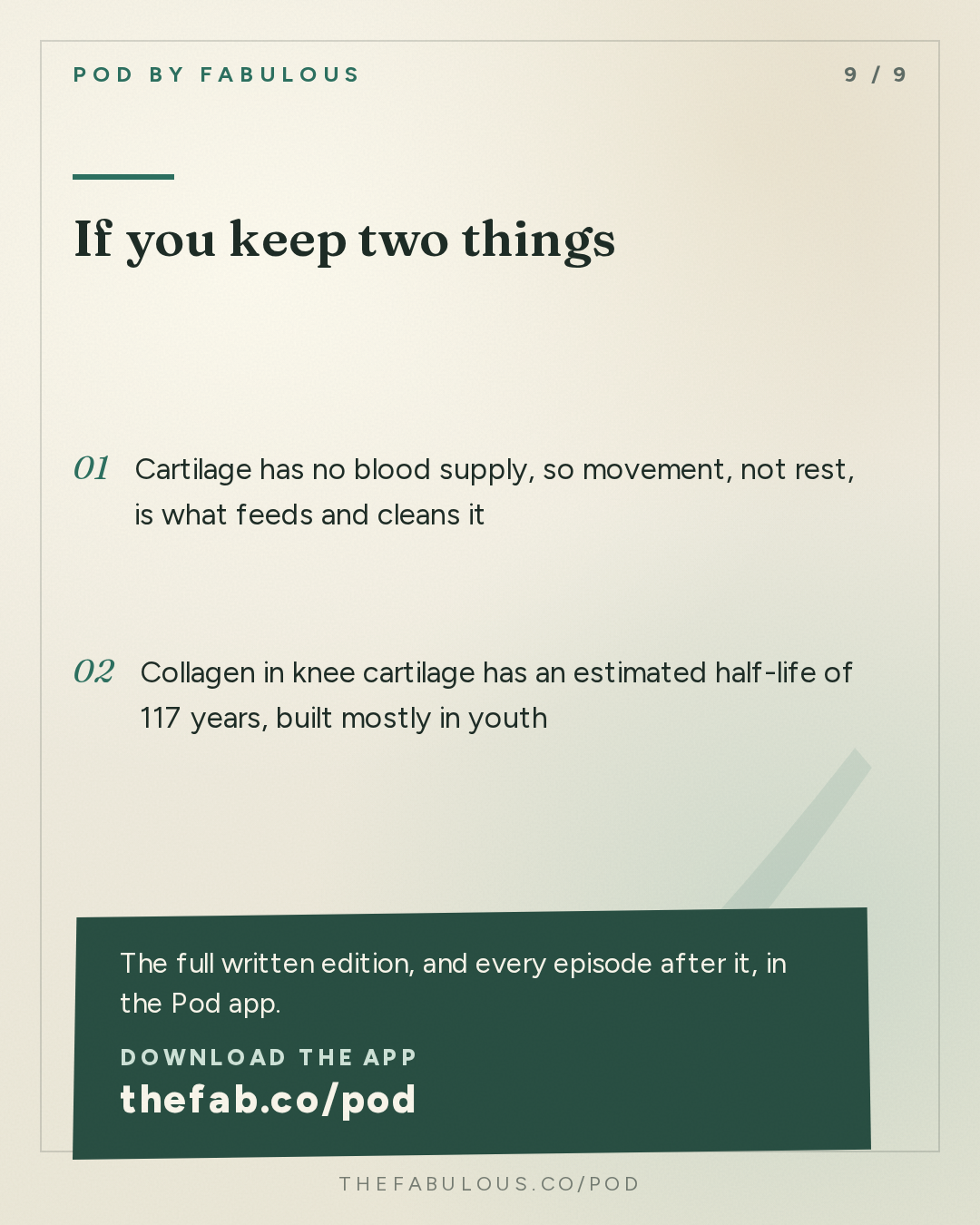
- Cartilage has no blood supply, so movement, not rest, is what feeds and cleans it (23:24)
- Collagen in knee cartilage has an estimated half-life of 117 years, built mostly in youth (32:58)
- Musculoskeletal Syndrome of Menopause links joint pain and muscle loss to falling estrogen, affecting about 70% of women in the transition (50:37)
- Recreational runners show lower osteoarthritis rates than sedentary people, while elite-volume runners show the highest rates (54:28)
- Deep squats spread load over a larger knee contact area than heavy partial squats, undercutting the deep-squat-is-dangerous myth (56:13)
The episode in cards
By the numbers
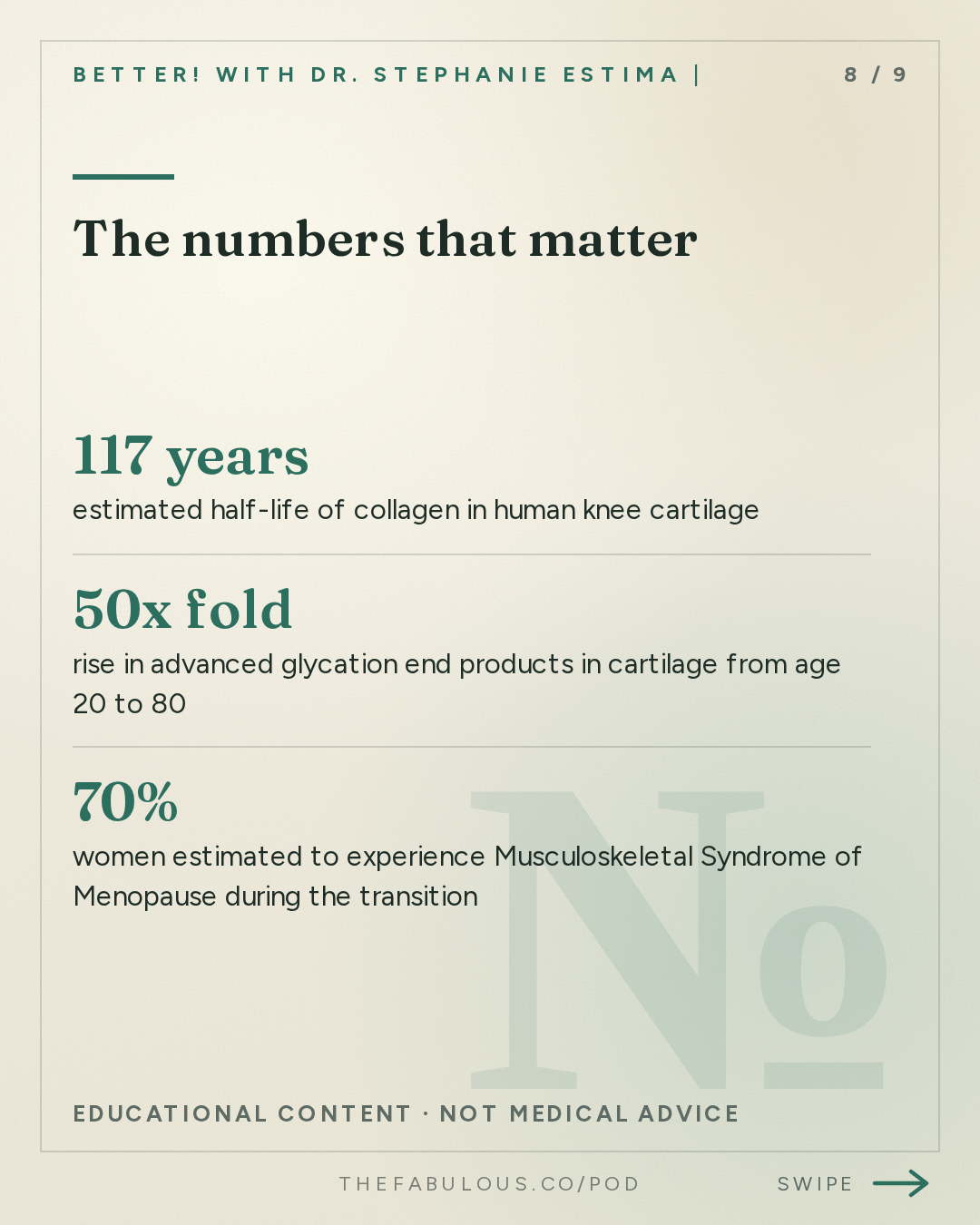
- 117 years estimated half-life of collagen in human knee cartilage
- 50x fold rise in advanced glycation end products in cartilage from age 20 to 80
- 70% percent women estimated to experience Musculoskeletal Syndrome of Menopause during the transition
In their words
“Your cartilage is not like a tire. It doesn't have a set amount of tread to it. Your cartilage is actually much more like a sponge”
“Motion is actually groceries, right? Gro- like, motion is the nutrients. It's how you get the nutrients in and how you take the”
“It is not a substitute for lifting”
“You should never treat pain as the toll that you pay for progress.”
Protocols
-
Pain Monitoring Rule
Dr. Stephanie Estima says discomfort during a lift can go up to a 4 or 5 out of 10, as long as it settles right after the set ends and is not worse the following morning.
Every training session
-
Deload Every Four to Six Weeks
Estima recommends scheduling a deliberate deload week every four to six weeks, pulling back volume or intensity, or taking a full break from the gym, so connective tissue has time to catch up to muscle adaptation.
Every 4 to 6 weeks
-
Leave Reps in Reserve
Estima advises finishing most sets on big compound lifts, such as squats, deadlifts, and presses, with one to three reps left in the tank rather than training to failure, which keeps form intact and avoids shifting load onto tendons and ligaments.
Every set on major lifts
-
Modify Squat Depth, Don't Eliminate It
Estima suggests finding the squat depth that is pain-free today, using a box, a heel lift, or a goblet hold if needed, and gradually working back toward full range instead of avoiding squats altogether.
Ongoing, reassessed as pain changes
Questions this episode answers
Do deep squats wreck your knees?
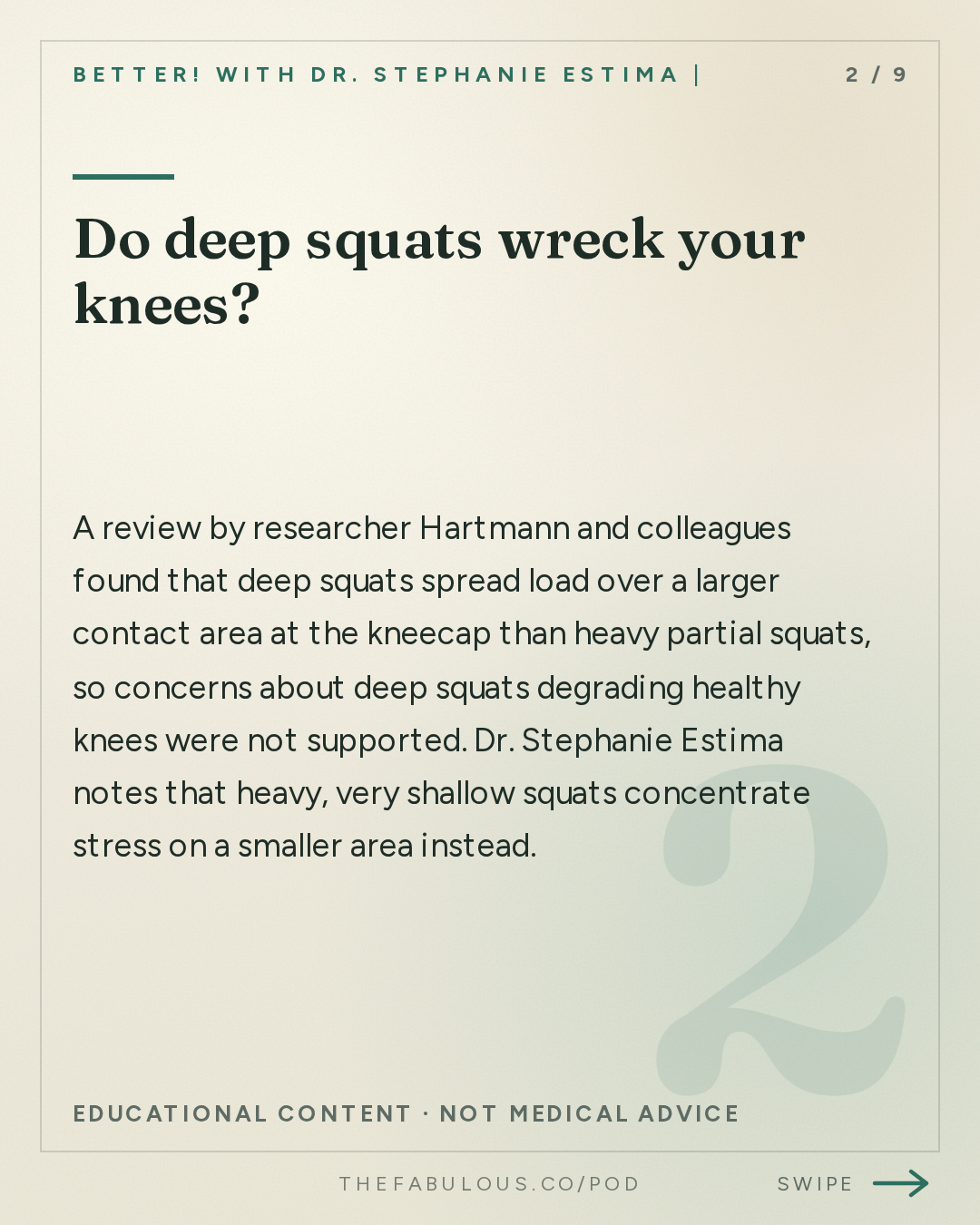
A review by researcher Hartmann and colleagues found that deep squats spread load over a larger contact area at the kneecap than heavy partial squats, so concerns about deep squats degrading healthy knees were not supported (56:13). Dr. Stephanie Estima notes that heavy, very shallow squats concentrate stress on a smaller area instead.
What is Musculoskeletal Syndrome of Menopause (MSM)?
It's a term proposed by orthopedic surgeon Dr. Vonda Wright in a 2024 review, linking joint pain, muscle loss, and osteoarthritis progression in midlife women to one common driver: declining estrogen (50:06). A Harvard Health summary of that work estimates about 70% of women experience some form of it during the menopause transition (50:37).
How does cartilage get nutrients if it has no blood supply?
Articular cartilage is avascular, so it relies on synovial fluid and movement instead of blood vessels (23:24). Compression during movement pushes fluid and waste out of the cartilage, and release draws fresh, nutrient-carrying fluid back in, a cycle Dr. Stephanie Estima calls cyclical loading (25:28).
Does running cause knee osteoarthritis?
A 2017 meta-analysis found osteoarthritis in about 3.5% of recreational runners versus 10.2% of sedentary controls and 13.3% of elite competitive runners (54:28). The pattern suggests moderate running does not raise risk, while very high training volumes might.
Can strength training improve flexibility as well as stretching?
A 2021 systematic review and meta-analysis by researcher Jose Alfonso and colleagues found no significant difference between strength training and stretching for improving range of motion (65:34). Dr. Stephanie Estima adds that lifting through a controlled full range also teaches the nervous system that a deep position is safe under load.
The full read, in cards
Go deeper
- Dutch research team study on collagen half-life in human articular cartilage — estimated knee cartilage collagen half-life at 117 years using an amino acid chemical clock
- Vonda Wright et al., 2024 review proposing Musculoskeletal Syndrome of Menopause — argued joint pain, muscle loss, and osteoarthritis in midlife women share estrogen decline as a common driver
- Steven Messier et al., 2005 study on weight loss and knee load — found each pound of body weight lost removed about four pounds of force from the knee per step
- Alessio Bricca et al., 2019 systematic review, British Journal of Sports Medicine — MRI-based trials found knee-loading exercise did not harm cartilage
- 2017 meta-analysis on running and osteoarthritis prevalence — found lower osteoarthritis prevalence in recreational runners than sedentary controls, highest in elite runners
- Jose Alfonso et al., 2021 systematic review and meta-analysis — found strength training improved range of motion as well as stretching
Mentioned
Dr. Vonda Wright · Dr. Stu McGill · Keith Barr · Steven Messier · Alessio Bricca · Jose Alfonso · Musculoskeletal Syndrome of Menopause
More from this show and category
Keith Baar's Tendon Isometric Protocol Explained
Tendons stop responding to exercise after about 10 minutes and need six to eight hours before another session helps. Physiologist Keith Baar's fix is the 3LD isometric: a 30-second, low-load hold that lets the tendon 'creep' and spread tension evenly, replacing both heavy lifting and the outdated RICE protocol for injury recovery.
How to Build Glutes Without Growing Legs
Hip dips are permanent anatomy, not a fitness failure, says glute researcher and hip thrust inventor Bret Contreras. He explains why horizontal moves like hip thrusts and kickbacks are gentler on joints than squats, how women recover faster than men, and how a five-month training rotation builds glutes while sparing the legs.
Muscle Power vs Strength for Longevity
Psychophysiologist Paul Taylor says muscle power, not size or strength, best predicts how long people live. He tells Dr. Stephanie Estima that myokines, signaling molecules released by contracting muscle, act like an internal pharmacy, and he gives dosing-style guidance on power training, protein, omega-3, and cold plunge limits.

ADHD in Perimenopause: Why Symptoms Intensify
Dr. Jolene Brighten says ADHD in women often surfaces in perimenopause, when falling estrogen stops masking lifelong symptoms. Estrogen supports dopamine and acetylcholine, so its decline during the luteal phase and perimenopause worsens executive function, mood, and focus, explaining why many women are diagnosed only in their 30s and 40s.
