BETTER! with Dr. Stephanie Estima
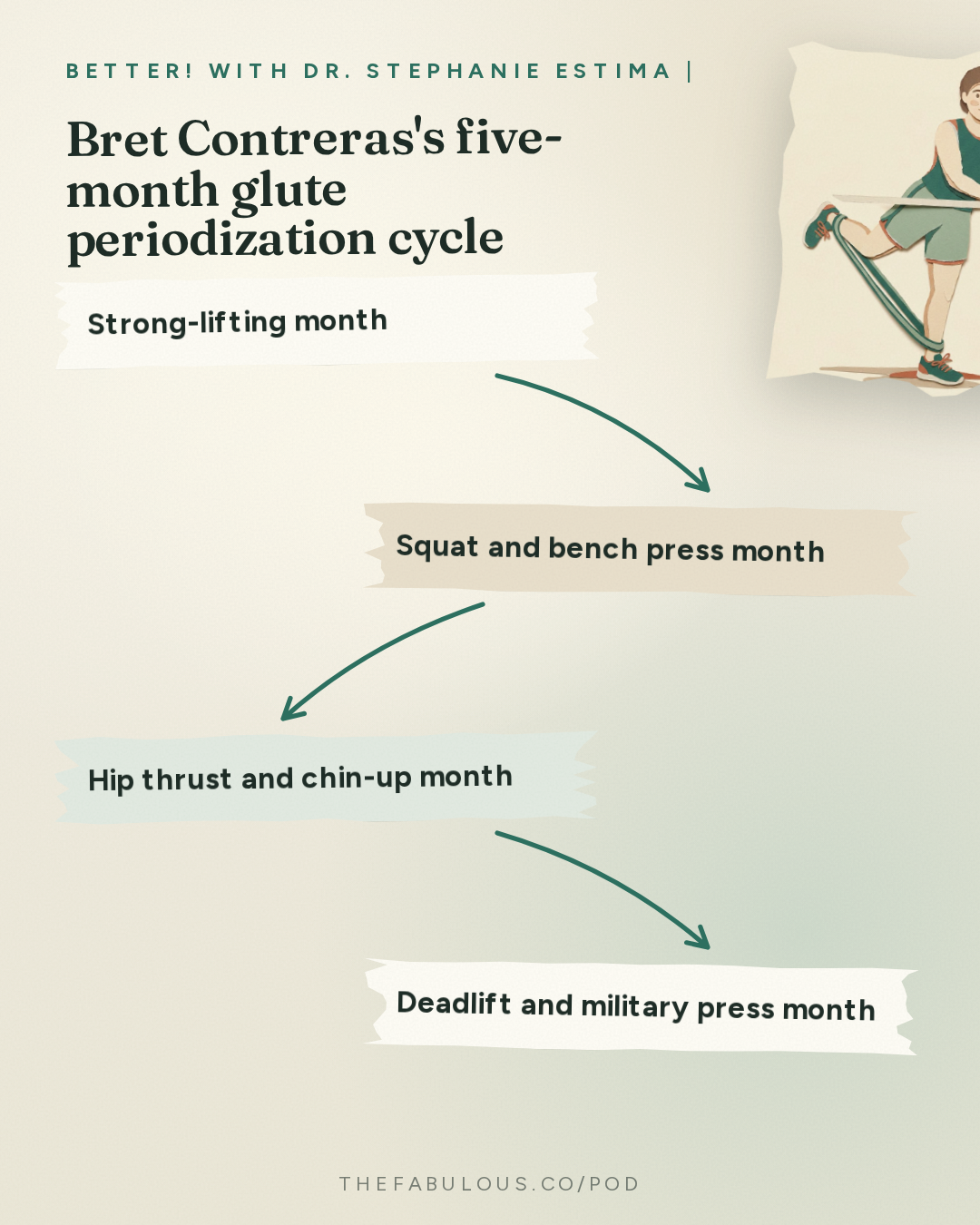
How to Build Glutes Without Growing Legs
How To Build Round & Strong Glutes with Bret Contreras, PhD. aka the Glute Guy
▶ Listen to the full episode More from BETTER! with Dr. Stephanie Estima
The brief
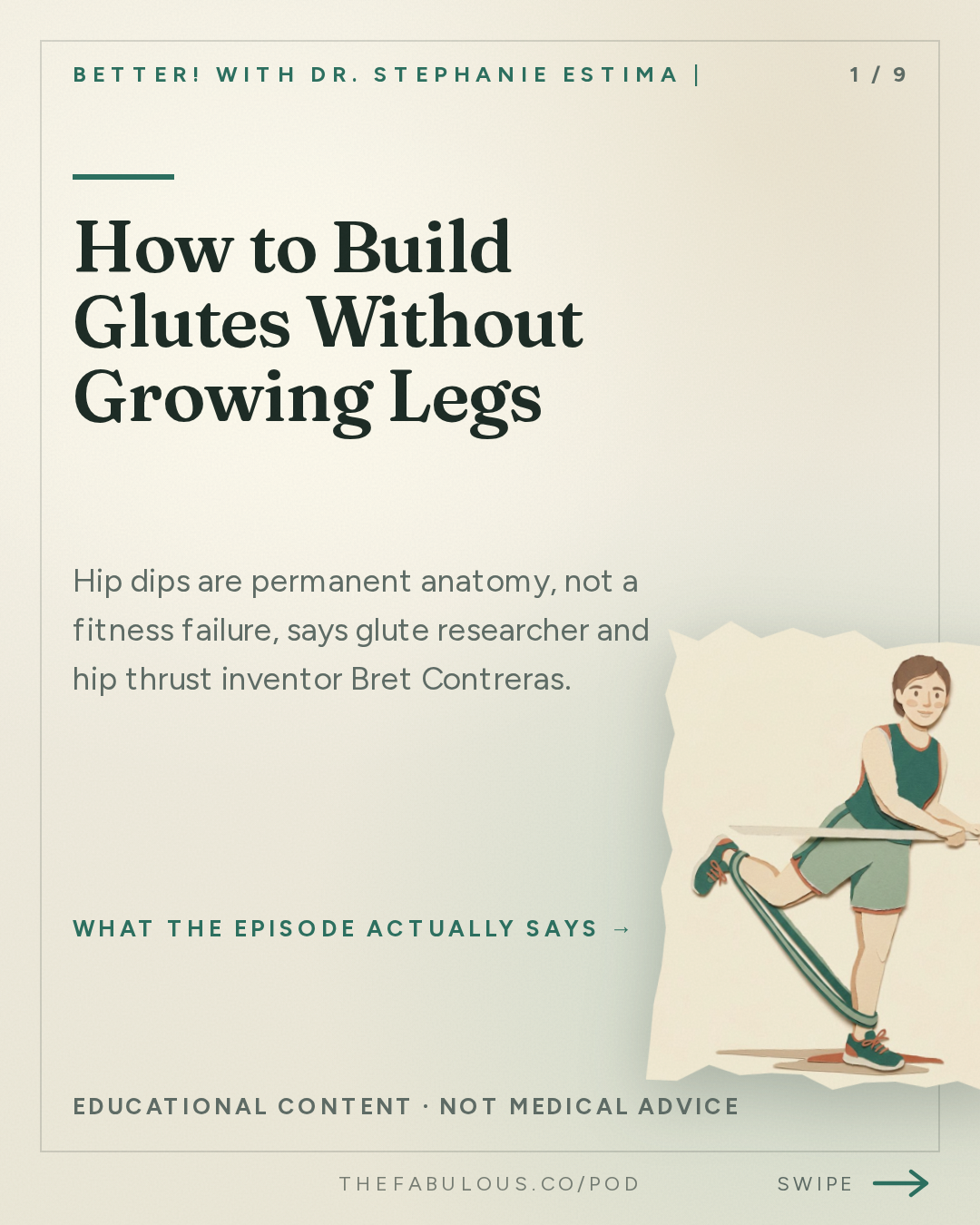
Hip dips are permanent anatomy, not a fitness failure, says glute researcher and hip thrust inventor Bret Contreras. He explains why horizontal moves like hip thrusts and kickbacks are gentler on joints than squats, how women recover faster than men, and how a five-month training rotation builds glutes while sparing the legs.
Look at a skeleton from behind and you will see the problem before anyone names it. The glute medius and minimus run almost vertically down the side of the hip. The glute max runs on a diagonal, lower and further back. Between them, where no muscle exists at all, is a hollow. That hollow is the "hip dip," the inward dent above the thigh that has launched a thousand Instagram workouts promising to smooth it away. According to Bret Contreras, the strength scientist who invented the barbell hip thrust and holds a PhD in sport science, there is no exercise that touches it, because there is nothing there to train (17:43).
"Hip dips are anatomical, an anatomical certainty." — Bret Contreras [17:43]
That single fact sets the tone for an hour of conversation between Contreras and Dr. Stephanie Estima, host of the podcast Better, that is really an argument against guesswork. Contreras has published more than 50 peer-reviewed studies on glute training (1:34), and the thread running through everything he says is that the body does not reward magical thinking. It rewards load, position, and time, applied in a sequence that respects what connective tissue can handle.
Take the hip thrust itself, the exercise that made Contreras famous. He lists three mistakes he sees constantly. The first is not the lifter's fault: many machines are built for tall frames, which forces shorter women into straighter legs and turns a glute exercise into a de facto hamstring exercise (6:29). On a barbell or Smith machine, where foot placement is adjustable, he wants the knees bent to roughly 90 degrees with the shins close to vertical at the top of the lift (6:48). The second mistake is stopping short of full hip extension. Some muscles grow best when they are worked in a stretched position, but Contreras says the glutes are the exception. Since other exercises already stretch them, the hip thrust should be reserved for training them in the shortened, locked-out position (7:05). The third mistake is sliding backward on the bench mid-set, which shortens the range of motion and quietly makes a heavy set easier than it looks (7:56).
The anatomy nobody can fix with effort
The glutes are also unusual in how much fat they store inside the muscle itself, not around it. Contreras says healthy people carry roughly 15 percent intramuscular fat in the glutes, but in unhealthy individuals that figure can run as high as 50 percent (19:06). That is fat inside the muscle tissue, not layered over it, and it partly explains why some people appear to have fuller glutes without much visible muscle definition. Contreras calls this phenomenon, when fat preferentially settles in the glutes during a weight gain, a "genetic BBL," something he has watched repeatedly in Latina clients in Florida whose waists stay narrow while weight goes straight to the hips (19:06).
None of this is incidental trivia. It sets up the episode's real argument, which is that a lot of women want a specific look, rounder glutes without bigger thighs, and that this is a legitimate training goal rather than a character flaw. Contreras wrote a blog post on the subject back in 2010 and has returned to it in videos and an e-book ever since, because, as he puts it, "it's a significant market" (32:09). He is also blunt about the backlash: "This pisses hardcore lifters off, and I don't know why, because we all have the right to train our body how we want" (32:32).
Training the glutes without the legs
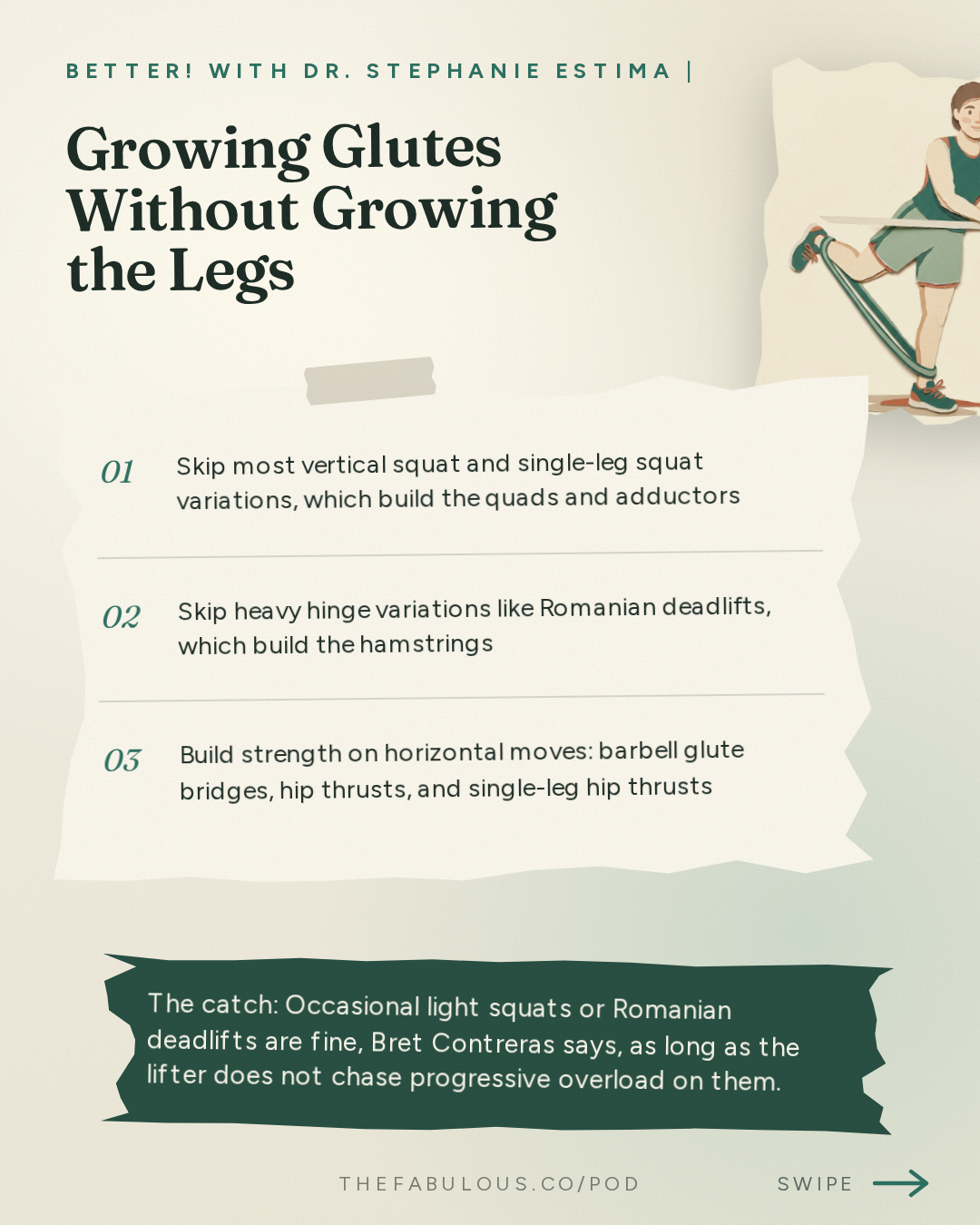
The practical answer involves subtraction as much as addition. Contreras tells women who want this look to drop most vertical squat and hinge variations, the movements that load the quads, adductors, and hamstrings, and instead build real strength on horizontal lifts: barbell glute bridges, hip thrusts, and single-leg hip thrust variations (33:23). Layered on top of that is heavy volume of lateral work, cable kickbacks and hip abduction in both the frontal and transverse planes. Occasional light squats or Romanian deadlifts are fine, he says, as long as the lifter resists the urge to chase progressive overload on them (33:43).
This is where Contreras introduces a term worth remembering: "penalty-free volume." Heavy vertical lifts like squats and deadlifts are hardest in the stretched position, which is exactly where strain injuries and connective-tissue wear happen. Horizontal and lateral glute exercises work the muscle in its shortened, squeezed position instead, so they carry much less systemic cost.
"They tend to be easier on the body, easier to recover from at a muscular standpoint and on a systemic standpoint." — Bret Contreras [26:35]
Because of that lower cost, Contreras adds four to six sets of kickbacks and abduction onto the end of a session almost as a free bonus, extra stimulus without extra fatigue. It is also part of why he thinks women can train glutes three times a week without the burnout a man would experience doing three heavy squat days. He traces this recovery advantage to a mix of factors still being studied: estrogen's apparent protective effect against muscle damage, lower absolute strength producing less of the tissue "clamping" that worsens damage, and simple specialization, since women who skip dedicated arm, trap, and calf days free up recovery capacity for the glutes (53:42). In his own "Booty by Bret" program, a typical week nets nine sets each for the upper-body pressing and pulling muscles, the quads, and the hamstrings, against 36 sets for the glutes, a volume Contreras says his clients recover from without issue (55:37).
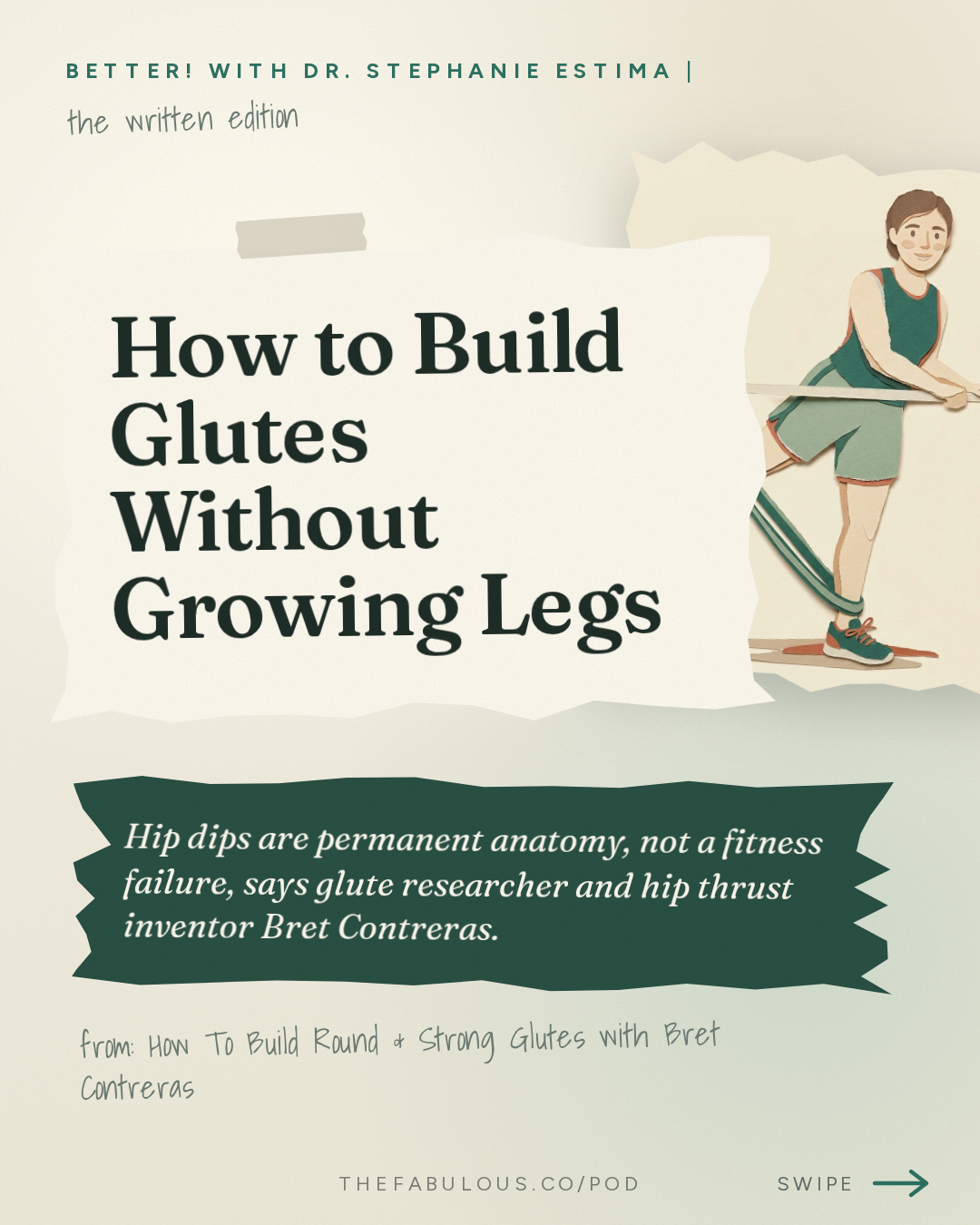
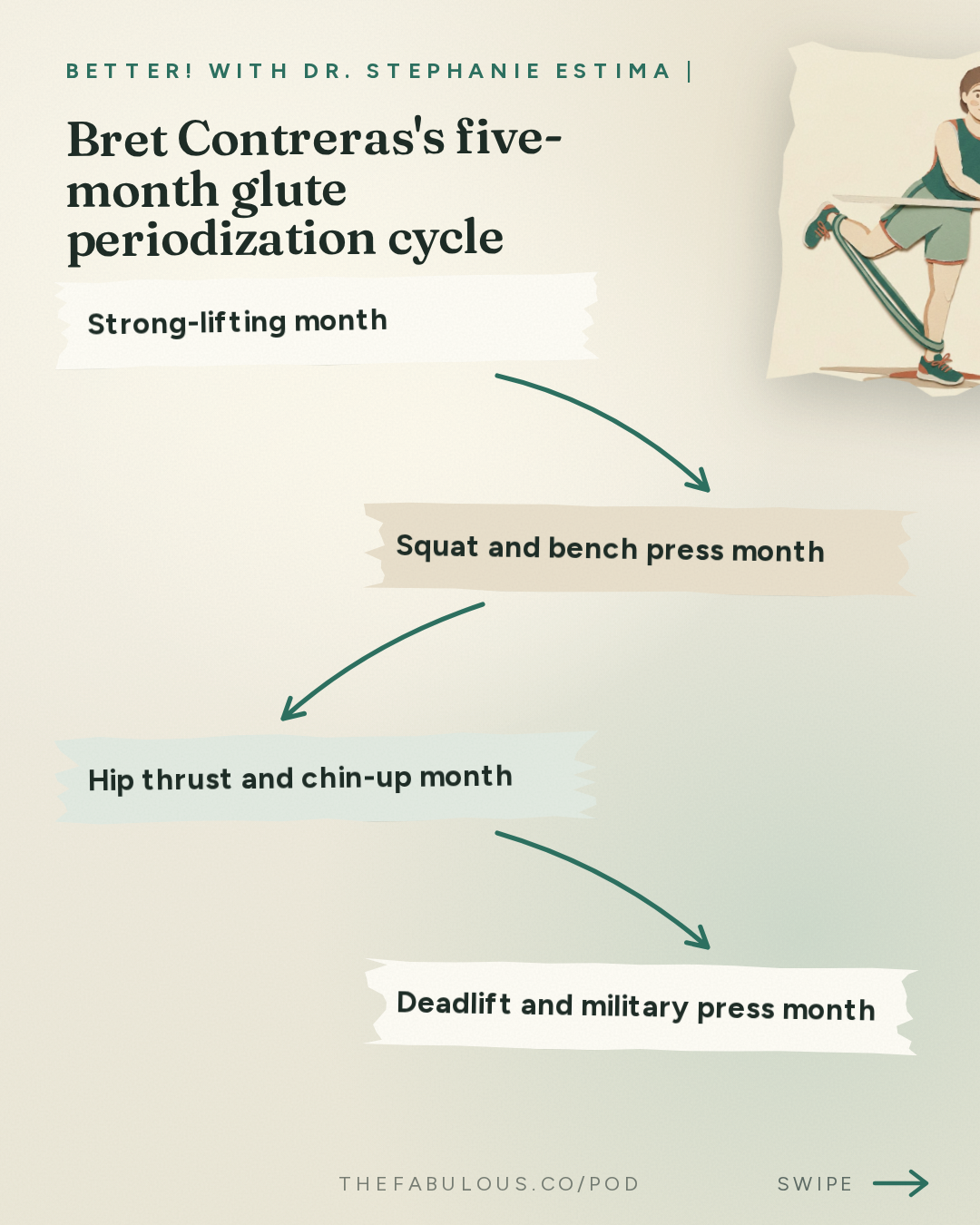
The structure that ties all of this together is a periodization system Contreras built after years of reading classic texts by Romanian-Canadian sport scientist Tudor Bompa and watching the rotating training cycles used by the late powerlifting coach Louie Simmons. Rather than chasing one lift year-round, which Contreras says is why so many powerlifters get hurt, he rotates the priority every four weeks across a five-month cycle: a strong-lifting month covering six main lifts, then dedicated months for squat and bench press, hip thrust and chin-up, deadlift and military press, and a final variety-focused glute month before the cycle starts over (68:04). Each month is designed so the joint or muscle group stressed in the previous block gets a break, knees recover during hip thrust month, the low back recovers during the glute variety month, and so on (68:24). Estima points out on air that this also suits connective tissue, which she notes takes roughly 12 to 21 weeks to adapt, far longer than the week or so muscle itself needs (71:52).
What makes the system sustainable, in Contreras's telling, is a simple asymmetry.
"It's hard to build, easy to maintain." — Bret Contreras [73:01]
That line is really the whole episode in miniature. Glutes, like most tissue, do not require constant maximal effort once they have been built. They require a plan that respects anatomy that cannot be changed, like the hollow behind a hip dip, and makes smart use of the anatomy that can, through load, position, and patience. Contreras adds one more plain warning against the social-media shortcuts that keep this subject so full of myths: "You can't just have a wimpy TheraBand and do light glute movements and develop glute mass" (12:23). The glutes, like everything else in the body, do not care how a post performs. They care what gets loaded, and for how long.
Ask this episode anything
Pod's AI answers from the episode itself, with the minute mark so you can hear it yourself.
Or start with one of these
Ask this episode
Pod's AI listens to the whole episode to answer, and points you to the minute it comes from.
The rest of this answer, and any question after it
Answers come from the episode itself, never from a summary of it.
ContinueKey takeaways
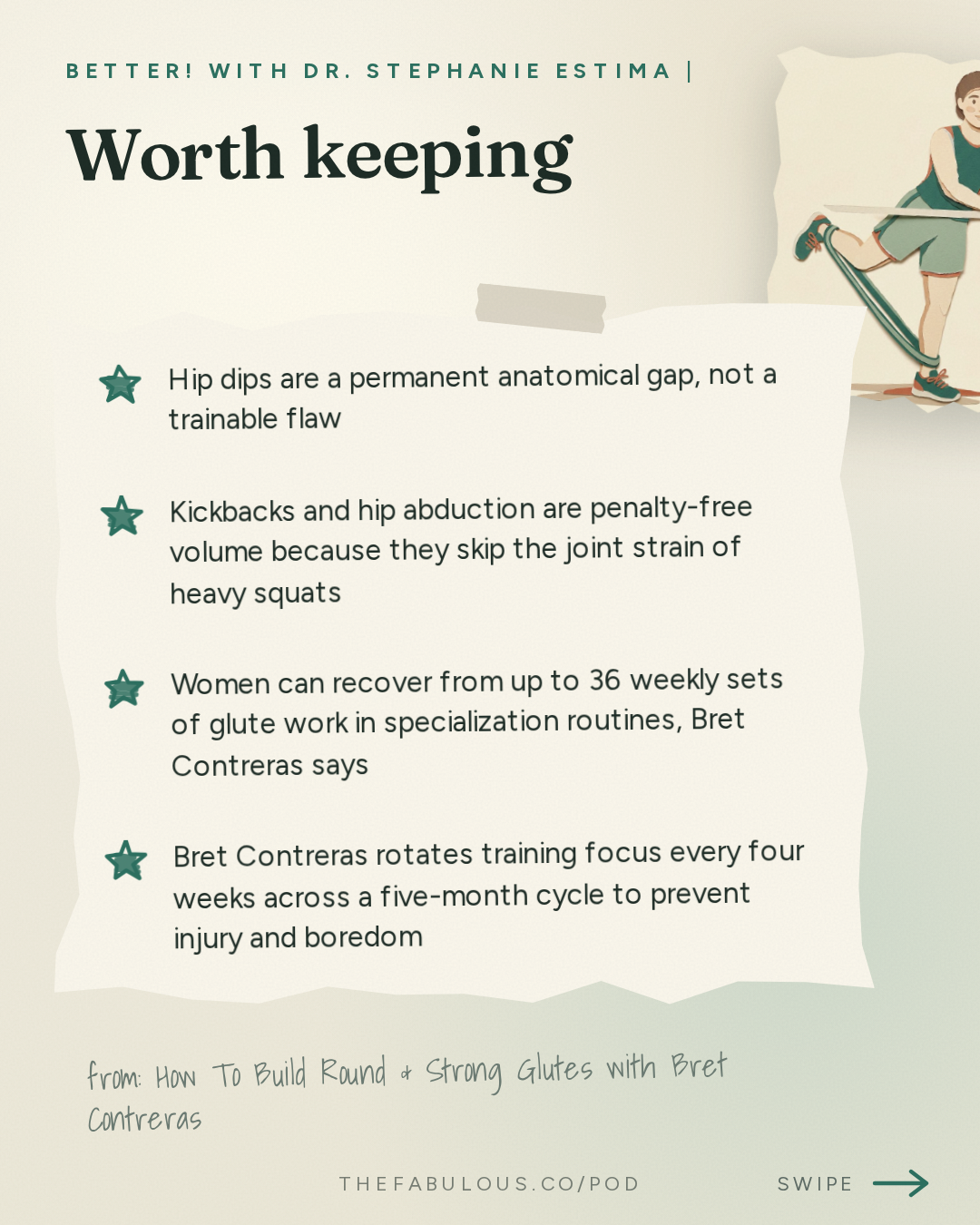
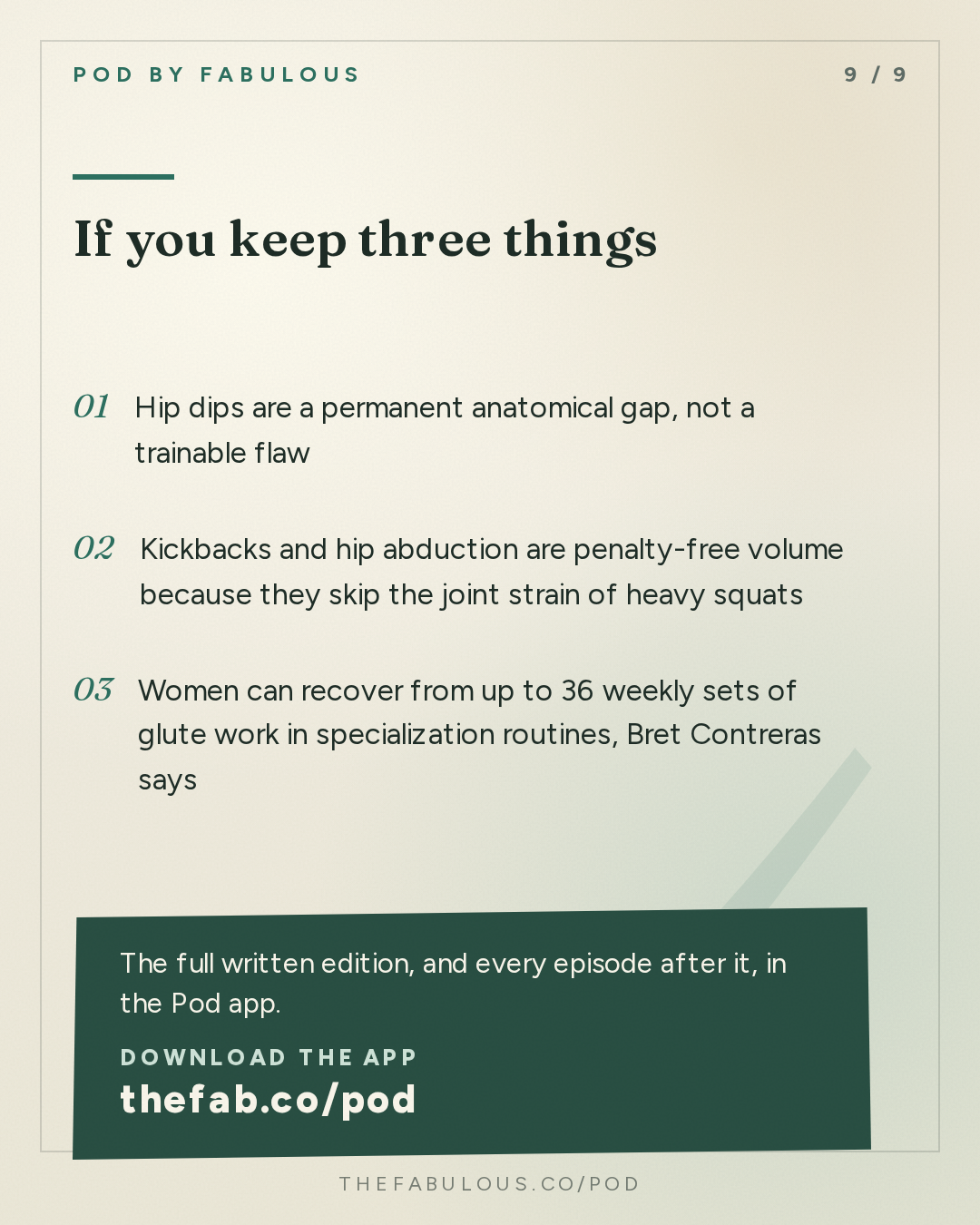
- Hip dips are a permanent anatomical gap, not a trainable flaw
- Kickbacks and hip abduction are penalty-free volume because they skip the joint strain of heavy squats
- Women can recover from up to 36 weekly sets of glute work in specialization routines, Bret Contreras says
- Bret Contreras rotates training focus every four weeks across a five-month cycle to prevent injury and boredom
- To grow glutes without bigger legs, skip vertical squats and hinges and prioritize hip thrusts and lateral moves
The episode in cards

By the numbers
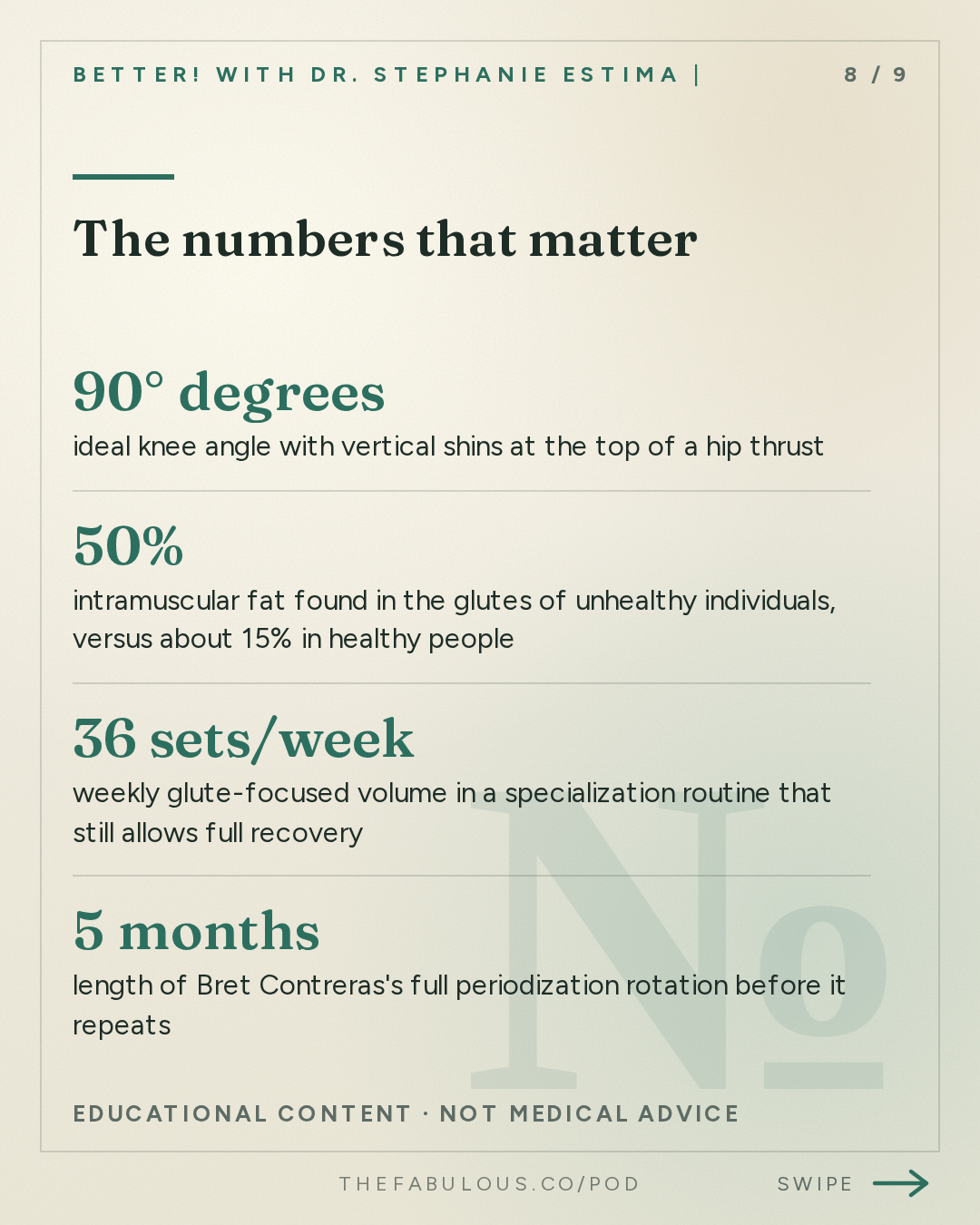
- 90° degrees ideal knee angle with vertical shins at the top of a hip thrust
- 50% percent intramuscular fat found in the glutes of unhealthy individuals, versus about 15% in healthy people
- 36 sets/week weekly glute-focused volume in a specialization routine that still allows full recovery
- 5 months length of Bret Contreras's full periodization rotation before it repeats
In their words
“Hip dips are anatomical, an anatomical certainty.”
“They tend to be easier on the body, easier to recover from at a muscular standpoint and on a systemic standpoint.”
“You can't just have a wimpy TheraBand and do light glute movements and develop glute mass.”
“It's hard to build, easy to maintain.”
Protocols
-
Fixing hip thrust form
Bret Contreras has lifters set their feet so the shins stay close to vertical and the knees bend to roughly 90 degrees at the top of the hip thrust, then drive all the way to full hip extension and lockout on every rep. He notes the catch is that many hip thrust machines are built for tall frames, which forces shorter lifters into straighter legs that turn the move into more of a hamstring exercise.
every hip thrust set
-
Growing glutes without growing the legs
Bret Contreras has clients skip most vertical squat and single-leg squat variations, which load the quads and adductors, and most heavy hinge variations, which load the hamstrings, replacing them with barbell glute bridges, hip thrusts, cable kickbacks, and hip abduction in both the frontal and transverse planes. The catch, he says, is that occasional light squats or Romanian deadlifts are still fine as long as the lifter does not chase progressive overload on them.
three or more sessions a week
-
Penalty-free volume add-ons
Bret Contreras adds four to six sets of cable kickbacks and hip abduction to the end of training sessions because these moves work the glutes in a shortened, squeezed position rather than a stretched one. The catch is that this volume only works as a bonus on top of a base of hip thrusts and squats, not as a replacement for them.
added at the end of most sessions, up to three times a week
-
The five-month periodization rotation
Bret Contreras rotates training priority in four-week blocks: a strong-lifting month across six main lifts, then dedicated months for squat and bench press, hip thrust and chin-up, deadlift and military press, and a final variety-focused glute month before the cycle repeats. The catch is that each month only pushes progressive overload on the priority lifts, while the rest are trained at a lighter, maintenance level, because strength is easy to hold once it is built.
four-week blocks, five-month full cycle
Questions this episode answers
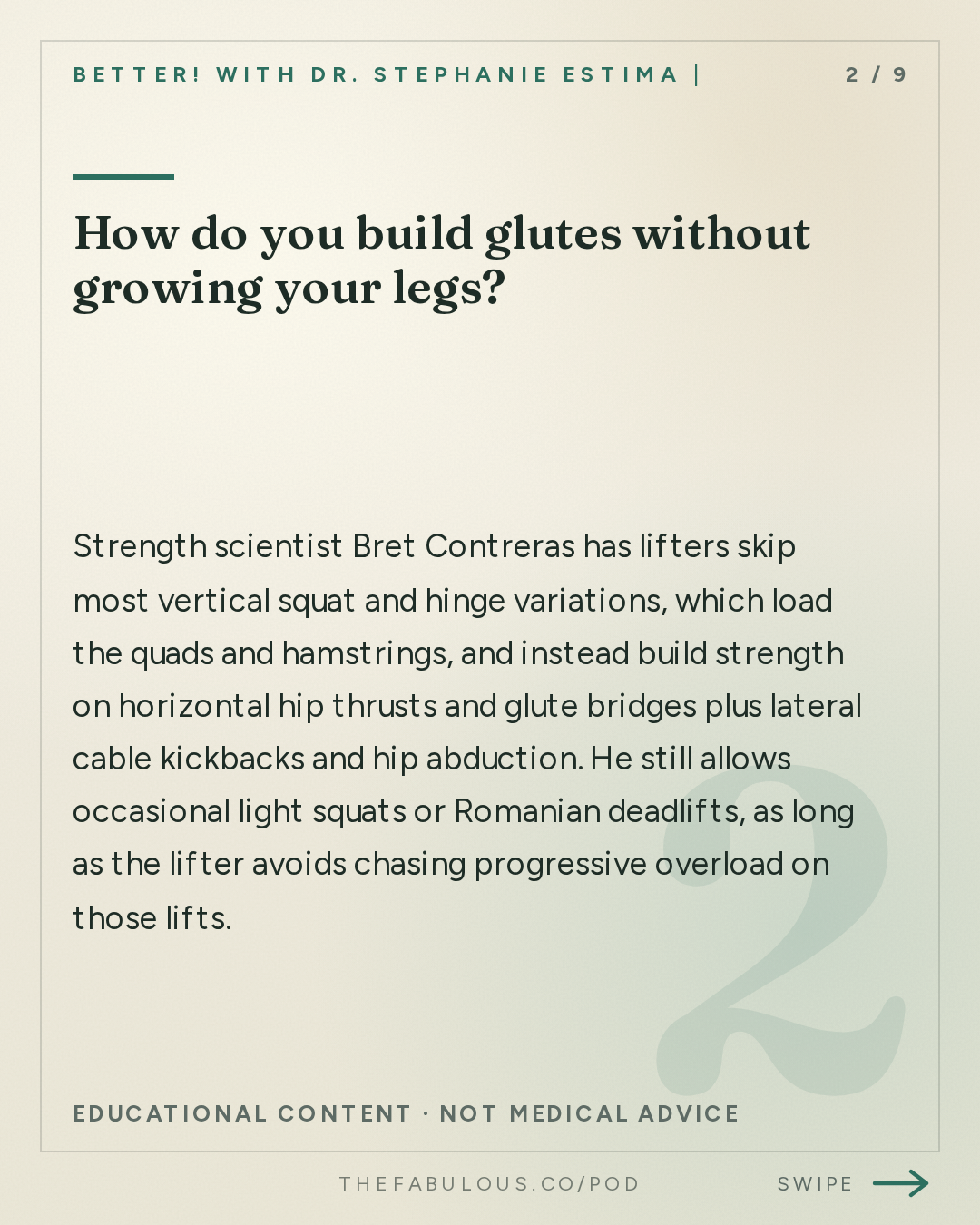
How do you build glutes without growing your legs?
Strength scientist Bret Contreras has lifters skip most vertical squat and hinge variations, which load the quads and hamstrings, and instead build strength on horizontal hip thrusts and glute bridges plus lateral cable kickbacks and hip abduction (33:23). He still allows occasional light squats or Romanian deadlifts, as long as the lifter avoids chasing progressive overload on those lifts (33:43).
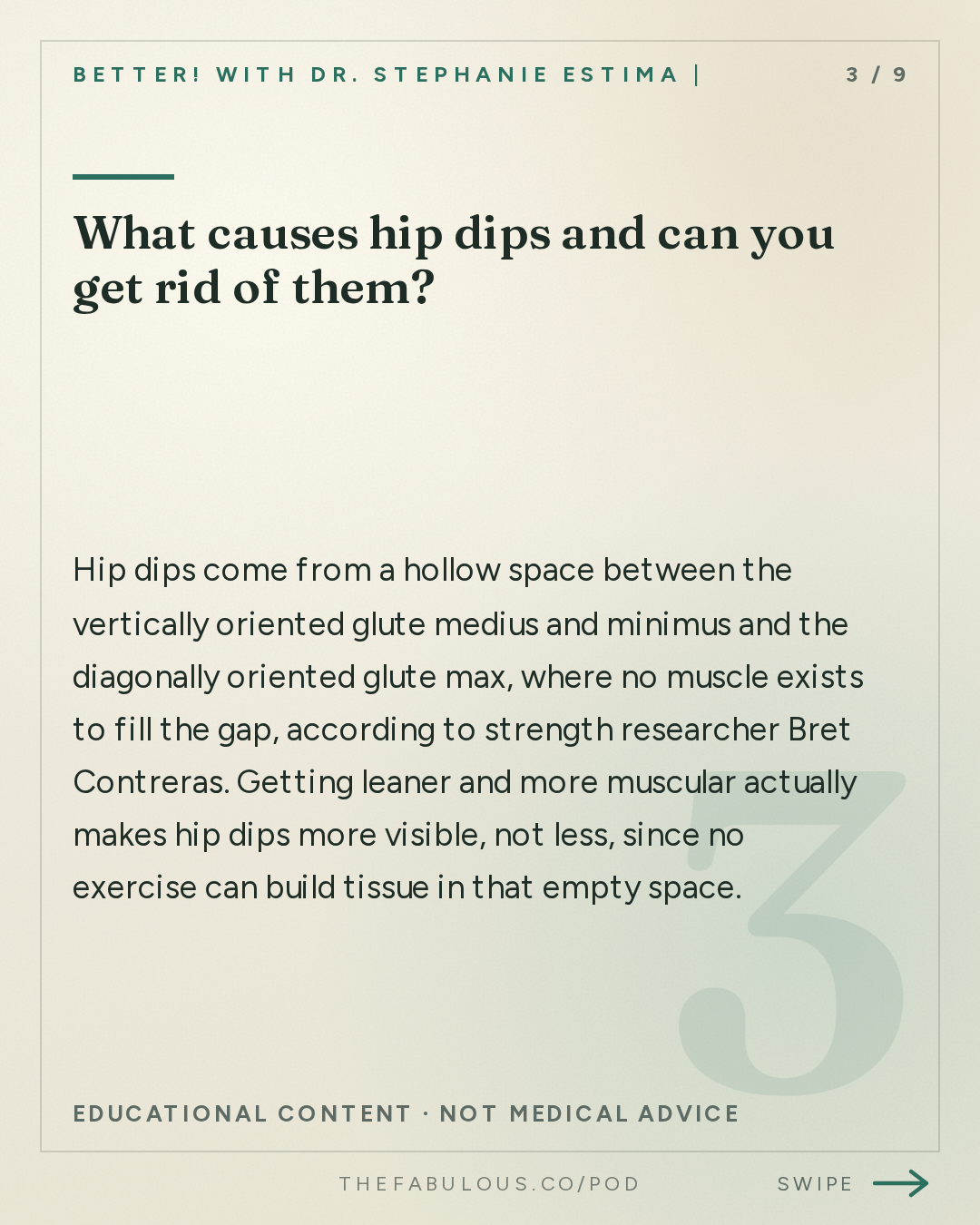
What causes hip dips and can you get rid of them?
Hip dips come from a hollow space between the vertically oriented glute medius and minimus and the diagonally oriented glute max, where no muscle exists to fill the gap, according to strength researcher Bret Contreras (17:43). Getting leaner and more muscular actually makes hip dips more visible, not less, since no exercise can build tissue in that empty space (18:06).
What is penalty-free volume in glute training?
Bret Contreras uses this term for horizontal and lateral exercises like cable kickbacks and hip abduction, which work the glutes in a shortened, squeezed position rather than a stretched one (25:42). Because they avoid the connective-tissue strain and systemic fatigue of heavy squats or deadlifts, lifters can add four to six sets after a workout without hurting recovery (26:35).
Why can women recover faster than men from training?
Bret Contreras points to several possible mechanisms: estrogen's apparent protective effect against muscle damage, lower absolute strength producing less tissue occlusion, and the fact that women concentrating effort on fewer muscle groups, mainly the glutes, leaves more recovery capacity for that area (53:42). He has seen female clients handle up to 36 sets of glute work a week in specialization routines (55:37).
What is Bret Contreras's five-month periodization system?
It rotates training focus in four-week blocks: a strong-lifting month covering six main lifts, then dedicated months for squat and bench press, hip thrust and chin-up, deadlift and military press, and a variety-focused glute month, before the cycle repeats (68:04). Contreras designed the order so joints stressed in one month, like the knees after squat month, get to recover during the next (68:45).
What's the correct hip thrust form?
Bret Contreras, inventor of the barbell hip thrust, says the knees should bend to roughly 90 degrees with vertical shins at the top of the movement, and lifters should drive to full hip extension and lockout rather than stopping short (06:48). He also warns against sliding backward on the bench mid-rep, since that shortens the range of motion and makes the lift easier than it should be (07:56).
The full read, in cards
Go deeper
- Glute Lab — Bret Contreras's book on glute training anatomy and methodology
- Strong Curves — Contreras's co-authored book on strength training built around women's lower-body goals
- Study on knee-banded hip thrusts — found banded hip thrusts raise upper glute max activation without added lower glute activation, even with 10% lighter loads
Mentioned
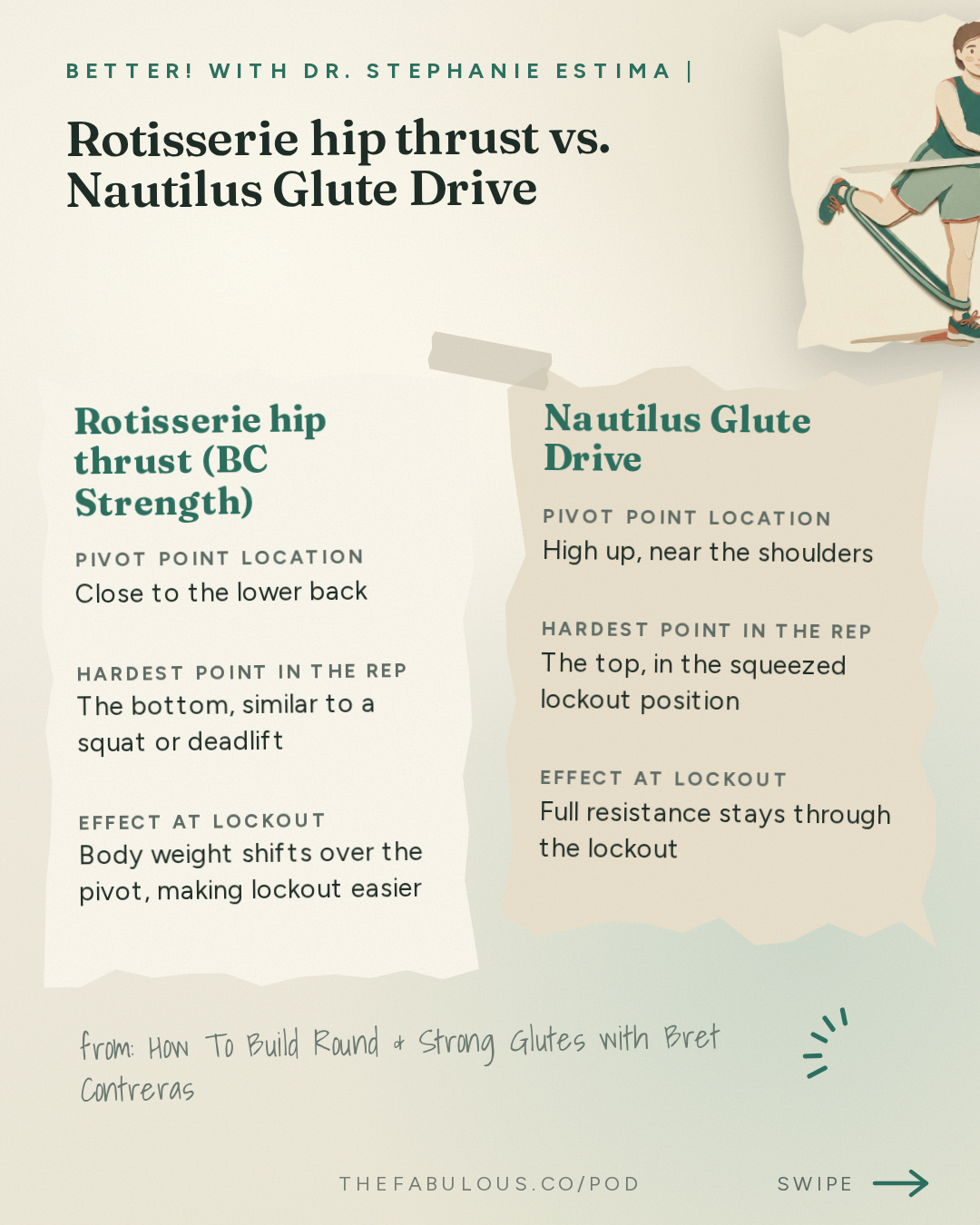
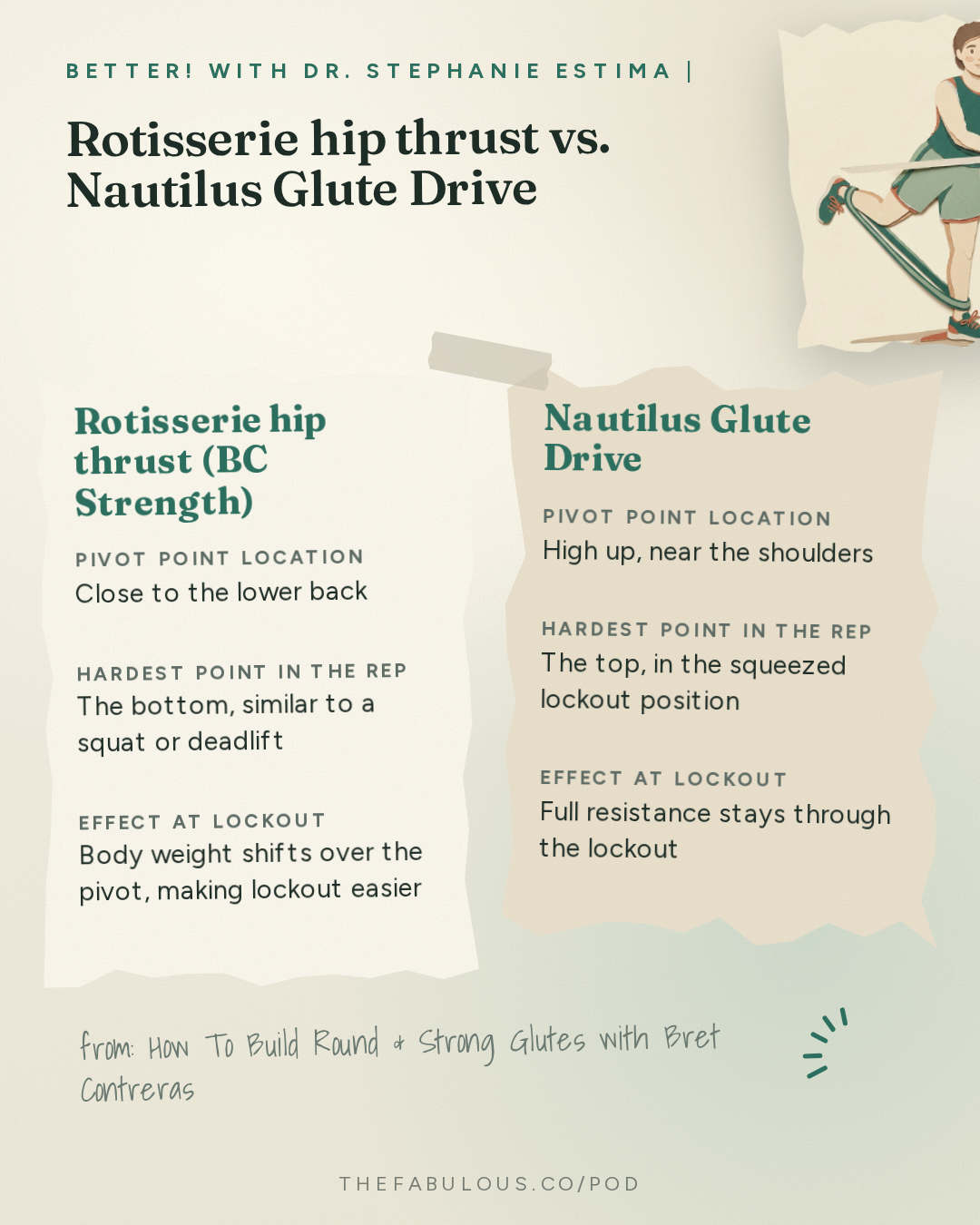
Bret Contreras · Stephanie Estima · Glute Lab · Strong Curves · Nautilus Glute Drive · BC Strength · Louie Simmons · Tudor Bompa · Smith Machine
More from this show and category
Muscle Power vs Strength for Longevity
Psychophysiologist Paul Taylor says muscle power, not size or strength, best predicts how long people live. He tells Dr. Stephanie Estima that myokines, signaling molecules released by contracting muscle, act like an internal pharmacy, and he gives dosing-style guidance on power training, protein, omega-3, and cold plunge limits.

ADHD in Perimenopause: Why Symptoms Intensify
Dr. Jolene Brighten says ADHD in women often surfaces in perimenopause, when falling estrogen stops masking lifelong symptoms. Estrogen supports dopamine and acetylcholine, so its decline during the luteal phase and perimenopause worsens executive function, mood, and focus, explaining why many women are diagnosed only in their 30s and 40s.
Strength Training for Hypermobility, Done Safely
Hypermobile joints move past normal range because ligaments are too loose, so strength training, not stretching, is the primary fix. Dr. Stephanie Estima recommends training within 80% of available range of motion, using slow eccentrics and isometric holds, plus adequate protein and vitamin C to support connective tissue repair.

Physiology of Grief and Heart Attack Risk
Grief is not just an emotion, it is a measurable physiological event: a 21-times spike in heart attack risk in the first 24 hours after a loss, elevated cortisol for months, and a brain that keeps treating the dead as still out there somewhere.
